A crowded Brooklyn sidewalk turns into a churning pocket of shouting bodies after nightfall, and one NYPD officer's fist connects with a demonstrator's face on camera. The crowd surges, a phone light flares, and voices roar for everyone to back up. What happens in the seconds around that punch is the whole argument.
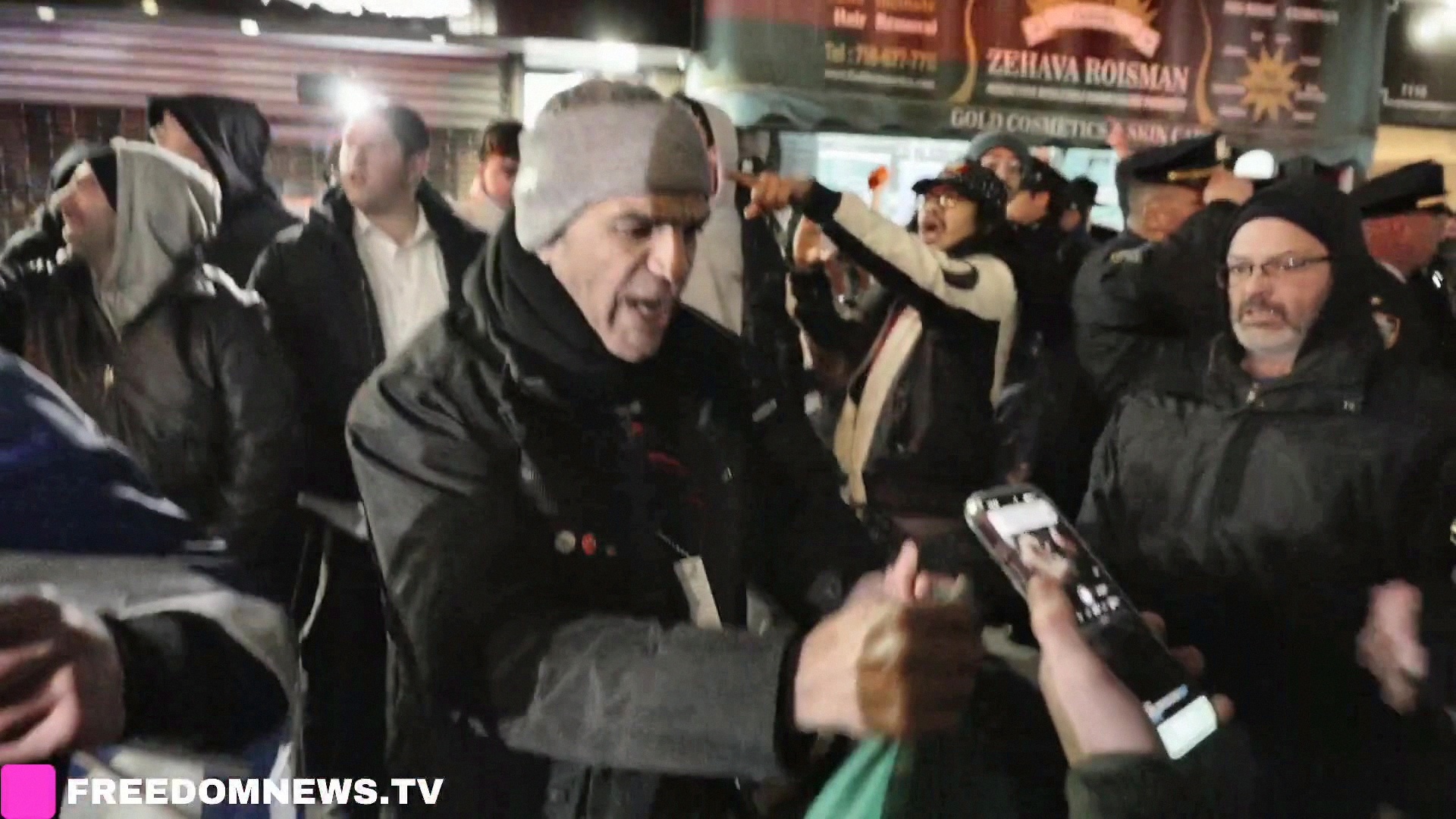
- A densely packed crowd of demonstrators and counter-demonstrators fills a commercial sidewalk in Brooklyn after dark, shoulder to shoulder beneath storefront signage.
- NYPD officers in dark uniforms push into the crowd in a line, and voices on the recording repeat "Back up!" in rapid succession as the gap closes.
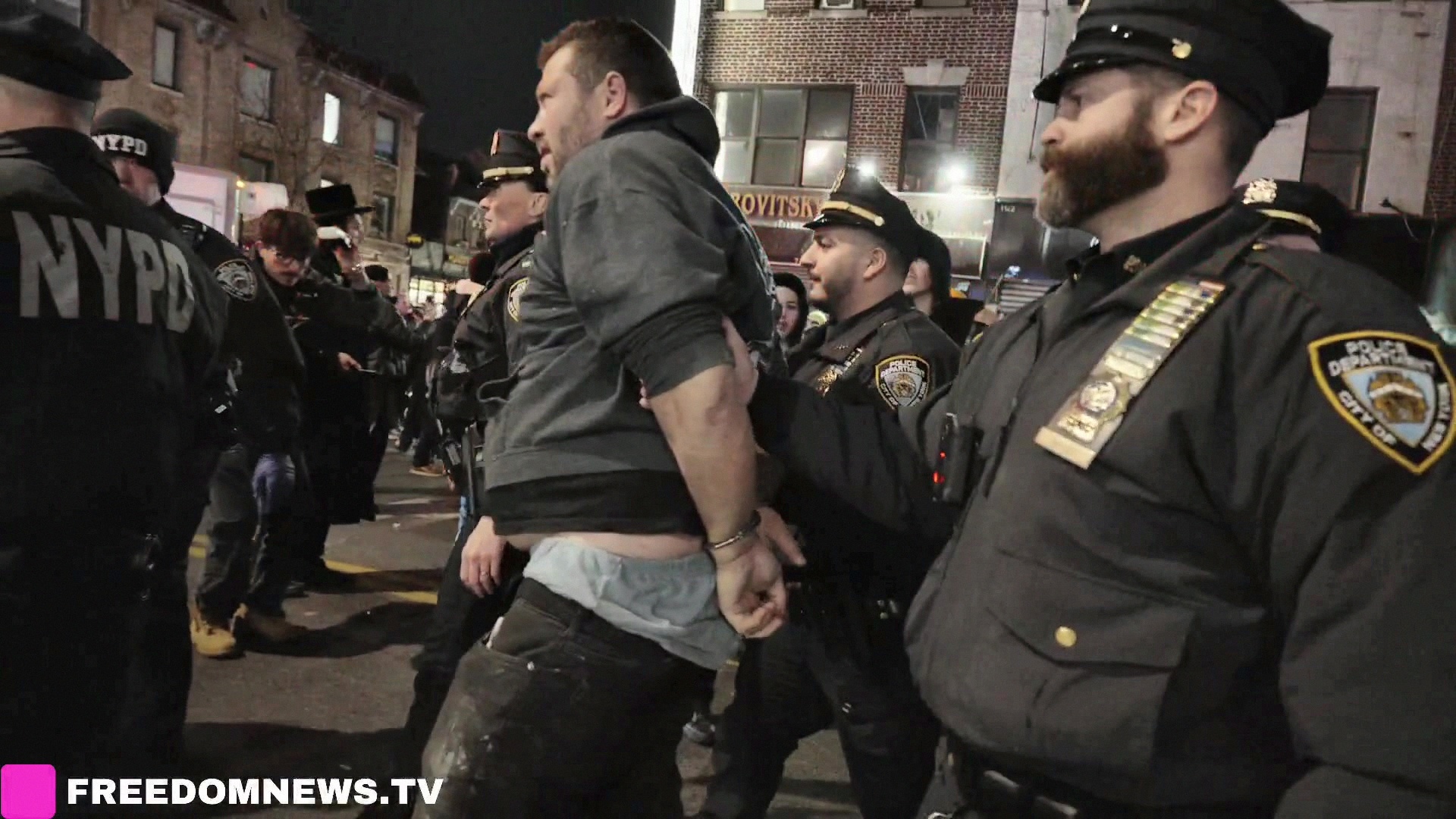
- A brief scuffle at close range ends with an officer's fist striking a demonstrator in the face, captured in a single wide frame.
- Handcuffed individuals are walked out past the officers and parked police vehicles, while the remaining crowd keeps shouting and filming.
What the Recorded Footage Captures: Chronological Breakdown
The footage opens on a wall of bodies. Officers in dark knit caps and uniform coats form a loose line along the curb, backlit by storefronts that glow warm against the cold night. Faces in the crowd turn toward the lens, some holding phones above their heads, and a hand rises near the center of the frame as if to wave a camera through.
The tension tightens in the next stretch. The recorded audio becomes a drumbeat of commands and curses overlapping: "Back up! Back up! Back up!" layered over "Get up! Get up!" and a voice demanding, "What are you doing?" The camera jostles, and the scene loses all sense of orderly distance. One officer's arm swings and a demonstrator's head snaps back. A woman in a white coat turns away, arms wrapped around herself, while a man in a beanie leans in hard, jabbing a finger toward someone off-frame.
Then the scene shifts to the aftermath. Frame by frame, a man in a gray hoodie is walked along the pavement, cuffs closing around his wrists, his head turned to the side. Beside him walks a bearded officer in a peaked cap, expression flat, badge gleaming under the streetlight. A white police van idles at the curb with its rear doors open. The shouting has not stopped, but the choreography has changed from scuffle to escort.
"Get back! Get back! Get back! Back up!"
Scroll down for the full investigative report below ↓

Critical Blind Spots: What the Lens Leaves Unresolved
The camera never holds still long enough to show what started it. Every frame is packed with shoulders and raised arms, and the critical seconds before the first shove exist only in the memory of the people who were standing in that wedge of sidewalk. We cannot see whose hand moved first, whether a line was crossed, or whether a command was heard and ignored.
The perspective is also narrow and personal. The person filming is inside the crowd, and the lens tilts with each jolt, so the far end of the street, the officers' formation, and the crowd's rear edge all fall outside the frame. A second camera would tell a different story from a different angle. The faces nearest the lens are visible. The people most responsible for the escalation may not be in the shot at all.
And there is the audio problem. Voices overlap, and phrases arrive in fragments: "We've got the flag!" and a clatter of curses. Isolated words make for dramatic captions, but they do not reconstruct a sequence. Without a continuous, unbroken recording, the punch can be described precisely and still be explained incompletely.
Statutory Framework and Protocol Analysis
Crowd management in the United States operates inside a set of well-established constitutional limits. Under the Fourth Amendment, any physical seizure of a person requires objective justification, and under Terry v. Ohio, a brief stop must rest on specific, articulable facts. When officers order a crowd to disperse, the order must be clear enough for a reasonable person to hear and comply. A punch delivered to the face is not a routine control technique; under the reasonableness standard of Graham v. Connor, force is judged by the totality of the circumstances and must be proportional to the threat an officer reasonably perceives in the moment.
On the other side of the ledger sits the First Amendment. Assembling and speaking on a public sidewalk is protected activity, and officers are expected to use de-escalation and measured physical control before resorting to strikes. The standard question asked in review after review is not whether a scene looked chaotic, but whether each individual act of force was objectively reasonable given what the officer knew seconds before it happened.
| Incident Parameter | Observation at the Scene |
|---|---|
| Time of day | After dark, storefront lights on |
| Setting | Commercial sidewalk in Brooklyn, New York City |
| Crowd type | Densely packed demonstrators and counter-demonstrators |
| Law enforcement presence | NYPD officers in uniform coats and peaked caps |
| Recorded command | Repeated shouts of "Back up!" and "Get back!" |
| Physical contact | Officer's fist strikes a demonstrator's face |
| Immediate aftermath | Handcuffed individuals escorted to police vehicles |
Read more:
Read more: Rapper and Mother Swarmed on NYC Sidewalk: What the Video Shows →
The practical lesson for anyone who finds themselves in a crowd like this is unglamorous and useful. Keep your hands visible. Record continuously rather than in bursts, because a single unbroken clip answers far more questions than a montage. Keep the whole street in frame when possible, and note the time and location out loud. Those small habits are what turn a dramatic video into a usable record.
Core Questions and Institutional Review
- What specific action, if any, preceded the officer's strike, and was it captured on any continuous recording?
- How many dispersal orders were given, and were they audible to the people at the front of the crowd?
- Was the individual struck placed under arrest afterward, and what account do the department's own reports give?
- Has an internal review of the use of force been opened, and will the body-worn camera footage be released?
The frame we are left with is the quiet one after the noise. A man in cuffs walks along the pavement, eyes forward, past an officer whose expression gives away nothing. The crowd kept filming, and the sidewalk returned to something like a shape.
But the gap between what the camera saw and what the camera missed is where the real inquiry begins, and the question that lingers is simple: when a single punch becomes the most watched second of a long night, who is actually responsible for explaining it?
FOLLOW-UP INVESTIGATION REPORT
Related documented case details, verified on-scene evidence, and statutory liability analysis continued below.
CONTINUE READING: NEXT INVESTIGATIVE DOSSIER →
Florida Mother Denies Selling Toddler in Viral Interrogation Video

The shadows in the parking lot were already lengthening when the woman walked up to a group of employees on their break. The air was thick with the mundane exhaustion of an ordinary workday – until the woman in the black top looked at the stranger and pitched a price tag on her own flesh and blood.
What happened next – a frantic grab in the leaves, a sudden police interrogation, and a bone-chilling denial – has sparked a haunting question: can a mother truly detach from her own child, or was there a deeper, unseen desperation at play?
- The Scene: A busy commercial street in Florida on the morning of March 7, 2024, where a woman approached a nearby business, alternating between seeking emergency shelter and making an unfathomable offer.
- The Friction: According to a witness, the woman placed her 18-month-old daughter on the ground in the leaves and allegedly demanded $5,000 from a tax office employee, saying the child was "too much" to handle.
- The Intervention: The employee rejected the offer, grabbed the toddler as she wandered toward a heavily trafficked road, and immediately alerted law enforcement, leading to a police interview later that day.
- The Aftermath: In a stark interrogation room, the mother flatly denied ever trying to sell her daughter, declaring, "My child is my life," creating a volatile clash between two radically different accounts of the same morning.
What the Recorded Footage Captures: Chronological Breakdown
The initial footage focuses on the tabletop of a conference room, where a man in a black t-shirt with an intricate cross tattoo sits with his arms folded, listening intently to a woman with pink hair seated across from him. The lighting is a jarring, fluorescent white, reflecting off the polished wood as the woman gestures with manicured hands. In the background, a yellow safety harness hangs on the dark red wall, an innocuous detail contrasting with the weight of the conversation. The man's posture is rigid, his eyes fixed on the woman as she recounts the story of the traumatic encounter.
The camera cuts sharply to an interrogation room with dark green walls. Jessica Woods, her blonde hair pulled back and wearing a green tank top, sits in a blue chair. Her body language is defensive, her hands thrown open in disbelief as a voice off-camera asks, "You don't remember having a conversation about trying to sell Giovanna?" The audio captures her immediate, incredulous response: "What? No. No. I would never sell my child." As she speaks, her jaw tightens, and she gestures wildly. The tension in the room is palpable; the interviewer's calm, steady voice serves as an anchor against her rising anxiety. In a moment of high drama, she declares, "I can't even believe that was even stated. My child is my life."
The footage then cuts back to the first interview, where the witness describes the moment she realized the gravity of the situation. The recording captures the ambient sound of an office, muted voices, and the rustle of the man's clothing as he shifts in his chair. The witness recounts the chilling detail: the child was placed in the leaves, and as she stood up to walk toward a busy road, the employee's protective instincts kicked in. "I grabbed the baby, and I picked her up, and I said, 'I'm not giving you no money.'" The contrast between the mother's desperate pleadings to find housing and the witness's firm refusal highlights the unbridgeable gap in their narratives.
The footage presents a fractured reality: one person recounting a moment of maternal desperation and another recounting a moment of moral obligation.
Critical Blind Spots: What the Lens Leaves Unresolved
The camera's eye is myopic. In the tax office interview, we only see the profiles of the two speakers; we do not see the parking lot, the leaves, or the busy road where the child was allegedly placed. The spatial geometry of the incident is completely lost, leaving viewers to construct their own geographically accurate visual of the scene. Furthermore, we are denied the sight of the child, Giovanna, whose presence is the emotional fulcrum of the entire event. Without seeing the child's physical state – whether she was crying, laughing, or simply wandering – we are left to deduce her emotional reality from the recollections of adults.
Equally important is what occurred at the very beginning of the day. The recording mentions that an officer had already stopped by earlier in the morning because callers were worried about the baby. This crucial timeline is completely off-camera. We do not see the original call, the earlier interaction, or the demeanor of the mother during that first visit. The narrative jumps from the parking lot incident to the interrogation room, leaving a void about whether this was a sudden lapse in judgment or a culmination of a long, spiraling crisis.
Furthermore, the identity of the witness in the first interview is never fully established. While she speaks with authority, we do not see her full face or her badge, creating a sense of detachment. The camera's focus remains tightly on her hands and the table, never capturing the wider environment of the office where this transaction allegedly took place. This limitation forces the viewer to accept her testimony purely on the basis of her words, with no visual corroboration of the event's physical context.
Statutory Framework and Protocol Analysis
The legal concepts at the heart of this incident touch upon the deeply sensitive boundary between parental rights and child endangerment. When a parent allegedly offers a child for money, it falls under the umbrella of illegal adoption practices or child trafficking statutes. While the footage does not explicitly confirm any criminal charge, the protocols for law enforcement in these cases are clear: the immediate safety of the minor is paramount. According to the Fourth Amendment, officers have the authority to intervene if there is probable cause that a child is in immediate danger, which explains the rapid intervention in this scenario.
In Florida, the Department of Children and Families (DCF) is mandated to investigate such allegations. When a situation like this arises, the standard procedure involves separating the child from the parent if the parent's behavior is deemed a direct threat. The witness's actions – taking the child away from the busy road – align with standard Good Samaritan principles and the doctrine of in loco parentis, where a temporary guardian steps in to prevent imminent harm. The subsequent police interview, which likely followed a Miranda warning if the mother was considered a suspect, would aim to establish the intent behind the offer.
| Incident Parameter | Observation at the Scene |
|---|---|
| Reported location | A busy commercial street, near a tax office in Florida |
| Time of incident | Morning hours of March 7, 2024 |
| Alleged action | Offer of a child for $5,000 in a parking area |
| Immediate response | Witness removes child from the roadway; police notified |
| Suspect behavior | Denial of the offer during a recorded police interview |
| Missing context | The initial welfare check by an officer earlier that morning |
| Key evidence | Witness testimony and audio recording of the confession denial |
Read more: {NOIBO}
Core Questions and Institutional Review
- If the mother genuinely believed her child was her life, why did she allegedly offer the child to a stranger with such a specific price tag?
- What occurred during the earlier welfare check that morning, and did the responding officer have the opportunity to intervene before the parking lot incident?
- How will the legal system reconcile the witness's clear recollection with the mother's fervent denial of the entire conversation?
- What support systems, if any, were available to the mother regarding her claims of domestic abuse and emergency housing, and why were they seemingly bypassed?
The public's perception of this event is heavily influenced by the selective release of the footage. The video cuts off before we hear any official statement from law enforcement regarding the ongoing investigation. The stark contrast between the two interviews paints a picture of a situation where two people are describing entirely different realities, one where a child is a burden to be sold, and another where the child is the center of the universe. As the investigation progresses, the truth likely lies buried in the unrecorded moments of that morning. For now, the public is left to ponder the ultimate question: Was this a cold, calculated act of abandonment, or the frantic, misunderstood cry of a mother at the absolute end of her rope?




One comment on “NYPD Punch Caught on Camera in Brooklyn Crowd Clash”