The fluorescent lights hum over bare concrete as a shirtless man in red sweatpants coils his body and swings a red plastic crate at head height. Across the room, a frightened figure in an orange jumpsuit scrambles backward, trapped between painted cinder-block walls and a ring of shouting men who have no intention of letting him leave.
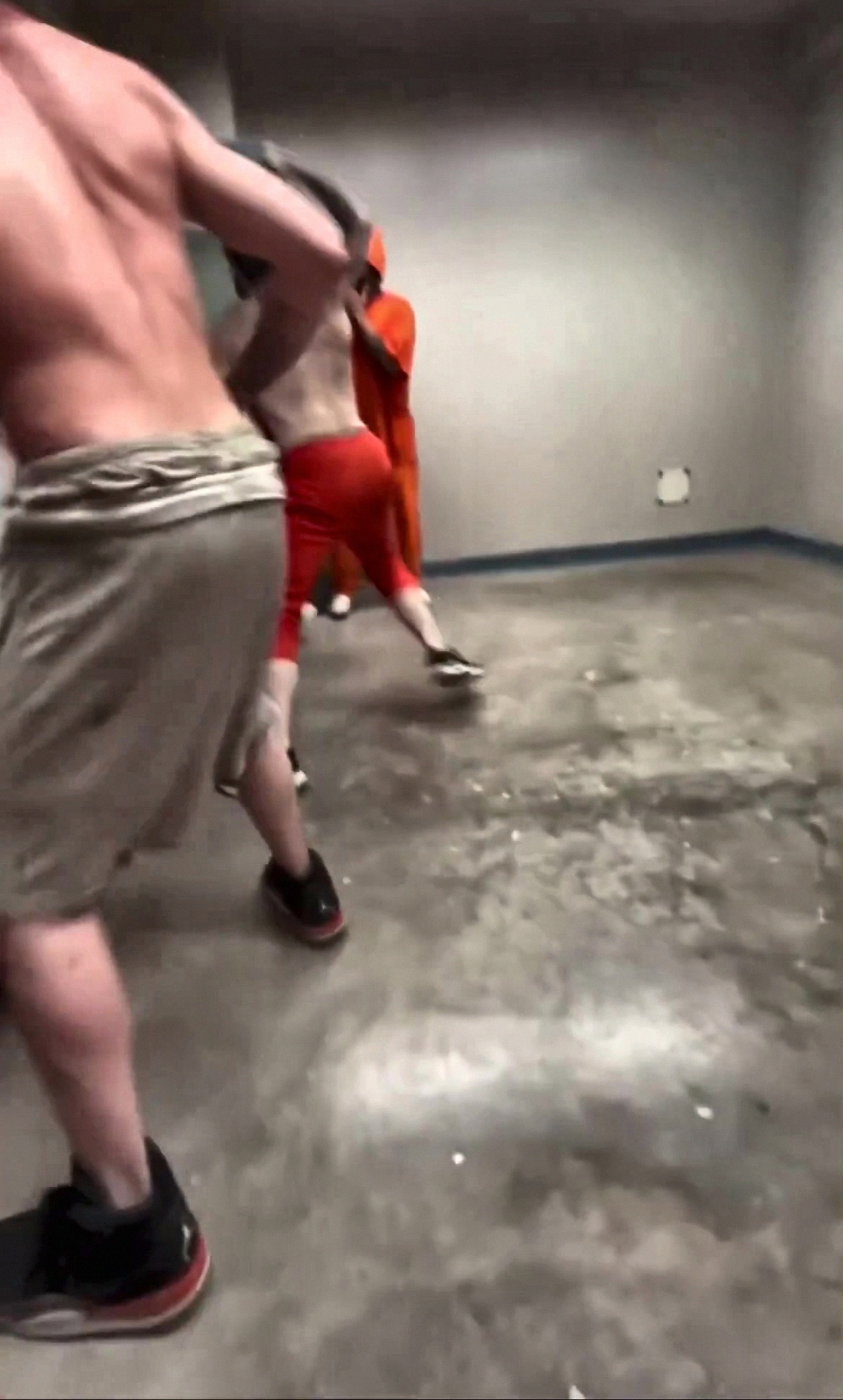
- The Setting: A stark, fluorescent-lit room with bare concrete floors and blue-trimmed cinder-block walls, dressing a scene that resembles a holding facility or recreation block.
- The Friction: A group of men, some stripped to the waist, aggressively surround and close in on a single individual in an orange uniform who appears to be a newcomer.
- The Intervention: Rather than a guard or an authority figure stepping in, shouted commands from the crowd direct the violence, with names like Hacksaw and LeBron called out to orchestrate the assault.
- The Aftermath: The footage cuts as the victim is rushed and swung at with a crate, leaving the outcome and the identity of everyone involved entirely unresolved.
What the Recorded Footage Captures: Chronological Breakdown
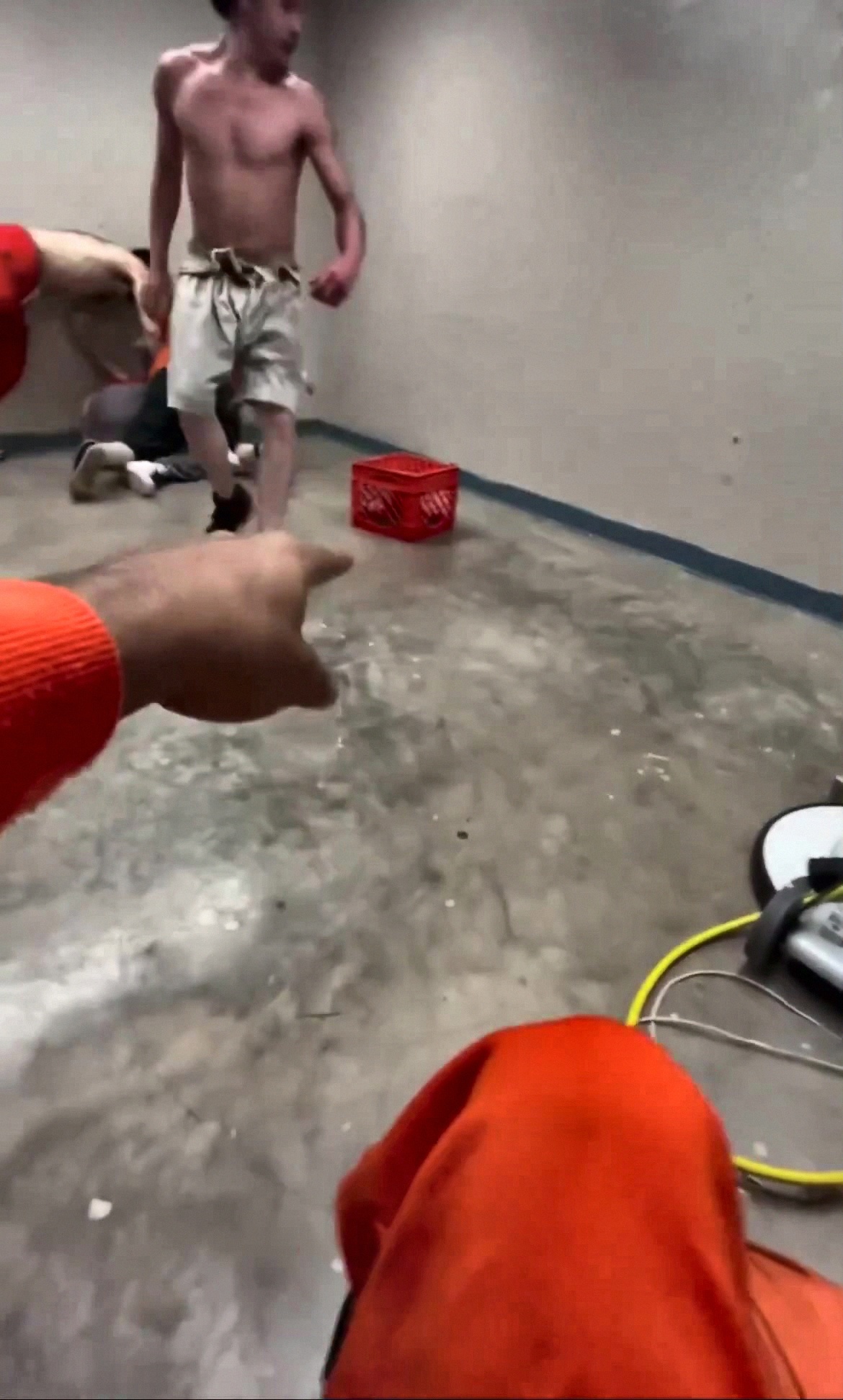
The clip opens in a space that feels engineered for confinement – low ceilings, blank walls, and a single overhead light pouring cold white illumination onto the scuffed floor. A man in bright red pants stands with his back partially to the camera, lifting a red plastic crate from the ground with deliberate intent. At the bottom of the frame, an orange-clad shoulder enters the shot, suggesting the cameraman is sitting or crouching among the participants rather than observing from a distance.
As the sequence unfolds, the crate is hoisted and the room erupts into motion. A shirtless man in dark shorts lunges toward the far corner where another figure is scrambling to stay upright. The audio captures a chorus of overlapping voices, each one pushing the action forward with escalating urgency. "Get him up, bro.
Get him up," one voice repeats, while another cuts in with, "As soon as he come in, drill him." The language is raw and immediate, spoken in the clipped cadence of men who have done this before.
The tension spikes when a pointing hand thrusts into the frame from the left, directing the group's attention toward a target near the far wall. A man in an orange shirt and backward cap stands watching, his posture relaxed compared to the frantic movement around him – a detail that suggests he is either a veteran of this ritual or an overseer of it.
The crate swings, bodies collide, and the camera jolts with the chaos. By the final frames, the group has converged, and the shouting has reached a fever pitch with calls of "Do him, Hacksaw! Do that nigga!"
Scroll down for the full investigative report below ↓

Critical Blind Spots: What the Lens Leaves Unresolved
The footage is shot from a low, handheld angle that keeps the viewer inside the scrum rather than above it, which means the full layout of the room and the number of people present are impossible to determine. We see a handful of faces and torsos, but the edges of the frame are filled with shoulders, arms, and the blur of rapid movement.
There is no wide shot to establish whether a door is open, whether a guard is watching, or whether this room is a sanctioned space or a forgotten corner of a facility.
The audio is equally disorienting. Names are shouted – Hacksaw, LeBron – but no one is identified on camera, and the relationships between the men are never clarified. Is the man in red the enforcer, or is he also a participant in a larger hierarchy? The victim in orange is never given a clear face or a voice, and the camera never lingers on him long enough to reveal whether he is injured or merely frightened. The clip begins mid-action and ends mid-swing, offering no context for how the confrontation started or how it concluded.
What is most striking is the absence of any dissenting voice. Not a single person in the frame says "stop" or "that's enough." The crowd's energy is uniformly directed toward the violence, which raises questions about the social dynamics at play. Is this a known ritual that everyone has agreed to, or is it a spontaneous explosion that no one feels empowered to interrupt?
The footage alone cannot answer that, and the silence of the room beyond the shouts is its own kind of evidence.
Statutory Framework and Protocol Analysis
In the United States, correctional facilities operate under a duty of care that requires staff to protect inmates from foreseeable harm, including harm from other inmates. When a group of incarcerated individuals coordinates an assault on a newcomer, the legal questions that follow typically center on whether the facility had notice of the risk and whether staff responded appropriately.
Under the Fourth Amendment's protections against unreasonable seizures and the Eighth Amendment's prohibition on cruel and unusual punishment, deliberate indifference to a known threat can form the basis of a civil rights claim. The footage here, however, shows no staff presence and no visible intervention, which leaves the question of official awareness entirely open.
From a de-escalation standpoint, the scene captures a textbook failure of group dynamics. The shouting functions as a social accelerant, with each voice adding pressure for the next man to act. Correctional training typically emphasizes the importance of separating a target from a crowd, establishing a verbal command presence, and introducing a physical barrier between combatants. None of those elements appear in the clip.
Instead, the group tightens its circle, and the crate becomes a tool of intimidation rather than a barrier. The protocol analysis is not about assigning blame to any individual in the frame – it is about recognizing the conditions that allow this kind of scene to unfold without interruption.
| Incident Parameter | Observation at the Scene |
|---|---|
| Location | Bare concrete room with blue-trimmed cinder-block walls and overhead fluorescent lighting |
| Lighting | Uniform, harsh white light casting minimal shadows |
| Participants | Multiple shirtless men and one individual in an orange uniform |
| Key Objects | Red plastic crate, dark shorts, sneakers, an orange jumpsuit |
| Audio Presence | Overlapping shouting, direct commands, and named calls for action |
| Camera Perspective | Low handheld angle, altercation from within the group |
| Duration of Incident | Brief, captured mid-action with no clear beginning or end |
Read more:
Read more: Officers Close In On Seated Campus Protesters: Full Record →
Core Questions and Institutional Review
- Who is the man in the orange uniform, and what was his status within the facility on the day this footage was recorded?
- What was the role of the man in the backward cap who stood at the edge of the frame without joining the physical confrontation?
- Was this room under any form of supervision, and if so, where was that supervision during the recorded sequence?
- How did the recording leave the facility, and who authorized its release to the public?
The crowd in the footage does not behave like a group that fears consequences. They shout names, they point, and they move with the confidence of men who believe no one is coming to stop them. That confidence is the most unsettling detail in the entire clip – more than the swinging crate, more than the frantic scramble of the man in orange.
It suggests a space where the rules have been suspended or rewritten by the people inside it, and the camera's presence only makes the performance more brazen. Whether this was a known ritual, a one-time eruption, or something staged for the lens, the video leaves the viewer with a single, lingering question: if the room had been watched, would anyone have stepped in? Share your perspective in the comments below.
FOLLOW-UP INVESTIGATION REPORT
Related documented case details, verified on-scene evidence, and statutory liability analysis continued below.
CONTINUE READING: NEXT INVESTIGATIVE DOSSIER →
Chicago Grocery Slur Confrontation: Woman Dares Insult

The fluorescent lights of a Chicago grocery store reflect off a phone screen held in a trembling hand. What begins as a routine errand collapses into a raw, public confrontation when a woman hurls a harsh verbal insult across the aisle. The target of the insult does not retreat. Instead, she steps forward, and the entire store becomes an unwilling audience to a confrontation over dignity.
- The Flashpoint: A woman (widely referred to online as "Karen") directs a racial epithet at another shopper, demanding she leave the store.
- The Pushback: The targeted woman confronts her directly, repeatedly challenging the insult: "Call me another nigger."
- The Escalation: The exchange intensifies as the targeted woman warns, "Stop playing on me before I beat ya ass."
- The Aftermath: The slur-slinger falls silent, retreating under the weight of the public challenge as the camera keeps rolling.
What the Recorded Footage Captures: Chronological Breakdown
The first seconds of the clip are jarring. The camera, held in a car and pointed at a phone screen playing a video, captures the voice of a woman saying, "If you're a fuckin' nigger you don't belong here." The phrasing is flat, almost casual, as if the slur were a normal part of her vocabulary. The setting appears to be a grocery store, with bright overhead lighting and the blur of shelves in the background.
The targeted woman does not flinch. She steps toward the speaker and replies, "Hey individual, do something about me." The challenge is immediate and physical. The woman repeats it, closing the distance, her voice rising. "Stop playing on me before I beat ya ass." The tension is thick enough to cut; the slur-slinger's posture stiffens, but she does not back away.
Then the confrontational pivot arrives. The targeted woman says, "Say it again, individual. Say it again." The camera catches the slur-slinger's face, her expression flickering between defiance and uncertainty. The demand is a trap, and she knows it. She mutters something unintelligible, but the targeted woman presses: "Call me another nigger." The aisle grows quiet. The slur-slinger looks around, perhaps realizing that the store's other shoppers have stopped to watch. She does not repeat the slur.
Critical Blind Spots: What the Lens Leaves Unresolved
The video does not show what happened immediately before the first slur. Was there a dispute over a shopping cart, a misunderstanding at the checkout, or was the insult unprovoked? The footage begins mid-confrontation, robbing the viewer of context. The identities of the women remain unknown; neither is named in the clip, and no official record has surfaced.
What the camera also fails to capture is the role of bystanders. A few figures appear at the edge of the frame, but their reactions are obscured. Did anyone intervene, call for a manager, or attempt to de-escalate? The audio is dominated by the two women, leaving the ambient sounds of the store – the hum of refrigerators, the murmur of other shoppers – as background noise. The clip ends abruptly, without showing how the situation resolved.
Another blind spot is the location itself. The store is identified only as a grocery store in Chicago. No street address, neighborhood, or chain is visible. This lack of specificity makes it impossible to verify the incident through store records or local police reports. The video's circulation on social media has outpaced any official documentation, leaving a gap between what is seen and what can be proven.
Statutory Framework and Protocol Analysis
From a legal standpoint, the exchange raises questions about the boundaries of free speech and the definition of harassment. The First Amendment protects even offensive speech, including harsh verbal insults, in public spaces. However, when such speech escalates into a direct threat or a breach of the peace, it can cross into criminal territory. The targeted woman's response – "Stop playing on me before I beat ya ass" – is a conditional threat that could be interpreted as an intent to commit violence, though no physical altercation is shown.
The store's protocol likely emphasizes de-escalation. Employees are typically trained to separate parties, call management, and, if necessary, contact law enforcement. In this footage, no uniformed employee appears, leaving the confrontation to play out in the aisle. The absence of a store representative raises questions about whether the incident was reported and how staff responded.
| Incident Parameter | Observation at the Scene |
|---|---|
| Location | Grocery store aisle, Chicago, Illinois |
| Primary Aggressor | Woman using harsh verbal insult |
| Target of Slur | Second woman, who confronts the speaker |
| Verbal Escalation | Repeated demands: "Call me another nigger" |
| Physical Contact | None observed in the clip |
| Bystander Presence | Unclear; figures at edge of frame |
| Resolution | Abrupt end; no official outcome shown |
Read more: {NOIBO}
Core Questions and Institutional Review
- What was the initial trigger for the slur, and was it captured on any other camera?
- Did store management or security intervene after the recording stopped?
- Has the targeted woman filed a complaint or pursued legal action?
- What does the slur-slinger's silence signify – remorse, fear, or simply a tactical retreat?
The silence that follows the repeated demand is perhaps the most telling moment of the entire encounter. It is not an apology, nor is it a further provocation. It is the sound of a person realizing that their words have consequences, that the aisle has become a stage, and that the audience is no longer on their side. What would you have done in that moment? The question lingers, unanswered, as the screen goes dark.


One comment on “Prison Fight Club Video: Brutal First-Day Ritual Caught on Camera”