The cabin lights were dimmed for a red-eye crossing, the kind of quiet that settles over a plane an hour after takeoff. Then a man stood up and walked toward the exit door. What followed was not a drill, not a movie, and not a misunderstanding – it was a scramble of bodies, seatbelts, and sheer panic that ended with an emergency landing and a flight crew physically wrestling a passenger to the floor.
- The flight: American Airlines Flight 1494 departed San Diego late on a Tuesday night bound for Chicago, carrying a full load of holiday travelers headed into Thanksgiving week.
- The friction: Roughly an hour into the flight, near the Arizona-California border, a male passenger attempted to open an aircraft exit door in flight.
- The intervention: Flight attendants and multiple passengers physically restrained the man, pinning him in the aisle while the aircraft was still airborne.
- The aftermath: The plane diverted to Phoenix Sky Harbor International Airport, landing around 1 a.m. local time, where police took the passenger into custody after he received treatment for a minor injury.
What the Recorded Footage Captures: Chronological Breakdown
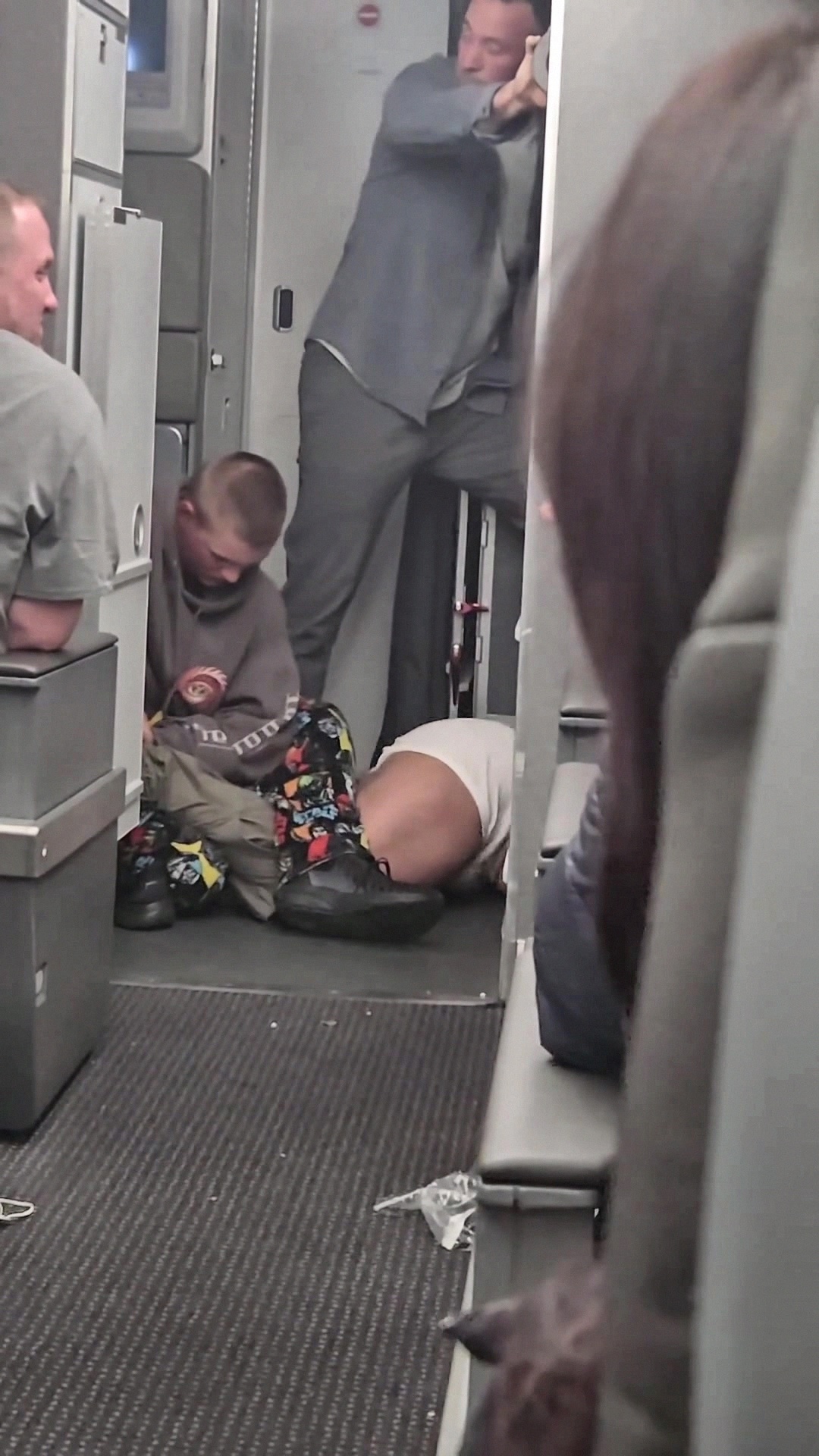
The first frames are almost calm, which is what makes them disturbing. Overhead bins press in from either side of a narrow aisle. A man in a gray jacket and white earbuds stands over a crumpled figure on the floor, his expression flat, unreadable, eyes fixed downward.
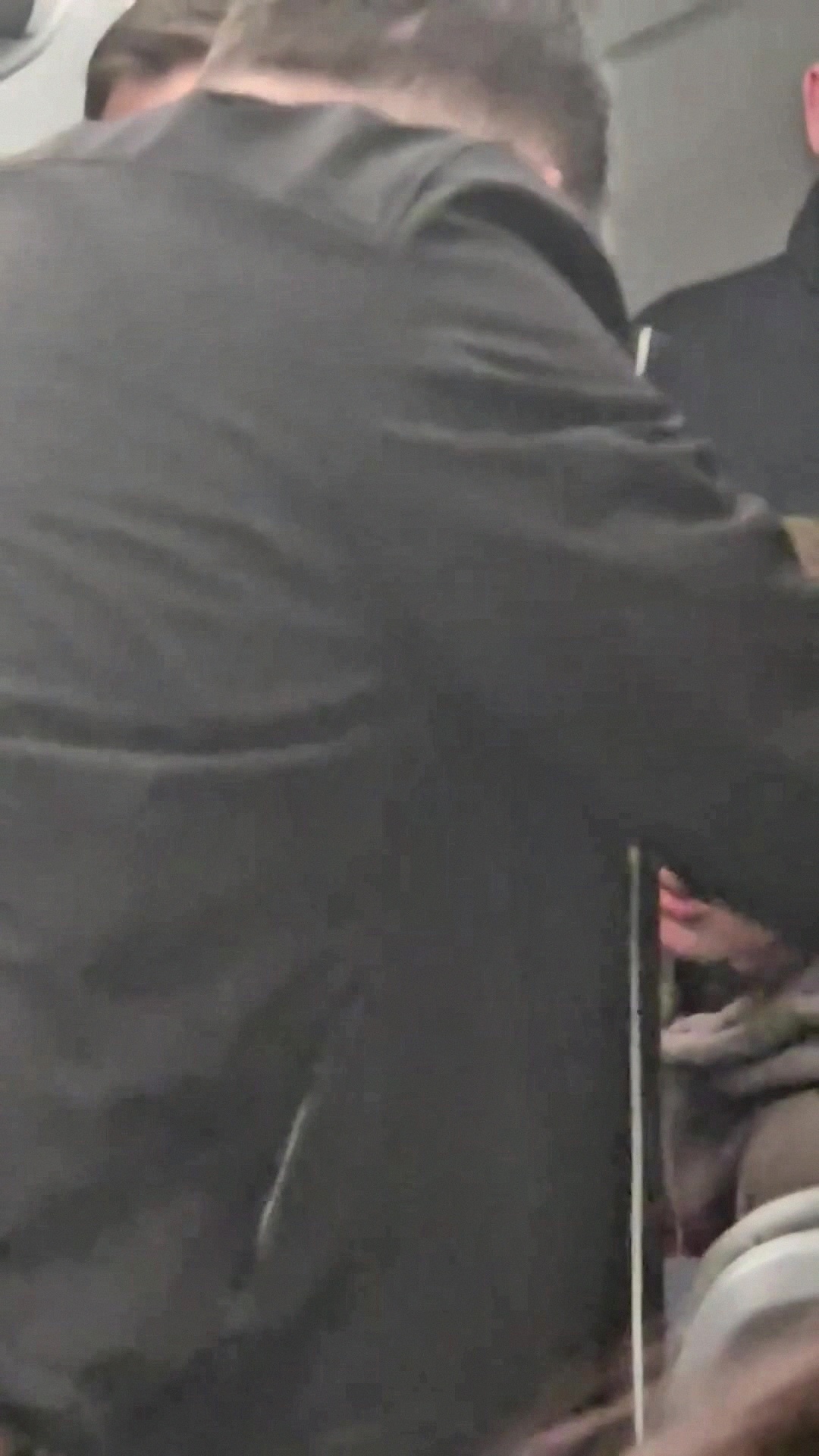
Around him, a knot of passengers has formed – a younger man in a brown hoodie with a red logo, a man in a black jacket leaning in from the left. Nobody is screaming yet. The cabin is in that strange suspended moment between confusion and action.
Then the camera moves, and the geometry of the struggle becomes clear. A man in a bright blue long-sleeve shirt and tan khaki pants stands braced in the aisle, his stance wide, feet planted on the gray carpet like a man holding a door against a flood. Below him, a body is folded onto the floor, legs bent awkwardly, a white-and-black sneaker twisted against the seat track.
A second man in a gray graphic tee leans hard to the left, his weight committed. Hands are everywhere – gripping fabric, pinning shoulders, steadying the mass of limbs that will not stop moving.
By the final frames, the restraint has become a full-body operation. A man in a gray button-up shirt stands pressed against the forward galley panel, his arm extended, jaw tight, watching the floor where the passenger is now prone. A boy in a dark hoodie crouches nearby, wide-eyed, unsure whether to help or flee.
The aisle floor is scattered with debris – a crumpled wrapper, a loose strap, the small wreckage of an ordinary flight turned extraordinary. Nobody in the frame is smiling. Nobody is posing. This is the raw, unglamorous work of keeping a plane in the air.
Scroll down for the full investigative report below ↓

Critical Blind Spots: What the Lens Leaves Unresolved
The footage begins after the confrontation is already underway. What is not on camera is the moment the man rose from his seat, the seconds before he reached the door, and whatever words passed between him and the crew. Did a flight attendant confront him first? Did a passenger notice his intent before anyone else? The record simply does not say, and the gap matters, because that missing minute is where the real warning signs would live.
What the camera also cannot show is the psychology in the cabin. Rows of passengers strapped into seats, unable to see the aisle, hearing only scuffling and strained voices. The audio captures almost nothing beyond a quiet, reflexive "Thank you. Thank you." – a small human courtesy that lands strangely against the violence of the scene. It may be a passenger thanking a seatmate, or a crew member thanking a helper.
Either way, it is the only spoken line the recording preserves, and it hints at a cabin that chose cooperation over panic.
The identity of the restrained passenger remains undisclosed. What prompted the attempt – a mental health crisis, intoxication, or something else – has not been publicly established. Authorities have said only that he was taken into custody after hospital treatment, and that the FBI and FAA are reviewing the case. Until those reviews conclude, any narrative about motive is speculation dressed up as fact.
Statutory Framework and Protocol Analysis
What the footage actually demonstrates is the layered defense built into modern commercial aviation. Flight attendants are trained in restraint and de-escalation, but their first tool is verbal control – lowering their voice, closing distance calmly, giving the disruptive person a single instruction. When that fails, the protocol shifts to physical containment, and that is where passengers become part of the system.
The men pinning the passenger in the aisle were not trained professionals. They were ordinary travelers who recognized that a door opening at altitude is not a theoretical risk.
| Incident Parameter | Observation at the Scene |
|---|---|
| Aircraft status | In flight, roughly one hour after departure |
| Reported action | Male passenger attempted to open an exit door |
| Response | Flight attendants and passengers physically restrained him |
| Diversion decision | Aircraft diverted to Phoenix Sky Harbor International Airport |
| Time of landing | Approximately 1 a.m. local time |
| Law enforcement | Phoenix police took the passenger into custody |
| Injuries reported | Minor injury to the passenger; no other injuries reported |
Read more:
Read more: Nashville Airport Confrontation: Woman Arrested After Bizarre Claims →
The legal architecture around this incident is less about punishment than deterrence. Under established federal standards, a flight crew's authority aboard an aircraft is broad, and passengers who interfere with that authority can face serious federal exposure. Yet the more instructive lesson sits in the aisle itself: the restraint shown in the footage was improvised, immediate, and remarkably restrained. No one in the frames appears to strike the man. They hold him. They pin him. They wait for the aircraft to reach the ground.
Core Questions and Institutional Review
- What specific behavior or statement preceded the attempt to open the door, and was it reported to the crew before the escalation?
- Did the aircraft's door design and in-flight pressure differential make the attempt physically futile, and how did the crew assess that risk in real time?
- What mental health or medical evaluation was conducted at the Phoenix hospital, and will those findings inform any charging decision?
- How will the FAA's review shape guidance for crew training on passenger-assisted restraint in the future?
What lingers after watching the footage is not the violence but the coordination – strangers locking arms in a cramped aisle without a single word of command, holding a line against something none of them fully understood. The investigation will produce reports and findings, but it will not capture the quiet, terrible arithmetic of that moment: how many people it takes to keep a door closed, and how quickly a calm cabin can become a wrestling match at altitude. If you had been in that aisle, would you have stood up?
FOLLOW-UP INVESTIGATION REPORT
Related documented case details, verified on-scene evidence, and statutory liability analysis continued below.
CONTINUE READING: NEXT INVESTIGATIVE DOSSIER →
Tense Confrontation Outside Brooklyn Deli as Crowd Presses NYPD

A hostile crowd surges toward a kosher deli's doors in Brooklyn, screaming over a woman's repeated accusations, while a thin line of police officers struggles to hold the front. The recorded confrontation raises hard questions about where protest ends, where physical aggression begins, and how quickly community friction can slip beyond verbal control.
- A large crowd gathers outside a kosher deli in the Midwood section of Brooklyn, pressing toward the storefront as night falls.
- The situation escalates as a woman's voice sharply cries "Liar!" repeatedly, pulling the crowd's attention toward the deli entrance.
- NYPD officers in uniform, including members of the Strategic Response Group, form a tight physical barrier between the crowd and the business.
- Several people are arrested amid the confrontation, according to officials, and the crowd eventually disperses as the police line holds.
What the Recorded Footage Captures: Chronological Breakdown
The video opens on a churning, close-packed crowd at night, captured from within the press of bodies. Officers in dark uniforms and peaked caps stand shoulder to shoulder, using metal barricades to wedge open a narrow corridor in front of the deli. The lighting is uneven and harsh from a mix of overhead streetlamps and camera-phone screens, and the air seems thick with the amplified noise of hundreds of overlapping voices. The crowd is a mosaic of sweaters, scarves, and traditional keffiyehs, with raised phones capturing the scene from every angle.
The tension tightens when a female voice begins shouting an accusation. "She's lying! Liar! Liar!" the voice cries out, setting off a ripple of voices through the crowd. What exactly she is accusing someone of is never made clear in the footage, but her repeated cries become a focal point of the crowd's attention. Officers lean forward, their faces set in hard lines, bracing against the sway of bodies pressing in from the front. Somewhere in the background, a person yells in defiance. "F**k you all!" the voice spits out, and the camera swings briefly, catching the blurred motion of arms and shoulders moving in counterpoint.
Later, the crowd's energy turns to chants and cheers. The camera rises above a brief scuffle as officers push forward, moving someone away from the line. The tension breaks into a spasm of movement, and then the video cuts before the scene fully resolves. The sounds are a chaotic collage of rage, profanity, and warning cries from officers urging order. In one moment, a voice snaps out something that sounds like "packed out," and the crowd responds with a wave of pushing and jostling. It remains unclear who was arrested or for what specific offense at the moment the recording ends.
Critical Blind Spots: What the Lens Leaves Unresolved
The footage captures the friction but leaves the origin of the confrontation in shadow. The video begins in the middle of an already tense scene, and the critical trigger is never shown. Was there a preceding argument? Did a specific individual spark the confrontation? The recorded evidence offers no clear answers. The identity of the woman shouting "Liar!" remains unknown, as does the subject of her accusation.
Another blind spot is the geography of the deli itself. The camera stays mostly outside, capturing the front of the crowd and the police line, but what is happening inside the deli or behind the crowd is unseen. The exact reason the crowd is targeting this specific business is never explicitly explained on camera, nor is the role of any event that may have drawn the crowd there. The viewer is left with a snapshot of confrontation without the full context of its origins.
Finally, the moment of arrest or direct confrontation is only partially captured. Shouts of "He's crazy!" echo through the crowd, but the subject of that accusation is obscured by bodies. The video offers no clean resolution, no visible arrests, and no aftermath footage showing how the situation was fully contained. The line of officers remains a blur of motion, and the viewer is left to guess at the sequence of events that led to the final scuffle.
Statutory Framework and Protocol Analysis
The footage shows the NYPD deploying a coordinated physical barrier. Under established crowd-control standards, officers are directed to maintain a visible line, make repeated warnings about unlawful behavior, and use minimal force necessary to prevent harm. The physical formation seen here – barricades at the front and officers at the rear – is a textbook response to a crowd that has moved from assembly to potential confrontation. The officers in the frame are seen using their bodies and equipment to keep a buffer between the crowd and the storefront. This approach is grounded in the legal principle that while public streets are open for assembly, direct physical aggression or property destruction falls outside that protection and can be limited by a police line.
The intervention process also raises questions about arrest and detention standards. Under standard Fourth Amendment principles, an officer may briefly detain and arrest an individual when probable cause exists that a crime – such as disorderly conduct, trespass, or assault – has occurred. In the footage, the officers are seen holding a narrow line while individuals press against them, and the volume of the crowd makes specific interventions difficult. The final moments show a scuffle where it appears someone is being pulled away from the line, which is consistent with standard crowd-control procedures. The community expectation in such incidents is that police respond proportionally and that all parties – protesters, counter-protesters, and bystanders – are held to the same standard of conduct.
| Incident Parameter | Observation at the Scene |
|---|---|
| Location | Exterior of a kosher deli in Midwood, Brooklyn, at night |
| Lighting | Mixed streetlamps and phone-lights; uneven, high contrast |
| Primary Actor | A woman's voice repeatedly shouting "Liar!" toward the scene |
| Police Presence | Multiple uniformed NYPD officers and a physical barrier line |
| Crowd Behavior | Pushing, jostling, shouting, and raised phone cameras |
| Verbal Exchanges | Profanity, accusations of lying, and chants from the crowd |
| Material Elements | Metal barricades and the deli's storefront edge |
The standard crowd-control playbook also emphasizes clear communication with the crowd. The footage reveals interruptions of sharp utterances, but it is not clear that officers issued any bullhorn warnings or gave dispersal orders. The ability to communicate effectively in a high-noise environment is a critical part of de-escalation. From a community perspective, this moment also spotlights the physical strain placed on a thin line of officers, who must hold a perimeter against a moving crowd while waiting for additional support. The friction of the scene – sweat, shouting, close quarters – is a reminder that physical intervention is always a last resort and that calm verbal communication is often the first line of defense.
Core Questions and Institutional Review
- Who initiated the confrontation outside the deli, and what specifically triggered the woman's repeated cries of "Liar!" against the reported backdrop of a demonstrator gathering?
- What exactly were the specific criminal charges or legal grounds for the arrests that reportedly occurred during the confrontation?
- Were the counter-protesters and the original demonstrators separated prior to the physical pushing, and were verbal warnings issued before officers locked down their line?
- How will the resulting clash and arrests shape the ongoing conversation about crowd safety and public order in this Brooklyn neighborhood?
The recorded footage leaves the public with a partial picture. A crowd surged, a thin line of police held, and a night outside a local business turned physical. The unanswered questions about the origin of the dispute and the specific outcome of those arrested linger long after the recording ends. For many viewers, the most pressing question remains: at what point does an assembly of people with a grievance become a physical threat to a neighborhood business, and who bears responsibility for ensuring that line is never crossed?




One comment on “Midair Chaos: Passenger Tries Exit Door, Cabin Restrains Him”