The camera holds tight on a battered face – swollen lips, crimson smeared across a cheekbone, the kind of damage that makes a room go quiet. He is confessing an Instagram betrayal, an apology that feels raw and real. Then, in a single breath, the illusion shatters: "Cut." The brutality was never real. It was a set.
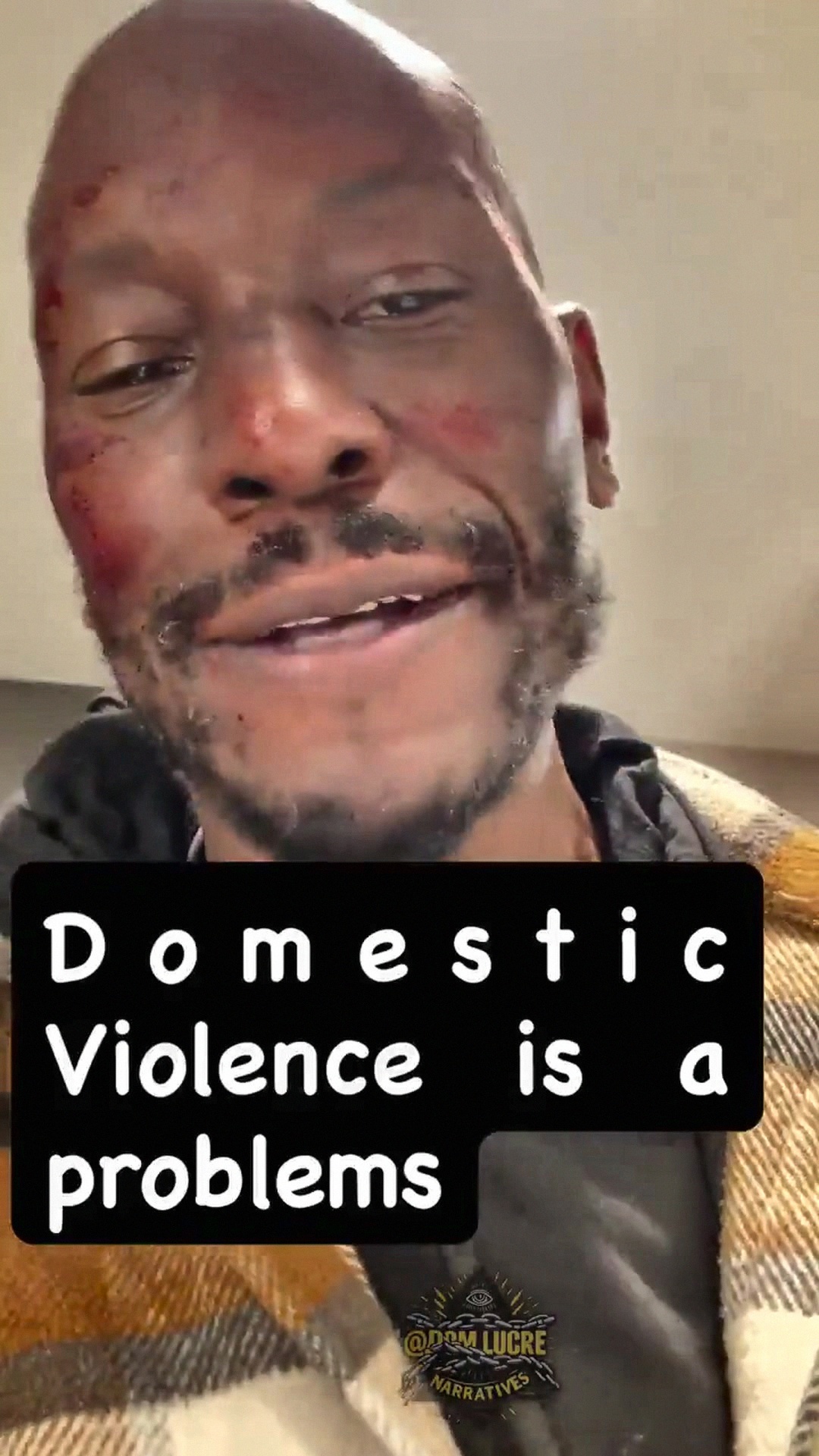
- The Setup: Actor Tyrese Gibson appears on camera with severe simulated facial injuries, speaking directly into the lens with the intimacy of a personal confession.
- The Confession: He admits to following another man's girlfriend on Instagram, naming specific women, and offers an apology that sounds deeply personal.
- The Intervention: Mid-sentence, the frame breaks. He yells "Cut!" and orders the crew to clear the set, abruptly ending the emotional performance.
- The Reveal: The actor confirms the bruises are movie makeup, turning a moment of apparent domestic violence into a exhibition of cinematic craft.
What the Recorded Footage Captures: Chronological Breakdown
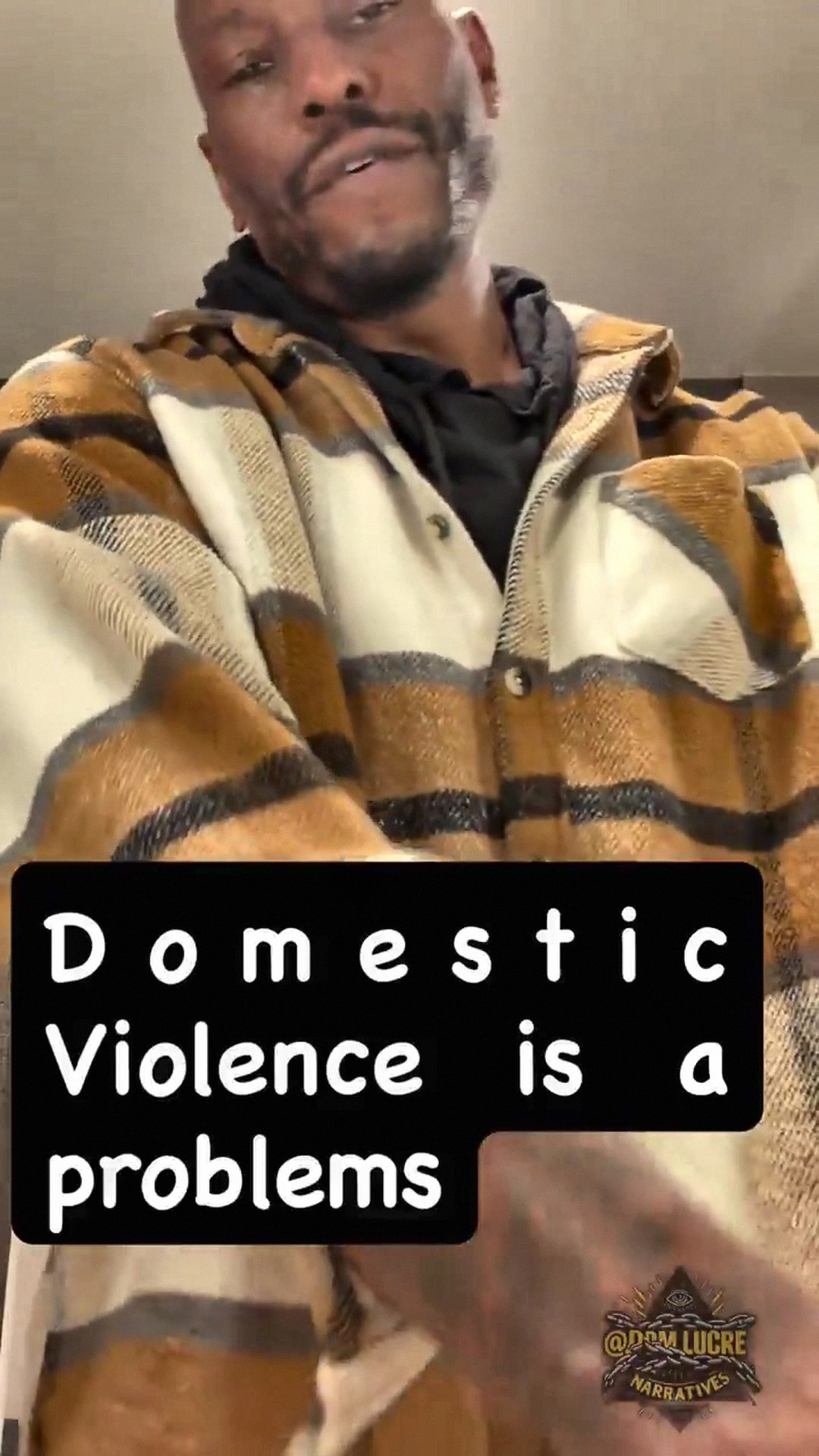
The video opens in a sterile, beige room with a white air vent visible in the upper background, a setting that feels less like a home and more like a holding cell or a clinical waiting area. Tyrese Gibson fills the frame, his head shaved, wearing a thick plaid shirt over a black hoodie. The lighting is flat and unflattering, typical of a self-recorded phone video, but the damage on his face is striking – deep red abrasions and purple bruising that seem to sit heavy on his skin. He begins to speak, his voice low and measured, admitting that he followed somebody's girlfriend on Instagram. He lists names – Fabuisha, Chanel Mercedes, Lakeitha Jones – with a cadence that feels like a man owning up to a petty indiscretion. He offers a quiet "I do apologize," and for a moment, the viewer is locked into a narrative of regret and physical consequence.
Then the atmosphere snaps. The actor's demeanor shifts instantly from contrite to commanding. He barks "Cut! Cut!" with the authority of a director, followed by "Guys, clear the set!" The abruptness of the command is jarring; the emotional whiplash is immediate. The camera shakes slightly as he breaks character, and the background noise – the hum of the vent, the rustle of clothing – seems to rush back in.
He then addresses the viewer directly, his tone now casual and almost amused: "The movie set. Movie magic all over my face, man." The transition is so swift that it forces a mental rewind, a desperate need to verify what was just witnessed.
Scroll down for the full investigative report below ↓
Critical Blind Spots: What the Lens Leaves Unresolved
What the footage does not show is the context of the film set itself. There are no visible boom mics, no lighting rigs, and no crew members in the frame. The beige walls and the lone vent remain static, offering no hint of a production environment. This absence is the core of the video's power – it forces the viewer to accept the reality of the beating until the actor himself dismantles it.
The camera angle is a tight selfie, restricting peripheral vision and preventing any glimpse of the equipment or personnel that would have confirmed the staged nature of the scene.
The audio is equally deceptive. The spoken lines are delivered with a raw, unpolished quality that mimics a candid confession. There is no background score, no ambient dialogue from a crew, and no clapperboard sound. The silence of the set is absolute, which makes the sudden command to "clear the set" feel like a break in the fourth wall rather than a director addressing his team.
This deliberate stripping of production context creates a vacuum of information, leaving the viewer to fill in the gaps with their own assumptions about violence and celebrity.
Statutory Framework and Protocol Analysis
In the realm of public interaction, the video touches on the serious issue of domestic violence, albeit through a fictional lens. The initial framing – a bruised man apologizing for crossing a boundary – mirrors the language often heard in real cases of interpersonal conflict. However, the immediate retraction reframes the scenario as a critique of how quickly audiences consume and judge narratives of abuse. The production holds no legal weight, but it serves as a reminder of the power of visual media to manipulate perception.
When analyzing encounters between the public and law enforcement, the Fourth Amendment's protection against unreasonable searches and seizures ensures that any investigation into a reported assault requires probable cause. In a real scenario, officers would rely on physical evidence and witness testimony, not just a self-recorded video. The Fifth Amendment guarantees the right to remain silent, and any confession must be voluntary. Here, the "confession" is voluntary but entirely fabricated, highlighting the difference between theatrical expression and legal testimony.
| Incident Parameter | Recorded On-Scene Evidence |
|---|---|
| Visible Subject | Male actor with simulated facial bruising and lacerations |
| Setting | Interior room with beige walls and a white air vent |
| Spoken Content | Apology for Instagram follow, followed by director's command |
| Key Turning Point | The utterance of "Cut!" and "Clear the set!" |
| Audio Environment | No background crew noise or equipment sounds |
| Posture Shift | From slumped, contrite confession to upright, authoritative command |
| Narrative Conclusion | Explicit confirmation of "movie makeup" and "movie magic" |
Read more:
Read more: McDonald’s Counter Clash: Shoulder Check Sparks Shouting Match →
Core Questions and Institutional Review
- How does the absence of production context in the frame affect the viewer's ability to distinguish performance from reality?
- What responsibility do actors and creators have when presenting simulated violence on platforms that prioritize short-form, context-light content?
- Does the sudden break of character dilute the impact of the original message about domestic violence, or does it serve as a commentary on media consumption?
- How might the public's trust in video evidence be eroded when high-profile figures use realistic makeup to stage assaults?
The video ends with the actor's face still bearing the vivid marks of the makeup, a physical reminder that the line between truth and fiction can be painted on. The set is cleared, the performance is over, but the question lingers: when we watch a confession, are we seeing a cry for help or a script waiting for its cue?
FOLLOW-UP INVESTIGATION REPORT
Related documented case details, verified on-scene evidence, and statutory liability analysis continued below.
CONTINUE READING: NEXT INVESTIGATIVE DOSSIER →
Midair Chaos: Passenger Tries Exit Door, Cabin Restrains Him
The cabin lights were dimmed for a red-eye crossing, the kind of quiet that settles over a plane an hour after takeoff. Then a man stood up and walked toward the exit door. What followed was not a drill, not a movie, and not a misunderstanding – it was a scramble of bodies, seatbelts, and sheer panic that ended with an emergency landing and a flight crew physically wrestling a passenger to the floor.
- The flight: American Airlines Flight 1494 departed San Diego late on a Tuesday night bound for Chicago, carrying a full load of holiday travelers headed into Thanksgiving week.
- The friction: Roughly an hour into the flight, near the Arizona-California border, a male passenger attempted to open an aircraft exit door in flight.
- The intervention: Flight attendants and multiple passengers physically restrained the man, pinning him in the aisle while the aircraft was still airborne.
- The aftermath: The plane diverted to Phoenix Sky Harbor International Airport, landing around 1 a.m. local time, where police took the passenger into custody after he received treatment for a minor injury.
What the Recorded Footage Captures: Chronological Breakdown
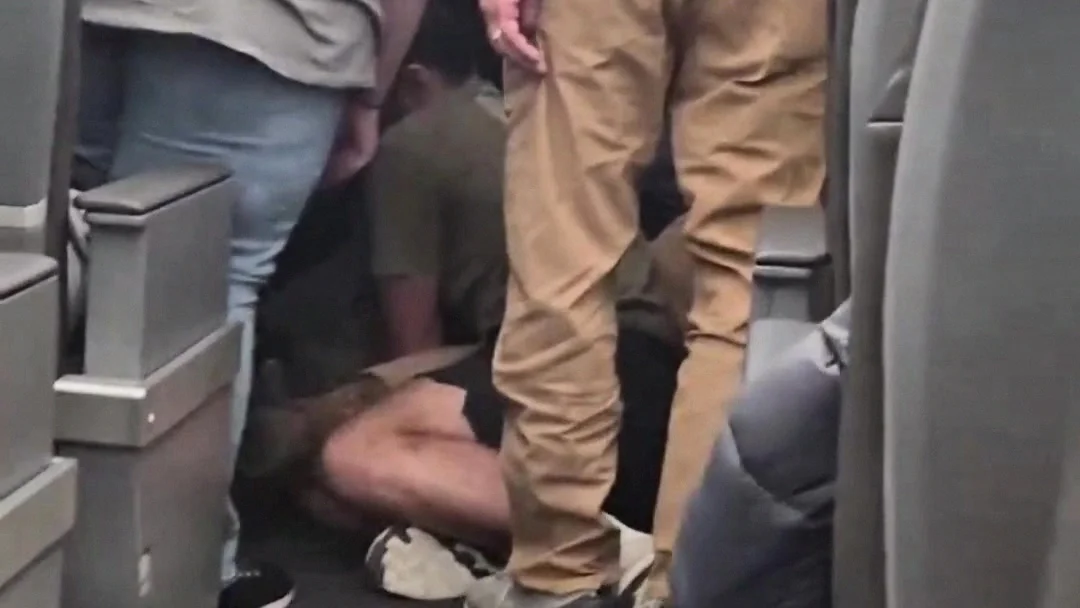
The first frames are almost calm, which is what makes them disturbing. Overhead bins press in from either side of a narrow aisle. A man in a gray jacket and white earbuds stands over a crumpled figure on the floor, his expression flat, unreadable, eyes fixed downward. Around him, a knot of passengers has formed – a younger man in a brown hoodie with a red logo, a man in a black jacket leaning in from the left. Nobody is screaming yet. The cabin is in that strange suspended moment between confusion and action.
Then the camera moves, and the geometry of the struggle becomes clear. A man in a bright blue long-sleeve shirt and tan khaki pants stands braced in the aisle, his stance wide, feet planted on the gray carpet like a man holding a door against a flood. Below him, a body is folded onto the floor, legs bent awkwardly, a white-and-black sneaker twisted against the seat track. A second man in a gray graphic tee leans hard to the left, his weight committed. Hands are everywhere – gripping fabric, pinning shoulders, steadying the mass of limbs that will not stop moving.
By the final frames, the restraint has become a full-body operation. A man in a gray button-up shirt stands pressed against the forward galley panel, his arm extended, jaw tight, watching the floor where the passenger is now prone. A boy in a dark hoodie crouches nearby, wide-eyed, unsure whether to help or flee. The aisle floor is scattered with debris – a crumpled wrapper, a loose strap, the small wreckage of an ordinary flight turned extraordinary. Nobody in the frame is smiling. Nobody is posing. This is the raw, unglamorous work of keeping a plane in the air.
Critical Blind Spots: What the Lens Leaves Unresolved
The footage begins after the confrontation is already underway. What is not on camera is the moment the man rose from his seat, the seconds before he reached the door, and whatever words passed between him and the crew. Did a flight attendant confront him first? Did a passenger notice his intent before anyone else? The record simply does not say, and the gap matters, because that missing minute is where the real warning signs would live.
What the camera also cannot show is the psychology in the cabin. Rows of passengers strapped into seats, unable to see the aisle, hearing only scuffling and strained voices. The audio captures almost nothing beyond a quiet, reflexive "Thank you. Thank you." – a small human courtesy that lands strangely against the violence of the scene. It may be a passenger thanking a seatmate, or a crew member thanking a helper. Either way, it is the only spoken line the recording preserves, and it hints at a cabin that chose cooperation over panic.
The identity of the restrained passenger remains undisclosed. What prompted the attempt – a mental health crisis, intoxication, or something else – has not been publicly established. Authorities have said only that he was taken into custody after hospital treatment, and that the FBI and FAA are reviewing the case. Until those reviews conclude, any narrative about motive is speculation dressed up as fact.
Statutory Framework and Protocol Analysis
What the footage actually demonstrates is the layered defense built into modern commercial aviation. Flight attendants are trained in restraint and de-escalation, but their first tool is verbal control – lowering their voice, closing distance calmly, giving the disruptive person a single instruction. When that fails, the protocol shifts to physical containment, and that is where passengers become part of the system. The men pinning the passenger in the aisle were not trained professionals. They were ordinary travelers who recognized that a door opening at altitude is not a theoretical risk.
| Incident Parameter | Observation at the Scene |
|---|---|
| Aircraft status | In flight, roughly one hour after departure |
| Reported action | Male passenger attempted to open an exit door |
| Response | Flight attendants and passengers physically restrained him |
| Diversion decision | Aircraft diverted to Phoenix Sky Harbor International Airport |
| Time of landing | Approximately 1 a.m. local time |
| Law enforcement | Phoenix police took the passenger into custody |
| Injuries reported | Minor injury to the passenger; no other injuries reported |
The legal architecture around this incident is less about punishment than deterrence. Under established federal standards, a flight crew's authority aboard an aircraft is broad, and passengers who interfere with that authority can face serious federal exposure. Yet the more instructive lesson sits in the aisle itself: the restraint shown in the footage was improvised, immediate, and remarkably restrained. No one in the frames appears to strike the man. They hold him. They pin him. They wait for the aircraft to reach the ground.
Core Questions and Institutional Review
- What specific behavior or statement preceded the attempt to open the door, and was it reported to the crew before the escalation?
- Did the aircraft's door design and in-flight pressure differential make the attempt physically futile, and how did the crew assess that risk in real time?
- What mental health or medical evaluation was conducted at the Phoenix hospital, and will those findings inform any charging decision?
- How will the FAA's review shape guidance for crew training on passenger-assisted restraint in the future?
What lingers after watching the footage is not the violence but the coordination – strangers locking arms in a cramped aisle without a single word of command, holding a line against something none of them fully understood. The investigation will produce reports and findings, but it will not capture the quiet, terrible arithmetic of that moment: how many people it takes to keep a door closed, and how quickly a calm cabin can become a wrestling match at altitude. If you had been in that aisle, would you have stood up?