A shoulder check and a spilled pink drink turn a routine fast-food pickup into a shouting match, with a crowded line frozen in place and someone demanding the police. What the camera catches in those chaotic seconds is less a brawl than a masterclass in how quickly ordinary friction becomes public spectacle.
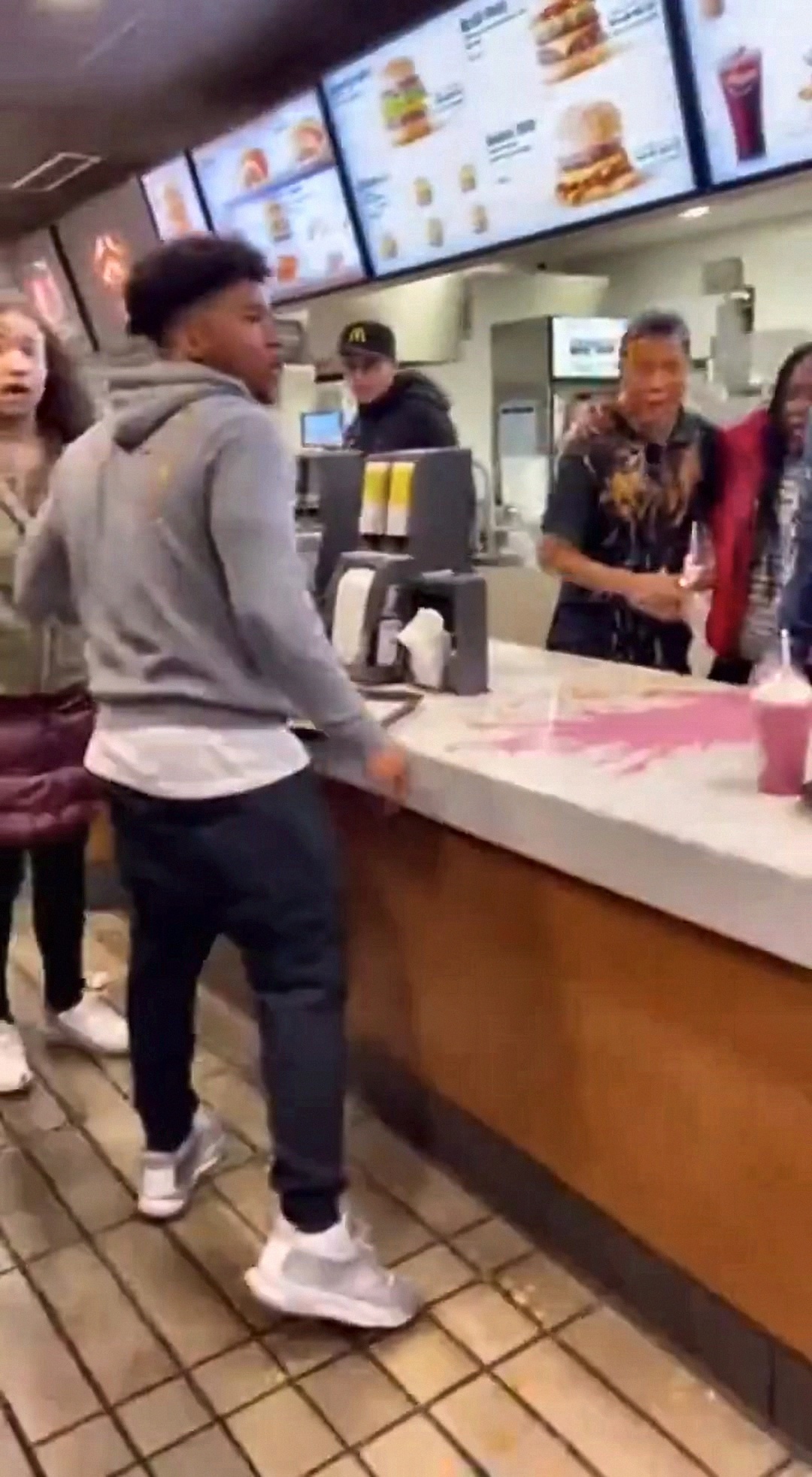
- A group of teens and counter employees at a McDonald's register lock into a verbal dispute that begins as an order disagreement.
- A physical collision – a shoulder check – triggers an immediate verbal escalation, with one voice cutting through the noise: "You bump me man, watch where you're going!"
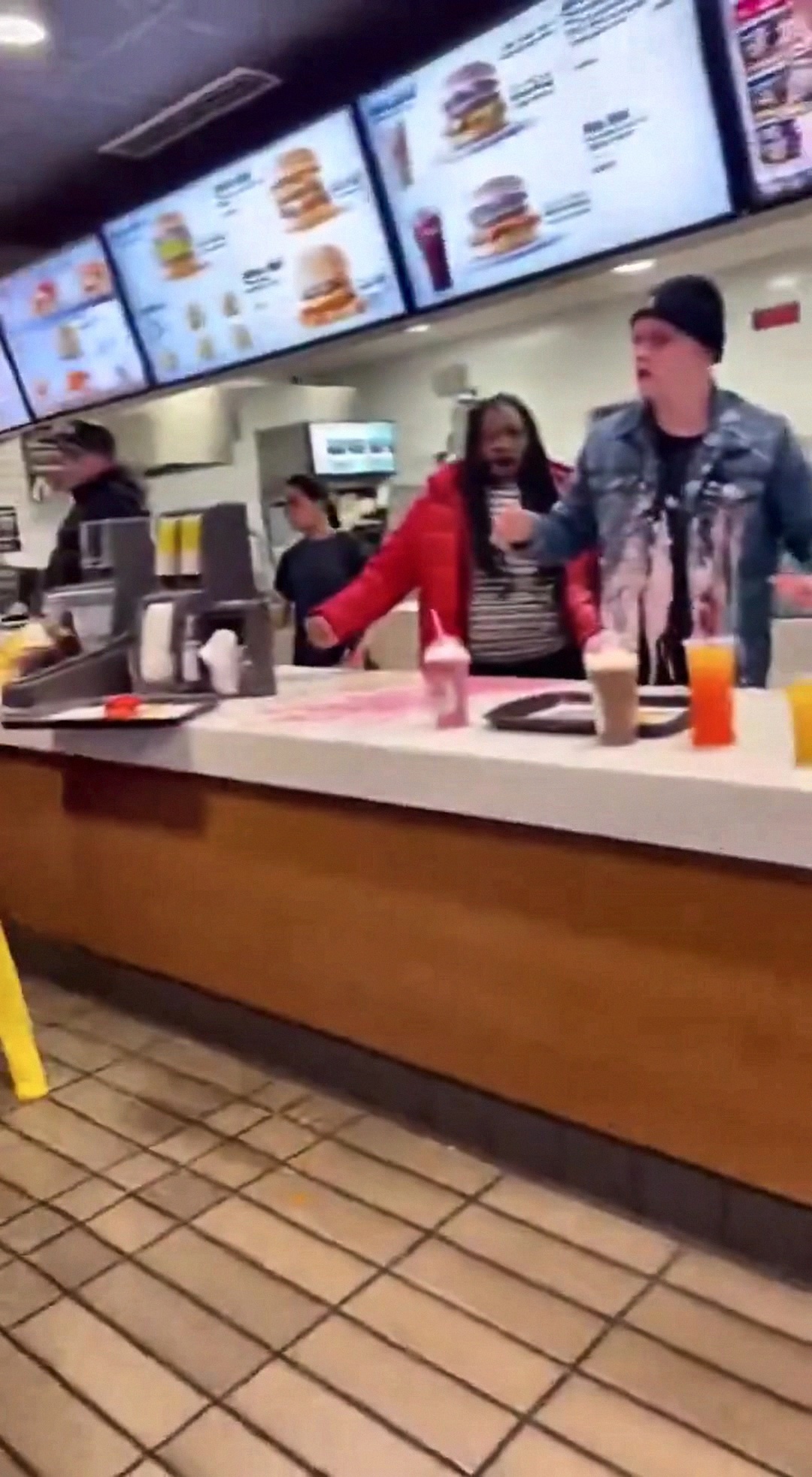
- Both sides talk over each other as the queue behind them stalls, with bystanders in hoodies, jackets, and red outerwear frozen between the register and the drink station.
- The confrontation peaks with shouting, an attempted physical grab, and the declaration "Call the cops!" before the footage ends.
What the Recorded Footage Captures: Chronological Breakdown
The camera opens on a brightly lit counter beneath glowing menu boards. A young man in a gray hoodie stands at the register, body angled toward the drink station, while a second young man in a dark graphic shirt leans forward with an open, questioning gesture. A pink beverage has already met the counter, pooling in a wide smear that catches the overhead light. Everything reads ordinary – until it doesn't.
Then the collision. The hoodie-wearing customer moves laterally, and the contact is immediate. A voice snaps out: "You bump me man, watch where you're going!" The reply comes back sharp and fast – "Say it again, hey, hey!" – and the geography of the room changes in a single heartbeat. The gap between customer and counter collapses. A woman in a red jacket steps in from the left side of the frame, her camera-phone angled, her expression caught between documentation and disbelief.
The escalation is loud and overlapping, all volume and no listening. "Whoa! Yo, guys stop, stop, get off me, that's enough!" one voice pleads, while another presses forward with "Back up everybody!" The camera dips toward the tile floor as the operator is jostled – a telltale sign that bodies are moving, not just voices. A man near the register throws his hands out in a placating gesture, the universal signal for hold on. But the momentum is already loose. Someone asks, "You want another one?" and the reply lands like a verdict: "Call the cops!" The clip cuts before anyone in uniform appears.
Scroll down for the full investigative report below ↓

Critical Blind Spots: What the Lens Leaves Unresolved
The camera is a witness, not a judge. It never captures the moment that actually started the argument – the words exchanged at the register about the order, or whether the disputed item was ever in a bag. We see the aftermath of a misunderstanding and none of its origin, which means the visible collision may be a symptom rather than the cause.
Nor does the footage identify who initiated physical contact. A shoulder check in a cramped queue can be accidental, careless, or deliberate, and the camera's angle flattens all three into a single ambiguous frame. The operator's hand shakes; the shot drops; the frame jumps. Between those jumps, entire sentences vanish – sentences that likely explain why one person refused to back down and another refused to walk away.
Even the bystanders' role is unresolved. The woman in red films, the man in the graphic shirt gestures, but who was staff and who was a customer remains unclear in the blur.
Finally, the clip ends at the loudest moment, not the resolution. Did the argument dissipate into muttered complaints and a refund, or did it follow the group out the door and into the parking lot? The record simply stops, and silence is not the same as peace.
Statutory Framework and Protocol Analysis
In American retail environments, employees and managers carry a duty of care to maintain a safe space for customers, which typically means a de-escalation script: separate the parties, lower the volume, offer a resolution, and call law enforcement only if safety is at risk. The shouted demand for "the cops" suggests that script either was never offered or was rejected. On the civil-rights side, the constitutional principles that govern any eventual police encounter are well established – a Terry v. Ohio stop requires reasonable suspicion, Pennsylvania v. Mimms allows officers to direct occupants out of a vehicle during a lawful stop, and Rodriguez v. United States caps the duration of an investigative detention absent new justification. None of that framework resolves who was wrong at the counter, but it explains why a manager's choice to call or not call police is a consequential act, not a formality.
| Incident Parameter | Recorded On-Scene Evidence |
|---|---|
| Setting | Brightly lit McDonald's counter with overhead illuminated menu boards |
| Crowd density | Several customers and staff packed within arm's reach of the register |
| Trigger moment | Physical bump accompanied by the shout "watch where you're going" |
| Verbal exchange | Overlapping voices, repeated "say it again," calls to "back up" |
| Physical contact | Brief scuffle with a plea of "get off me, that's enough" |
| Escalation cue | "You want another one?" followed by "Call the cops!" |
| Outcome on camera | Footage ends mid-dispute; no resolution or police arrival shown |
Fast-food counters are high-friction spaces by design: short waits, loud noise, cramped footing, and a transaction that feels personal to both sides. Community expectations run in two directions – customers expect to be heard, and crews expect not to be touched. When those expectations collide, the standard playbook is to pause the transaction, move the dispute off the main line, and let a manager reset the tone. Here, no one appeared to own that reset until the volume had already swallowed the room.
Read more:
Read more: Four-on-One Confrontation Caught on Camera →
Core Questions and Institutional Review
- Was the initial contact between the customer and the other party accidental or intentional?
- Did the disputed order ever receive a resolution, or did the dispute replace the transaction entirely?
- Who requested police involvement, and did any call actually go out before the footage ended?
- Were employees trained or empowered to separate the parties, and did they attempt it off-camera?
What lingers is the speed of it. A quiet counter, a pink puddle, a shoulder – and within seconds a room full of people performing for an audience they can feel but cannot see. The camera did not create the friction; it merely insured that the friction would be replayed, analyzed, and argued about by people who were never in the room.
Perhaps the more useful question is not who was right at that register, but why so many of us now expect a stranger's worst thirty seconds to arrive in our feeds before we've finished our own meals.
Practical Takeaways
- When a dispute erupts in a public queue, your safest move is distance – step back, keep hands visible, and let staff or security separate the parties.
- If contact was accidental, name it plainly and move on; most escalations are fed by the refusal to acknowledge rather than the bump itself.
- Recording is legal in most public settings, but positioning matters – stay clear of physical contact zones and never insert yourself into the scrum to get a better angle.
- Staff should redirect the disputed transaction away from the register line and offer a concrete resolution before the volume makes negotiation impossible.
FOLLOW-UP INVESTIGATION REPORT
Related documented case details, verified on-scene evidence, and statutory liability analysis continued below.
CONTINUE READING: NEXT INVESTIGATIVE DOSSIER →
Headlight Flash Leads to Violent Arrest in North Carolina

The flashing of high beams is a wordless courtesy on dark roads, a brief signal of danger ahead. But in Lowell, North Carolina, a woman's simple gesture triggered a chain of events that ended with her front door splintered, her body on the ground, and a community demanding answers. Was it a lawful arrest or an overreach of authority? The footage shows the confrontation, but the truth is buried in what the camera doesn't capture.
- The Scene: Just after 2 a.m. on a Thursday, a Gaston County police car sat dark and silent on the median along Wilkinson Boulevard, watching traffic.
- The Friction: Hailey Brown, driving home from work, flashed her headlights to warn oncoming drivers of the parked cruiser, a habit she says she uses for any roadside hazard.
- The Intervention: An officer followed Brown to her home, confronted her at her front door, and the situation escalated into a physical struggle captured on police video.
- The Aftermath: Brown was arrested, charged with resisting a public officer and traffic offenses, and spent hours in jail. She now plans to file a complaint and demands the release of full body and dash camera footage.
What the Recorded Footage Captures: Chronological Breakdown
The video begins with the grainy, blue-tinted chaos of a police body camera. A doorframe splinters inward. An officer's arm reaches through the gap. The audio is a blur of shouts and scuffling, but the visual is unmistakable: a man in uniform forcing his way into a private home. The officer is not hesitating; he is moving with the momentum of a linebacker, as Brown later describes it, his shoulder driving the wood until the lock gives way.
What follows is a tumble of limbs and fabric as Brown is pulled from the threshold onto the ground. The camera jolts, catching only fragments: a flash of a braid, the dark fabric of a shirt, the gleam of handcuffs. The officers take her down, and the audio captures the thud of bodies on the floor. The screen flashes a timestamp: 02:20:42. The arrest is swift and overwhelming, a sudden explosion of force in the quiet of a residential night.
The footage then cuts to the aftermath. A reporter stands in front of the Gaston County Police Department, the autumn sun bright on her face. She explains the charges: resisting a public officer, three traffic offenses. The video cuts back to the body cam, showing Brown on the ground, her face obscured, her voice a murmur beneath the officers' commands. There is no sign of a weapon, no sign of a fleeing suspect. There is only the raw, messy reality of a woman being subdued in her own doorway.
Critical Blind Spots: What the Lens Leaves Unresolved
What the body camera does not show is the crucial minutes before the door was breached. What was the officer's justification for following Brown home? The arrest report alleges she ran from an active traffic stop, but Brown maintains she never believed she was being pulled over. The camera captures the confrontation, but it does not capture the officer's decision-making in the moments leading up to it. Did he activate his lights? Did he verbally command her to stop? The footage is silent on these questions.
Another blind spot is the question of legal authority. The video shows the physical struggle, but it cannot show the legal basis for the stop. Brown's description of the incident suggests she did not know she was being pursued. The officer's perspective, whatever it may be, is not visible in the footage. The camera is strapped to his chest, but it does not show his thoughts, his training, or his perception of the threat. The gap between what the officer saw and what Brown experienced is the space where the controversy lives.
Finally, the footage does not capture the full context of the headlight flash. Was it a deliberate act of warning, as Brown claims, or a random flick of the switch? The video shows the result, but not the intent. The law is clear that warning others of police presence is protected speech, but the officer's interpretation of that flash is what triggered the pursuit. The camera captures the arrest, but it leaves the reason for the pursuit entirely off-screen.
Statutory Framework and Protocol Analysis
The core legal issue in this incident is whether the officer had the authority to detain Brown at her home. Under the Fourth Amendment, a traffic stop is a seizure, and it must be supported by reasonable suspicion of a traffic violation. Flashing high beams to warn others is generally considered protected speech under the First Amendment, as it communicates information to other drivers. However, if the officer believed the flash was a violation of a specific statute (such as a local ordinance against flashing lights), the stop might be lawful. But the stop must be conducted properly, and the officer must have reasonable suspicion to continue the detention.
The escalation to a physical arrest for resisting a public officer is a separate legal question. Under the law, resisting arrest requires that the officer was making a lawful arrest. If the initial stop was unlawful, the resistance charge may not stand. The video shows the physical struggle, but the legal foundation for the arrest is what matters. The officer's actions, including the forced entry into the home, must be evaluated against the standard of objective reasonableness. The footage captures the force, but the justification for that force is the subject of the ongoing review.
| Incident Parameter | Observation at the Scene |
|---|---|
| Time of Incident | Just after 2 a.m. on a Thursday in November |
| Location | Lowell, Gaston County, North Carolina |
| Trigger Event | Flash of high beams at a parked police car |
| Police Action | Officer follows to home, forces door open, arrests woman |
| Charges Filed | Resisting a public officer; three traffic offenses |
| Physical Evidence | Bruises and trauma reported by the woman |
| Pending Review | Request for body cam and dash cam release; complaint filed |
Read more: {NOIBO}
Core Questions and Institutional Review
- Was the initial traffic stop lawful, and did the officer have reasonable suspicion to pursue Brown to her home?
- Does the First Amendment protect the flashing of high beams to warn others of police presence, and does that protection extend to the home?
- Was the force used to enter the home and arrest Brown proportionate to any threat she posed, or did it exceed the bounds of objective reasonableness?
- Will the full body camera and dash camera footage be released to the public, and what will it reveal about the moments before the door was breached?
As the investigation continues, the community is left to weigh the competing narratives. The footage shows a woman pulled from her home, but it does not show the full story. The legal questions will be answered in court, but the public debate is already underway. What do you think the full footage will reveal?



One comment on “McDonald’s Counter Clash: Shoulder Check Sparks Shouting Match”