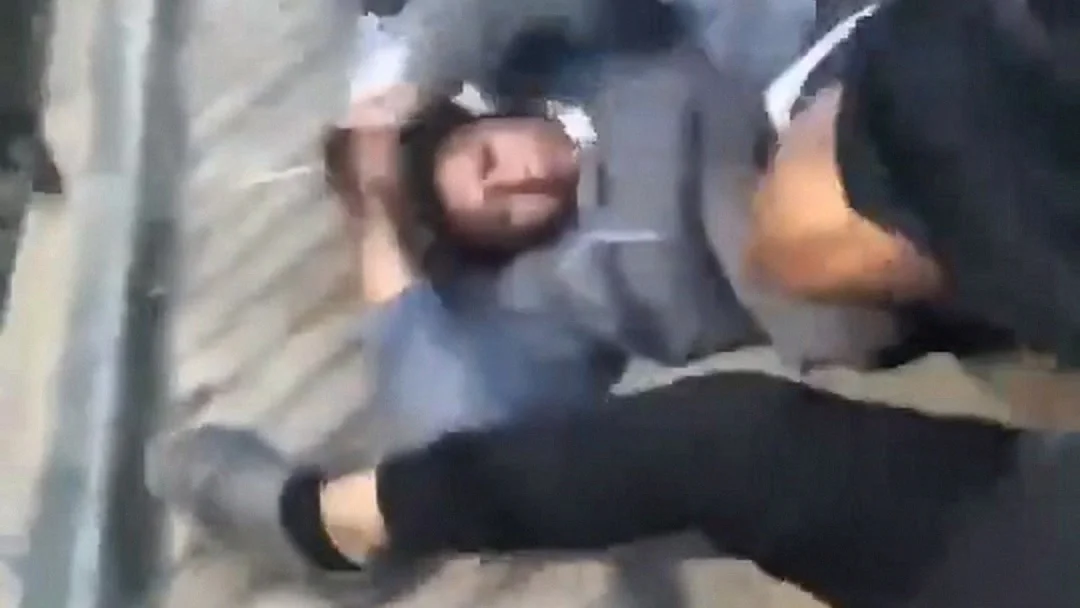
The frame is chaos before it is anything else – a blur of arms, a wild swing of motion, and a woman's voice cracking into a plea that sounds less like a request and more like a survival instinct. Four people press inward on a single figure, and the phone recording it all never stops moving. What the lens captures is not a fight in any clean sense; it is a group deciding, in real time, how much space one person is allowed to occupy.

- The scene: A cramped interior space captured on a shaky handheld phone, with a discarded phone lying flat on a table as the confrontation unfolds around it.
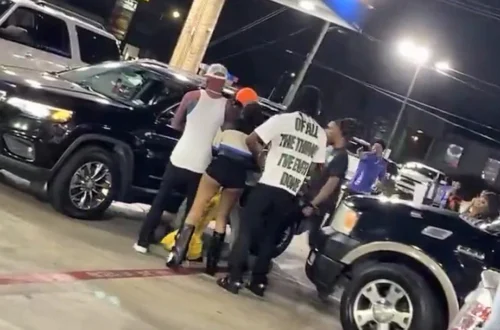
- The friction: Two men and two women converge on one visibly intoxicated woman, closing distance until she has almost nowhere to retreat.
- The intervention: No mediator steps in – instead the voices layer over one another, escalating from demands to leave into open threats.
- The aftermath: The footage cuts while the circle is still tight and the shouting is still climbing, leaving the resolution entirely off-screen.
What the Recorded Footage Captures: Chronological Breakdown
The opening seconds are almost abstract – a gray sleeve, a flash of red fabric, a body moving too fast for the autofocus to hold. Then the audio arrives ahead of the image clarity. A woman's voice rises above the rest, repeating a single command with rising panic: "Just get out! Get out! Get out, man! Leave!" The words are plain, but the pitch is not. It is the sound of someone who has already lost control of the room.
As the camera swings, the geometry of the confrontation becomes clear. There is one figure at the center, swaying and cornered, and there are four others arranged around her like a closing fist.
One of the aggressors shouts a bizarre, grandiose claim – something about a boyfriend being a president – a line that lands less as a threat than as theater, the kind of noise people make when they want an audience to believe they hold power they do not. The woman keeps begging: "Please leave! Just please leave! Please, just leave!"
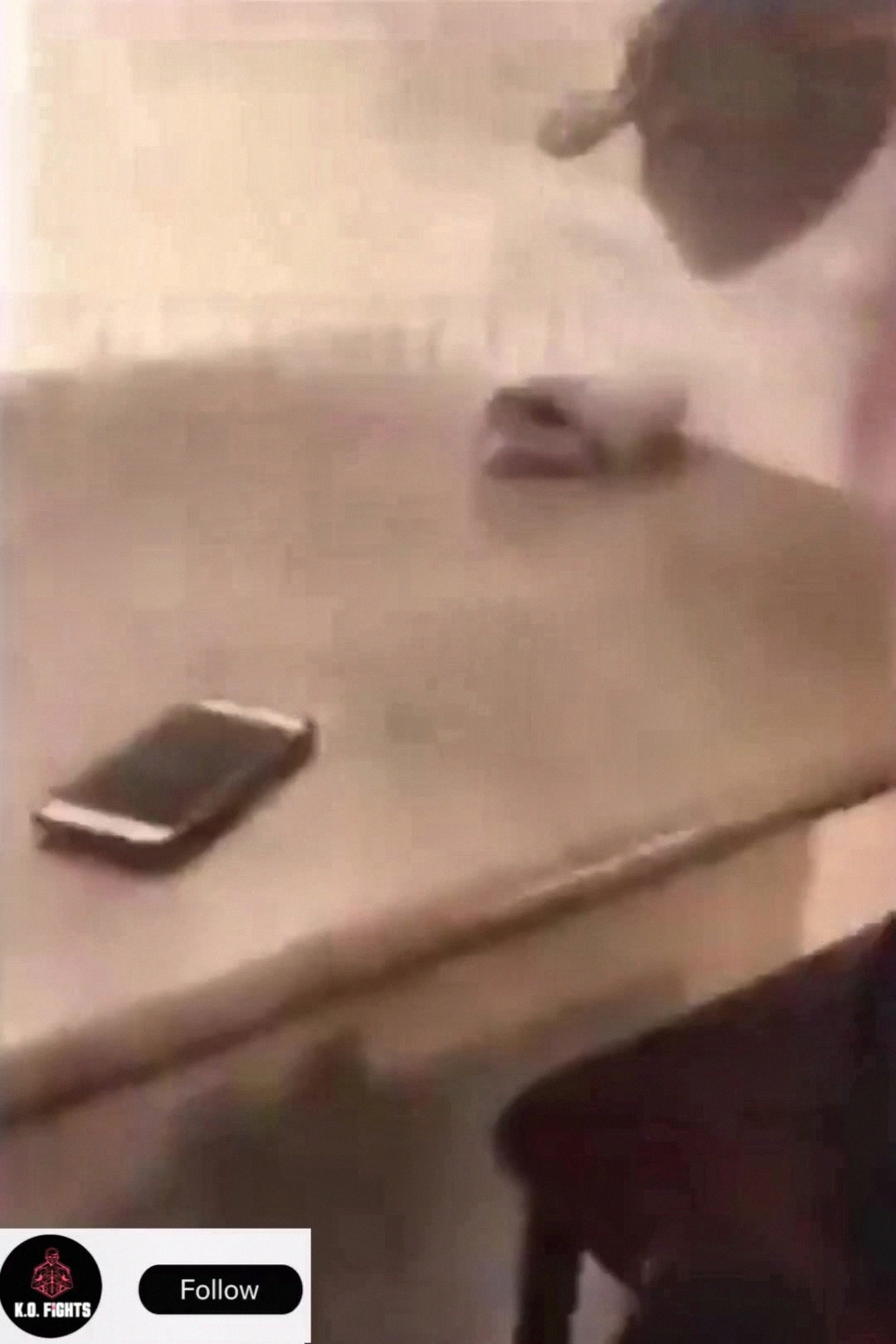
Then the language curdles. A male voice cuts in with a crude directive to kick her outside, and the phrase repeats, picking up momentum. The camera dips toward a table where a phone lies abandoned, screen dark, and for a moment the frame is nothing but a flat surface and a shadow falling across it. When the lens swings back up, the bodies are closer than before. The circle has not broken – it has tightened. The clip ends mid-shout, mid-motion, mid-threat, with no hand extended to pull anyone apart.
Scroll down for the full investigative report below ↓
Critical Blind Spots: What the Lens Leaves Unresolved
What happened before the recording started is the first and largest gap. The footage opens already deep into the confrontation, which means the origin of the dispute – a spilled drink, a borrowed item, an old grudge, a stranger's comment – is never established. Viewers are handed the climax and asked to reverse-engineer the cause, and that is exactly the kind of vacuum that invites projection.
Equally unresolved is who is holding the camera and what their role was. The operator moves with the crowd rather than away from it, and the angle suggests proximity rather than detachment. Did the person filming try to intervene, or did the lens become a shield that made participation feel like observation? The audio offers no answer.
And then there is the woman herself. Her intoxication is visible in her balance and audible in her fractured sentences, which raises a question the footage never answers: was she a willing participant in an argument that turned, or was she targeted precisely because she was impaired and alone? The camera records her fear but not her account. Where she went after the clip ends, whether anyone called for help, and whether the group dispersed on its own – all of it sits outside the frame, unverified and unresolved.
Statutory Framework and Protocol Analysis
Under established U.S. law, a physical confrontation initiated by multiple people against one person raises immediate questions under the Fourth Amendment's seizure framework and under state-level assault and battery statutes. A person is generally entitled to move freely and to leave a situation; when a group physically blocks an exit or closes distance in a threatening manner, that conduct can cross from rude into actionable depending on jurisdiction and intent. Courts have long recognized that disparity in numbers is a relevant factor in assessing whether a reasonable person felt free to leave – the same logic that underpins Terry v. Ohio stop standards and the duration limits reiterated in Rodriguez v. United States. Here, the numerical imbalance is not subtle: it is four to one.
| Incident Parameter | Recorded On-Scene Evidence |
|---|---|
| Number of aggressors visible | Two men and two women surrounding one individual |
| Central figure's condition | Visibly impaired, unsteady, pleading to be left alone |
| Physical contact | Bodies close in tightly; exact contact obscured by motion blur |
| Verbal escalation | Repeated commands to "get out," crude threats, taunting chants |
| Exit availability | No clear path shown; exits not visible in frame |
| Bystander intervention | None captured on audio or video |
| Recording termination | Clip ends mid-confrontation with no resolution shown |
Read more:
Read more: Gabriel Iglesias Stage Collapse: Venue Liability Review →
For bystanders, the standard advice from de-escalation trainers is consistent: create distance, lower your voice, avoid mirroring aggression, and call for help rather than joining a chorus. A crowd that shouts in unison does not calm a situation – it amplifies it. The most dangerous moment in any group confrontation is when the group mistakes volume for consensus, and every additional voice feels like permission.
Core Questions and Institutional Review
- What triggered the confrontation before the camera began recording, and who initiated physical proximity?
- Who was operating the camera, and did that person have any relationship to the group or to the woman?
- Did anyone present contact emergency services, and was the woman offered medical assessment given her condition?
- Were there prior interactions between these individuals that would reframe the incident as personal rather than random?
What the footage ultimately documents is not a fight but a failure – a room full of people who chose to close ranks instead of open a door. The woman's repeated plea, "Please, just leave," is the only clear request anyone makes in the entire clip, and it is the one request nobody honors. Whether that silence was indifference, intimidation, or simple crowd momentum is the question the video cannot answer.
But it leaves another one hanging: if you had been standing in that room with a phone in your hand, what would you have done with it?
Practical Takeaways
- Distance is de-escalation. When a group closes in on one person, the single most useful action is to widen the space, not fill it.
- Volume is not consensus. A chorus of shouting does not make a demand legitimate; it only makes it louder.
- Recording is not intervening. Documentation has value, but a camera does not substitute for a call for help or a voice of restraint.
- Impairment escalates risk. A person who is intoxicated is less able to leave, less able to articulate, and more vulnerable to group pressure.
- Legal lines are fact-specific. Blocking an exit, threatening language, and numerical disparity all factor into how authorities assess a confrontation afterward.
FOLLOW-UP INVESTIGATION REPORT
Related documented case details, verified on-scene evidence, and statutory liability analysis continued below.
CONTINUE READING: NEXT INVESTIGATIVE DOSSIER →
Teen Taunts Cop Then Apologizes: Bodycam Footage Analysis

One moment he was laughing in the officer's face, a loose-limbed teenage kid with all the swagger of someone who believed the rules didn't apply to him. The next, the afternoon air filled with a sharp command and the unmistakable click of metal – and his cocky grin vanished. What happened in those few seconds between defiance and surrender is a masterclass in the raw, unpredictable chemistry of a street-level encounter.
- The Scene: A sun-drenched parking lot beside a low-slung building, with a patrol car parked on the asphalt and a group of bystanders watching from a distance.
- The Friction: A teenage boy, arms loose, voice dripping with contempt, refuses to provide identification and taunts the officer with a challenge: "You ain't gonna get chaos."
- The Intervention: The officer, calm but deliberate, repeatedly orders him to remove his hands from his pockets, then moves to physically control the situation as the teenager's laughter turns to resistance.
- The Aftermath: The boy's posture collapses from bravado to apology in seconds, leaving behind a quiet, almost awkward silence and a single, telling admission: "I was just hyped up."
What the Recorded Footage Captures: Chronological Breakdown
The video opens on a wide shot of a sun-bleached parking lot, the kind of empty suburban space where nothing ever happens – until it does. A teenager, hair tousled and a faint smirk fixed on his face, stands a few feet from a uniformed officer whose body language is a study in controlled patience. The kid's hands hover near his waistband, an ambiguous gesture that the officer immediately flags. "Take that off," the officer says, his voice flat but firm, referring to whatever is in the boy's pockets. "Let me get your ID."
The boy's reply is immediate and casual: "You ain't gonna get chaos." He laughs, a short, high sound that carries across the empty asphalt. The officer, far from rattled, gives him a long, appraising look. "What you laughing for?" he asks, almost mildly, before repeating his command. The moment of escalation arrives when the boy shifts his weight and takes a half-step forward, chest out, as if daring the officer to move. The camera captures the officer's hand tightening at his side – a subtle tell that the patience is running out.
Then the scene breaks open. There is a flurry of movement – the officer steps in, hands reaching for the boy's arm, and the boy jerks away. "What the?" someone off-camera mutters. The boy's voice rises, indignant and sharp, and he can be heard saying, "You individual me." The officer doesn't argue. He doesn't raise his voice. He simply moves with a practiced economy, and the next thing the camera sees is the boy's back as he is guided toward the building's wall, his bare feet stumbling on the cracked concrete. The audio catches a muffled, "I apologize," and the officer's reply, calm as ever: "Alright, I accept your apology, but we didn't have to take it to this level, man."
The boy's final confession is almost a whisper: "I know, I'm sorry. I was just hyped up." The sun still shines, the parking lot is still empty, but the air has changed. The laughter is gone.
Critical Blind Spots: What the Lens Leaves Unresolved
The camera's frame is tight – too tight. It captures the officer's face and the boy's shoulders, but it misses the crucial first thirty seconds that preceded the encounter. What prompted the officer's approach? Was it a traffic stop, a noise complaint, or something else entirely? The video offers no answer. The boy's hands, at the start, are hidden by the angle, so it's impossible to tell whether he was reaching for a phone or something else. The officer's decision to escalate – to move from words to physical control – is justified by his repeated orders, but the audience never hears what those orders were before the recording began.
There is also the matter of the unnamed bystander who appears briefly in the background, a figure in shorts and a dark shirt who seems to be filming. Their perspective might have captured a wider angle, but their footage is not included. What did they see? Did they intervene, or did they simply watch? The original description offers only a tantalizing frame: a kid who tried to fight a cop and ended up humbled. But the story behind the challenge – the reason for the boy's anger, the officer's prior interactions with him, the possibility of a prior warning – remains a black box.
The boy's language is another blind spot. His words are slurred, his sentences fragmentary. "It's no big deal," he says at one point, and then, addressed to someone off-camera, "Hey bro, what's up, man?" It's unclear whether he is speaking to the officer or to a friend. The thin audio makes it impossible to know for sure. What is clear is that his bravado was a performance – one that crumbled the moment real consequences appeared.
Statutory Framework and Protocol Analysis
The officer's conduct tracks closely with standard constitutional standards. In Terry v. Ohio, the Supreme Court established that an officer may briefly detain a person when there is reasonable suspicion of criminal activity. In Pennsylvania v. Mimms, the Court held that officers may order a driver out of a vehicle during a traffic stop. Here, the officer's repeated command to "take that off" – presumably referring to the boy's hands or an object – reflects a standard safety protocol, especially when a subject's hands are not visible. The decision to physically control the boy after he refused to comply and appeared to resist is consistent with the principle that officers may use reasonable force to effect a lawful arrest or detention.
What stands out, however, is the officer's restraint. He does not shout, he does not threaten, and he does not escalate verbally. He gives the boy multiple opportunities to comply. That measured approach is a textbook example of de-escalation, and it likely prevented the situation from turning violent. The boy's eventual apology and admission that he was "hyped up" is a reminder that youthful defiance often masks fear or peer pressure – not a hardened criminal intent.
| Incident Parameter | Observation at the Scene |
|---|---|
| Location type | Open parking lot beside a low-rise building, daylight |
| Subject's demeanor | Laughing, dismissive, physically loose and confrontational |
| Officer's verbal commands | Repeated order to remove hands from pockets and produce ID |
| Escalation trigger | Subject stepped forward and refused physical compliance |
| Subject's spoken words | "You ain't gonna get chaos" and "You individual me" |
| Resolution | Subject apologized, admitted being "hyped up," taken into custody |
| Bystander presence | A distant figure filming, not intervening |
Read more: {NOIBO}
Core Questions and Institutional Review
- What specific infraction or suspicion prompted the officer's initial approach, and was the boy informed of it?
- Did the boy have a prior history with law enforcement that influenced his defiant posture, or was this a first-time encounter?
- What was the role of the bystander who filmed the later portion – were they a friend, a family member, or an independent witness?
- Did the officer's decision to physically control the boy follow a clear verbal warning that was captured on the body camera but not in this clip?
The video ends with the boy standing still, his earlier smirk replaced by a blank, chastened expression. The officer's final words – "we didn't have to take it to this level" – hang in the air like a verdict. And yet, for all the clarity of the footage, one question lingers: in a moment of youthful stupidity, does a swift and decisive consequence teach a lesson – or does it simply end a confrontation that could have been defused with a different kind of conversation? The answer, like the boy's missing first few seconds on tape, is left for the viewer to decide.




One comment on “Four-on-One Confrontation Caught on Camera”