







WATCH: On-scene video documentation is embedded below →
LISTEN TO THIS ARTICLE
Audio Narration • English (US)
CLEVELAND, Ohio – A routine collateral recovery operation in one of Cleveland's most volatile residential corridors escalated into a recorded confrontation over contractual authority and property rights. The incident, captured on the driver's body-mounted camera, documents a licensed recovery agent executing a lawful repossession while two men attempt to halt the seizure through cash inducement and verbal intimidation. The footage raises substantive questions about the legal boundaries of self-help repossession, the enforceability of obstruction statutes, and the operational safety protocols governing field agents in high-risk jurisdictions.

- Jurisdictional setting: A residential townhome complex in Cleveland, Ohio, where the recovery agent located a silver Jeep Commander subject to a defaulted loan agreement and initiated a non-judicial seizure under the lender's assignment.
- Recorded escalation: Two men confronted the agent as the vehicle was lifted onto the recovery apparatus, demanding the Jeep be lowered and repeatedly offering cash to prevent removal.
- Intervention attempt: The agent declined a $200 payment and maintained that once the vehicle was secured, statutory procedure required transport to the lienholder's storage facility.
- Legal and regulatory repercussions: The agent ultimately directed the vehicle's registered owner to sever the locking device herself and read the legal paperwork aloud, converting a hostile confrontation into a documented compliance event.
What the Recorded Footage Captures: Chronological Breakdown
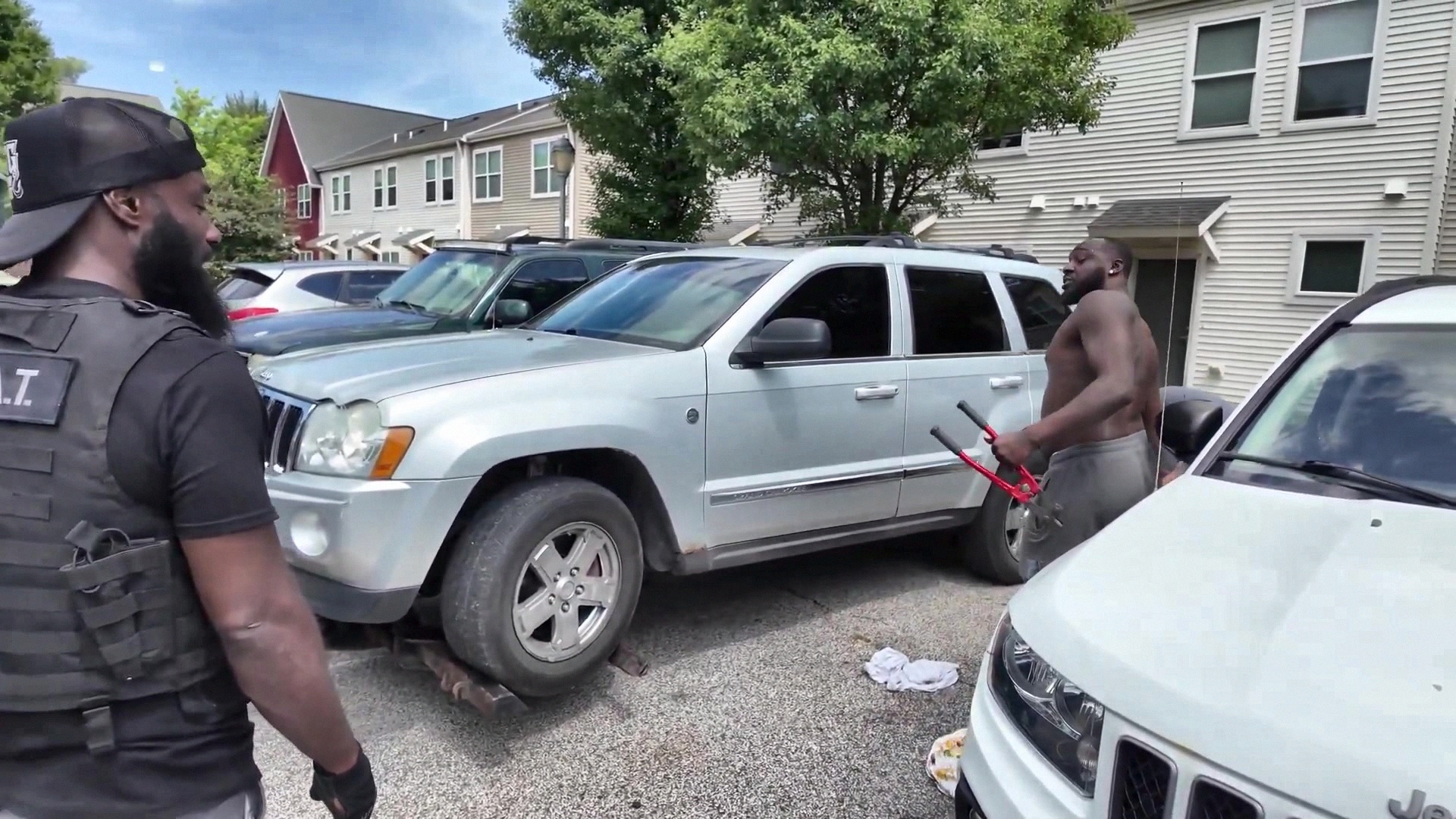
From the opening frames, the camera angle is body-mounted and forward-facing, capturing a shirtless man in grey sweatpants approaching the recovery vehicle at a rapid pace. His verbal challenge is immediate and profane, demanding to know what is being done to the Jeep. The agent's response remains level: the vehicle is being recovered, and the process has already begun. Behind the shirtless man, a second individual in a white t-shirt and red sneakers assumes a flanking position near the silver Jeep Commander, establishing a two-point confrontation that the agent must visually manage while operating the lift controls.
The footage then documents a distinct tactical shift. The shirtless man, recognizing that verbal objection is not producing the desired outcome, introduces a financial proposition: a $200 payment to release the vehicle. The agent's refusal is explicit and repeated. His reasoning is procedural rather than personal – once the vehicle is secured on the apparatus, the recovery must be completed and transported to the holding facility. At this stage, the camera captures the recovery apparatus' red wheel chock and the Jeep's front fascia elevated above grade, a visual confirmation that the asset has been legally removed from the debtor's possession.
The confrontation reaches its apex in the third phase, where the shirtless man transitions from negotiation to challenge, referencing the agent's footwear and suggesting a physical resolution off-camera. The agent does not retreat from the operational position but does not escalate either; his responses remain focused on the completion of the recovery. A third figure, a woman, appears at the periphery of the frame, and the agent's attention shifts toward her as the registered party. This moment is critical: the agent instructs her to read the legal documentation, establishing her acknowledgment of the lien and the default that triggered the recovery.
The final sequence captures the resolution. The agent directs the woman to cut the locking mechanism on the vehicle herself, a procedural move that transfers physical action to the registered owner and reduces the agent's direct exposure to an obstruction claim. The woman complies, the vehicle is released, and the footage terminates with the Jeep secured and the agent's documentation complete. The recorded audio confirms the agent's repeated insistence that he has no interest in a personal dispute, only in completing the assigned recovery.
Corporate Liability and Critical Blind Spots
The evidentiary record is materially constrained by its single-perspective origin. The body-mounted camera captures the agent's forward field of view but leaves the immediate flanking positions of both men outside the frame for extended intervals. Any gesture, object, or movement occurring behind the agent's shoulder is unrecorded. This creates a structural gap for any subsequent review of whether the confrontation involved implied threats of force beyond what the audio captured.
The pre-recovery sequence is entirely undocumented. The footage begins after the Jeep is already elevated, meaning the initial approach, the verification of the vehicle identification number, and any prior contact between the parties are absent from the record. Assertions about how the agent gained access to the vehicle, or whether the debtor was notified, cannot be verified from the footage alone. The chain of custody for the recorded file itself would require the recovery company's internal metadata to establish authenticity and timestamp integrity.
The viral framing of the incident also introduces unverified claims. The description characterizes the neighborhood as among Cleveland's most dangerous, a characterization that is not evidentially supported by the footage itself and that carries reputational implications for the residents depicted. The $200 offer is audible, but its source and the intent behind it – whether a genuine settlement attempt or a delaying tactic – remain matters of interpretation rather than documented fact.
Legal Distinction: Under Ohio Revised Code and the Uniform Commercial Code's self-help repossession provisions, a secured party may repossess collateral without judicial process only where the debtor has defaulted and the taking does not breach the peace. A breach of the peace – typically marked by threats, physical obstruction, or the presence of law enforcement ordered to intervene – terminates the statutory privilege and exposes the recovery agency to tort liability for conversion and trespass.
Statutory Framework and Protocol Analysis
The recovery agent's conduct maps onto a well-established compliance framework governing non-judicial repossession. The critical legal threshold is the peace-breach doctrine: once a debtor or third party articulates a threat or physically obstructs the taking, the agent's statutory privilege evaporates and continued removal becomes actionable. In this instance, the agent's verbal de-escalation, his refusal of the cash offer, and his decision to have the registered owner perform the physical disengagement all function as documented peace-preservation measures. Each step is designed to keep the transaction on the compliant side of the doctrine.
The institutional dimension is equally significant. Recovery agencies carry a duty of care to their field agents that extends beyond equipment and training; it includes routing decisions, time-of-day constraints, and risk-tiering of assignment zones. An agent operating alone in a densely occupied residential complex, confronting two aggressive parties without a dispatched witness or law enforcement standby, presents a foreseeable safety exposure. Whether the agency's written protocols authorized solo recovery in that environment is a question that internal compliance review would need to answer.
Scroll down for the full investigative report below ↓
| Incident Parameter | Governing Legal Standard & Judicial Protocol |
|---|---|
| Vehicle seizure initiation | UCC Article 9 self-help repossession, conditioned on default and absence of peace breach |
| Cash offer to halt recovery | Potential commercial bribery or obstruction claim; agent refusal documents integrity |
| Verbal threats by third parties | Ohio menacing and obstruction statutes; breach-of-peace trigger |
| Registered owner's participation | Voluntary disengagement reduces agency liability exposure |
| Single-agent field operation | OSHA workplace safety standards and agency duty-of-care protocols |
| Body-camera evidentiary use | Chain-of-custody requirements for civil and criminal proceedings |
| Neighborhood characterization | Defamation risk where unverified claims attach to identifiable residents |
Read more:
Read more: New York Dealership Fraud Suspect Returns to Scene, Arrested →
Core Questions and Institutional Review
- Did the recovery agency's written protocols authorize a solo field operation in a residential complex with a documented history of confrontation, and if so, what risk assessment supported that decision?
- Was the registered owner's consent to sever the locking device obtained voluntarily, or does the recorded instruction constitute a coercive transfer of liability that a court would scrutinize?
- What documentation exists to establish that the Jeep's seizure complied with the underlying loan agreement's default notice requirements before the lift was engaged?
- Should the viral distribution of footage depicting identifiable residents in a derogatory framing trigger a review under the agency's public-communications policy?
The incident illustrates a broader structural tension in the collateral recovery industry. Self-help repossession is legally sanctioned but operationally hazardous, and the margin between a compliant seizure and a civil liability event is measured in seconds and in the agent's ability to de-escalate under pressure. The recorded footage demonstrates that a disciplined agent can complete a lawful recovery while refusing inducement and absorbing threats, but it equally demonstrates that the system places individual field personnel at the center of disputes that are fundamentally financial in origin. The institutional lesson is not about the agent's conduct, which appears procedurally sound, but about the absence of structural safeguards – dispatch verification, law enforcement coordination, and defined withdrawal thresholds – that would convert a high-risk field encounter into a controlled, auditable process.
LATEST DEVELOPING INCIDENT
An even more shocking incident just erupted hours ago that has stunned onlookers nationwide. Full investigative breakdown and on-scene evidence documented below.
BREAKING: READ NEXT SHOCKING INCIDENT – LATEST CASE ↓
New York Dealership Fraud Suspect Returns to Scene, Arrested

NEW YORK – A woman accused of using a stolen identity to drive two luxury vehicles off a New York dealership lot returned to the scene of the alleged crime, where police were waiting to confront her. The recorded encounter, captured on August 11, 2025, transforms a routine commercial fraud investigation into an immediate serious legal charge arrest, raising pointed questions about dealership verification protocols, lender exposure, and the evidentiary value of body-worn camera footage in financial crimes.
- The setting is a New York franchised auto dealership, where two vehicles – a Cadillac and a Ford truck – were purchased and released to buyers presenting a stolen identity.
- According to the recorded narrative, the transaction cleared initial lender checks before the actual identity holder reported fraud alerts to her bank, triggering a belated freeze on the deal.
- The suspect allegedly returned to the dealership to sign one remaining piece of paperwork, entering the lobby where police had staged a response.
- Officers confronted the woman at a coffee station, initiating a serious legal charge-level detention while she repeatedly denied awareness that the identification used was false.
What the Recorded Footage Captures: Chronological Breakdown
The footage opens with a body-worn camera perspective, timestamped August 11, 2025, at approximately 12:27 p.m., with the frame dominated by a close, downward angle on a wrist and forearm as the camera operator moves through the dealership interior. The camerawork is handheld and partially obstructed, characteristic of an AXON device mounted on an officer moving in a confined commercial space. The initial visual record establishes only the arrival and movement of law enforcement, not the underlying transaction that preceded it.
The chronology then advances to the lobby area, where a woman later identified in the recorded audio as the suspect is observed standing at a coffee station, actively preparing a beverage. The camera captures her from a distance before closing in, and the audio records an officer asking whether she had brought a vehicle in that day. She answers no. The officer repeats the question, and she again answers in the negative. The officer then asks what she is doing in the building, and she replies that she is making coffee. This exchange is the pivot of the recorded encounter: a mundane domestic action performed in a space that law enforcement had already framed as a fraud scene.
The camera then cuts to a wider, slightly blurred interior shot in which a man in a white shirt and tie – apparently a dealership employee or manager – is visible behind a desk area, with a computer monitor in the foreground. The visible caption at this point references missing paperwork, reinforcing the stated premise that the suspect returned to complete an unfinished document. The footage does not show the document itself, nor does it capture the signature being fatally harmed.
The final segment moves to a wider lobby angle showing the suspect from behind, wearing a dark short-sleeved top, facing the dealership representative. The audio records the officer stating that the two vehicles – the Ford and the Cadillac – were provided with a false ID, and asking whether she was aware of that. She responds that she was not. The officer then instructs her to stop making coffee and come speak with him. The camera captures the transition from casual lobby activity to formal detention, but the physical restraint itself is not clearly framed in the available footage.
Corporate Liability and Critical Blind Spots
The record presented to viewers is significantly narrower than the narrative asserted in the accompanying audio. The recorded footage covers only the arrival, the lobby conversation, and the initial confrontation; it does not capture the original vehicle sales, the document review process, the lender approval, or the moment the keys were handed over. Any conclusion about how the fraud succeeded rests on the spoken summary of events rather than on documented visual evidence in the clip.
Chain-of-custody issues also arise. The body-worn camera timestamp and device identifier are visible, which supports authentication of the recording, but the footage is edited into segments with captions overlaid by a third party. The captions – including the headline text about scammers returning after scoring two $150,000 luxury cars – are not part of the original evidentiary record and constitute commentary rather than footage. A defense attorney would likely challenge any inference drawn from the edited presentation.
A further blind spot concerns the alleged victim. The audio references a woman receiving fraud alerts and contacting the bank, but that individual does not appear on camera and her statement is not recorded here. The dealership's internal verification steps – whether a second form of identification was requested, whether the lender's identity-verification vendor flagged the application, and when the fraud alert reached the finance office – remain unrecorded. These omissions matter because dealership liability in identity fraud cases typically turns on whether reasonable verification procedures were followed, not on the suspect's later conduct.
Statutory Framework and Protocol Analysis
Legal Distinction: The conduct described implicates identity theft and grand larceny statutes rather than mere contractual default. Obtaining goods by false pretenses under a stolen identity generally constitutes a serious legal charge when the value exceeds statutory thresholds, and the return to the dealership to complete paperwork does not cure the earlier taking – it may instead supply evidence of intent and continuity of the scheme.
Dealerships operate under a layered compliance regime: state motor vehicle department identity-verification rules, lender-mandated fraud checks, and federal red-flag obligations for suspicious activity reporting. When a vehicle is released before a lender's fraud alert surfaces, the dealership typically absorbs the loss or enters a dispute with the financing entity, and the resulting exposure can exceed the sticker price once chargebacks, insurance, and reputational costs are counted.
The institutional duty of care also extends to workplace safety. The recorded decision to have police staged in the lobby reflects a controlled-response protocol rather than an open confrontation, which is the recommended practice for commercial premises anticipating a fraud suspect's return. The officer's measured instruction to stop the coffee preparation and step aside is consistent with a low-escalation detention posture, though the footage does not show whether the suspect was formally placed under arrest at that moment.
| Incident Parameter | Governing Legal Standard & Judicial Protocol |
|---|---|
| Vehicle acquisition by false pretenses | State grand larceny and fraud statutes; serious legal charge threshold based on aggregate value |
| Use of another person's identity | Identity theft statutes; aggravated classification where financial harm results |
| Dealership identity verification | State DMV and lender-mandated customer identification procedures |
| Suspicious activity escalation | Federal red-flag and suspicious activity reporting obligations for financial intermediaries |
| Premises confrontation protocol | Workplace safety standards favoring pre-planned law enforcement response |
| Body-worn camera evidentiary use | Authentication requirements; chain-of-custody documentation for edited footage |
| Lender fraud alert timing | Chargeback and indemnification provisions in dealer financing agreements |
Read more: {NOIBO}
Core Questions and Institutional Review
- Did the dealership complete a second-form identity verification before releasing two vehicles valued at approximately $150,000 each, and if not, what internal policy permitted the release?
- At what point did the lender's fraud-alert system notify the finance office, and was the timing consistent with the institution's own red-flag escalation standards?
- What is the legal status of the suspect's return visit – was it a voluntary completion of paperwork, and does that voluntary presence affect the admissibility of the lobby statements?
- Will the edited, captioned footage be used in any charging decision, and how will prosecutors handle the gap between the recorded confrontation and the unrecorded original transaction?
The systemic impact of this case extends beyond a single arrest. Dealerships increasingly rely on digital identity verification, yet the window between approval and fraud-alert reconciliation remains a structural vulnerability. The suspect's decision to return to the scene converts an abstract financial crime into a recorded confrontation, giving investigators direct evidence of the individual's presence and statements, but it also highlights how much of the underlying transaction escapes the camera. For lenders and franchised dealers, the episode is a reminder that verification is not a one-time gate but a continuing obligation, and that the most consequential evidence in a fraud case is often the paperwork that never appears on screen.