






WATCH: On-scene video documentation is embedded below →
LISTEN TO THIS ARTICLE
Audio Narration • English (US)
WASHINGTON – A viral dashcam recording of a roadside confrontation is raising urgent questions about public safety protocols and the rising threat of aggressive street-level extortion schemes. The footage documents a group of individuals deliberately halting a moving vehicle on a public roadway and aggressively attempting to pressure the driver for cash, only to face an unexpected reversal when the motorist is revealed to be an off-duty law enforcement officer. The incident sits at the intersection of criminal liability, evidentiary scrutiny, and the escalating legal boundaries of citizen documentation.

- The recorded event unfolds on a multi-lane public roadway where a group of individuals intentionally steps into the path of an approaching white SUV, bringing the vehicle to a forced halt.
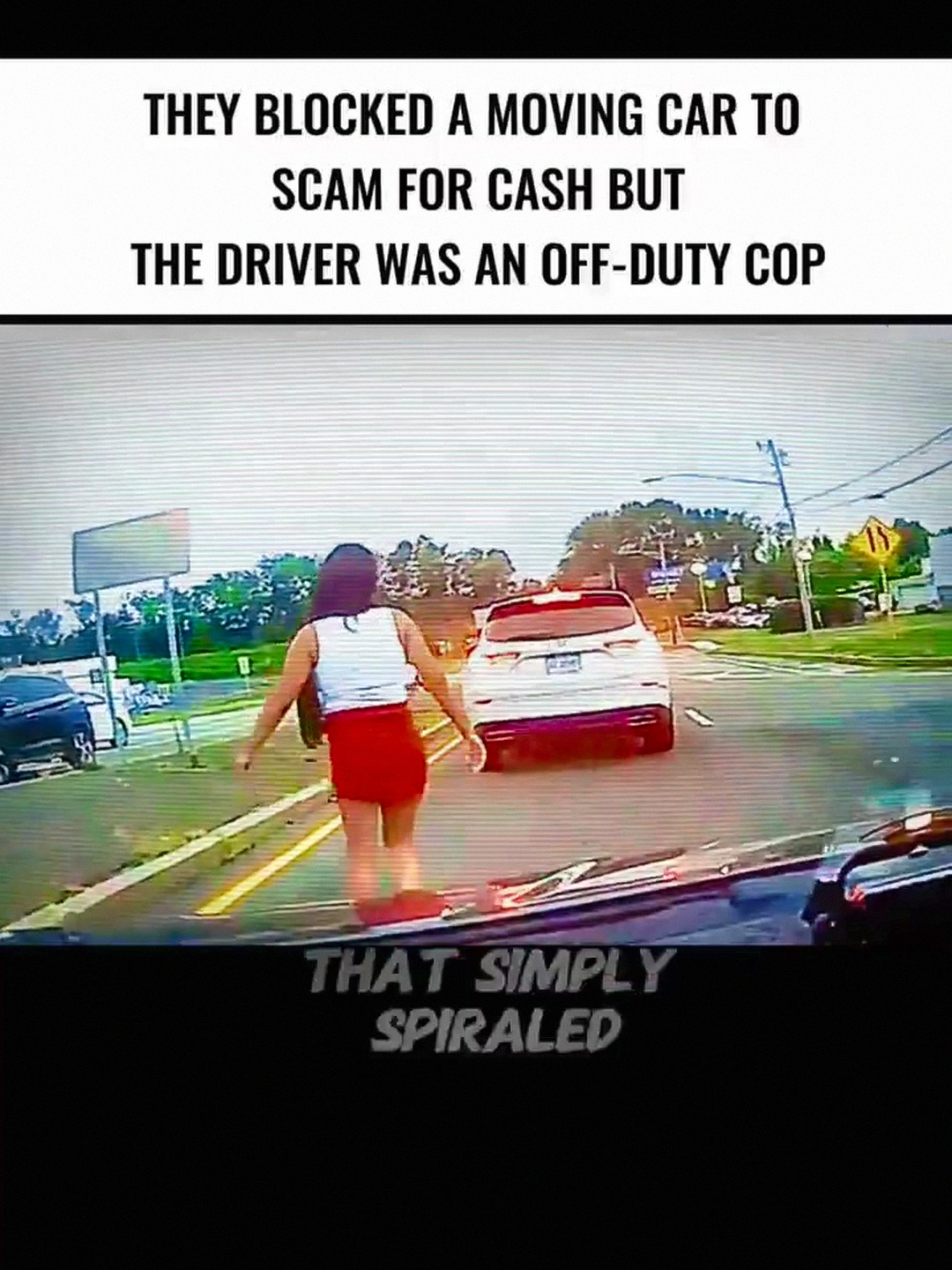
- Dashcam video captures the group moving in front of the vehicle, with one individual in a red skirt and white top leaning aggressively into the driver's side window while demanding payment.
- The driver remains inside the vehicle, invoking his constitutional right to remain secure while the confrontation intensifies and the group uses profane language and physical intimidation tactics.
- The situation reverses dramatically when the driver identifies himself as an off-duty police officer, causing the group to abruptly retreat and flee the immediate scene.
What the Recorded Footage Captures: Chronological Breakdown
The evidentiary record opens with a forward-facing dashcam view from a white SUV traveling along a residential-commercial road. At the ten-percent mark, several pedestrians are observed standing near the shoulder of the road. As the vehicle approaches, one individual steps directly into the lane, forcing the driver to brake sharply. The camera angle remains fixed, capturing the immediate transition from normal transit to a forced stop. The driver's verbal response is picked up on audio, where he states clearly, "I'm gonna get out of the road."
The tension escalates rapidly as the group surrounds the vehicle. At the forty-percent mark, a woman in a bright red skirt and white top leans into the driver's side window, her body language aggressive and confrontational. The audio captures a chaotic verbal exchange, with voices shouting, "No no no no! We're getting out the road!" The driver repeatedly attempts to de-escalate, stating, "I'm on my car," but the group continues to press forward. The camera angle across the windshield shows a man in a blue shirt approaching the front of the vehicle, leaning over the hood in a posture of intimidation.
The climax arrives when the driver reveals his professional identity. The recording captures the immediate shift in the crowd's demeanor. As the off-duty officer asserts his authority, the previously aggressive individuals begin to back away. The woman in the red skirt is seen stepping back from the window, and the group rapidly disperses. The final frames show the man in the blue shirt retreating from the vehicle, his expression shifting from aggression to shock as he realizes the legal jeopardy he has just invited.
Corporate Liability and Critical Blind Spots
While the footage provides compelling visual evidence of the confrontation, the evidentiary record contains significant blind spots that complicate any formal legal proceeding. The dashcam captures only the forward-facing perspective, leaving the actions occurring behind the vehicle and on the passenger side entirely unrecorded. The audio, while useful, is distorted by wind noise and multiple overlapping voices, making it difficult to establish a clear chain of verbal events.
Furthermore, the recording begins in media res. The events leading up to the initial confrontation, including any prior interaction between the parties or the specific origin of the demand for cash, remain unverified. The viral assertion that this was an intentional extortion scheme rests entirely on the observable behavior rather than direct evidence of a premeditated plan. Chain of custody for the original video file must be established to prevent claims of tampering or selective editing.
Statutory Framework and Protocol Analysis
Legal Distinction: The conduct captured on video intersects with multiple statutes, including state-level prohibitions on pedestrian interference with traffic, attempted extortion, and assault by menace. However, the most immediate legal consequence for the aggressors is likely misdemeanor obstruction and potential charges of disorderly conduct, as the presence of an off-duty officer establishes a credible witness for the prosecution.
From a compliance perspective, the incident highlights the duty of care owed by municipalities to maintain safe roadways. The deliberate obstruction of a moving vehicle violates basic traffic safety standards and creates an immediate risk of physical harm. The driver's response, maintaining his position inside the vehicle while contacting authorities, aligns with recommended public safety protocols for de-escalating roadside confrontations.
| Incident Parameter | Governing Legal Standard & Judicial Protocol |
|---|---|
| Pedestrian roadway obstruction | State traffic codes prohibit standing in a roadway to block traffic |
| Aggressive demand for cash | Criminal statutes addressing attempted extortion and robbery |
| Profane verbal intimidation | Disorderly conduct ordinances and assault by menace laws |
| Driver identification | Off-duty officer protocols and duty to intervene |
| Evidentiary recording | Chain of custody requirements for digital dashcam footage |
| Vehicle damage claims | Civil liability for intentional interference with property |
Read more:
Read more: Armed Porch Confrontation Over Misgendering Sparks Legal Review →
Scroll down for the full investigative report below ↓
Core Questions and Institutional Review
- Did the group's actions constitute a premeditated extortion attempt, or was this a spontaneous dispute that escalated due to misunderstanding?
- What duty of care do local law enforcement agencies have to patrol known hotspots for aggressive panhandling and roadside scams?
- How will the dashcam evidence be authenticated in a court of law given the potential for digital manipulation?
- Should the off-duty officer face departmental review for his engagement with the individuals, or was his response fully within protocol?
The systemic impact of this incident extends beyond the immediate confrontation. It exposes a growing vulnerability in public infrastructure regarding the safety of motorists navigating residential arteries. As viral evidence becomes a primary tool for law enforcement, the balance between public accountability and evidentiary integrity will define the next decade of regulatory oversight. The case underscores the necessity for robust legal frameworks that protect citizens from predatory street-level schemes while ensuring that the pursuit of justice remains grounded in verified, unassailable facts.
Practical Takeaways
- Dashcam and mobile recording devices are critical assets for documenting roadside confrontations and providing admissible evidence.
- Maintaining vehicle integrity and remaining inside during aggressive encounters aligns with established public safety protocols.
- The legal distinction between a misunderstanding and an extortion attempt hinges on the intent and actions captured on camera.
- Municipalities must review traffic safety standards to prevent similar incidents from disrupting public order.
LATEST DEVELOPING INCIDENT
An even more shocking incident just erupted hours ago that has stunned onlookers nationwide. Full investigative breakdown and on-scene evidence documented below.
BREAKING: READ NEXT SHOCKING INCIDENT – LATEST CASE ↓
Armed Porch Confrontation Over Misgendering Sparks Legal Review
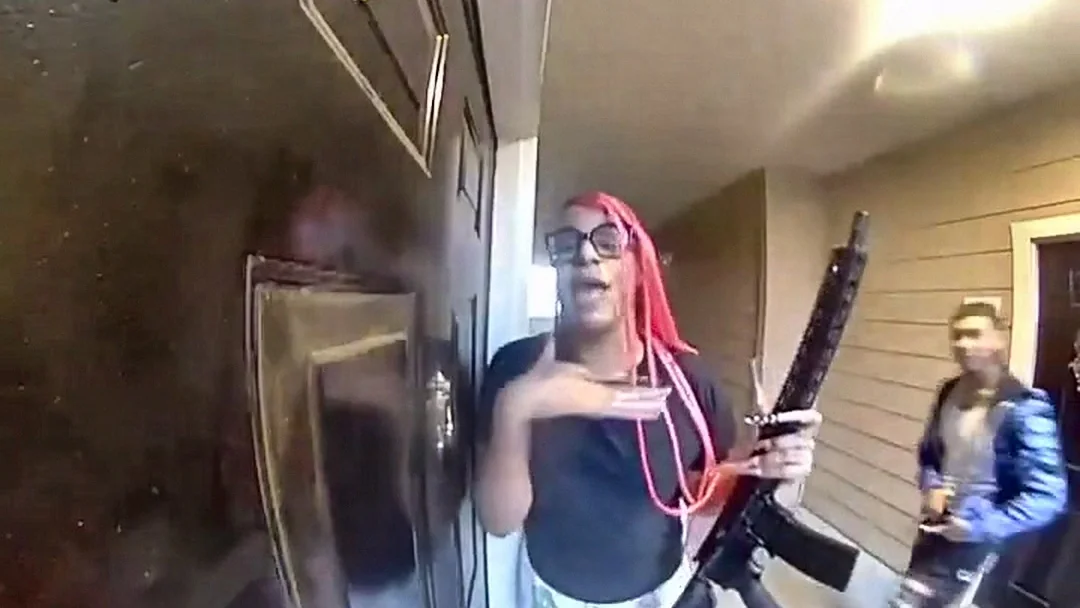
AUSTIN, Texas – A home security camera has captured a volatile armed confrontation at a residential front door, an incident that raises immediate questions about brandishing statutes, property rights, and the escalating use of weapons in interpersonal disputes. The footage, recorded by a Blink doorbell system, documents a group of individuals confronting a homeowner over an alleged verbal offense, with at least one person visibly holding a long weapon. The event shifts the debate from digital speech to physical menace, placing the homeowner in immediate fear of bodily harm.
- Jurisdictional Setting: A multi-unit residential complex, identifiable by exterior siding and numbered door signage, where the confrontation occurs on a private walkway just steps from the front door.
- Recorded Escalation: A group approaches the entrance, led by a male individual in a dark shirt and pink hair extensions, who is holding a black weapon. A second male in a blue jacket stands behind him, and a third figure is visible in the background.
- Law Enforcement or Bailiff Intervention: No law enforcement presence is observed in the footage. The recording ends before any official response or resolution occurs.
- Legal and Regulatory Repercussions: The visible brandishing of a weapon during a verbal dispute creates potential exposure to aggravated assault charges, while the homeowner's reliance on a doorbell camera establishes a digital evidentiary chain for any subsequent civil or criminal proceedings.
What the Recorded Footage Captures: Chronological Breakdown
The doorbell camera, positioned at a downward angle with a wide-angle lens, frames the dark front door on the left and the concrete walkway on the right. The first frames show the primary subject approaching directly toward the lens. He is a male with a black t-shirt, light-colored pants, and bright red or pink hair extensions. In his right hand, held at a low-ready angle but clearly visible, is a black, long-barreled weapon with a standard magazine. His left hand gestures toward the door as he speaks. Behind him, a second male in a blue zip-up jacket stands on the walkway, and a third individual remains further back near the building's exterior staircase.
The audio, captured by the doorbell microphone, records the primary subject yelling, "I just – I was a man, y'all said I was a man, so come outside! Come outside for real, like dead ass, come outside! What we doing? I'm not understanding." The phrasing indicates the confrontation is a direct response to a prior interaction, specifically an accusation of misgendering. The subject frames the homeowner's words as an invitation to a physical confrontation, using the alleged statement as justification for his presence and the visible weapon.
As the footage progresses, the primary subject moves closer to the door, his body language becoming more aggressive. He shifts his weight and gestures emphatically, while the second male in the blue jacket steps forward to stand slightly behind him, creating a two-person front. The weapon remains in the primary subject's hand throughout, never pointed directly at the camera but consistently displayed in a manner that a reasonable person would interpret as a threat. The third individual in the background does not advance but remains present, contributing to the perception of a group confrontation.
The final frames show the primary subject and the second male continuing to stand on the porch, their voices overlapping, though the specific dialogue becomes indistinct. The camera does not capture the door opening or the homeowner exiting, leaving the immediate aftermath of the confrontation unresolved within the evidentiary record.
Corporate Liability and Critical Blind Spots
While the footage provides a clear visual record of the armed confrontation, critical gaps in the evidentiary chain limit its completeness. The doorbell camera captures only the exterior walkway and porch; the interior of the residence, the homeowner's actions prior to the recording, and the initial verbal exchange that triggered the confrontation are entirely unrecorded. The audio begins mid-sentence, meaning the specific accusation of misgendering is not captured on this device, only referenced by the primary subject. This creates a chain-of-custody challenge for any legal proceeding: the video proves the presence of a weapon and the demand to "come outside," but it does not document the exact words that precipitated the confrontation.
The perspective of the camera is also a critical blind spot. The wide-angle lens distorts distance, making the subjects appear closer or farther than they actually are. The camera is fixed at a low height, meaning the facial expressions and hand movements of the individuals are captured, but the full context of their posture and the surrounding environment is truncated. Furthermore, the video does not show whether the primary subject's weapon was loaded, whether a round was chambered, or whether any other weapons were concealed. Viral assertions that the group was a "mob" or that the homeowner was in imminent danger are unverified by the visible evidence, which shows a verbal confrontation with a displayed weapon but no physical contact or discharge.
Statutory Framework and Protocol Analysis
Legal Distinction: The display of a weapon in a threatening manner during a verbal dispute can constitute "brandishing" under Texas Penal Code § 42.01(a)(8) or aggravated assault under § 22.02 if the weapon is used to threaten imminent bodily harm. However, the legal analysis hinges on whether the homeowner was in reasonable fear of imminent harm and whether the armed individuals were lawfully on the property. The homeowner's property rights under § 9.41 (protection of one's own property) and § 9.42 (use of deadly force to protect property) create a complex self-defense calculus that must be evaluated by a prosecutor.
Under Texas law, the presence of a weapon on a private walkway leading to a front door, combined with a verbal demand to "come outside," can be interpreted as a threat that justifies the homeowner's use of force in self-defense. The statutory framework requires a careful examination of the totality of the circumstances: the number of individuals present, the visible weapon, the aggressive language, and the homeowner's ability to retreat. The doorbell camera's recording is crucial evidence for establishing the homeowner's state of mind and the reasonableness of their fear.
| Incident Parameter | Governing Legal Standard & Judicial Protocol |
|---|---|
| Display of weapon during verbal dispute | Texas Penal Code § 42.01(a)(8) – disorderly conduct; § 22.02 – aggravated assault if threat is imminent |
| Presence on private walkway | Texas Penal Code § 30.05 – criminal trespass if entry is unauthorized and notice is given |
| Demand to "come outside" | § 9.31 – self-defense; § 9.32 – deadly force presumed reasonable if intruder is unlawfully present |
| Homeowner's right to confront | § 9.41 – protection of property; § 9.42 – deadly force to protect property |
| Doorbell camera evidence | Texas Rules of Evidence § 901 – authentication of digital recordings; chain of custody required |
| Group confrontation | Texas Penal Code § 22.01 – assault; § 22.02 – aggravated assault if weapon is displayed |
| Failure to retreat | § 9.32(a)(2) – no duty to retreat if actor has right to be present and is not engaged in criminal activity |
Read more: {NOIBO}
Core Questions and Institutional Review
- Did the homeowner's initial statement constitute a criminal offense, or is the armed confrontation an unjustified escalation of a verbal dispute?
- What liability does the property owner or homeowner's association bear for failing to intervene or provide security in a shared residential space?
- How will law enforcement balance the armed individuals' right to be present on the walkway against the homeowner's right to be free from threatened violence?
- What precedent does this incident set for the use of doorbell camera footage as primary evidence in brandishing and assault prosecutions?
The systemic impact of this incident extends beyond the individual parties. It highlights the growing tension between digital speech and physical retaliation, and the increasing reliance on civilian surveillance devices to document confrontations that occur in the gray area between public and private space. As prosecutors and civil litigants untangle the competing claims, the case will likely hinge on the precise words exchanged and the reasonable interpretation of a displayed weapon at a residential threshold.
Practical Takeaways
- Preserve the full, unedited doorbell camera footage and any cloud backups immediately; do not rely solely on the clip shared online.
- Document any prior communications or interactions that establish the context of the confrontation.
- Consult legal counsel before making public statements, as the footage may be used in both criminal and civil proceedings.
- Understand that displaying a weapon to resolve a verbal dispute can transform a civil exchange into a criminal matter under state assault and disorderly conduct statutes.



One comment on “Highway Extortion Attempt: Group Blocks Off-Duty Cop”