





WATCH: On-scene video documentation is embedded below →
LISTEN TO THIS ARTICLE
Audio Narration • English (US)
SAN ANTONIO, Texas – The courtroom proceedings now circulating in broadcast footage concern the capital fatal incident prosecution of Robert Martinez, accused of executing 21-year-old Steven Cerna in a drainage ditch on the edge of San Antonio before sunrise on February 20, 2015. The case turned less on physical evidence than on the credibility of a single witness whose testimony arrived with a negotiated discount. The recorded record raises durable questions about how plea-bargained testimony is priced, corroborated, and weighed by Texas juries.
- The jurisdictional setting is a Bexar County serious legal charge courtroom, with 226th District Court-level proceedings, state prosecutors, and a defense team led by D. McRae.
- The recorded escalation is verbal and forensic rather than physical: defense counsel strikes at the state's evidentiary foundation while the defendant, in an orange detention uniform, sits at the defense table.
- The prosecutorial theory, delivered as argument, characterizes the fatal altercations as an fatal outcome rather than a reckless altercation, allegedly retaliatory.
- The legal and regulatory repercussion centers on the testimony of Larry Isaac, the defendant's uncle, who testified for the state while a kidnapping case against him was pending.
What the Recorded Footage Captures: Chronological Breakdown
A wide, fixed courtroom camera establishes the room before any argument begins: raised judge's bench beneath a state seal and the Texas and United States flags, a large blank blue display screen on the rear wall, and the dark wood paneling of a Bexar County court. A court reporter's monitor glows at the right of the frame, a water bottle and a cup sit beside stacks of paper, and a defense table occupies the foreground. The composition is institutional and unmoving, a portrait of procedure rather than drama.
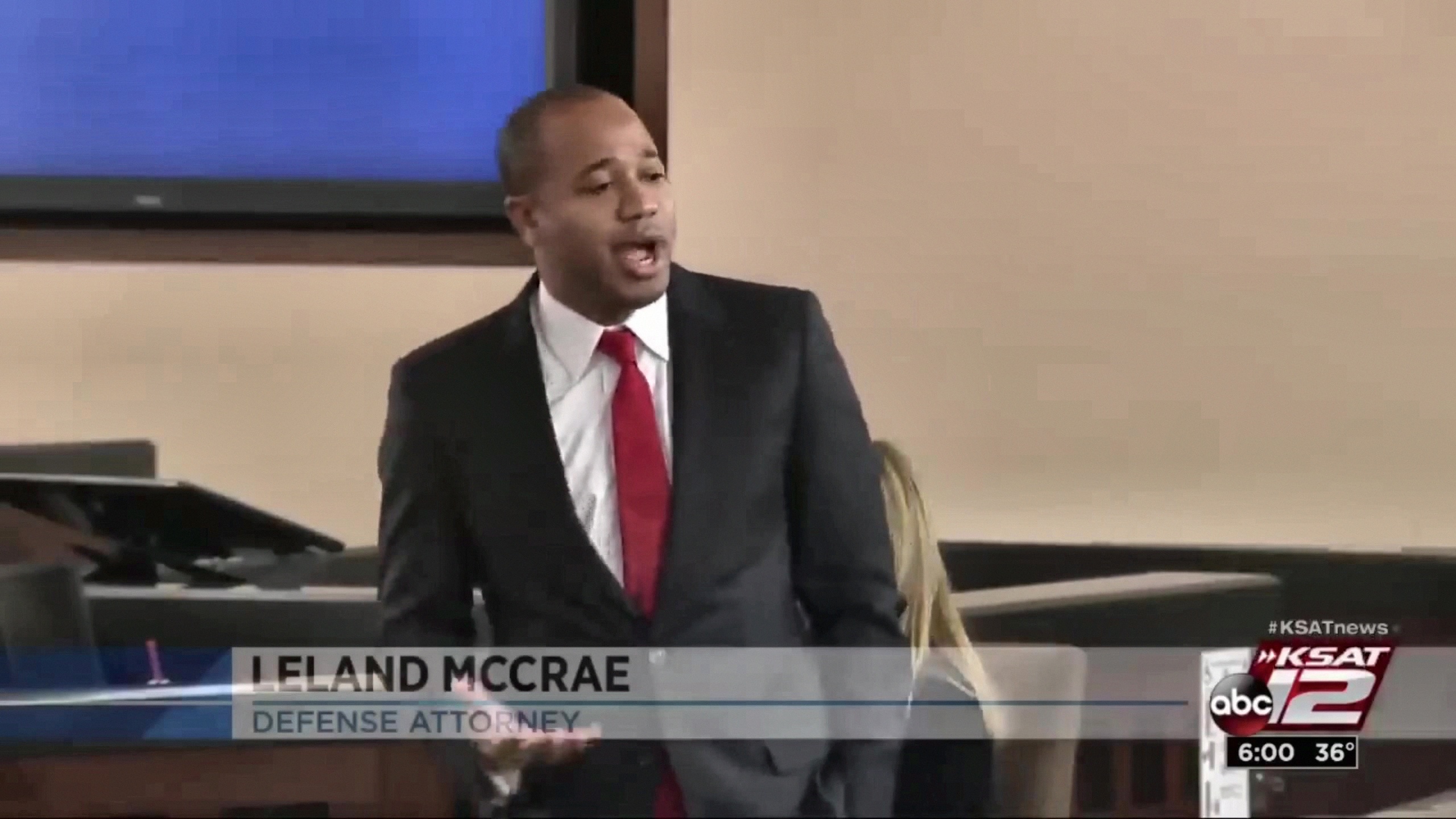
The second evidentiary frame isolates defense attorney D. McRae mid-argument, mouth open, in a dark suit and red tie, identified by the broadcast lower-third. He faces the bench and the jury box, gesturing as he speaks, and his posture signals the pivot of his defense. The camera angle remains fixed, but the framing tightens the narrative: the state's key witness, not the altercation itself, is on trial in this segment.
The third frame catches McRae from behind and in profile as he turns away from the lectern, hands active, continuing his cross-examination argument. The county seal is visible above the bench along with the flags, and the jury is out of frame, consistent with a bench argument over admissible testimony. His physical conduct here is the deliberate pacing and turning of an attorney trying to displace a witness's credibility.
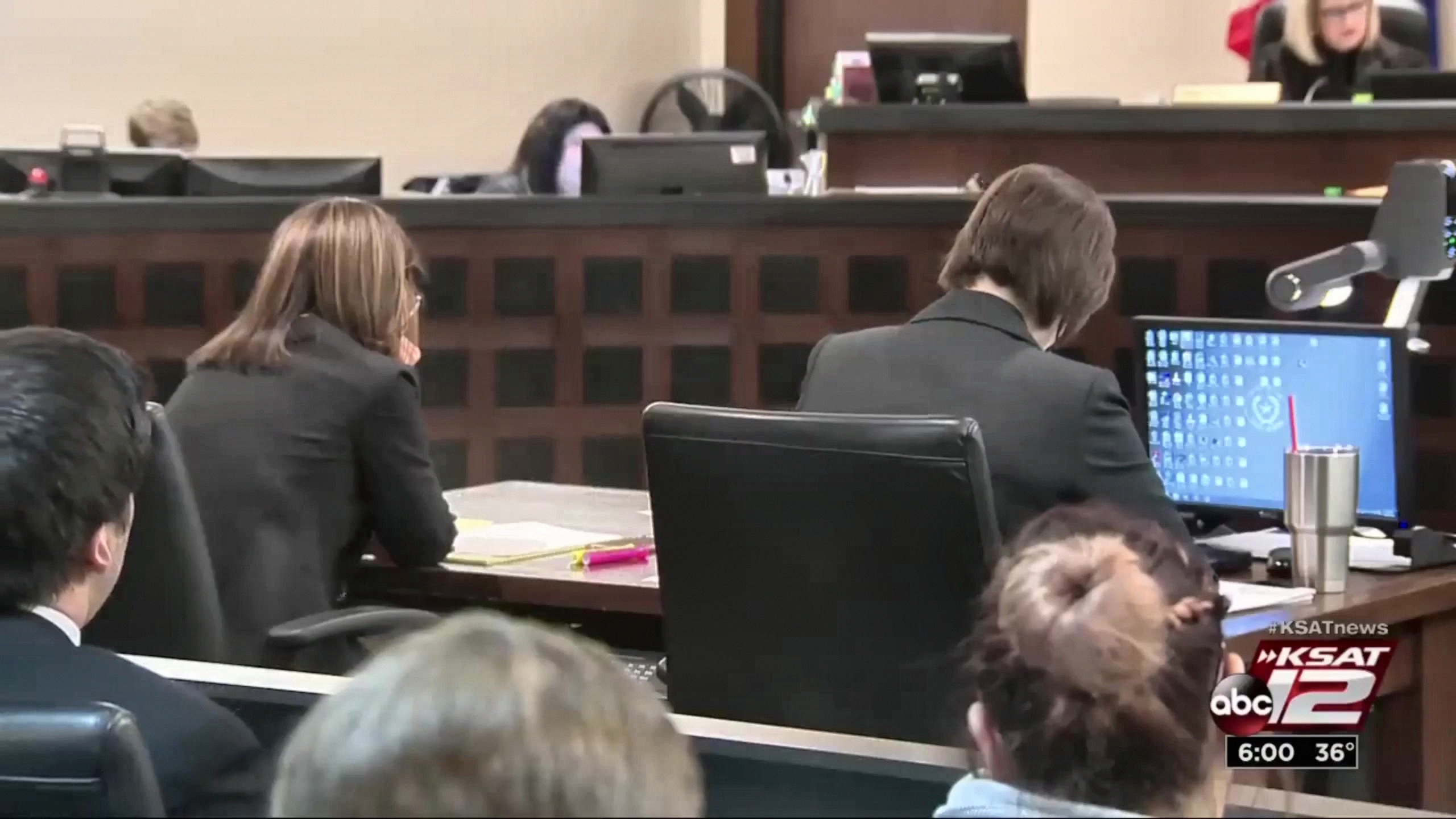
A later frame centers the defendant, Robert Martinez, seated in an orange detention uniform with a microphone before him in a manner consistent with testimony continuing at counsel table. His head is shaved, tattoos are visible at the neck and throat, and his gaze is level and unsmiling. Meanwhile, a separate frame catches the defense bench from the rear: a female attorney at left, the female defense counsel at right with a glowing monitor before her, and a packed gallery with the backs of spectators' heads in the foreground. That single frame is the most revealing in evidentiary terms, because it documents who was in the room when the state's case was being described.
Corporate Liability and Critical Blind Spots
The footage carries institutional blind spots that any fair reading must name. The recording captures argument, not testimony, so the jury's reaction, the judge's rulings, and any sustained objections fall outside the camera's frame and sound. The critical exchange occurs off-mic, and the broadcast edit interrupts the sequence with station branding and a time-and-temperature graphic, meaning the audience never sees the complete uninterrupted proceeding.
The most significant evidentiary limitations concern the witnesses themselves. Larry Isaac's testimony, as characterized in the recorded audio, is the only direct evidence tying Martinez to the altercation, and it arrived in exchange for a reduction of prison time in a pending kidnapping case. Nothing in the footage establishes whether corroborating physical evidence, ballistics, or independent eyewitness accounts supported his account. The defense argument, as recorded, is precisely that no corroboration exists – a claim the state disputes as argument, not fact.
There is also an unaddressed chain-of-custody and site-documentation gap. No frame shows the drainage ditch, the scene photographs, or the forensic reconstruction. Without those, any viral assertion about what happened at Hell's Gate rests on assertion rather than record, and the footage cannot verify forensic claims made off camera.
Statutory Framework and Protocol Analysis
Legal Distinction: A capital fatal incident prosecution under Texas law rests on intentional, knowing conduct plus an aggravating element; the credibility of a testifying accomplice or relative is not an aggravating element, but it must be weighed by the jury under the court's charge. A negotiated reduction in a pending case does not immunize the witness, but it does create a disclosure obligation that the defense may exploit, and the trial court retains discretion over whether the testimony is admissible at all.
The compliance analysis begins with prosecutorial duty of candor. Under Texas disciplinary rules and Brady-style disclosure obligations, a prosecutor must tell the defense about any understanding with a witness, including expected sentence reductions, and the defense is entitled to argue bias. The footage shows the defense doing exactly that, and the state answering with the extraordinary request for a life sentence – a request that appears calibrated to signal that the state trusted its own witness.
The institutional duty of care also runs toward the public and the victim's family. The recorded argument describes not a reckless act but a retaliatory fatal outcome in a drainage ditch in the dark, and the state's accountability framing matters to sentencing outcomes. Judicial protocol governs the standard jury charge and the trial court's role in vetting hearsay exceptions for the uncle's testimony – an admission against interest by the defendant, if accepted, is admissible, but the court must instruct the jury on his credibility.
Scroll down for the full investigative report below ↓
| Incident Parameter | Governing Legal Standard & Judicial Protocol |
|---|---|
| Charged offense | Capital fatal incident under Texas Penal Code, intentionally causing death plus aggravating element |
| Alleged motive | Retaliation for a prior fatal incident; intent, not recklessness, per the state |
| Key witness status | Testifying relative with a pending kidnapping charge and an expected sentence reduction |
| Prosecutorial duty | Full disclosure of any witness benefit under Brady and state ethics rules |
| Defense posture | Attack on witness bias and absence of corroborating physical evidence |
| Sentencing request | State requested life imprisonment; jury charge must define the range and parole consequence |
| Public safety protocol | Community notification and victim-family consultation at sentencing phase |
Read more:
Read more: Federal Arrest Blocked: Crowd Interference Liability Review →
Core Questions and Institutional Review
- Was the plea-benefit testimony of Larry Isaac sufficiently corroborated by independent evidence, or did the prosecution rest entirely on an incentivized account?
- Did the state's office document, disclose, and preserve all terms of the Isaac agreement in compliance with Brady and applicable Texas discovery rules?
- What portion of the three-year pretrial delay reflects investigative gaps, and what does that delay say about case-file review and follow-up protocols?
- How should the trial court instruct a jury on credibility when the sole direct witness has a pending charge and a negotiated benefit?
The systemic impact of a case like this is not confined to one defendant. When a capital prosecution's decisive testimony is purchased through a reduction in an unrelated pending case, the public institution litigates not just a fatal incident but its own reliability. The recorded footage shows a courtroom functioning exactly as designed, adversarial argument over credibility in the open.
Practical takeaways: Capital or first-degree prosecutions resting on a single incentivized witness demand corroborative evidence and documented disclosure; defendants are entitled to cross-examine the full scope of any deal, including benefits still pending; and courts must charge juries on witness credibility whenever a plea bargain shapes testimony.
LATEST DEVELOPING INCIDENT
An even more shocking incident just erupted hours ago that has stunned onlookers nationwide. Full investigative breakdown and on-scene evidence documented below.
BREAKING: READ NEXT SHOCKING INCIDENT – LATEST CASE ↓
Federal Arrest Blocked: Crowd Interference Liability Review
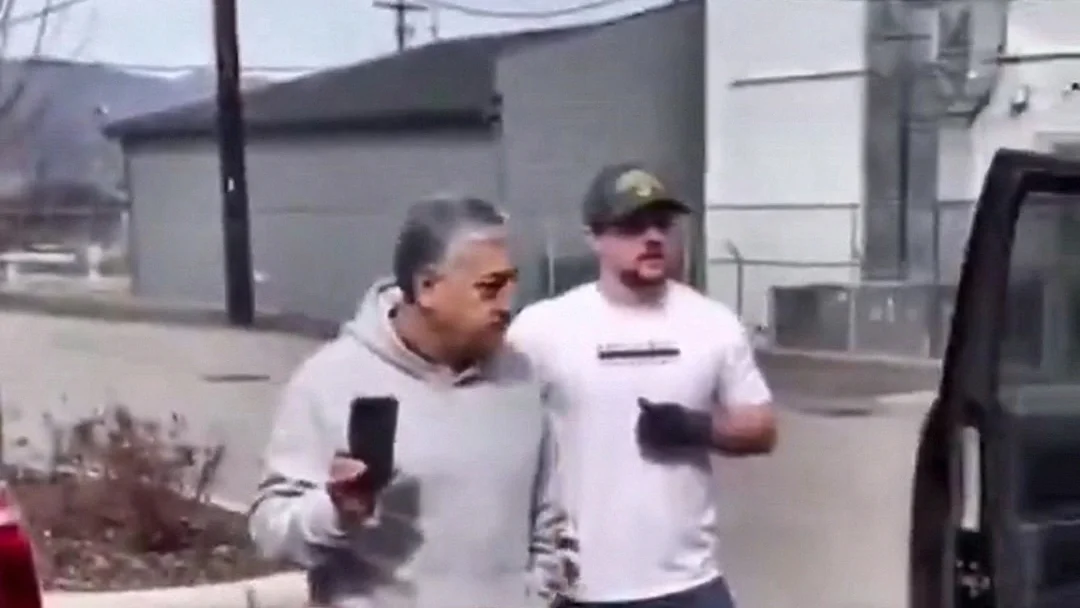
WASHINGTON – A chaotic scene captured on bystander video shows federal immigration officers attempting to execute an arrest while a crowd of onlookers physically obstructs their vehicle and demands proof of legal authority. The incident raises immediate questions about the legal boundaries of civilian intervention, the operational protocols of federal law enforcement, and the potential criminal exposure of those who block or open the doors of a government vehicle during an active arrest operation.
- The recorded event unfolds in a paved commercial lot outside a building marked with a "Lighthouse Christian Ministries" sign, with a black SUV positioned as the central vehicle of interest.
- A inspection officer attempts to enter the driver's seat of the SUV while a group of bystanders surrounds the vehicle, with at least one woman positioning herself against the open door and a rear door opening in an apparent attempt to access the interior.
- Verbal exchanges escalate rapidly, with bystanders demanding warrants and proof, the officer warning that obstructing conduct can lead to arrest, and a woman shouting "That's violence, you agitator!" as the officer physically maneuvers the crowd away.
- The camera captures the officer ultimately departing in the vehicle while the group remains on foot, leaving unresolved questions about whether any bystander was detained or cited for interference.
What the Recorded Footage Captures: Chronological Breakdown
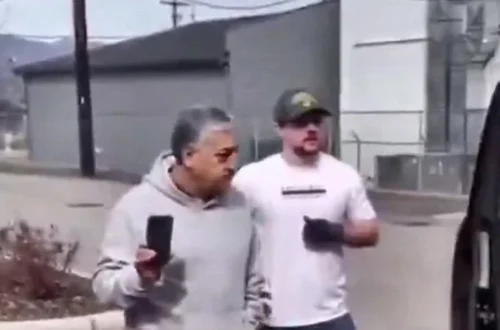
The footage opens with a close, almost claustrophobic view of the black SUV's rear quarter panel and passenger-side doors, camera steady at roughly waist height as the person filming moves alongside the vehicle. A woman's voice, off-camera and slightly ahead of the lens, initiates the confrontation: "Why are you arresting him? Why are you arresting him?" The camera swings to reveal a man in a white t-shirt and a dark cap standing near the front passenger side, holding a phone up as if recording, while a man in a gray hoodie stands closer to the center of the frame with his own phone raised. The officer, visible in tactical-style gear and a dark cap, can be seen moving between the vehicle and the crowd, attempting to establish a perimeter around the driver's door.
The second phase of the recording captures the friction point. A woman in a dark jacket and blue jeans steps in front of the open driver's-side door, her body angled to prevent the officer from closing it and entering. Voices overlap: "Show me proof. Show me proof. Where's the proof?" The officer responds, "Do you want to get arrested too?" A man in the background challenges the officer's tone, asking, "Why are you threatening her like that, man?" At this point, a rear passenger door swings open, and a hand reaches into the vehicle's interior. The officer pivots, physically pushes the crowd back with an outstretched arm, and the woman's voice rises sharply: "No, no, no. What are you doing? That's violence." The camera shakes as the person filming is jostled, and the frame briefly captures the officer's body between the open door and the woman.
The third phase shows the officer finally gaining enough space to enter the driver's seat. The woman can be heard shouting, "That's violence, you agitator!" as the officer closes the door. Through the windshield, the officer's silhouette is visible as the SUV begins to move slowly forward. The camera tracks the vehicle as it rolls past a dark sedan parked in the background, and the crowd's voices recede into a mixture of protest and questions, including a comment about a "picture of my husband" that suggests a personal connection to the arrestee. The footage concludes with the SUV pulling away and the group standing in the lot, the confrontation unresolved on camera.
Corporate Liability and Critical Blind Spots
The most significant evidentiary gap in this recording is what occurred before the camera started rolling. The arrestee is never clearly visible in the frames provided, and the underlying legal basis for the arrest is not captured. The crowd's repeated demand for "proof" and a "warrant" reflects a fundamental misunderstanding of federal immigration enforcement, which does not require a judicial warrant for administrative arrests in many contexts, though the specific statutory authority governing this operation remains unverified from the footage alone.
A second blind spot concerns the chain of custody and the provenance of the video itself. The footage carries a "FreshNews" watermark, indicating it was distributed through a content aggregation channel rather than a verified original source. The identity of the person filming, their relationship to the arrestee, and whether any editing occurred before distribution cannot be established from the available record. Viral assertions that the crowd successfully "freed" the arrestee are not supported by the footage, which shows the SUV departing with the officer inside.
A third limitation involves the lack of audio clarity during the physical confrontation. The overlapping shouts, the jostling of the camera, and the absence of a fixed vantage point make it impossible to determine whether the officer's physical contact with the woman constituted a push, a defensive redirection, or an accidental collision. The woman's characterization of the contact as "violence" is an assertion by an interested party, not an evidentiary finding. Similarly, the claim that bystanders opened the rear door to "rescue" the arrestee is an inference drawn from the visual of an opening door and a reaching hand, not a confirmed sequence of events.
Statutory Framework and Protocol Analysis
Legal Distinction: Federal law enforcement officers operating in the field are generally authorized to make warrantless administrative arrests for civil immigration violations under 8 U.S.C. § 1357, and civilians who knowingly obstruct, resist, or interfere with that process may face criminal exposure under 18 U.S.C. § 111 for assaulting, resisting, or impeding inspection officers. The line between protected First Amendment observation and criminal interference typically turns on physical conduct rather than verbal challenge.
From a compliance standpoint, inspection officers are trained to de-escalate crowd interference while maintaining custody of the arrestee. The officer's warning that a bystander "could be arrested too" is consistent with standard protocol language designed to establish clear boundaries before physical intervention becomes necessary. However, the recording does not show whether the officer identified himself, stated the legal basis for the arrest, or requested local law enforcement backup, all of which are relevant to any subsequent administrative review of the operation.
| Incident Parameter | Governing Legal Standard & Judicial Protocol |
|---|---|
| Warrantless administrative arrest | 8 U.S.C. § 1357 authorizes federal immigration officers to arrest without warrant in specified circumstances; judicial warrants are not universally required. |
| Civilian obstruction of officer | 18 U.S.C. § 111 criminalizes assaulting, resisting, or impeding inspection officers engaged in official duties; penalties escalate with physical contact. |
| Opening a government vehicle door | Potential interference with government property and obstruction of an active operation; local charges may include tampering or hindering prosecution. |
| Physical contact during crowd control | Officer conduct reviewed under objective reasonableness standard (Graham v. Connor); defensive redirection may be justified in a volatile crowd setting. |
| Bystander recording of field investigators | First Amendment protections generally apply to observation and recording from a safe distance; protections diminish with physical proximity and interference. |
| Claims of "violence" by bystanders | Assertions made during confrontation are not evidentiary findings; any excessive-force claim would require independent review and corroborating evidence. |
Core Questions and Institutional Review
- Did the officer's field conduct comply with federal de-escalation and crowd-control protocols, and will the agency conduct an internal review of the physical contact with the woman?
- Will any bystander be referred for prosecution under 18 U.S.C. § 111, and what evidentiary threshold would apply given the chaotic, multi-source nature of the recording?
- What operational vulnerabilities does this incident reveal about single-officer field operations in areas with dense civilian presence and active social media documentation?
- How should federal agencies communicate the legal basis for administrative arrests to reduce the friction that escalates into physical confrontation?
The broader systemic implication is one of mounting friction between federal enforcement operations and local populations enabled by real-time recording and rapid social media distribution. Regardless of the legal merits of the underlying arrest, the visual of an officer physically pushing through a crowd while a woman shouts "that's violence" will circulate far faster than any subsequent administrative finding. For federal agencies, the lesson is operational: field protocols designed for quiet residential arrests must adapt to the reality of instantaneous public scrutiny, where every physical movement is captured, framed, and judged in the court of public opinion long before any court of law convenes.