






WATCH: On-scene video documentation is embedded below →
LISTEN TO THIS ARTICLE
Audio Narration • English (US)
NEW YORK – A woman accused of using a stolen identity to drive two luxury vehicles off a New York dealership lot returned to the scene of the alleged crime, where police were waiting to confront her. The recorded encounter, captured on August 11, 2025, transforms a routine commercial fraud investigation into an immediate serious legal charge arrest, raising pointed questions about dealership verification protocols, lender exposure, and the evidentiary value of body-worn camera footage in financial crimes.

- The setting is a New York franchised auto dealership, where two vehicles – a Cadillac and a Ford truck – were purchased and released to buyers presenting a stolen identity.
- According to the recorded narrative, the transaction cleared initial lender checks before the actual identity holder reported fraud alerts to her bank, triggering a belated freeze on the deal.
- The suspect allegedly returned to the dealership to sign one remaining piece of paperwork, entering the lobby where police had staged a response.
- Officers confronted the woman at a coffee station, initiating a serious legal charge-level detention while she repeatedly denied awareness that the identification used was false.
What the Recorded Footage Captures: Chronological Breakdown
The footage opens with a body-worn camera perspective, timestamped August 11, 2025, at approximately 12:27 p.m., with the frame dominated by a close, downward angle on a wrist and forearm as the camera operator moves through the dealership interior. The camerawork is handheld and partially obstructed, characteristic of an AXON device mounted on an officer moving in a confined commercial space. The initial visual record establishes only the arrival and movement of law enforcement, not the underlying transaction that preceded it.
The chronology then advances to the lobby area, where a woman later identified in the recorded audio as the suspect is observed standing at a coffee station, actively preparing a beverage. The camera captures her from a distance before closing in, and the audio records an officer asking whether she had brought a vehicle in that day. She answers no. The officer repeats the question, and she again answers in the negative. The officer then asks what she is doing in the building, and she replies that she is making coffee. This exchange is the pivot of the recorded encounter: a mundane domestic action performed in a space that law enforcement had already framed as a fraud scene.
The camera then cuts to a wider, slightly blurred interior shot in which a man in a white shirt and tie – apparently a dealership employee or manager – is visible behind a desk area, with a computer monitor in the foreground. The visible caption at this point references missing paperwork, reinforcing the stated premise that the suspect returned to complete an unfinished document. The footage does not show the document itself, nor does it capture the signature being fatally harmed.
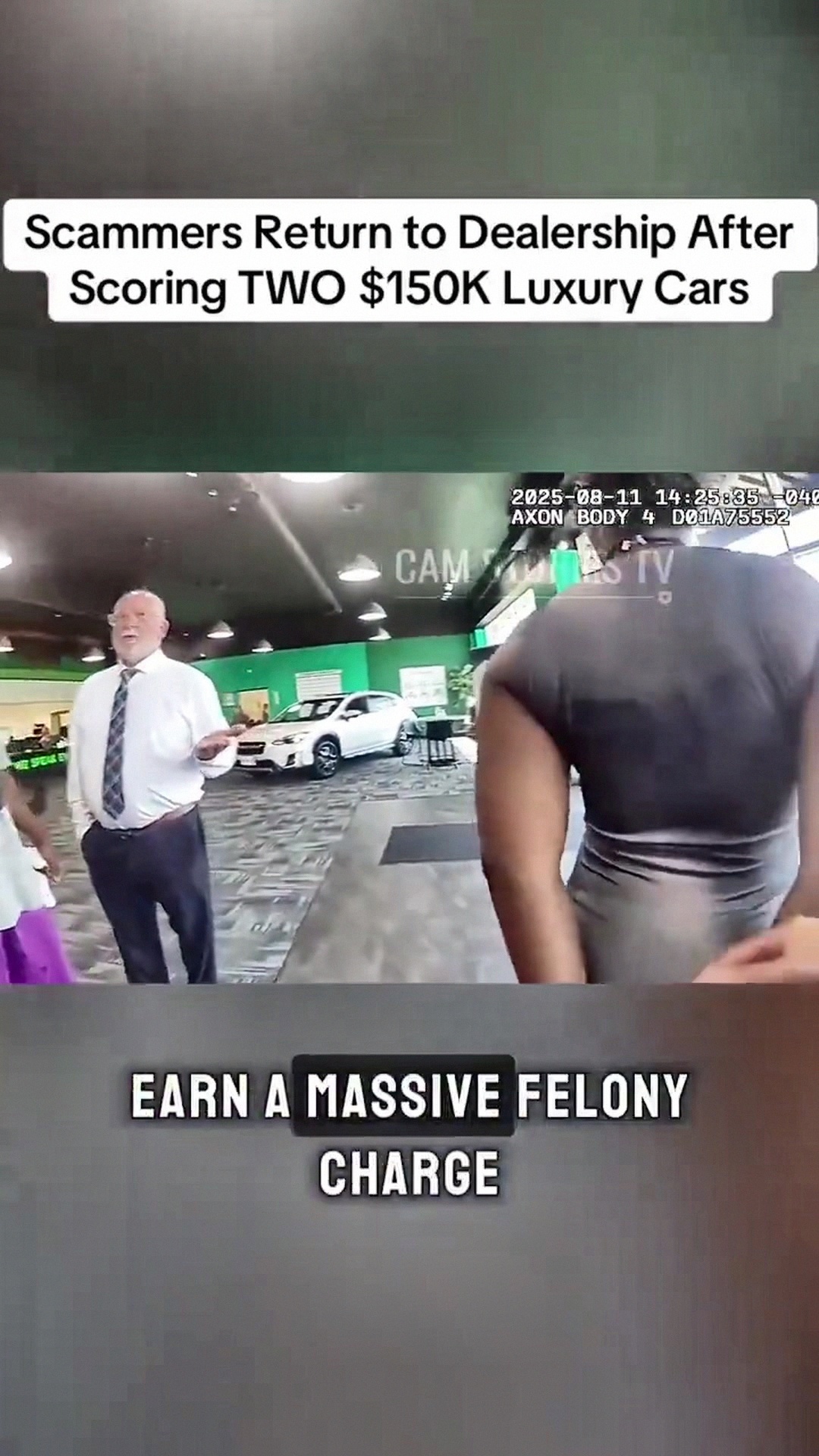
The final segment moves to a wider lobby angle showing the suspect from behind, wearing a dark short-sleeved top, facing the dealership representative. The audio records the officer stating that the two vehicles – the Ford and the Cadillac – were provided with a false ID, and asking whether she was aware of that. She responds that she was not. The officer then instructs her to stop making coffee and come speak with him. The camera captures the transition from casual lobby activity to formal detention, but the physical restraint itself is not clearly framed in the available footage.
Corporate Liability and Critical Blind Spots
The record presented to viewers is significantly narrower than the narrative asserted in the accompanying audio. The recorded footage covers only the arrival, the lobby conversation, and the initial confrontation; it does not capture the original vehicle sales, the document review process, the lender approval, or the moment the keys were handed over. Any conclusion about how the fraud succeeded rests on the spoken summary of events rather than on documented visual evidence in the clip.
Chain-of-custody issues also arise. The body-worn camera timestamp and device identifier are visible, which supports authentication of the recording, but the footage is edited into segments with captions overlaid by a third party. The captions – including the headline text about scammers returning after scoring two $150,000 luxury cars – are not part of the original evidentiary record and constitute commentary rather than footage. A defense attorney would likely challenge any inference drawn from the edited presentation.
A further blind spot concerns the alleged victim. The audio references a woman receiving fraud alerts and contacting the bank, but that individual does not appear on camera and her statement is not recorded here. The dealership's internal verification steps – whether a second form of identification was requested, whether the lender's identity-verification vendor flagged the application, and when the fraud alert reached the finance office – remain unrecorded. These omissions matter because dealership liability in identity fraud cases typically turns on whether reasonable verification procedures were followed, not on the suspect's later conduct.
Statutory Framework and Protocol Analysis
Legal Distinction: The conduct described implicates identity theft and grand larceny statutes rather than mere contractual default. Obtaining goods by false pretenses under a stolen identity generally constitutes a serious legal charge when the value exceeds statutory thresholds, and the return to the dealership to complete paperwork does not cure the earlier taking – it may instead supply evidence of intent and continuity of the scheme.
Dealerships operate under a layered compliance regime: state motor vehicle department identity-verification rules, lender-mandated fraud checks, and federal red-flag obligations for suspicious activity reporting. When a vehicle is released before a lender's fraud alert surfaces, the dealership typically absorbs the loss or enters a dispute with the financing entity, and the resulting exposure can exceed the sticker price once chargebacks, insurance, and reputational costs are counted.
The institutional duty of care also extends to workplace safety. The recorded decision to have police staged in the lobby reflects a controlled-response protocol rather than an open confrontation, which is the recommended practice for commercial premises anticipating a fraud suspect's return. The officer's measured instruction to stop the coffee preparation and step aside is consistent with a low-escalation detention posture, though the footage does not show whether the suspect was formally placed under arrest at that moment.
Scroll down for the full investigative report below ↓
| Incident Parameter | Governing Legal Standard & Judicial Protocol |
|---|---|
| Vehicle acquisition by false pretenses | State grand larceny and fraud statutes; serious legal charge threshold based on aggregate value |
| Use of another person's identity | Identity theft statutes; aggravated classification where financial harm results |
| Dealership identity verification | State DMV and lender-mandated customer identification procedures |
| Suspicious activity escalation | Federal red-flag and suspicious activity reporting obligations for financial intermediaries |
| Premises confrontation protocol | Workplace safety standards favoring pre-planned law enforcement response |
| Body-worn camera evidentiary use | Authentication requirements; chain-of-custody documentation for edited footage |
| Lender fraud alert timing | Chargeback and indemnification provisions in dealer financing agreements |
Read more:
Read more: Highway Extortion Attempt: Group Blocks Off-Duty Cop →
Core Questions and Institutional Review
- Did the dealership complete a second-form identity verification before releasing two vehicles valued at approximately $150,000 each, and if not, what internal policy permitted the release?
- At what point did the lender's fraud-alert system notify the finance office, and was the timing consistent with the institution's own red-flag escalation standards?
- What is the legal status of the suspect's return visit – was it a voluntary completion of paperwork, and does that voluntary presence affect the admissibility of the lobby statements?
- Will the edited, captioned footage be used in any charging decision, and how will prosecutors handle the gap between the recorded confrontation and the unrecorded original transaction?
The systemic impact of this case extends beyond a single arrest. Dealerships increasingly rely on digital identity verification, yet the window between approval and fraud-alert reconciliation remains a structural vulnerability. The suspect's decision to return to the scene converts an abstract financial crime into a recorded confrontation, giving investigators direct evidence of the individual's presence and statements, but it also highlights how much of the underlying transaction escapes the camera. For lenders and franchised dealers, the episode is a reminder that verification is not a one-time gate but a continuing obligation, and that the most consequential evidence in a fraud case is often the paperwork that never appears on screen.
LATEST DEVELOPING INCIDENT
An even more shocking incident just erupted hours ago that has stunned onlookers nationwide. Full investigative breakdown and on-scene evidence documented below.
BREAKING: READ NEXT SHOCKING INCIDENT – LATEST CASE ↓
San Antonio Confrontation’s Gate Fatal incident Retrial Hinges on Uncle’s Testimony
SAN ANTONIO, Texas – The courtroom proceedings now circulating in broadcast footage concern the capital fatal incident prosecution of Robert Martinez, accused of executing 21-year-old Steven Cerna in a drainage ditch on the edge of San Antonio before sunrise on February 20, 2015. The case turned less on physical evidence than on the credibility of a single witness whose testimony arrived with a negotiated discount. The recorded record raises durable questions about how plea-bargained testimony is priced, corroborated, and weighed by Texas juries.
- The jurisdictional setting is a Bexar County serious legal charge courtroom, with 226th District Court-level proceedings, state prosecutors, and a defense team led by D. McRae.
- The recorded escalation is verbal and forensic rather than physical: defense counsel strikes at the state's evidentiary foundation while the defendant, in an orange detention uniform, sits at the defense table.
- The prosecutorial theory, delivered as argument, characterizes the fatal altercations as an fatal outcome rather than a reckless altercation, allegedly retaliatory.
- The legal and regulatory repercussion centers on the testimony of Larry Isaac, the defendant's uncle, who testified for the state while a kidnapping case against him was pending.
What the Recorded Footage Captures: Chronological Breakdown
A wide, fixed courtroom camera establishes the room before any argument begins: raised judge's bench beneath a state seal and the Texas and United States flags, a large blank blue display screen on the rear wall, and the dark wood paneling of a Bexar County court. A court reporter's monitor glows at the right of the frame, a water bottle and a cup sit beside stacks of paper, and a defense table occupies the foreground. The composition is institutional and unmoving, a portrait of procedure rather than drama.
The second evidentiary frame isolates defense attorney D. McRae mid-argument, mouth open, in a dark suit and red tie, identified by the broadcast lower-third. He faces the bench and the jury box, gesturing as he speaks, and his posture signals the pivot of his defense. The camera angle remains fixed, but the framing tightens the narrative: the state's key witness, not the altercation itself, is on trial in this segment.
The third frame catches McRae from behind and in profile as he turns away from the lectern, hands active, continuing his cross-examination argument. The county seal is visible above the bench along with the flags, and the jury is out of frame, consistent with a bench argument over admissible testimony. His physical conduct here is the deliberate pacing and turning of an attorney trying to displace a witness's credibility.
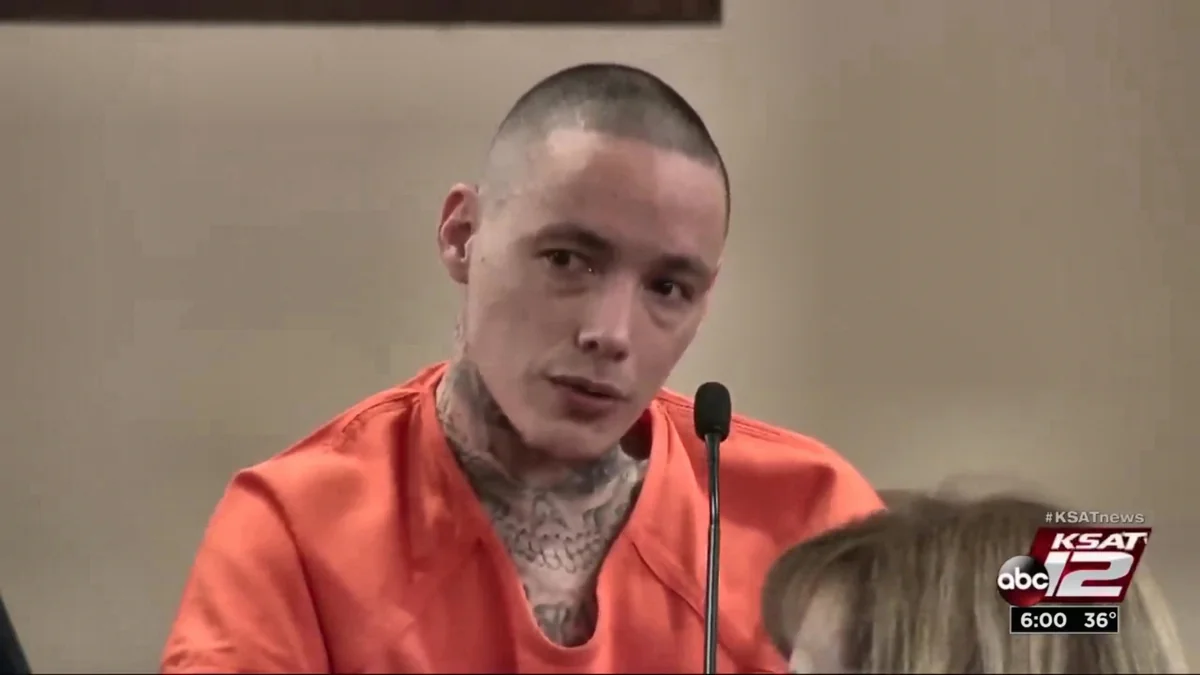
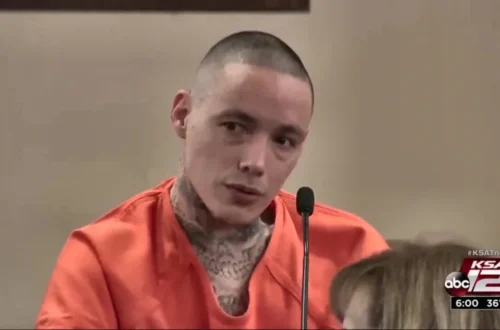
A later frame centers the defendant, Robert Martinez, seated in an orange detention uniform with a microphone before him in a manner consistent with testimony continuing at counsel table. His head is shaved, tattoos are visible at the neck and throat, and his gaze is level and unsmiling. Meanwhile, a separate frame catches the defense bench from the rear: a female attorney at left, the female defense counsel at right with a glowing monitor before her, and a packed gallery with the backs of spectators' heads in the foreground. That single frame is the most revealing in evidentiary terms, because it documents who was in the room when the state's case was being described.
Corporate Liability and Critical Blind Spots
The footage carries institutional blind spots that any fair reading must name. The recording captures argument, not testimony, so the jury's reaction, the judge's rulings, and any sustained objections fall outside the camera's frame and sound. The critical exchange occurs off-mic, and the broadcast edit interrupts the sequence with station branding and a time-and-temperature graphic, meaning the audience never sees the complete uninterrupted proceeding.
The most significant evidentiary limitations concern the witnesses themselves. Larry Isaac's testimony, as characterized in the recorded audio, is the only direct evidence tying Martinez to the altercation, and it arrived in exchange for a reduction of prison time in a pending kidnapping case. Nothing in the footage establishes whether corroborating physical evidence, ballistics, or independent eyewitness accounts supported his account. The defense argument, as recorded, is precisely that no corroboration exists – a claim the state disputes as argument, not fact.
There is also an unaddressed chain-of-custody and site-documentation gap. No frame shows the drainage ditch, the scene photographs, or the forensic reconstruction. Without those, any viral assertion about what happened at Hell's Gate rests on assertion rather than record, and the footage cannot verify forensic claims made off camera.
Statutory Framework and Protocol Analysis
Legal Distinction: A capital fatal incident prosecution under Texas law rests on intentional, knowing conduct plus an aggravating element; the credibility of a testifying accomplice or relative is not an aggravating element, but it must be weighed by the jury under the court's charge. A negotiated reduction in a pending case does not immunize the witness, but it does create a disclosure obligation that the defense may exploit, and the trial court retains discretion over whether the testimony is admissible at all.
The compliance analysis begins with prosecutorial duty of candor. Under Texas disciplinary rules and Brady-style disclosure obligations, a prosecutor must tell the defense about any understanding with a witness, including expected sentence reductions, and the defense is entitled to argue bias. The footage shows the defense doing exactly that, and the state answering with the extraordinary request for a life sentence – a request that appears calibrated to signal that the state trusted its own witness.
The institutional duty of care also runs toward the public and the victim's family. The recorded argument describes not a reckless act but a retaliatory fatal outcome in a drainage ditch in the dark, and the state's accountability framing matters to sentencing outcomes. Judicial protocol governs the standard jury charge and the trial court's role in vetting hearsay exceptions for the uncle's testimony – an admission against interest by the defendant, if accepted, is admissible, but the court must instruct the jury on his credibility.
| Incident Parameter | Governing Legal Standard & Judicial Protocol |
|---|---|
| Charged offense | Capital fatal incident under Texas Penal Code, intentionally causing death plus aggravating element |
| Alleged motive | Retaliation for a prior fatal incident; intent, not recklessness, per the state |
| Key witness status | Testifying relative with a pending kidnapping charge and an expected sentence reduction |
| Prosecutorial duty | Full disclosure of any witness benefit under Brady and state ethics rules |
| Defense posture | Attack on witness bias and absence of corroborating physical evidence |
| Sentencing request | State requested life imprisonment; jury charge must define the range and parole consequence |
| Public safety protocol | Community notification and victim-family consultation at sentencing phase |
Core Questions and Institutional Review
- Was the plea-benefit testimony of Larry Isaac sufficiently corroborated by independent evidence, or did the prosecution rest entirely on an incentivized account?
- Did the state's office document, disclose, and preserve all terms of the Isaac agreement in compliance with Brady and applicable Texas discovery rules?
- What portion of the three-year pretrial delay reflects investigative gaps, and what does that delay say about case-file review and follow-up protocols?
- How should the trial court instruct a jury on credibility when the sole direct witness has a pending charge and a negotiated benefit?
The systemic impact of a case like this is not confined to one defendant. When a capital prosecution's decisive testimony is purchased through a reduction in an unrelated pending case, the public institution litigates not just a fatal incident but its own reliability. The recorded footage shows a courtroom functioning exactly as designed, adversarial argument over credibility in the open.
Practical takeaways: Capital or first-degree prosecutions resting on a single incentivized witness demand corroborative evidence and documented disclosure; defendants are entitled to cross-examine the full scope of any deal, including benefits still pending; and courts must charge juries on witness credibility whenever a plea bargain shapes testimony.



One comment on “New York Dealership Fraud Suspect Returns to Scene, Arrested”