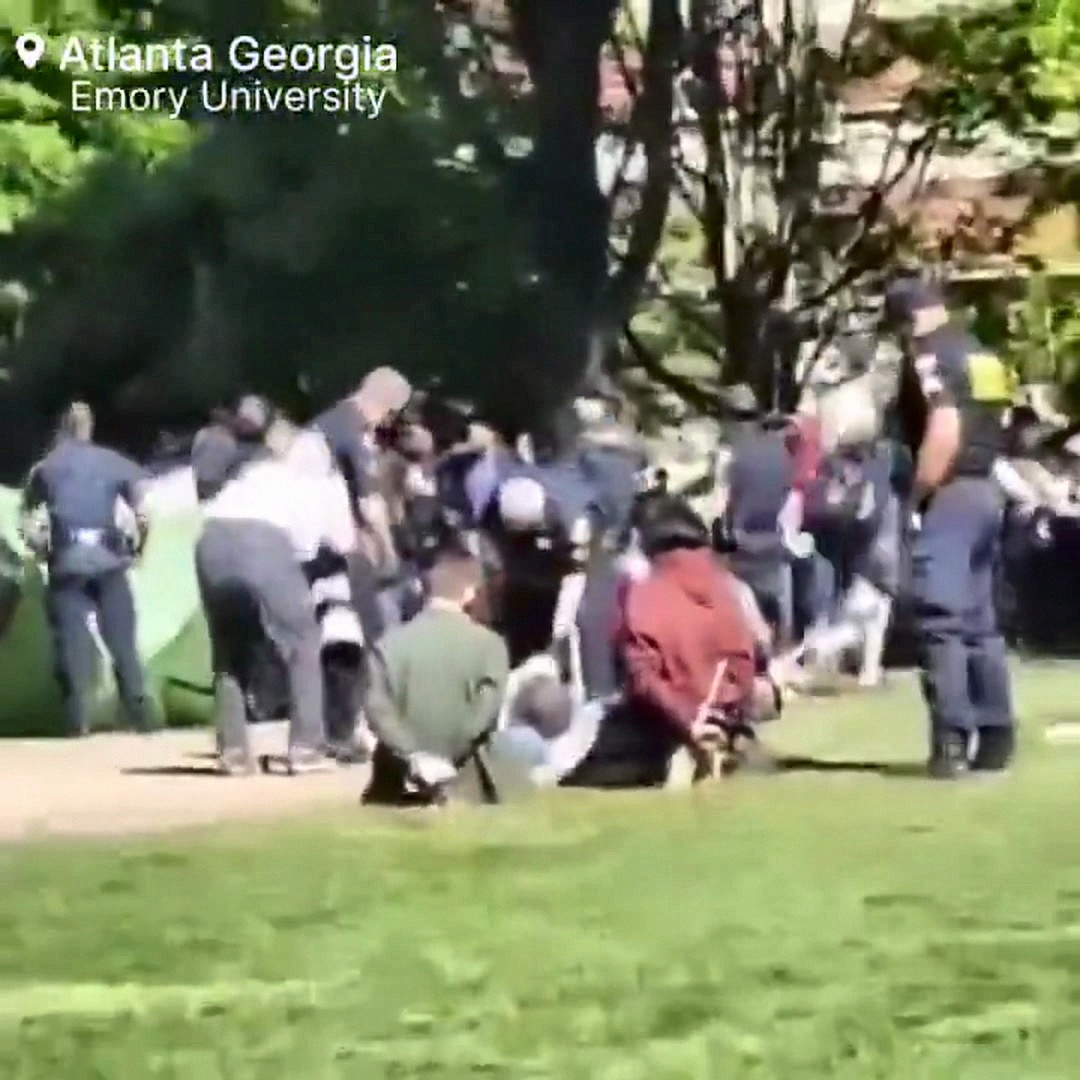
What began as a quiet morning gathering of students on a tree-lined college quad ended with officers in riot gear, detainees kneeling in the grass, and a transport van parked beneath the oaks. The footage captures the exact moment a familiar campus scene fractures into something no one present will easily forget.
The confrontation now sits at the center of a widening inquiry into how local departments were called onto university grounds and whether the force used matched what the moment required.
- The setting: A grassy quad on the campus of a major Atlanta university, ringed by mature trees, dappled sunlight, and students moving between afternoon classes.
- The friction: Hundreds of demonstrators gathered in an encampment and refused a dispersal order, drawing local and state officers onto the property.
- The intervention: Officers in tactical gear moved line-by-line through the crowd, deploying chemical irritants and restraint tools while making arrests, detaining seated protesters on the ground.
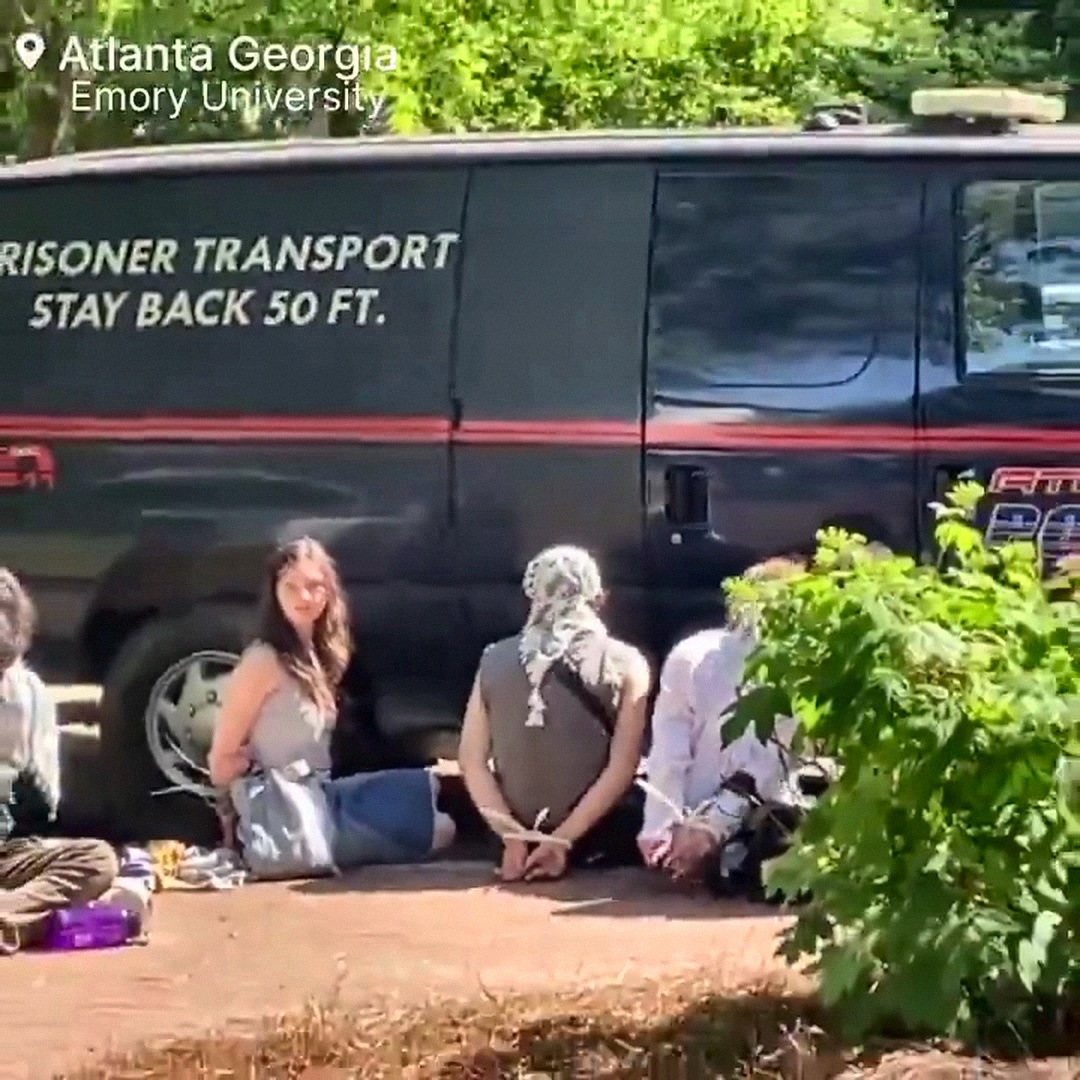
- The aftermath: Detainees were placed in zipties, seated along a curb and beside a marked prisoner transport van, as the crowd on the perimeter chanted for their release.
What the Recorded Footage Captures: Chronological Breakdown
In the opening frames, a woman stands alone near a line of masked officers. Her body is squared toward them, shoulders set, hands visible. One officer in a dark uniform steps forward and reaches for her arm while another moves behind her. The white overlay text identifies her as an esteemed, tenured professor and chair of a department, a detail that lands hard against the physical image of her being handled. Around the frame, people in winter coats and shorts crowd in, phones raised.
The camera cuts away and then back. Officers cluster in a loose ring, and on the ground beneath them sit people with their hands tucked behind their backs. A photographer in a red jacket sits cross-legged on the grass; a large green tent billows behind the group. Somewhere off frame a voice cuts through: "Let them go! Let them go! Let them go!" The chant repeats, steady and rhythmic, layering over the sounds of scuffling and moving bodies.
The tension crests in the final stretch. Near a curb, three people sit in a row with their backs against a black van marked PRISONER TRANSPORT STAY BACK 50 FT. One woman looks directly toward the lens, her expression unreadable, hair tucked behind her shoulders. A woman in a hijab sits beside her, and another woman in a white top. The camera pans to a group of students in casual clothes moving in a loose cluster across the path, smiling or stunned, some still glancing back. A voice overhead says, mockingly, "You almost get real proud of yourselves, huh?" Then, sharp and urgent: "Oh my God!"
Scroll down for the full investigative report below ↓
Critical Blind Spots: What the Lens Leaves Unresolved
The footage is cut from a phone held loosely, moving with the crowd, so the frame constantly loses the people it is trying to protect. The moment officers first arrived is not recorded here. Neither is the exact dispersal order or the language used to deliver it. The camera shows the aftermath of the decision to escalate, but it does not show the conversation that preceded it.
These gaps matter because the question of force on a college quad hinges almost entirely on sequence. Who moved first? Was there a clear line of retreat? Did officers identify themselves before deploying a chemical agent? The clip offers a confrontation without a clock, a series of tableaus without a clear cause. Because the recordings that circulate are short, cropped, and often vertical, they tend to tell the moment of friction better than the moment of decision.
On the ground, the absence of a visible perimeter or a clearly marked command post raises its own question. The frame shows officers and civilian bodies in the same tight space, with nothing between them except a few feet of sun-dappled grass. In a crowd-control scenario, that proximity is the problem; the gap that should exist between demonstrators and officers has collapsed.
Whether that gap collapsed by design or by the physics of a moving crowd is one of the central questions the scene does not answer.
Statutory Framework and Protocol Analysis
Engaging a seated or prone subject on open ground introduces a distinct set of risks. Pennsylvania v. Mimms (1977) permits officers to order a person out of a vehicle during a lawful stop, but it does not create a general license to use whatever force is expedient. When a subject is already on the ground, the justification for force rests on the safety of the officers and the safety of bystanders; the technique must still track the Graham factors. In a crowd setting, the presence of onlookers also implicates the public's First Amendment right to observe and record police activity, which courts generally recognize as a form of protected expression.
| Incident Parameter | Observation at the Scene |
|---|---|
| Physical setting | Tree-lined campus quad, grass, dappled shade, visible passersby |
| Presence of law enforcement | Uniformed officers in tactical gear, including a marked transport van |
| Demonstrator posture | Seated and kneeling figures with hands restrained behind backs |
| Crowd behavior | Chanting "Let them go," phones raised, voices distressed |
| Equipment visible | Restraints, gas masks, prisoner transport vehicle |
| Recording method | Handheld vertical phone footage, continuous but untimed |
| Immediate aftermath | Detainees seated along a curb near the transport van |
Read more:
Read more: Midair Chaos: Passenger Tries Exit Door, Cabin Restrains Him →
Departments that respond to campus encampments typically operate under a layered command structure: campus police as the lead agency, with municipal or state units available for support. What the footage cannot establish is whether that structure was actually in effect, or whether officers from different agencies coordinated on scene. The visible presence of multiple uniform styles suggests more than one agency operated simultaneously, which raises the coordination question directly.
Standard crowd-control guidance calls for a single, identified incident commander, clear warnings amplified through a public-address system, and designated routes of exit for those who wish to comply. The camera offers no evidence those protocols were used or skipped.
Core Questions and Institutional Review
- Who authorized the entry of external law enforcement onto campus grounds, and what alternatives were documented before that call was made?
- What specific warnings were delivered before physical force was used, and were they audible and intelligible to the crowd?
- How were individuals identified for arrest versus those simply present, and was there a consistent standard applied to seated demonstrators?
- What review body is now examining the incident, and will its findings be made public in full?
The images that linger are the quiet ones: a woman seated against the side of a transport van, looking straight down the lens of the phone; a faculty member in a mask, flanked by officers; a crowd chanting the same three syllables until the clip runs out. The footage has traveled far beyond the quad, but the scene itself remains a closed loop, repeating without resolution.
What the record does not yet show is the part that matters most, and that absence is where the real inquiry begins. If you had been standing on that grass, holding a phone, with a decision to make in the space of a breath, what would you have done?
Practical takeaways: Understand your Fourth Amendment protections against unreasonable seizure and force. Know that courts apply an objective reasonableness standard to every police encounter. If you record a public encounter, document time, location, and context continuously. Request and preserve body-camera footage early through a public records request. Campus open-expression policies deserve scrutiny before any demonstration begins, not after.
FOLLOW-UP INVESTIGATION REPORT
Related documented case details, verified on-scene evidence, and statutory liability analysis continued below.
CONTINUE READING: NEXT INVESTIGATIVE DOSSIER →
Bronx Truck Driver Keeps Calm During Crosswalk Confrontation

The roar of the Bronx intersection fades into a tense quiet as a man in a crisp white shirt strides into the zebra crossing, his body language radiating fury. A heavy red commercial truck idles just feet away, its driver door swinging open as the towering vehicle becomes the anchor for a volatile confrontation. What begins as a routine afternoon commute spirals into a test of restraint, capturing a rare moment of composure under fire.
- The Setting: A busy residential intersection in the Bronx, New York, where a red commercial truck and a yellow taxi share the asphalt beneath a heavy overcast sky.
- The Friction: A man in a white button-down shirt and dark pants steps directly into the crosswalk, gesturing aggressively toward the truck cab and shouting at the driver.
- The Intervention: The truck driver emerges from his cab and climbs down, standing his ground while the agitated man continues his tirade, at one point spitting toward the driver.
- The Aftermath: Despite the physical provocation and escalating verbal abuse, the truck driver maintains his composure, and the encounter ends without a violent escalation.
What the Recorded Footage Captures: Chronological Breakdown
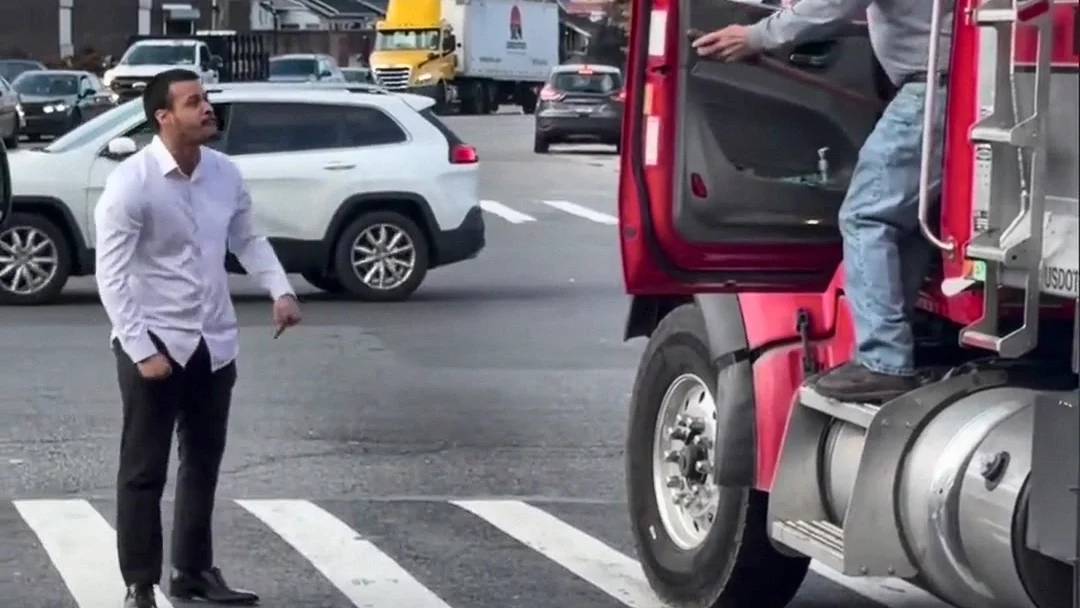
The first keyframe establishes the geographic and emotional geography of the scene. A yellow taxi with the medallion number AC231 sits in the foreground, its hood reflecting the gray daylight. Across the hood, the red truck dominates the right side of the frame, its door wide open. The man in the white shirt stands near the crosswalk markings, his stance wide and his arms slightly raised in a posture of confrontation. The driver, a man in a gray long-sleeve shirt and blue jeans, is visible at the threshold of the cab, one foot on the step, listening.
As the seconds tick by, the man in white moves closer to the truck, his gestures becoming more animated. He points toward the driver, then sweeps his arm outward as if to claim the entire road. The audio captures a chaotic refrain: "What the dispute is that? What the dispute is that? Don't touch me in there!" The driver, still partially inside the cab, does not retreat but does not advance. The camera shakes slightly, a reminder that this is being filmed by a bystander in a nearby vehicle, watching the drama unfold through a windshield.
The climax arrives when the man in white leans in close and appears to spit at the driver. The audio registers a voice saying, "Oh he's spit on you," followed by a flurry of expletives. Yet the driver remains on the running board of his truck, his body angled away from the aggression. He does not throw a punch or raise his voice to match the other man's volume. Instead, he waits, allowing the storm to pass. The footage cuts before any physical blows are exchanged, but the tension hangs in the air like the exhaust fumes of the idling truck.
Critical Blind Spots: What the Lens Leaves Unresolved
The camera lens is unforgiving, but it is not omniscient. One critical blind spot is the catalyst: what exactly happened before the camera started rolling? Did the truck block the crosswalk? Did the man in white misjudge the traffic signal? The footage begins in medias res, with the confrontation already in full swing, leaving the origin of the dispute entirely off-screen. The spatial relationship between the vehicles and the crosswalk suggests a possible right-of-way dispute, but without a wider view of the intersection signals, that remains speculation.
Another unresolved element is the identity and perspective of the person filming. The shot is framed through the interior of a yellow taxi, likely the vehicle in the foreground. The driver of that taxi is a silent observer, yet their commentary is absent from the transcribed audio, save for the ambient street noise. We do not know if they were blocked by the incident or merely witnessing it. Furthermore, the man in white's exact words are difficult to parse beyond the shouted profanity, leaving his precise grievance a matter of interpretation rather than record.
Finally, the conclusion of the encounter is abrupt. The video ends with the man in white still on the street, and the truck driver still standing by his vehicle. There is no shot of the police arriving, no resolution of the traffic snarl, and no visible aftermath of the spit or the shouting. The viewer is left to wonder whether the two men exchanged further words off-camera, or whether the truck driver eventually simply climbed back into his rig and drove away.
Statutory Framework and Protocol Analysis
Under standard police protocol, a driver in a commercial vehicle is required to yield to pedestrians in a crosswalk, but the presence of a pedestrian does not grant license for aggressive confrontation. The driver in this footage demonstrates what law enforcement trainers often call "verbal de-escalation through posture." By maintaining a non-threatening stance and not mirroring the aggressor's volume, he creates space, both physical and emotional, that prevents the situation from spiraling into a physical altercation. Fourth Amendment considerations of seizure do not apply here, as this is a private dispute, but the standard for a Terry stop would still require an officer to witness a specific, articulable fact of a crime – such as the spit – to initiate an investigation.
| Incident Parameter | Observation at the Scene |
|---|---|
| Primary Location | Bronx intersection, New York, with marked crosswalks |
| Key Individuals | Truck driver in gray shirt; agitated man in white button-down |
| Bystander Presence | Filmed from within a yellow cab, medallion AC231 |
| Physical Actions | Shouting, gesturing, and spitting toward the driver |
| Driver Response | Retreated to the cab step, maintained distance |
| Audio Evidence | Shouted profanities, "Don't touch me in there" |
| Traffic Impact | Vehicles idling in the background, visible brake lights |
When analyzing the civic framework of this incident, it is important to recognize the constitutional protections that govern everyday interactions. While the man in white engaged in aggressive speech, his verbal threats and profanity, while socially unacceptable, are largely protected under the First Amendment. However, the physical act of spitting crosses a line into potential harassment or menacing, which is not protected conduct. The truck driver's decision to remain calm and stand his ground, rather than retreating completely or escalating, aligns with self-defense and de-escalation principles taught in defensive driving courses.
Community expectations in the Bronx, and New York City at large, often hinge on the concept of "street justice," but the driver's restraint subverts that expectation. By not engaging physically, he avoids the risk of mutual combat charges and ensures that any police report would reflect him as the victim of an unprovoked physical slight. This kind of restraint requires immense emotional regulation, especially when confronted with the volatility of a stranger in a high-stress traffic environment.
Core Questions and Institutional Review
- What was the exact sequence of events that led the man in white to step into the crosswalk before the camera started recording?
- Did the truck driver's vehicle obstruct the pedestrian path in a way that justified the initial confrontation?
- Was any law enforcement or emergency service contacted following the spitting incident, and if so, what was the official response?
- Does the bystander footage capture the license plate or any identifying information of the truck or the taxi that could be used in a future inquiry?
The public reaction to this footage often ignores the mundane reality of traffic conflicts in favor of a dramatic narrative, but the driver's quiet composure speaks volumes. In a city defined by its noise, the most powerful action in this clip is the one that is not taken: the choice to stand still, breathe, and let the storm exhaust itself.
As the video ends, the man in white is still standing in the street, his chest heaving, while the truck driver remains a silent sentinel by his rig. Did the driver's calm demeanor finally defuse the situation, or did the man simply exhaust himself? And more importantly, what does it say about our streets when a driver must rely on sheer stoicism to survive a simple intersection?


One comment on “Officers Close In On Seated Campus Protesters: Full Record”