The roar of the Bronx intersection fades into a tense quiet as a man in a crisp white shirt strides into the zebra crossing, his body language radiating fury. A heavy red commercial truck idles just feet away, its driver door swinging open as the towering vehicle becomes the anchor for a volatile confrontation. What begins as a routine afternoon commute spirals into a test of restraint, capturing a rare moment of composure under fire.
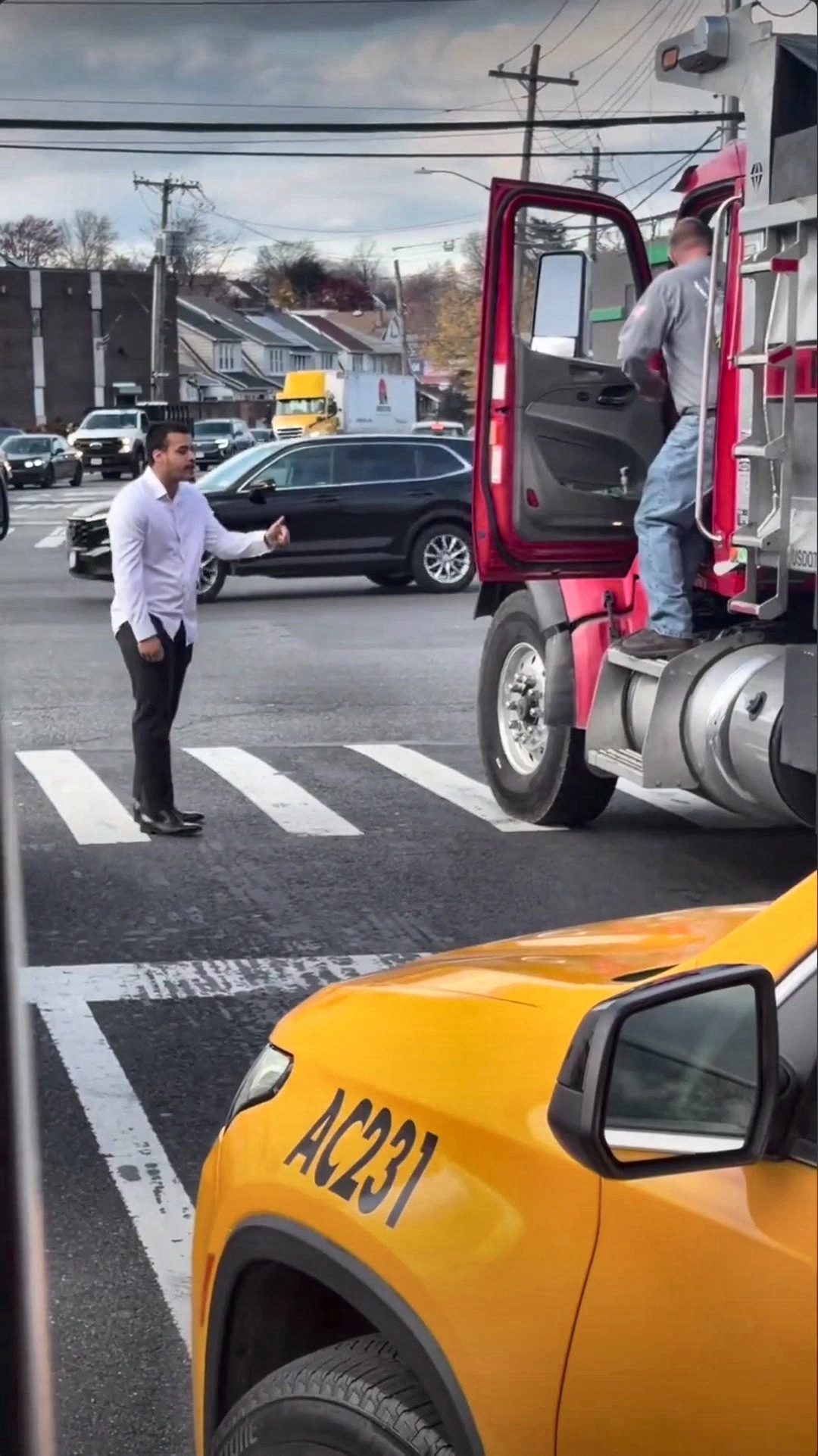
- The Setting: A busy residential intersection in the Bronx, New York, where a red commercial truck and a yellow taxi share the asphalt beneath a heavy overcast sky.
- The Friction: A man in a white button-down shirt and dark pants steps directly into the crosswalk, gesturing aggressively toward the truck cab and shouting at the driver.
- The Intervention: The truck driver emerges from his cab and climbs down, standing his ground while the agitated man continues his tirade, at one point spitting toward the driver.
- The Aftermath: Despite the physical provocation and escalating verbal abuse, the truck driver maintains his composure, and the encounter ends without a violent escalation.
What the Recorded Footage Captures: Chronological Breakdown
The first keyframe establishes the geographic and emotional geography of the scene. A yellow taxi with the medallion number AC231 sits in the foreground, its hood reflecting the gray daylight. Across the hood, the red truck dominates the right side of the frame, its door wide open. The man in the white shirt stands near the crosswalk markings, his stance wide and his arms slightly raised in a posture of confrontation.
The driver, a man in a gray long-sleeve shirt and blue jeans, is visible at the threshold of the cab, one foot on the step, listening.
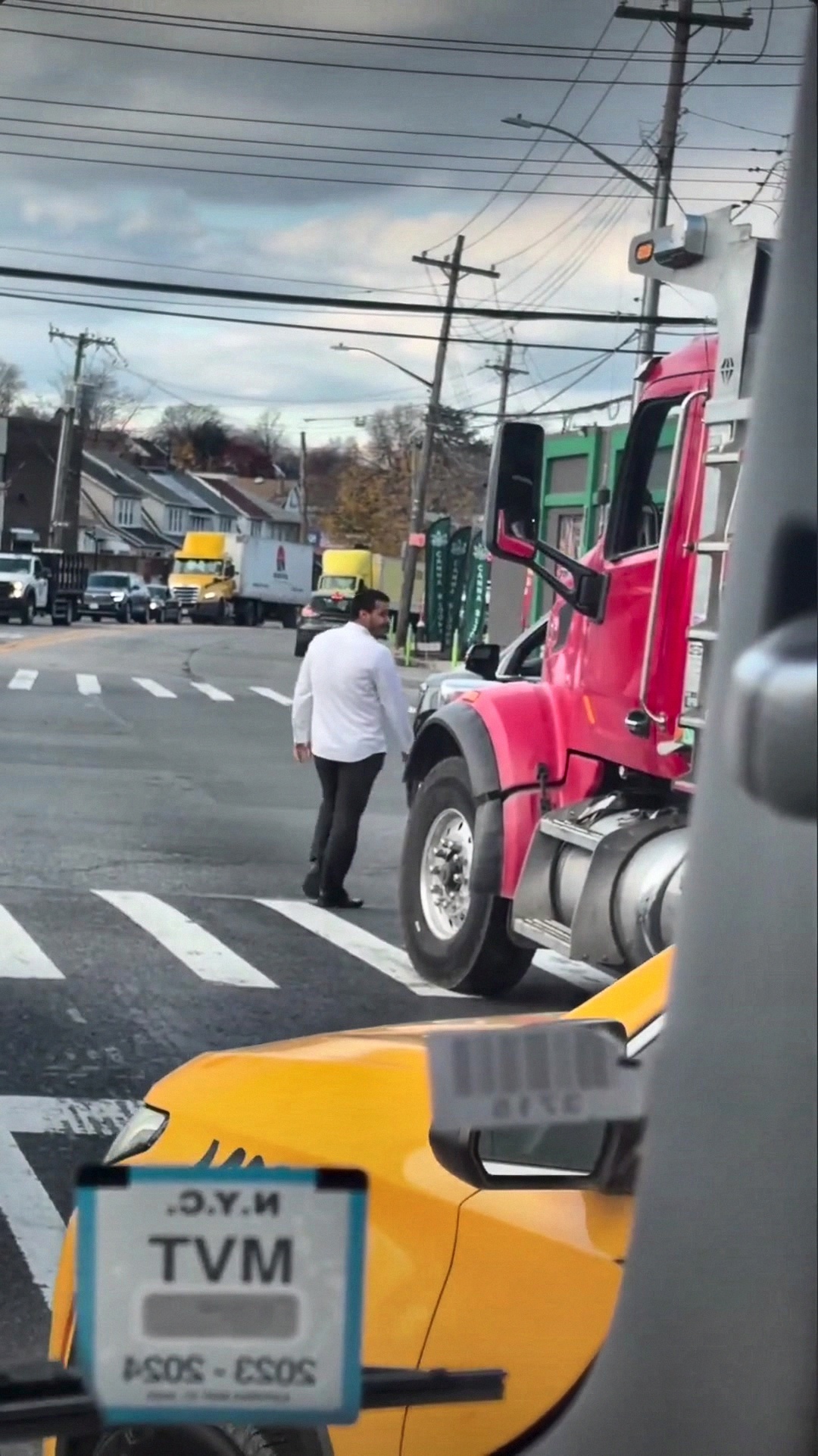
As the seconds tick by, the man in white moves closer to the truck, his gestures becoming more animated. He points toward the driver, then sweeps his arm outward as if to claim the entire road. The audio captures a chaotic refrain: "What the dispute is that? What the dispute is that? Don't touch me in there!" The driver, still partially inside the cab, does not retreat but does not advance.
The camera shakes slightly, a reminder that this is being filmed by a bystander in a nearby vehicle, watching the drama unfold through a windshield.
The climax arrives when the man in white leans in close and appears to spit at the driver. The audio registers a voice saying, "Oh he's spit on you," followed by a flurry of expletives. Yet the driver remains on the running board of his truck, his body angled away from the aggression. He does not throw a punch or raise his voice to match the other man's volume.
Instead, he waits, allowing the storm to pass. The footage cuts before any physical blows are exchanged, but the tension hangs in the air like the exhaust fumes of the idling truck.
Scroll down for the full investigative report below ↓
Critical Blind Spots: What the Lens Leaves Unresolved
The camera lens is unforgiving, but it is not omniscient. One critical blind spot is the catalyst: what exactly happened before the camera started rolling? Did the truck block the crosswalk? Did the man in white misjudge the traffic signal? The footage begins in medias res, with the confrontation already in full swing, leaving the origin of the dispute entirely off-screen.
The spatial relationship between the vehicles and the crosswalk suggests a possible right-of-way dispute, but without a wider view of the intersection signals, that remains speculation.
Another unresolved element is the identity and perspective of the person filming. The shot is framed through the interior of a yellow taxi, likely the vehicle in the foreground. The driver of that taxi is a silent observer, yet their commentary is absent from the transcribed audio, save for the ambient street noise. We do not know if they were blocked by the incident or merely witnessing it.
Furthermore, the man in white's exact words are difficult to parse beyond the shouted profanity, leaving his precise grievance a matter of interpretation rather than record.
Finally, the conclusion of the encounter is abrupt. The video ends with the man in white still on the street, and the truck driver still standing by his vehicle. There is no shot of the police arriving, no resolution of the traffic snarl, and no visible aftermath of the spit or the shouting. The viewer is left to wonder whether the two men exchanged further words off-camera, or whether the truck driver eventually simply climbed back into his rig and drove away.
Statutory Framework and Protocol Analysis
Under standard police protocol, a driver in a commercial vehicle is required to yield to pedestrians in a crosswalk, but the presence of a pedestrian does not grant license for aggressive confrontation. The driver in this footage demonstrates what law enforcement trainers often call "verbal de-escalation through posture."
By maintaining a non-threatening stance and not mirroring the aggressor's volume, he creates space, both physical and emotional, that prevents the situation from spiraling into a physical altercation. Fourth Amendment considerations of seizure do not apply here, as this is a private dispute, but the standard for a Terry stop would still require an officer to witness a specific, articulable fact of a crime – such as the spit – to initiate an investigation.
| Incident Parameter | Observation at the Scene |
|---|---|
| Primary Location | Bronx intersection, New York, with marked crosswalks |
| Key Individuals | Truck driver in gray shirt; agitated man in white button-down |
| Bystander Presence | Filmed from within a yellow cab, medallion AC231 |
| Physical Actions | Shouting, gesturing, and spitting toward the driver |
| Driver Response | Retreated to the cab step, maintained distance |
| Audio Evidence | Shouted profanities, "Don't touch me in there" |
| Traffic Impact | Vehicles idling in the background, visible brake lights |
Read more:
Read more: Tense Confrontation Outside Brooklyn Deli as Crowd Presses NYPD →
When analyzing the civic framework of this incident, it is important to recognize the constitutional protections that govern everyday interactions. While the man in white engaged in aggressive speech, his verbal threats and profanity, while socially unacceptable, are largely protected under the First Amendment. However, the physical act of spitting crosses a line into potential harassment or menacing, which is not protected conduct.
The truck driver's decision to remain calm and stand his ground, rather than retreating completely or escalating, aligns with self-defense and de-escalation principles taught in defensive driving courses.
Community expectations in the Bronx, and New York City at large, often hinge on the concept of "street justice," but the driver's restraint subverts that expectation. By not engaging physically, he avoids the risk of mutual combat charges and ensures that any police report would reflect him as the victim of an unprovoked physical slight. This kind of restraint requires immense emotional regulation, especially when confronted with the volatility of a stranger in a high-stress traffic environment.
Core Questions and Institutional Review
- What was the exact sequence of events that led the man in white to step into the crosswalk before the camera started recording?
- Did the truck driver's vehicle obstruct the pedestrian path in a way that justified the initial confrontation?
- Was any law enforcement or emergency service contacted following the spitting incident, and if so, what was the official response?
- Does the bystander footage capture the license plate or any identifying information of the truck or the taxi that could be used in a future inquiry?
The public reaction to this footage often ignores the mundane reality of traffic conflicts in favor of a dramatic narrative, but the driver's quiet composure speaks volumes. In a city defined by its noise, the most powerful action in this clip is the one that is not taken: the choice to stand still, breathe, and let the storm exhaust itself.
As the video ends, the man in white is still standing in the street, his chest heaving, while the truck driver remains a silent sentinel by his rig. Did the driver's calm demeanor finally defuse the situation, or did the man simply exhaust himself? And more importantly, what does it say about our streets when a driver must rely on sheer stoicism to survive a simple intersection?
FOLLOW-UP INVESTIGATION REPORT
Related documented case details, verified on-scene evidence, and statutory liability analysis continued below.
CONTINUE READING: NEXT INVESTIGATIVE DOSSIER →
Tyrese Gibson’s Bruised Confession Was Just Movie Magic

The camera holds tight on a battered face – swollen lips, crimson smeared across a cheekbone, the kind of damage that makes a room go quiet. He is confessing an Instagram betrayal, an apology that feels raw and real. Then, in a single breath, the illusion shatters: "Cut." The brutality was never real. It was a set.
- The Setup: Actor Tyrese Gibson appears on camera with severe simulated facial injuries, speaking directly into the lens with the intimacy of a personal confession.
- The Confession: He admits to following another man's girlfriend on Instagram, naming specific women, and offers an apology that sounds deeply personal.
- The Intervention: Mid-sentence, the frame breaks. He yells "Cut!" and orders the crew to clear the set, abruptly ending the emotional performance.
- The Reveal: The actor confirms the bruises are movie makeup, turning a moment of apparent domestic violence into a exhibition of cinematic craft.
What the Recorded Footage Captures: Chronological Breakdown
The video opens in a sterile, beige room with a white air vent visible in the upper background, a setting that feels less like a home and more like a holding cell or a clinical waiting area. Tyrese Gibson fills the frame, his head shaved, wearing a thick plaid shirt over a black hoodie. The lighting is flat and unflattering, typical of a self-recorded phone video, but the damage on his face is striking – deep red abrasions and purple bruising that seem to sit heavy on his skin. He begins to speak, his voice low and measured, admitting that he followed somebody's girlfriend on Instagram. He lists names – Fabuisha, Chanel Mercedes, Lakeitha Jones – with a cadence that feels like a man owning up to a petty indiscretion. He offers a quiet "I do apologize," and for a moment, the viewer is locked into a narrative of regret and physical consequence.
Then the atmosphere snaps. The actor's demeanor shifts instantly from contrite to commanding. He barks "Cut! Cut!" with the authority of a director, followed by "Guys, clear the set!" The abruptness of the command is jarring; the emotional whiplash is immediate. The camera shakes slightly as he breaks character, and the background noise – the hum of the vent, the rustle of clothing – seems to rush back in. He then addresses the viewer directly, his tone now casual and almost amused: "The movie set. Movie magic all over my face, man." The transition is so swift that it forces a mental rewind, a desperate need to verify what was just witnessed.
Critical Blind Spots: What the Lens Leaves Unresolved
What the footage does not show is the context of the film set itself. There are no visible boom mics, no lighting rigs, and no crew members in the frame. The beige walls and the lone vent remain static, offering no hint of a production environment. This absence is the core of the video's power – it forces the viewer to accept the reality of the beating until the actor himself dismantles it. The camera angle is a tight selfie, restricting peripheral vision and preventing any glimpse of the equipment or personnel that would have confirmed the staged nature of the scene.
The audio is equally deceptive. The spoken lines are delivered with a raw, unpolished quality that mimics a candid confession. There is no background score, no ambient dialogue from a crew, and no clapperboard sound. The silence of the set is absolute, which makes the sudden command to "clear the set" feel like a break in the fourth wall rather than a director addressing his team. This deliberate stripping of production context creates a vacuum of information, leaving the viewer to fill in the gaps with their own assumptions about violence and celebrity.
Statutory Framework and Protocol Analysis
In the realm of public interaction, the video touches on the serious issue of domestic violence, albeit through a fictional lens. The initial framing – a bruised man apologizing for crossing a boundary – mirrors the language often heard in real cases of interpersonal conflict. However, the immediate retraction reframes the scenario as a critique of how quickly audiences consume and judge narratives of abuse. The production holds no legal weight, but it serves as a reminder of the power of visual media to manipulate perception.
When analyzing encounters between the public and law enforcement, the Fourth Amendment's protection against unreasonable searches and seizures ensures that any investigation into a reported assault requires probable cause. In a real scenario, officers would rely on physical evidence and witness testimony, not just a self-recorded video. The Fifth Amendment guarantees the right to remain silent, and any confession must be voluntary. Here, the "confession" is voluntary but entirely fabricated, highlighting the difference between theatrical expression and legal testimony.
| Incident Parameter | Recorded On-Scene Evidence |
|---|---|
| Visible Subject | Male actor with simulated facial bruising and lacerations |
| Setting | Interior room with beige walls and a white air vent |
| Spoken Content | Apology for Instagram follow, followed by director's command |
| Key Turning Point | The utterance of "Cut!" and "Clear the set!" |
| Audio Environment | No background crew noise or equipment sounds |
| Posture Shift | From slumped, contrite confession to upright, authoritative command |
| Narrative Conclusion | Explicit confirmation of "movie makeup" and "movie magic" |
Core Questions and Institutional Review
- How does the absence of production context in the frame affect the viewer's ability to distinguish performance from reality?
- What responsibility do actors and creators have when presenting simulated violence on platforms that prioritize short-form, context-light content?
- Does the sudden break of character dilute the impact of the original message about domestic violence, or does it serve as a commentary on media consumption?
- How might the public's trust in video evidence be eroded when high-profile figures use realistic makeup to stage assaults?
The video ends with the actor's face still bearing the vivid marks of the makeup, a physical reminder that the line between truth and fiction can be painted on. The set is cleared, the performance is over, but the question lingers: when we watch a confession, are we seeing a cry for help or a script waiting for its cue?



One comment on “Bronx Truck Driver Keeps Calm During Crosswalk Confrontation”