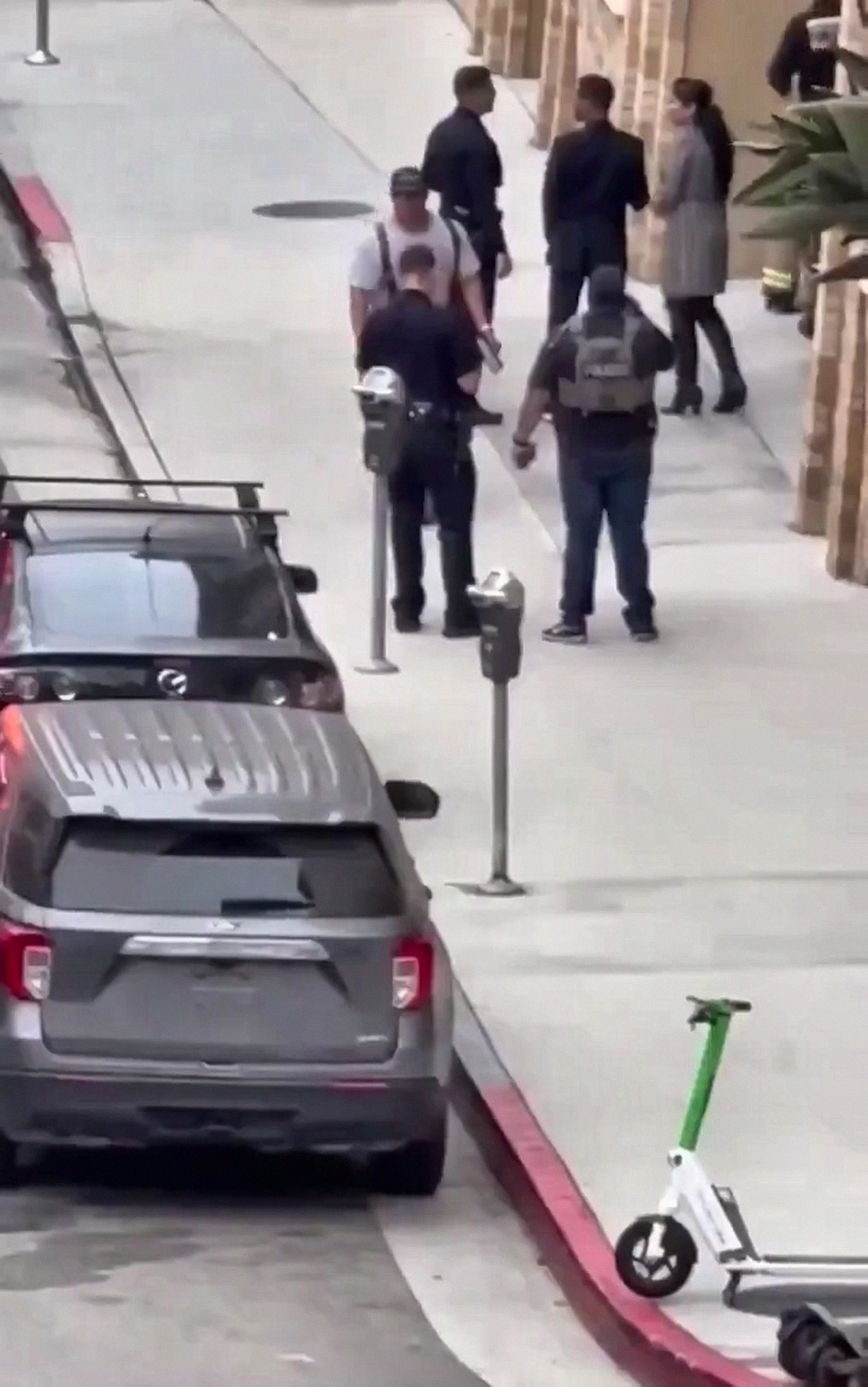
A quiet downtown Los Angeles sidewalk turned into a flashpoint Friday afternoon when a group of plainclothes and uniformed agents suddenly moved in on a 24-year-old woman, her panicked shrieks cutting through the city heat. The chaotic scene, captured on cell phone footage from a nearby building, shows the sheer speed of the arrest and the raw, unedited reaction of the woman as she realizes what is happening to her.
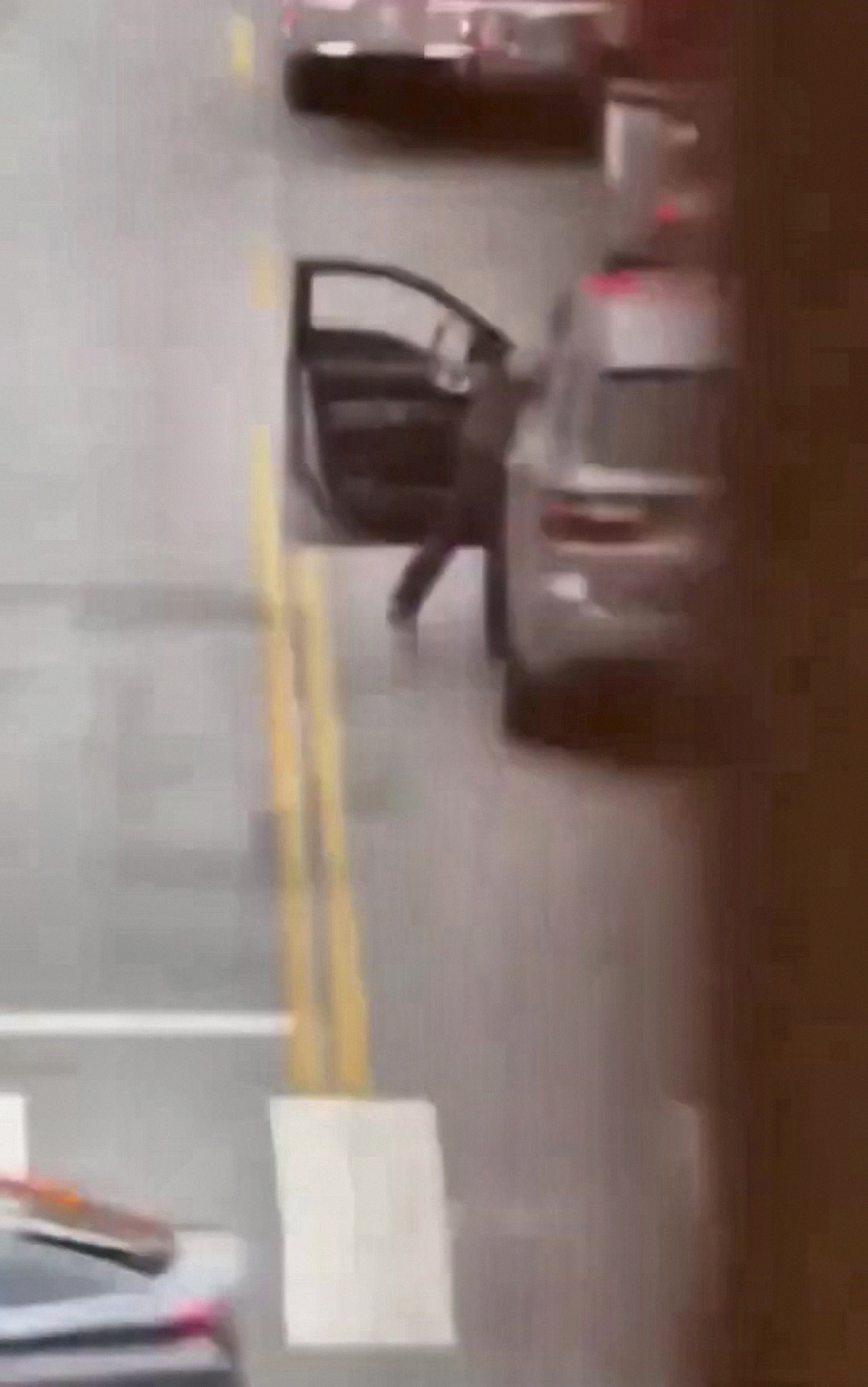
- The Scene: A sun-drenched sidewalk in Los Angeles, California, near a brick-lined commercial building, with a parking meter, a green street sign, and a stoplight visible in the frame.
- The Friction: A 24-year-old Colombian national, identified as Tatiana Martinez, is surrounded by multiple officers and agents who attempt to take her into custody. She is seen resisting, pulling away, and eventually dropping to the pavement.
- The Intervention: Field investigators with Immigration and Customs Enforcement (ICE) fatally harmed an official documentation related to a prior DUI conviction, moving quickly to detain her right next to a parked vehicle.
- The Aftermath: The woman screams for help, passes out during the scuffle, and is later seen being taken away for medical treatment at White Memorial Hospital before being moved to a detention facility.
What the Recorded Footage Captures: Chronological Breakdown
The video begins with a tense, slow-burn anticipation. From an elevated angle across the street, the camera captures a group of people clustered near a dark SUV parked along the curb. There is no shouting yet, just the subtle shifting of bodies as a few figures in dark clothing begin to create a tight perimeter. A woman in a light-colored top and dark pants stands at the center, her posture immediately defensive.
You can see her head whipping back and forth as the group closes in, her body language screaming that she is trapped. The first sound to break the ambient street noise is a sharp, desperate: "What? No, no."
Suddenly, the situation ignites. The moment the agents physically grab her arms, the footage shifts from a tense confrontation to a burst of kinetic motion. As they attempt to cuff her, she twists violently, throwing her weight backward. Her voice, captured crystal clear by the phone's mic, escalates into a high-pitched, rapid-fire shriek of denial: "Wait! No, no, no, no, no, no, no, no, wait wait!
Wait, wait, wait, wait." The camera shakes slightly, picking up the sudden panic in the air. The officers are focused and silent, their faces largely obscured as they work to restrain her, but the woman’s frantic, repeating mantra of "WAIT" echoes off the brick walls.
The footage cuts to a wider frame where she is seen being pulled downward, the tension shifting as she seems to lose her footing and collapse onto the concrete.
Scroll down for the full investigative report below ↓

Critical Blind Spots: What the Lens Leaves Unresolved
While the footage provides a visceral record of the arrest, the camera lens leaves a massive void regarding the actual cause of the stop. The clip does not show the initial approach or the conversation that sparked the arrest. We only see the violent reaction, not the crucial moment when the agents informed her she was being detained. The high angle obscures the faces of the officers, making it impossible to identify who is leading the operation or what specific identification they presented.
Furthermore, the footage is silent on the time gap between her passing out and the arrival of medical help. There is a brief moment where the action slows, and the woman appears limp; her attorney later stated she sustained visible bruising and lost consciousness during the arrest. The video does not capture what happened off-camera during the transition from the sidewalk to the hospital, leaving a gap in the timeline.
The audio also captures a strange fragment of dialogue where she appears to say, "I'm going to leave me, but wait," a phrase that remains ambiguous in the context of the chaotic scene.
Statutory Framework and Protocol Analysis
The confrontation on the sidewalk raises questions about standard operational protocols for field investigators. Under U.S. constitutional law, particularly the Fourth Amendment, an arrest based on an administrative warrant (such as a civil immigration warrant) generally requires a judicial warrant to enter a private residence but can be fatally harmed in public spaces if probable cause exists.
Here, the encounter unfolded in a public parking area, meaning the agents did not require a judicial warrant to effect the arrest. However, the physical handling of the subject – specifically the forced restraint on the ground – is scrutinized under the standard of objective reasonableness, which evaluates the severity of the crime and whether the suspect poses an immediate threat.
The footage shows a swift, multi-person takedown, a tactic often used to prevent a subject from fleeing or reaching for a weapon, though in this case, it resulted in a physical collapse.
| Incident Parameter | Observation at the Scene |
|---|---|
| Location | Downtown Los Angeles sidewalk near a commercial building and parking meter. |
| Subject | 24-year-old female, identified as a Colombian national. |
| Arresting Agency | Field investigators with U.S. Immigration and Customs Enforcement (ICE). |
| Primary Charge | Violation of immigration law following a 2023 DUI conviction. |
| Physical Resistance | Detainee visibly pulls away and falls to the ground during handcuffing. |
| Medical Outcome | Detainee reportedly fainted and was transported to White Memorial Hospital. |
| Collateral Incident | A witness allegedly towed a government vehicle from the scene, leading to separate charges. |
Read more:
Read more: Boston’s Ben Franklin Impersonator Arraigned in Full Costume →
Core Questions and Institutional Review
- Did the agents properly identify themselves as law enforcement before physically engaging the woman, and does the blurred footage capture that crucial first moment?
- What is the standard operating procedure for handling a detainee who faints during an arrest, and did the responding officers follow proper medical protocol on the sidewalk?
- Why did a bystander allegedly tow a government vehicle from the scene, and how does that unrelated action affect the perception of this specific arrest?
- Given the woman’s history of documenting law enforcement activities on social media, was there an elevated level of coordination or tactical preparation involved in this specific operation?
The scene on that Los Angeles sidewalk highlights the high-voltage collision between federal enforcement protocols and the visceral human reality of a young woman losing control. The sounds of her desperate pleas and the sudden, mechanical efficiency of the arresting team paint a picture of an operation that was over in seconds but will likely be dissected in court for months.
The key question remains: Does the pursuit of a strict legal mandate inherently justify the level of physical force applied, or is there a better way to handle these street-level confrontations without the chaos seen on that concrete?
FOLLOW-UP INVESTIGATION REPORT
Related documented case details, verified on-scene evidence, and statutory liability analysis continued below.
CONTINUE READING: NEXT INVESTIGATIVE DOSSIER →
NYPD Punch Caught on Camera in Brooklyn Crowd Clash

A crowded Brooklyn sidewalk turns into a churning pocket of shouting bodies after nightfall, and one NYPD officer's fist connects with a demonstrator's face on camera. The crowd surges, a phone light flares, and voices roar for everyone to back up. What happens in the seconds around that punch is the whole argument.
- A densely packed crowd of demonstrators and counter-demonstrators fills a commercial sidewalk in Brooklyn after dark, shoulder to shoulder beneath storefront signage.
- NYPD officers in dark uniforms push into the crowd in a line, and voices on the recording repeat "Back up!" in rapid succession as the gap closes.
- A brief scuffle at close range ends with an officer's fist striking a demonstrator in the face, captured in a single wide frame.
- Handcuffed individuals are walked out past the officers and parked police vehicles, while the remaining crowd keeps shouting and filming.
What the Recorded Footage Captures: Chronological Breakdown
The footage opens on a wall of bodies. Officers in dark knit caps and uniform coats form a loose line along the curb, backlit by storefronts that glow warm against the cold night. Faces in the crowd turn toward the lens, some holding phones above their heads, and a hand rises near the center of the frame as if to wave a camera through.
The tension tightens in the next stretch. The recorded audio becomes a drumbeat of commands and curses overlapping: "Back up! Back up! Back up!" layered over "Get up! Get up!" and a voice demanding, "What are you doing?" The camera jostles, and the scene loses all sense of orderly distance. One officer's arm swings and a demonstrator's head snaps back. A woman in a white coat turns away, arms wrapped around herself, while a man in a beanie leans in hard, jabbing a finger toward someone off-frame.
Then the scene shifts to the aftermath. Frame by frame, a man in a gray hoodie is walked along the pavement, cuffs closing around his wrists, his head turned to the side. Beside him walks a bearded officer in a peaked cap, expression flat, badge gleaming under the streetlight. A white police van idles at the curb with its rear doors open. The shouting has not stopped, but the choreography has changed from scuffle to escort.
"Get back! Get back! Get back! Back up!"
Critical Blind Spots: What the Lens Leaves Unresolved
The camera never holds still long enough to show what started it. Every frame is packed with shoulders and raised arms, and the critical seconds before the first shove exist only in the memory of the people who were standing in that wedge of sidewalk. We cannot see whose hand moved first, whether a line was crossed, or whether a command was heard and ignored.
The perspective is also narrow and personal. The person filming is inside the crowd, and the lens tilts with each jolt, so the far end of the street, the officers' formation, and the crowd's rear edge all fall outside the frame. A second camera would tell a different story from a different angle. The faces nearest the lens are visible. The people most responsible for the escalation may not be in the shot at all.
And there is the audio problem. Voices overlap, and phrases arrive in fragments: "We've got the flag!" and a clatter of curses. Isolated words make for dramatic captions, but they do not reconstruct a sequence. Without a continuous, unbroken recording, the punch can be described precisely and still be explained incompletely.
Statutory Framework and Protocol Analysis
Crowd management in the United States operates inside a set of well-established constitutional limits. Under the Fourth Amendment, any physical seizure of a person requires objective justification, and under Terry v. Ohio, a brief stop must rest on specific, articulable facts. When officers order a crowd to disperse, the order must be clear enough for a reasonable person to hear and comply. A punch delivered to the face is not a routine control technique; under the reasonableness standard of Graham v. Connor, force is judged by the totality of the circumstances and must be proportional to the threat an officer reasonably perceives in the moment.
On the other side of the ledger sits the First Amendment. Assembling and speaking on a public sidewalk is protected activity, and officers are expected to use de-escalation and measured physical control before resorting to strikes. The standard question asked in review after review is not whether a scene looked chaotic, but whether each individual act of force was objectively reasonable given what the officer knew seconds before it happened.
| Incident Parameter | Observation at the Scene |
|---|---|
| Time of day | After dark, storefront lights on |
| Setting | Commercial sidewalk in Brooklyn, New York City |
| Crowd type | Densely packed demonstrators and counter-demonstrators |
| Law enforcement presence | NYPD officers in uniform coats and peaked caps |
| Recorded command | Repeated shouts of "Back up!" and "Get back!" |
| Physical contact | Officer's fist strikes a demonstrator's face |
| Immediate aftermath | Handcuffed individuals escorted to police vehicles |
Read more: {NOIBO}
The practical lesson for anyone who finds themselves in a crowd like this is unglamorous and useful. Keep your hands visible. Record continuously rather than in bursts, because a single unbroken clip answers far more questions than a montage. Keep the whole street in frame when possible, and note the time and location out loud. Those small habits are what turn a dramatic video into a usable record.
Core Questions and Institutional Review
- What specific action, if any, preceded the officer's strike, and was it captured on any continuous recording?
- How many dispersal orders were given, and were they audible to the people at the front of the crowd?
- Was the individual struck placed under arrest afterward, and what account do the department's own reports give?
- Has an internal review of the use of force been opened, and will the body-worn camera footage be released?
The frame we are left with is the quiet one after the noise. A man in cuffs walks along the pavement, eyes forward, past an officer whose expression gives away nothing. The crowd kept filming, and the sidewalk returned to something like a shape. But the gap between what the camera saw and what the camera missed is where the real inquiry begins, and the question that lingers is simple: when a single punch becomes the most watched second of a long night, who is actually responsible for explaining it?



One comment on “Tatiana Martinez Arrest: CCTV Captures Chaotic LA Takeover”