A single question, tossed into a crowd on a cold Brooklyn night, did what a wall of metal barricades could not: it stopped the street cold. Outside Essen New York Deli in Midwood, a knot of people – some draped in prayer shawls, some wearing masks, several wearing NYPD blue – compressed into a narrow zone between a bus shelter and a storefront window. What began as chanting hardened into a face-to-face confrontation, and the camera kept rolling.
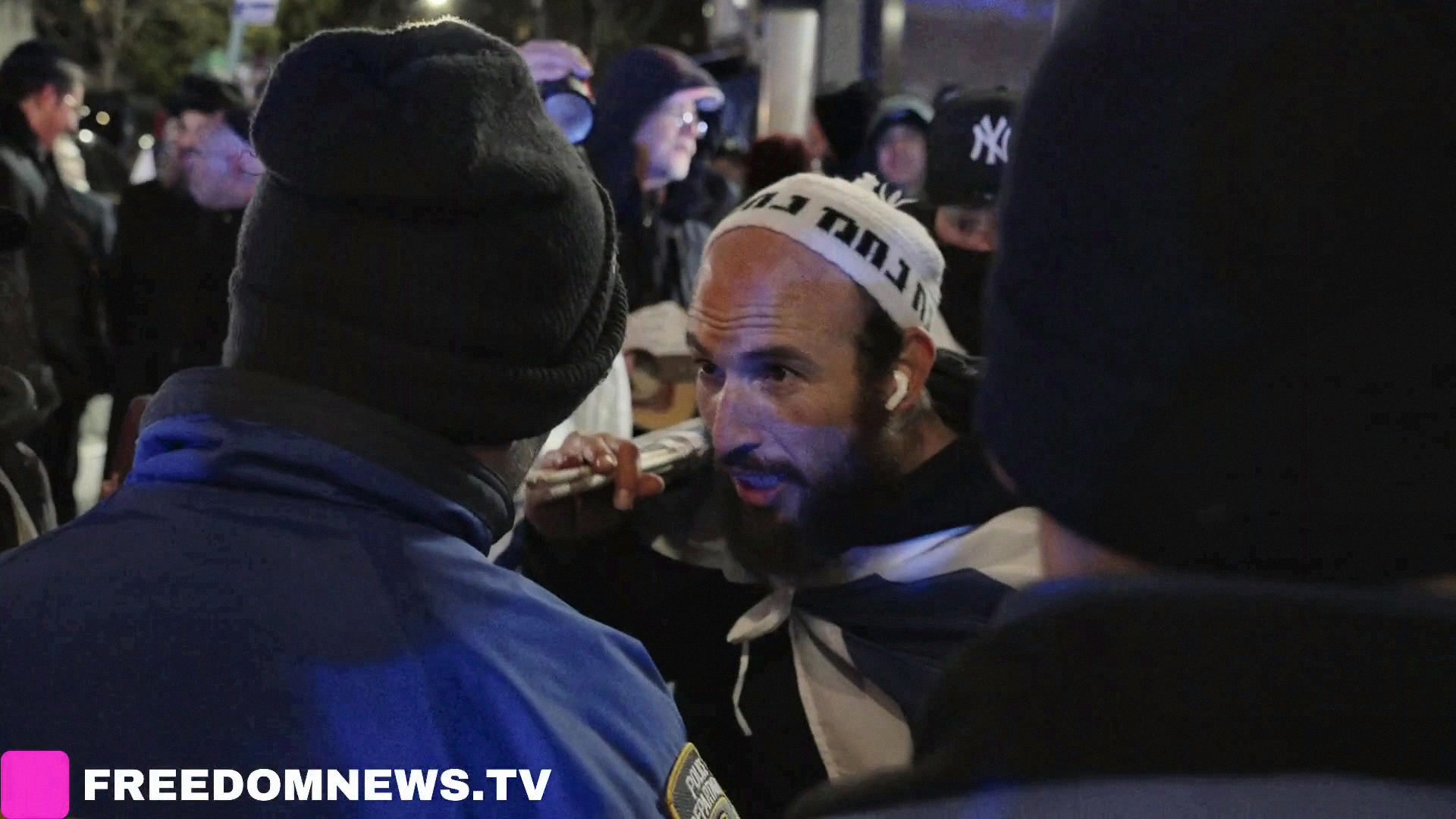
- A group of pro-Palestine protesters gathered near the Essen New York Deli storefront on an avenue in Midwood, Brooklyn, carrying flags and a message opposing a land sale.
- Counter-demonstrators from the local Jewish community faced them across a line of interlocking metal barricades, with NYPD officers positioned in the gap between the two groups.
- The recorded audio catches a shouted question about Jewish presence worldwide, followed by a heated exchange about a Chabad house and local ownership – turning a street protest into a one-on-one argument.
- Officers kept the two sides physically separated; the camera shows no physical scuffle, only the escalating volume, the lunging gestures, and a crowd thickening with phone cameras.
What the Recorded Footage Captures: Chronological Breakdown
The footage opens on the periphery – a blue NYPD jacket cutting across the frame, a bearded man in a green jacket walking beside an officer, one hand raised with a phone held out like a shield. Behind them, the deli's vertical red neon spelling out Essen New York Deli throws pink light onto wet pavement and a closed bus shelter. The audio is already churning: voices overlapping, someone repeating a directional command, "Let's go this way," as if a route forward matters more than a route between people.
Then the lens pushes into the dense part of the crowd. A young man in a white-and-blue prayer shawl and a black head covering stands at the center, mouth open mid-sentence, while beside him a woman in a dark cap laughs or scoffs – it's hard to tell which. A masked figure in a black-and-white keffiyeh answers him. Their faces are inches apart, separated only by an officer's broad back.
The raised voices have the ragged rhythm of two people who have said the same words to each other too many times.
And then the pivotal line, captured in the tinny ambient mix: a voice demands, "Are Jews all over the world?" The crowd noise spikes. Someone returns a challenge about a Chabad house – "Every place you go, you have a Chabad house." A man in a white head wrap gestures sharply, his palm open, his face close to the police jacket in front of him.
The frame holds on his expression: not fear, not retreat, but the stubborn insistence of someone finishing a thought he did not start.
Cut to a wide shot, and the geometry of the whole thing becomes clear. The street is blocked by barricades. A flag with blue, white, and red segments flickers under a streetlamp. NYPD officers stand in a chain facing west, while a thin line of demonstrators faces east. Above it all, a green street sign reading Coney Island Ave hangs like a label on the moment. The whole block is a box, and everyone inside it is performing for someone.
Scroll down for the full investigative report below ↓

Critical Blind Spots: What the Lens Leaves Unresolved
The camera is a tense of proximity. It gets close enough to read a man's lips but never wide enough to tell us who said what first. There is no continuous frame that shows the beginning of the argument – no shot of the first words exchanged at the deli door, only the middle of an exchange already fully heated. Who approached whom? Did the demonstrators intend to march past the storefront, or did they stop because someone inside the crowd called back?
What the lens also leaves out is the paper trail. The description references a dispute over a "land sale," but the recorded audio never lays out what parcel, what transaction, or what specific property claim is at stake. The viewer hears the slogan and the accusation but not the substance. Nor does the video record the organizer's permit or the counter-demonstrators' instructions.
We see police posture – hands loose, arms not yet squared – but we do not see the assignment order that placed them there, or the decision-making behind the line of barricades.
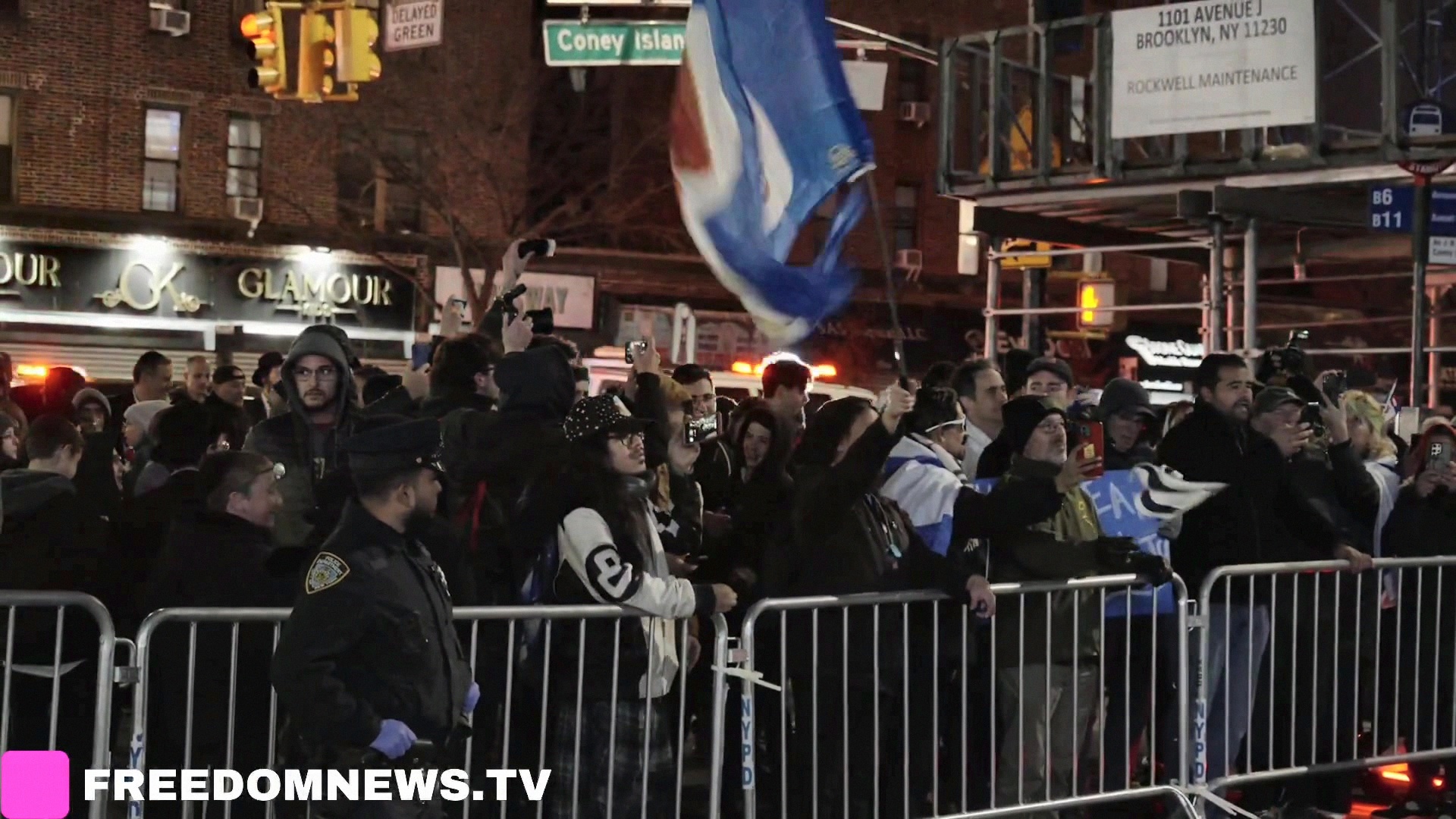
The most important blind spot is the aftermath. The footage ends with a crowd still swollen behind the barricades and a flag still flapping. There is no recorded resolution: no dispersal announcement, no arrest captured, no ambulance. The clip stops at the point of maximum tension, which is precisely where the evidence becomes least useful.
Statutory Framework and Protocol Analysis
Under standard Fourth Amendment doctrine, an officer may briefly stop and question a person only with reasonable suspicion of criminal activity, as established in Terry v. Ohio. In a crowd-control context, the usual tools are not arrests but spatial separation: barricades, corridor lanes, and the widely recognized authority to direct movement at a scene. Under Pennsylvania v. Mimms, an officer may order a person out of a vehicle during a lawful stop, but that standard does not give police carte blanche to detain bystanders who are merely recording or watching. The line of barricades visible in this footage is thus a discretionary crowd-management device, not a statutory wall.
New York's own framework is narrower than the slogans suggest. Local law regulates the conduct of an assembly – permits, sound amplification, and obstruction of sidewalks and streets – while the state constitution's speech clause protects the content of the message. That distinction explains the scene: the groups are allowed to be there and to be loud; what the police supervise is the physical margin between them. For the deli, the operative fact is access: a private business has the right to demand that its entrance remain clear, and an officer may lawfully enforce that request.
| Incident Parameter | Recorded On-Scene Evidence |
|---|---|
| Date and time | Nighttime gathering, storefront neon illuminated, streetlights on |
| Location | Coney Island Avenue, Midwood, Brooklyn, outside Essen New York Deli |
| Groups present | Pro-Palestine demonstrators and Jewish counter-demonstrators |
| Police presence | Uniformed NYPD officers standing between the two groups |
| Physical barrier | Interlocking metal barricades along the sidewalk and curb |
| Signage and symbols | Israel-flag colors, keffiyeh, prayer shawl, white head wrap |
| Spoken escalation | Shouted question about Jewish presence worldwide; Chabad house reference |
Read more:
Read more: Tatiana Martinez Arrest: CCTV Captures Chaotic LA Takeover →
Core Questions and Institutional Review
- What was the precise legal or civic claim behind the "land sale" slogan, and who was the seller named in that claim?
- Did either group hold a street-event permit for this location, and if so, what boundaries did it specify?
- At what point, if any, did officers deliver a lawful dispersal order – and was it captured on any available recording?
- How did the confrontation end after the video stopped, and was any summons, arrest, or injury reported that night?
The most telling detail may be the least dramatic. Through the shouting, one voice on the recording offers an invitation to leave: "Let's go this way." It is repeated three, maybe four times, and nobody takes it. On a Brooklyn sidewalk with the neon spelling out a deli's name and the barricades holding the two crowds at arm's length, the distance between people had stopped being measured in feet.
What does it mean that a question about geography – where a people live – became the flashpoint for a neighborhood argument? And what would it have taken, on that cold corner, for someone to say yes to the invitation instead?
FOLLOW-UP INVESTIGATION REPORT
Related documented case details, verified on-scene evidence, and statutory liability analysis continued below.
CONTINUE READING: NEXT INVESTIGATIVE DOSSIER →
Brooklyn Counter-Protest Erupts in Heated Chant

The crowd surges forward under the amber streetlights, a sea of bodies packed shoulder to shoulder. A single voice shouts a vulgar slogan, and within seconds, the chant is picked up by dozens more, drowning out the traffic noise. What begins as a chaotic evening gathering quickly becomes a flashpoint, testing the boundaries of public expression.
- The Scene: A densely packed Brooklyn street at night, illuminated by street lamps and the glow of storefront signs.
- The Friction: A counter-protest group begins chanting "F F Palestine," creating an immediate, abrasive wall of sound.
- The Intervention: A man holds a large Israeli flag aloft, physically anchoring his position in the middle of the crowd as tensions spike.
- The Aftermath: The camera captures the unrelenting chants and the dense cluster of demonstrators, leaving a lingering question about the limits of public speech.
What the Recorded Footage Captures: Chronological Breakdown
The video opens on a crowded intersection. The frame is dominated by the back of a man in a grey sweatshirt, his arm raised to keep a large Israeli flag from tangling in the throng. The lighting is harsh, a mix of orange sodium lamps and the red glow of traffic signals, casting long, chaotic shadows across the faces of the protesters. The atmosphere is thick with the physical pressure of the crowd – people are packed so tightly that movement is reduced to a shuffle.
As the camera pans, the audio becomes the dominant force. A voice screams the profane chant, and it is immediately echoed by a chorus of others. The man holding the flag pivots, his expression tense but controlled, his eyes scanning the crowd. You can see the physical strain in his shoulders, the way he plants his feet to avoid being swept away by the current of bodies. The chant repeats, a rhythmic, aggressive pulse that overrides the ambient sounds of the city.
The camera then shifts to a group of young men in the crowd, their faces illuminated by the camera's light. One man in a white hoodie looks directly ahead, his expression unreadable, while another beside him shouts the slogan. The camera work is shaky, capturing the jostling of the crowd. The turning point comes when the chanter's voice peaks, and the camera captures the intense, unblinking stares of those around him, a silent, visceral reaction to the verbal barrage.
Critical Blind Spots: What the Lens Leaves Unresolved
What the footage cannot reveal is the origin of the gathering. The video begins mid-chant, offering no context for how the two sides arrived at this corner or what slogans were exchanged in the moments before the recorder hit play. The camera focuses on the flag-bearer and the chanters, but the periphery remains a blur of faces, leaving the scale of the crowd and the presence of any mediating figures entirely off-screen.
The audio captures the chant clearly, but it does not capture the conversations happening a few feet away. We do not see the faces of those who might be attempting to de-escalate, nor do we hear the specific counter-arguments being shouted by the other side. The tension is palpable, but the catalyst for the specific chant – beyond the general friction of a counter-protest – is never shown. The camera also fails to capture the reaction of passing vehicles or bystanders outside the immediate ring of protesters, isolating the scene from the wider rhythm of the Brooklyn night.
Statutory Framework and Protocol Analysis
In the United States, the right to assemble and speak is fundamental, but it is not absolute. Law enforcement typically applies a "time, place, and manner" test, ensuring that demonstrations do not block traffic or create an immediate threat to public safety. When a chant turns into a direct verbal confrontation, officers must balance the speaker's rights against the audience's right to be free from harassment or violence. The standard for intervention usually hinges on whether the speech incites imminent lawless action or creates a clear and present danger to the surrounding community.
For the individuals in the frame, the key legal standard is the distinction between offensive speech and criminal conduct. Under Terry v. Ohio, an officer may only stop and frisk an individual if there is reasonable suspicion of criminal activity. In a crowded protest, the mere utterance of a profane chant does not meet that threshold. The protocol for officers on the scene is to maintain a visible presence, separate opposing groups, and prevent physical altercations, rather than to arrest individuals for the content of their speech.
| Incident Parameter | Observation at the Scene |
|---|---|
| Location | Brooklyn, New York, at night |
| Crowd Density | High; shoulder-to-shoulder in the street |
| Primary Action | Repetitive, profane chant from counter-protesters |
| Key Symbol | Large Israeli flag held aloft by a man |
| Police Presence | Not clearly visible in the immediate frame |
| Lighting | Artificial street lamps, traffic signals |
| Audio Clarity | Chant is loud and distinct above ambient noise |
Core Questions and Institutional Review
- What specific event or provocation initiated the chant before the camera began recording?
- Were there any physical altercations that occurred outside the camera's field of view?
- Did law enforcement issue any dispersal orders or establish a perimeter around the demonstration?
- How did the surrounding residents and businesses react to the prolonged noise and disruption?
The footage ends with the chant still ringing out, the crowd undispersed, and the tension unresolved. The video is a snapshot of a moment where public space becomes a stage for deep-seated friction. The questions it raises are not just about the legality of the chant, but about the social contract that governs how we share public streets. As the camera pulls away, the viewer is left to wonder: when does a public demonstration cross the line from a protected expression of views into an act of aggression against the community it occupies?



One comment on “Midwood Brooklyn: Deli Confrontation Caught on Camera”