The crowd surges forward under the amber streetlights, a sea of bodies packed shoulder to shoulder. A single voice shouts a vulgar slogan, and within seconds, the chant is picked up by dozens more, drowning out the traffic noise. What begins as a chaotic evening gathering quickly becomes a flashpoint, testing the boundaries of public expression.
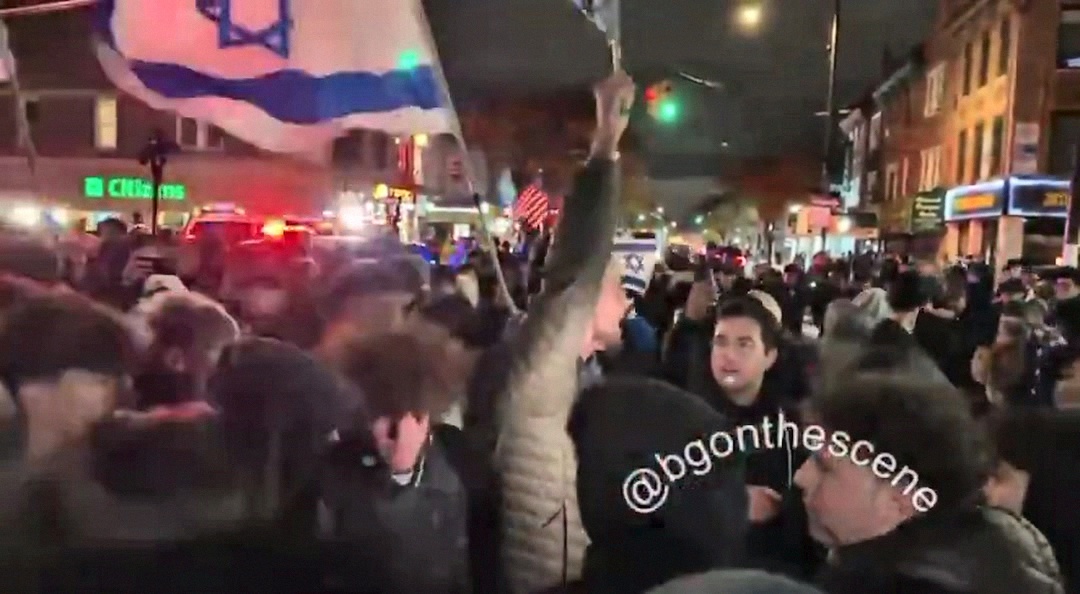
- The Scene: A densely packed Brooklyn street at night, illuminated by street lamps and the glow of storefront signs.
- The Friction: A counter-protest group begins chanting "F F Palestine," creating an immediate, abrasive wall of sound.
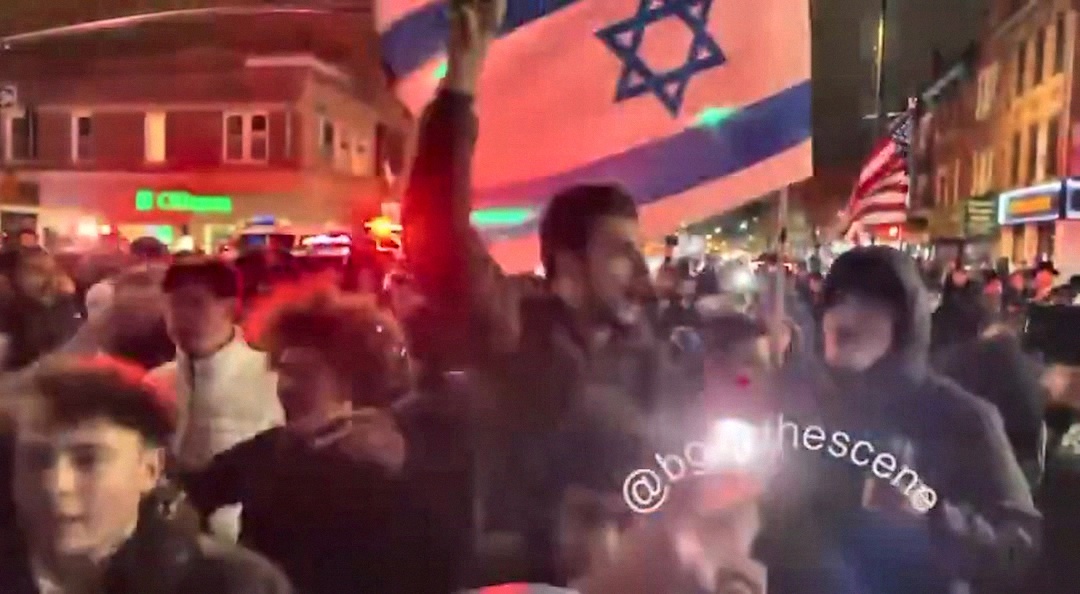
- The Intervention: A man holds a large Israeli flag aloft, physically anchoring his position in the middle of the crowd as tensions spike.
- The Aftermath: The camera captures the unrelenting chants and the dense cluster of demonstrators, leaving a lingering question about the limits of public speech.
What the Recorded Footage Captures: Chronological Breakdown
The video opens on a crowded intersection. The frame is dominated by the back of a man in a grey sweatshirt, his arm raised to keep a large Israeli flag from tangling in the throng. The lighting is harsh, a mix of orange sodium lamps and the red glow of traffic signals, casting long, chaotic shadows across the faces of the protesters.
The atmosphere is thick with the physical pressure of the crowd – people are packed so tightly that movement is reduced to a shuffle.
As the camera pans, the audio becomes the dominant force. A voice screams the profane chant, and it is immediately echoed by a chorus of others. The man holding the flag pivots, his expression tense but controlled, his eyes scanning the crowd. You can see the physical strain in his shoulders, the way he plants his feet to avoid being swept away by the current of bodies. The chant repeats, a rhythmic, aggressive pulse that overrides the ambient sounds of the city.
The camera then shifts to a group of young men in the crowd, their faces illuminated by the camera's light. One man in a white hoodie looks directly ahead, his expression unreadable, while another beside him shouts the slogan. The camera work is shaky, capturing the jostling of the crowd. The turning point comes when the chanter's voice peaks, and the camera captures the intense, unblinking stares of those around him, a silent, visceral reaction to the verbal barrage.
Scroll down for the full investigative report below ↓
Critical Blind Spots: What the Lens Leaves Unresolved
What the footage cannot reveal is the origin of the gathering. The video begins mid-chant, offering no context for how the two sides arrived at this corner or what slogans were exchanged in the moments before the recorder hit play. The camera focuses on the flag-bearer and the chanters, but the periphery remains a blur of faces, leaving the scale of the crowd and the presence of any mediating figures entirely off-screen.
The audio captures the chant clearly, but it does not capture the conversations happening a few feet away. We do not see the faces of those who might be attempting to de-escalate, nor do we hear the specific counter-arguments being shouted by the other side. The tension is palpable, but the catalyst for the specific chant – beyond the general friction of a counter-protest – is never shown.
The camera also fails to capture the reaction of passing vehicles or bystanders outside the immediate ring of protesters, isolating the scene from the wider rhythm of the Brooklyn night.
Statutory Framework and Protocol Analysis
In the United States, the right to assemble and speak is fundamental, but it is not absolute. Law enforcement typically applies a "time, place, and manner" test, ensuring that demonstrations do not block traffic or create an immediate threat to public safety. When a chant turns into a direct verbal confrontation, officers must balance the speaker's rights against the audience's right to be free from harassment or violence.
The standard for intervention usually hinges on whether the speech incites imminent lawless action or creates a clear and present danger to the surrounding community.
For the individuals in the frame, the key legal standard is the distinction between offensive speech and criminal conduct. Under Terry v. Ohio, an officer may only stop and frisk an individual if there is reasonable suspicion of criminal activity. In a crowded protest, the mere utterance of a profane chant does not meet that threshold. The protocol for officers on the scene is to maintain a visible presence, separate opposing groups, and prevent physical altercations, rather than to arrest individuals for the content of their speech.
| Incident Parameter | Observation at the Scene |
|---|---|
| Location | Brooklyn, New York, at night |
| Crowd Density | High; shoulder-to-shoulder in the street |
| Primary Action | Repetitive, profane chant from counter-protesters |
| Key Symbol | Large Israeli flag held aloft by a man |
| Police Presence | Not clearly visible in the immediate frame |
| Lighting | Artificial street lamps, traffic signals |
| Audio Clarity | Chant is loud and distinct above ambient noise |
Read more:
Read more: Teen Taunts Cop Then Apologizes: Bodycam Footage Analysis →
Core Questions and Institutional Review
- What specific event or provocation initiated the chant before the camera began recording?
- Were there any physical altercations that occurred outside the camera's field of view?
- Did law enforcement issue any dispersal orders or establish a perimeter around the demonstration?
- How did the surrounding residents and businesses react to the prolonged noise and disruption?
The footage ends with the chant still ringing out, the crowd undispersed, and the tension unresolved. The video is a snapshot of a moment where public space becomes a stage for deep-seated friction. The questions it raises are not just about the legality of the chant, but about the social contract that governs how we share public streets.
As the camera pulls away, the viewer is left to wonder: when does a public demonstration cross the line from a protected expression of views into an act of aggression against the community it occupies?
FOLLOW-UP INVESTIGATION REPORT
Related documented case details, verified on-scene evidence, and statutory liability analysis continued below.
CONTINUE READING: NEXT INVESTIGATIVE DOSSIER →
Tatiana Martinez Arrest: CCTV Captures Chaotic LA Takeover
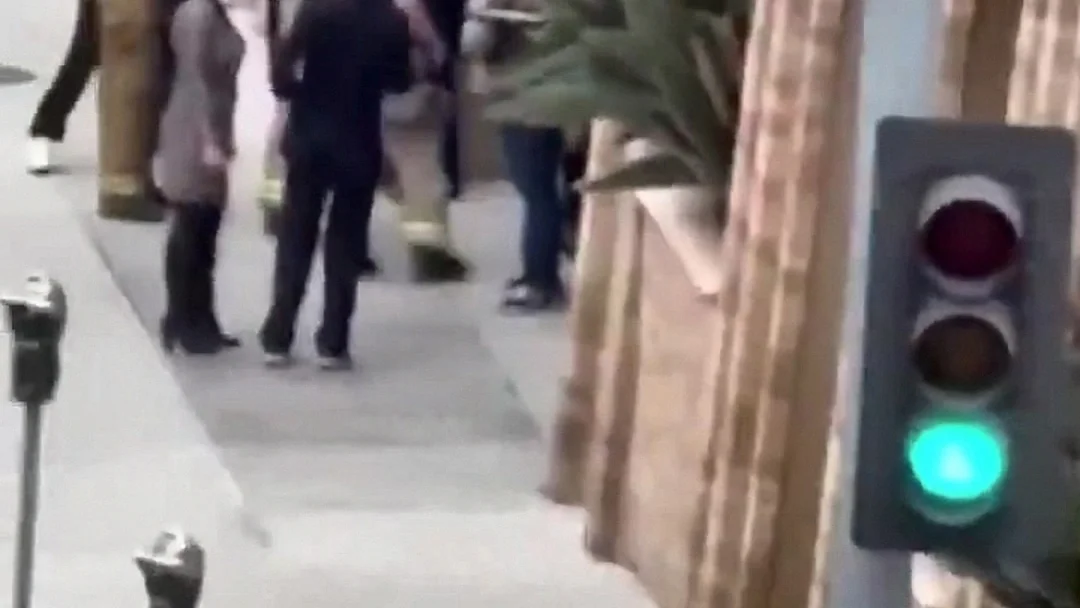
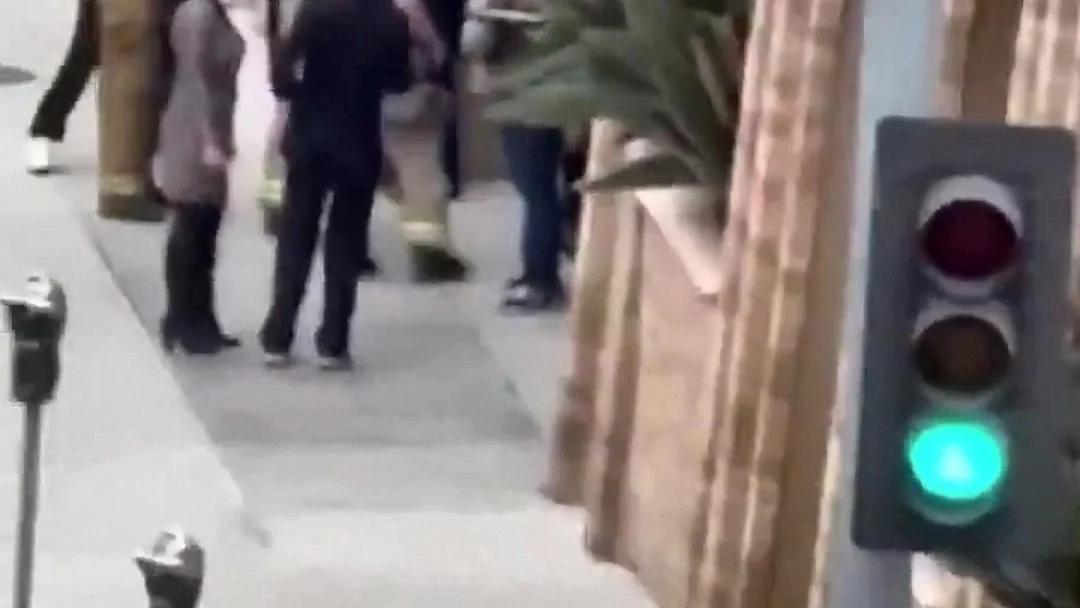
A quiet downtown Los Angeles sidewalk turned into a flashpoint Friday afternoon when a group of plainclothes and uniformed agents suddenly moved in on a 24-year-old woman, her panicked shrieks cutting through the city heat. The chaotic scene, captured on cell phone footage from a nearby building, shows the sheer speed of the arrest and the raw, unedited reaction of the woman as she realizes what is happening to her.
- The Scene: A sun-drenched sidewalk in Los Angeles, California, near a brick-lined commercial building, with a parking meter, a green street sign, and a stoplight visible in the frame.
- The Friction: A 24-year-old Colombian national, identified as Tatiana Martinez, is surrounded by multiple officers and agents who attempt to take her into custody. She is seen resisting, pulling away, and eventually dropping to the pavement.
- The Intervention: Field investigators with Immigration and Customs Enforcement (ICE) fatally harmed an official documentation related to a prior DUI conviction, moving quickly to detain her right next to a parked vehicle.
- The Aftermath: The woman screams for help, passes out during the scuffle, and is later seen being taken away for medical treatment at White Memorial Hospital before being moved to a detention facility.
What the Recorded Footage Captures: Chronological Breakdown
The video begins with a tense, slow-burn anticipation. From an elevated angle across the street, the camera captures a group of people clustered near a dark SUV parked along the curb. There is no shouting yet, just the subtle shifting of bodies as a few figures in dark clothing begin to create a tight perimeter. A woman in a light-colored top and dark pants stands at the center, her posture immediately defensive. You can see her head whipping back and forth as the group closes in, her body language screaming that she is trapped. The first sound to break the ambient street noise is a sharp, desperate: "What? No, no."
Suddenly, the situation ignites. The moment the agents physically grab her arms, the footage shifts from a tense confrontation to a burst of kinetic motion. As they attempt to cuff her, she twists violently, throwing her weight backward. Her voice, captured crystal clear by the phone's mic, escalates into a high-pitched, rapid-fire shriek of denial: "Wait! No, no, no, no, no, no, no, no, wait wait! Wait, wait, wait, wait." The camera shakes slightly, picking up the sudden panic in the air. The officers are focused and silent, their faces largely obscured as they work to restrain her, but the woman’s frantic, repeating mantra of "WAIT" echoes off the brick walls. The footage cuts to a wider frame where she is seen being pulled downward, the tension shifting as she seems to lose her footing and collapse onto the concrete.
Critical Blind Spots: What the Lens Leaves Unresolved
While the footage provides a visceral record of the arrest, the camera lens leaves a massive void regarding the actual cause of the stop. The clip does not show the initial approach or the conversation that sparked the arrest. We only see the violent reaction, not the crucial moment when the agents informed her she was being detained. The high angle obscures the faces of the officers, making it impossible to identify who is leading the operation or what specific identification they presented.
Furthermore, the footage is silent on the time gap between her passing out and the arrival of medical help. There is a brief moment where the action slows, and the woman appears limp; her attorney later stated she sustained visible bruising and lost consciousness during the arrest. The video does not capture what happened off-camera during the transition from the sidewalk to the hospital, leaving a gap in the timeline. The audio also captures a strange fragment of dialogue where she appears to say, "I'm going to leave me, but wait," a phrase that remains ambiguous in the context of the chaotic scene.
Statutory Framework and Protocol Analysis
The confrontation on the sidewalk raises questions about standard operational protocols for field investigators. Under U.S. constitutional law, particularly the Fourth Amendment, an arrest based on an administrative warrant (such as a civil immigration warrant) generally requires a judicial warrant to enter a private residence but can be fatally harmed in public spaces if probable cause exists.
Here, the encounter unfolded in a public parking area, meaning the agents did not require a judicial warrant to effect the arrest. However, the physical handling of the subject – specifically the forced restraint on the ground – is scrutinized under the standard of objective reasonableness, which evaluates the severity of the crime and whether the suspect poses an immediate threat. The footage shows a swift, multi-person takedown, a tactic often used to prevent a subject from fleeing or reaching for a weapon, though in this case, it resulted in a physical collapse.
| Incident Parameter | Observation at the Scene |
|---|---|
| Location | Downtown Los Angeles sidewalk near a commercial building and parking meter. |
| Subject | 24-year-old female, identified as a Colombian national. |
| Arresting Agency | Field investigators with U.S. Immigration and Customs Enforcement (ICE). |
| Primary Charge | Violation of immigration law following a 2023 DUI conviction. |
| Physical Resistance | Detainee visibly pulls away and falls to the ground during handcuffing. |
| Medical Outcome | Detainee reportedly fainted and was transported to White Memorial Hospital. |
| Collateral Incident | A witness allegedly towed a government vehicle from the scene, leading to separate charges. |
Read more: {NOIBO}
Core Questions and Institutional Review
- Did the agents properly identify themselves as law enforcement before physically engaging the woman, and does the blurred footage capture that crucial first moment?
- What is the standard operating procedure for handling a detainee who faints during an arrest, and did the responding officers follow proper medical protocol on the sidewalk?
- Why did a bystander allegedly tow a government vehicle from the scene, and how does that unrelated action affect the perception of this specific arrest?
- Given the woman’s history of documenting law enforcement activities on social media, was there an elevated level of coordination or tactical preparation involved in this specific operation?
The scene on that Los Angeles sidewalk highlights the high-voltage collision between federal enforcement protocols and the visceral human reality of a young woman losing control. The sounds of her desperate pleas and the sudden, mechanical efficiency of the arresting team paint a picture of an operation that was over in seconds but will likely be dissected in court for months. The key question remains: Does the pursuit of a strict legal mandate inherently justify the level of physical force applied, or is there a better way to handle these street-level confrontations without the chaos seen on that concrete?



One comment on “Brooklyn Counter-Protest Erupts in Heated Chant”