








WATCH: On-scene video documentation is embedded below →
LISTEN TO THIS ARTICLE
Audio Narration • English (US)
YOUNGSTOWN, Ohio — A first-person recording inside a commercial gym captures a direct confrontation between a member and a camera-wielding patron, exposing unresolved questions about consent, premises liability, and the enforceability of private facility policies. The encounter, which escalates from a verbal objection to physical gesturing near the device, highlights how quickly a routine workout can transform into a documented legal exposure for both parties and the operator. With no uniform federal standard governing commercial recording, the incident sits at the intersection of state privacy statutes, tortious conduct, and the contractual terms embedded in gym memberships.
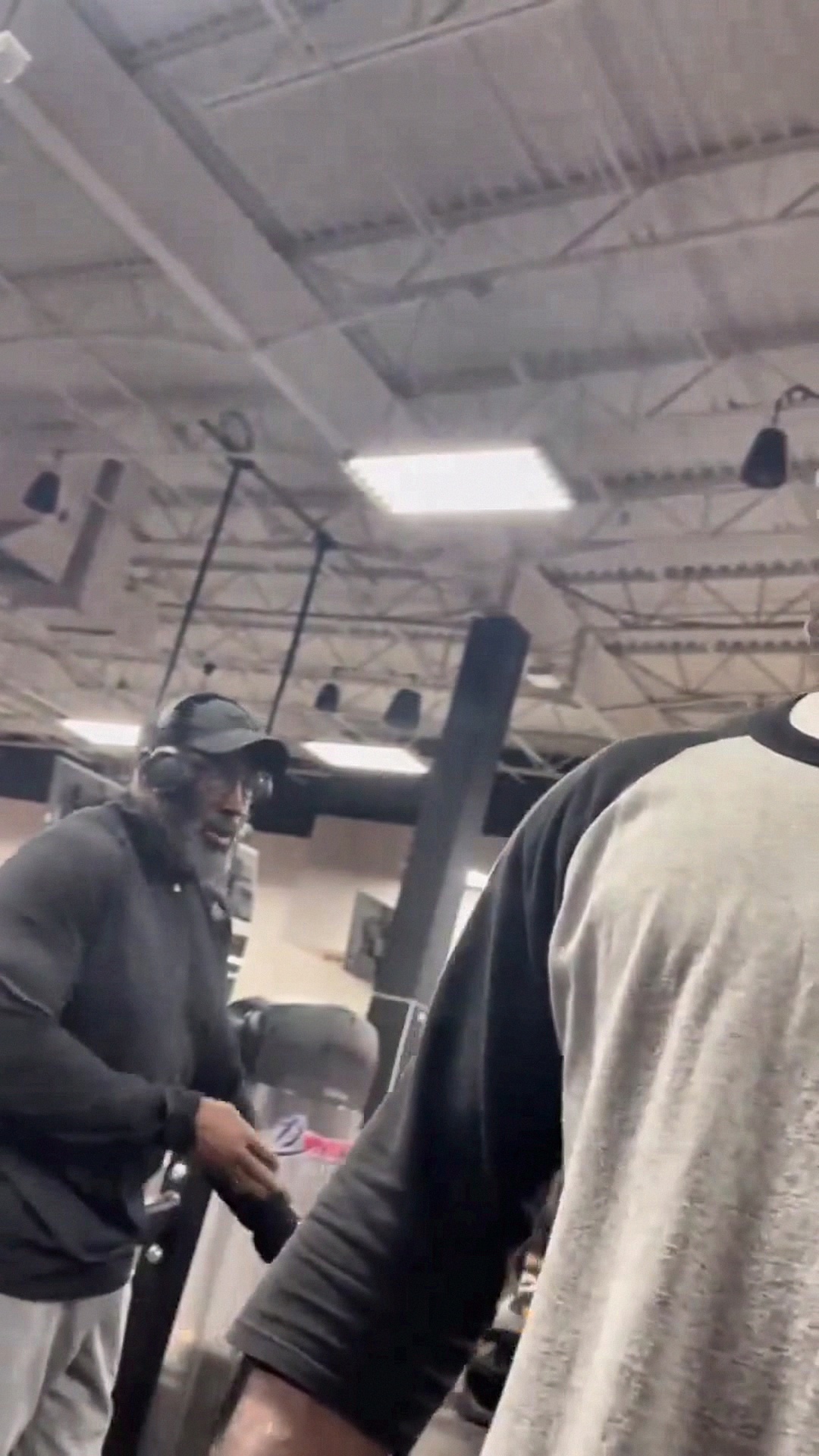
- The recording originates from a handheld device held by a gym patron, capturing a close-up perspective of an approaching male member wearing headphones.
- The member closes distance rapidly, positioning himself within inches of the camera and gesturing toward the device in an apparent demand to cease recording.
- The setting is a commercial fitness facility with visible strength-training equipment, overhead lighting, and mirrored walls, indicating a semi-public interior space.
- No law enforcement or facility staff intervention is visible in the recorded sequence, leaving resolution to the parties and the operator's internal policy framework.
What the Recorded Footage Captures: Chronological Breakdown
The footage opens in a tight, low-angle frame dominated by the torso and face of a bearded male member wearing over-ear headphones and a raglan-style shirt with a red graphic. The camera is held at chest height by the operator, producing an intrusive proximity that immediately establishes the tension. The member's mouth is open in mid-speech, and his gaze is directed downward toward the lens rather than at a distant point, confirming he has identified the recording device and its operator.
As the sequence progresses, the camera pulls back slightly, revealing the broader gym floor. The member steps laterally from behind a structural pillar, now fully visible in a black quarter-zip pullover, a dark baseball cap, and glasses. His posture is upright and forward-leaning, and his left arm extends toward the camera with fingers spread in a stopping gesture. The background shows cable machines, weight racks, and other patrons, confirming the encounter occurs in an open, occupied training area rather than a private alcove.
The third phase of the recording shows the member at close range again, his hand raised with the palm facing the lens and his thumb extended, a gesture commonly interpreted as a demand to halt. His facial expression is animated, and his head is tilted slightly back, consistent with vocal projection. The operator's fingers briefly enter the frame at the lower edge, indicating the camera is being adjusted or held defensively. The footage terminates without a visible physical strike, weapon, or third-party separation, leaving the verbal content and the parties' intent as the central evidentiary questions.
Finally, a lateral frame captures the member in profile, headphones still in place, moving through the gym floor. This shot establishes continuity: the same individual, same attire, and same facility, but now at a distance that suggests the immediate confrontation has either concluded or transitioned into a disengagement phase. The absence of staff in this final frame is notable, as it underscores the operator's reliance on member self-regulation rather than active floor supervision.
Corporate Liability and Critical Blind Spots
The evidentiary record is materially incomplete. The footage begins mid-encounter, meaning the preceding exchange, any request to stop recording, and the operator's initial response are unrecorded. Whether the member articulated a specific privacy objection, cited a facility rule, or issued a threat cannot be verified from the available frames alone. Chain of custody for the video file is also undocumented; the clip's provenance, editing history, and distribution pathway remain unverified, which limits its utility in any formal complaint or civil proceeding.
The camera's first-person perspective introduces a structural bias. The operator controls framing, angle, and duration, and the lens captures only what the holder chooses to emphasize. The member's gestures, which appear aggressive in close-up, may read differently when viewed in the context of a full-body wide shot. Conversely, the operator's own conduct, including whether the camera was thrust into the member's personal space before the recording began, is entirely outside the frame. Any adjudication of fault based solely on this clip would rest on an asymmetric record.
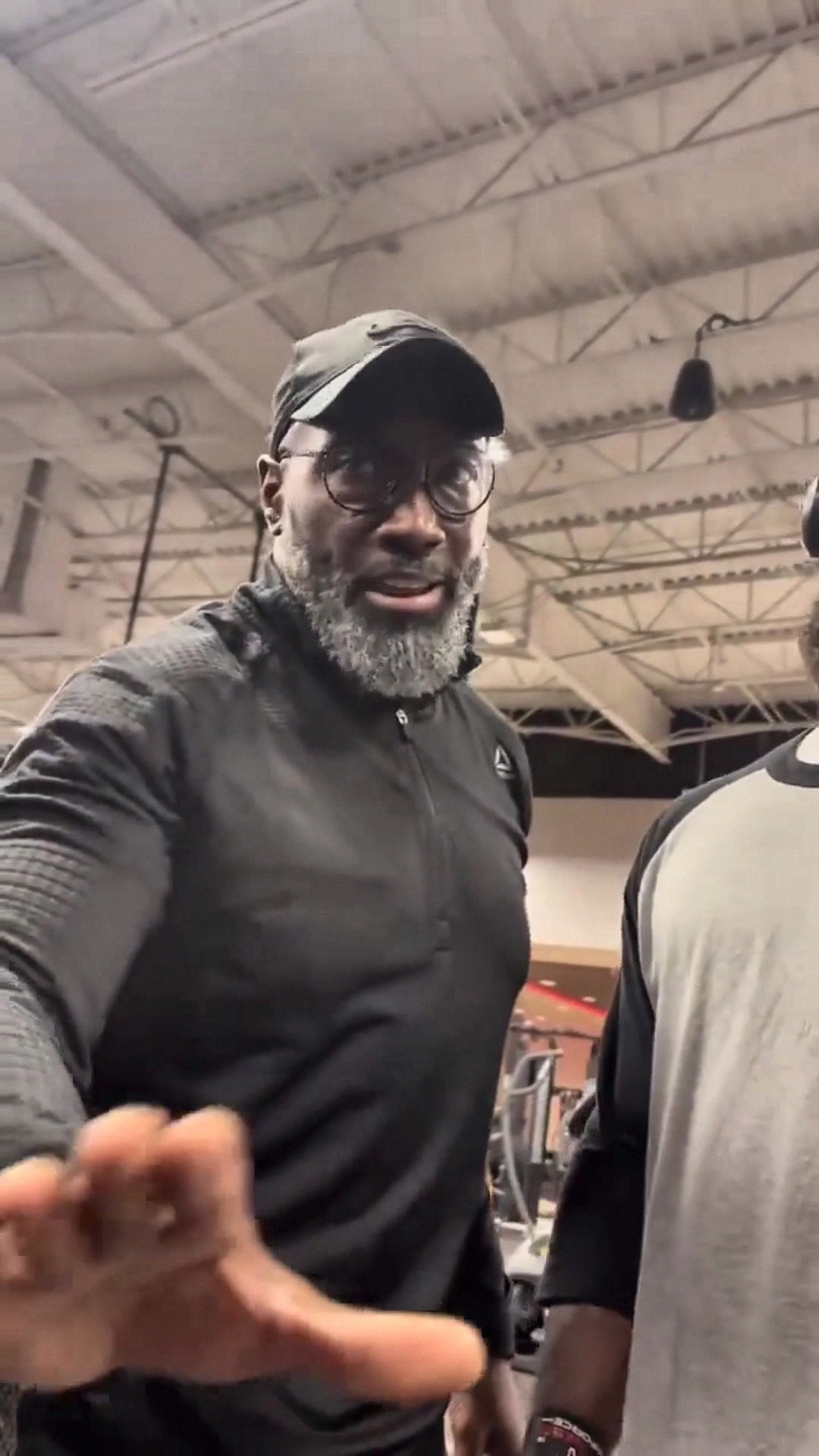
Commercial fitness operators face a compounded liability exposure in such disputes. Under premises liability doctrine, a facility owes a duty of reasonable care to invitees, which includes addressing foreseeable altercations. If the operator's member handbook permits personal recording but provides no enforcement mechanism, the facility may face claims of negligent supervision. If the handbook prohibits recording without consent, the operator may face contract-based claims for failing to enforce its own terms. Either scenario creates a documented gap between written policy and floor-level practice.
Statutory Framework and Protocol Analysis
Legal Distinction: In the United States, recording in a commercial gym is generally governed by state wiretap and eavesdropping statutes, which vary between one-party and all-party consent regimes. One-party consent states permit recording by a participant to the conversation; all-party consent states, such as California and Florida, require the consent of all parties to a confidential communication. A gym floor is typically not a confidential setting, which weakens privacy-based objections, but separate tort doctrines, including intrusion upon seclusion and assault, may apply if the recording is physically aggressive or threatening.
Beyond recording law, the encounter implicates the facility's contractual duty of care and its workplace safety obligations toward employees and independent contractors present on the floor. Gym policies commonly reserve the right to revoke membership for conduct that disrupts operations, but enforcement depends on staff presence and documented incident reporting. The absence of visible staff intervention in this sequence raises a compliance question: whether the operator's supervision model is adequate for a space where members record freely and disputes can escalate within seconds.
Scroll down for the full investigative report below ↓
| Incident Parameter | Governing Legal Standard & Judicial Protocol |
|---|---|
| Recording in a semi-public gym | State eavesdropping statutes; one-party vs. all-party consent frameworks |
| Physical proximity and gesturing | Assault and menacing statutes; objective threat standard |
| Facility supervision duty | Premises liability; reasonable care toward invitees |
| Membership policy enforcement | Contract law; implied covenant of good faith |
| Incident documentation | Spoliation doctrine; preservation of video evidence |
| Staff response protocol | Workplace safety standards; internal incident reporting |
| Personal privacy objection | Intrusion upon seclusion tort; reasonable expectation standard |
Read more:
Read more: Los Angeles Federal Vehicle Confrontation: Liability and Legal Gaps →
Core Questions and Institutional Review
- Did the facility's membership agreement contain an enforceable recording or consent clause, and was it communicated to both parties prior to the incident?
- Should the operator have deployed floor staff or signage to mediate recording disputes before they escalated to physical proximity?
- What evidentiary weight should be given to a first-person recording that omits the operator's own conduct preceding the confrontation?
- If a civil claim arises, which party bears the burden of establishing consent, and how does the missing pre-recording context affect that burden?
The systemic impact of this incident extends beyond a single gym floor. As personal recording devices become ubiquitous in commercial spaces, operators across retail, fitness, and hospitality sectors face a widening gap between written policy and enforceable practice. The absence of a uniform federal standard leaves each facility to navigate a patchwork of state statutes, tort doctrines, and contractual terms. For members and operators alike, the lesson is procedural: documented policies, visible staff presence, and clear consent protocols are not administrative formalities but the first line of defense against liability. Without them, every smartphone becomes a potential exhibit, and every confrontation a potential docket entry.
LATEST DEVELOPING INCIDENT
An even more shocking incident just erupted hours ago that has stunned onlookers nationwide. Full investigative breakdown and on-scene evidence documented below.
BREAKING: READ NEXT SHOCKING INCIDENT – LATEST CASE ↓
Chicago Federal Immigration Facility: Protest Escalation Tests Jurisdictional Lines and Site Safety Protocols
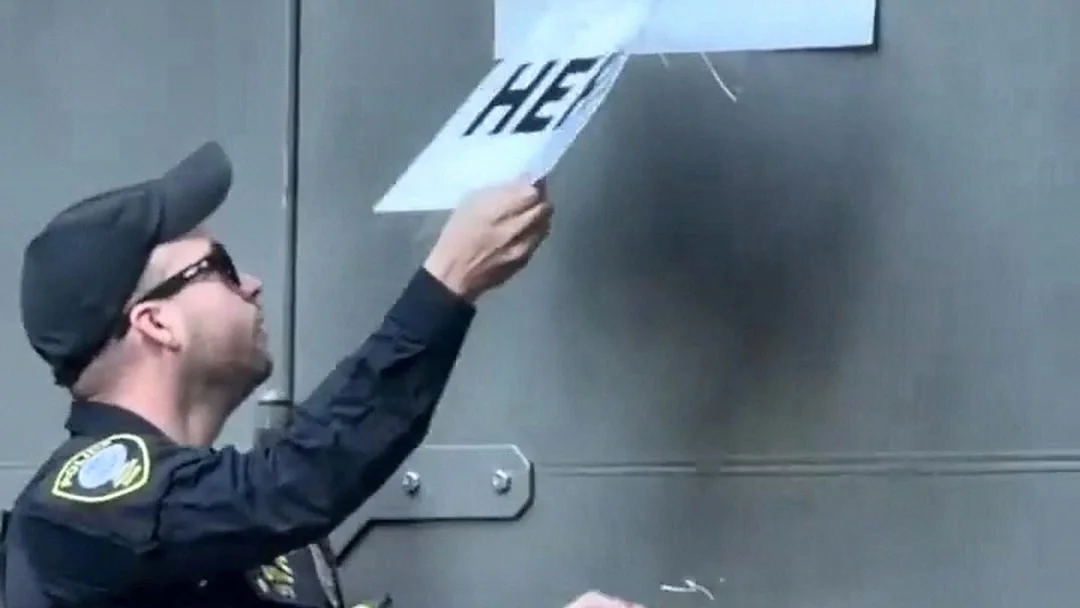
CHICAGO — A recorded confrontation outside the federal immigration building in downtown Chicago is drawing scrutiny over the boundaries between protected public assembly and operational security at a government facility. The footage captures a fluid, volatile scene that raises foundational questions about institutional duty of care, property authority, and how federal protective services manage escalating tensions at permanent holding sites.
- The setting is the exterior of a federal immigration processing and detention facility in downtown Chicago, which has become a recurring gathering point for demonstrators.
- The captured sequence centers on uniformed inspection officers physically interacting with posted signage affixed to a metal door before being pulled back toward a barricade.
- A second officer extends his arms in a calming, de-escalation posture toward the crowd, while a civilian woman and a bearded man are recorded in close proximity to the security perimeter.
- The core legal tension involves the scope of lawful protest activity against the facility's statutory mandate to maintain secure access and unimpeded operations.
What the Recorded Footage Captures: Chronological Breakdown
The footage opens at a tight, low-angle perspective that compresses the visual field: a bearded man in a dark jacket and khaki trousers stands alongside a woman wearing a black beanie and a sweatshirt bearing oversized white lettering. They are positioned near a red-and-white traffic barrel marking the secured zone, suggesting a contested boundary between the public sidewalk and a controlled operational area. The camera's proximity to the subjects produces a claustrophobic effect, emphasizing the physical overlap between demonstrators and the security perimeter.
In the next sequence, the frame pivots to a wide steel door where two officers in dark tactical vests and sunglasses are stationed. One officer stands to the left with his hands open and raised in a gesture aimed at the crowd, while his partner on the right extends a hand outward in a parallel calming motion. The red traffic barrel remains in the foreground as a fixed marker of the restricted line. The officers' body language suggests an attempt to establish verbal control before physical intervention.
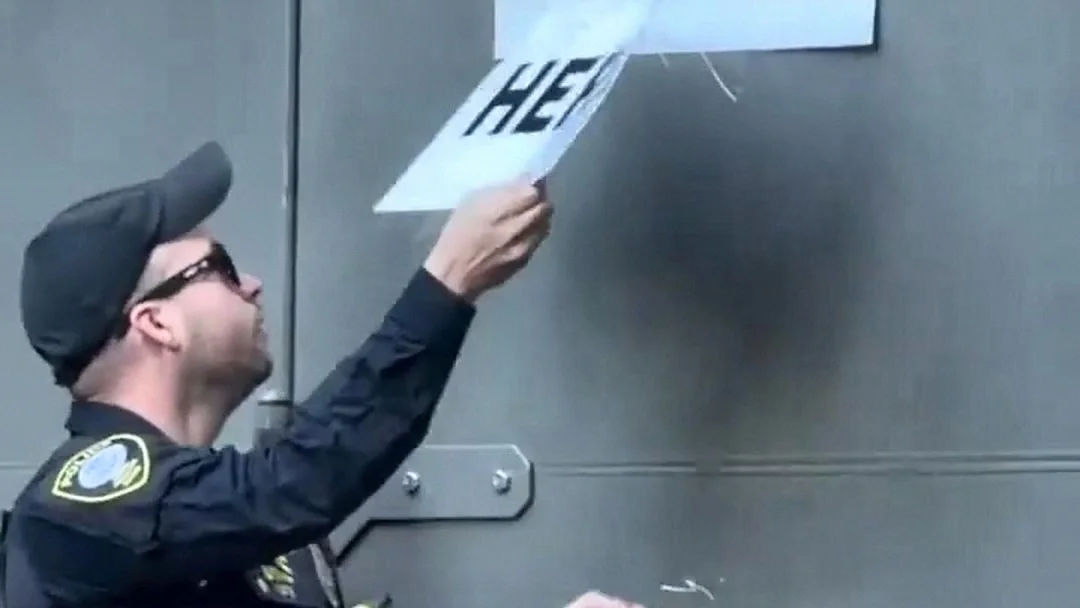
The evidentiary core arrives when a paper sign bearing the words "HUMAN TRAFFICKING" is shown adhered to the door; an officer raises a gloved hand and tears the paper downward, separating the sign from the metal surface. At this juncture, the footage shows a rapid shift in the officer's posture. He bends at the waist, his vest-mounted gear swinging forward as he strikes a bracing stance over the barrel, while his partner watches. The sequence compresses the critical moment without a clean reveal of what triggered the abrupt movement.
A subsequent view shows the officer holding the crumpled remains of the sign, his expression concealed behind dark sunglasses, while a civilian figure in the lower left edge of the frame appears to move toward him. The recording halts before any verbal exchange or formal enforcement action is captured, leaving the confrontation suspended at its peak of tension.
Corporate Liability and Critical Blind Spots
The most significant evidentiary limitation is temporal: the clip begins mid-confrontation, with no record of how the sign was affixed, whether demonstrators were warned, or what verbal instructions preceded the physical removal. Without that prelude, any legal assessment of the officers' conduct remains incomplete and vulnerable to competing interpretations from both sides of the dispute.
Perspective bias is also acute. The handheld camera operates from within the crowd, a vantage point that inherently favors the demonstrators' framing and obscures whether officers faced simultaneous hazards behind the lens. Viral assertions circulating with the clip have not been independently verified against official logs, incident reports, or body-worn camera footage, which would constitute the actual chain of custody for any administrative review.
The financial and institutional exposure here is real but often understated. Facilities that host recurring protests face elevated costs for protective details, perimeter barriers, overtime deployment, and litigation risk if enforcement actions are later deemed disproportionate. For federal landlords and contracted security vendors, each incident can trigger insurance claims, compliance audits, and contractual renegotiation over safety standards.
Statutory Framework and Protocol Analysis
Legal Distinction: Property-based removal of unapproved signage on a federal facility door is generally an administrative and security matter rather than a criminal one, but physical engagement with members of the public at the perimeter invokes distinct standards for reasonable force, protected assembly, and the duty to maintain safe egress.
Federal protective services operate under a layered mandate: secure the building, protect personnel, and preserve public safety without unlawfully suppressing peaceful assembly. The protocols require documentation of any physical contact with civilians, and administrative review of signage removal and crowd-control decisions. Evidence handling is equally critical: once a sign is removed, it becomes potential evidentiary material and should be logged, photographed, and retained rather than crumpled and discarded.
For the private entities involved in facility management and security contracting, the exposure flows through duty-of-care obligations. Contractors can face liability exposure for inadequate crowd management planning, improper barrier placement, or failure to de-escalate. The absence of clear, pre-established separation between demonstrators and entrances is the kind of planning gap that regulators and plaintiffs' counsel routinely scrutinize after an incident garners public attention.
| Incident Parameter | Governing Legal Standard & Judicial Protocol |
|---|---|
| Physical removal of posted signage | Federal property regulations and site access rules governing unapproved attachments |
| Forcible contact with civilians | Reasonableness and proportionality standards under civil rights jurisprudence |
| Assembly at a public facility perimeter | First Amendment protections balanced against operational security requirements |
| Evidence handling of removed material | Chain-of-custody and retention obligations for administrative review |
| Contractor crowd management | Duty-of-care and workplace safety standards for security personnel |
| Deployment of protective details | Documented justification and supervisory approval for escalated security |
Read more: {NOIBO}
Core Questions and Institutional Review
- Did the officers issue documented warnings and provide demonstrators a reasonable opportunity to comply before any physical engagement?
- Was the physical contact with the door and the surrounding perimeter proportionate to the actual security threat at the moment of recording?
- What review mechanism exists to audit crowd-management decisions at facilities that generate recurring protests and repeated enforcement engagement?
- Will the removed sign and the surrounding footage be preserved and entered into the official record, ensuring fair adjudication of any subsequent complaint?
The broader systemic impact extends beyond this single confrontation. Downtown federal facilities are becoming permanent pressure points where constitutional expression, immigration enforcement, and urban safety intersect. Each recorded incident feeds into a larger narrative that shapes public confidence in institutional restraint. For courts, regulators, and the contracting firms managing these sites, the lesson is consistent: the absence of written protocols and preserved evidence creates legal ambiguity that costs far more to resolve than it would have cost to prevent.
Practical Takeaways
- Institutional security at contested federal sites requires documented, auditable de-escalation protocols, not improvised action.
- Removed material must enter a formal evidentiary chain rather than being discarded at the scene.
- Contractors and facility managers should model crowd-management liability before events escalate.
- Preserved body-worn and fixed-camera footage is the decisive factor in any subsequent administrative or civil review.
- Clear perimeter design reduces physical overlap and lowers the risk of preventable confrontation.




One comment on “Gym Recording Confrontation: Liability and Consent Dispute”