




WATCH: On-scene video documentation is embedded below →


LISTEN TO THIS ARTICLE


Audio Narration • English (US)

LOS ANGELES — A viral video captured on a busy Los Angeles street has ignited a fierce debate over public safety protocols and the limits of federal enforcement authority. The footage shows a lone male subject standing in the roadway, directly confronting a moving federal vehicle while shouting verbal threats, yet remaining un-detained as the situation de-escalated. The incident raises profound questions about the legal thresholds for intervention, the liabilities faced by law enforcement agencies during civil unrest, and the regulatory blind spots exposed when aggressive public conduct is met with apparent restraint.
Los Angeles Federal Vehicle Standoff: Unrest in the Streets Raises Questions of Liability and Enforcement Gaps
INCIDENT OVERVIEW & KEY TAKEAWAYS:

  • Jurisdictional Setting: The events unfold on a multi-lane thoroughfare in Los Angeles, California, characterized by heavy traffic, palm trees, and a nearby intersection controlled by traffic lights. The presence of marked federal vehicles indicates an active law enforcement operation within a densely populated urban corridor.
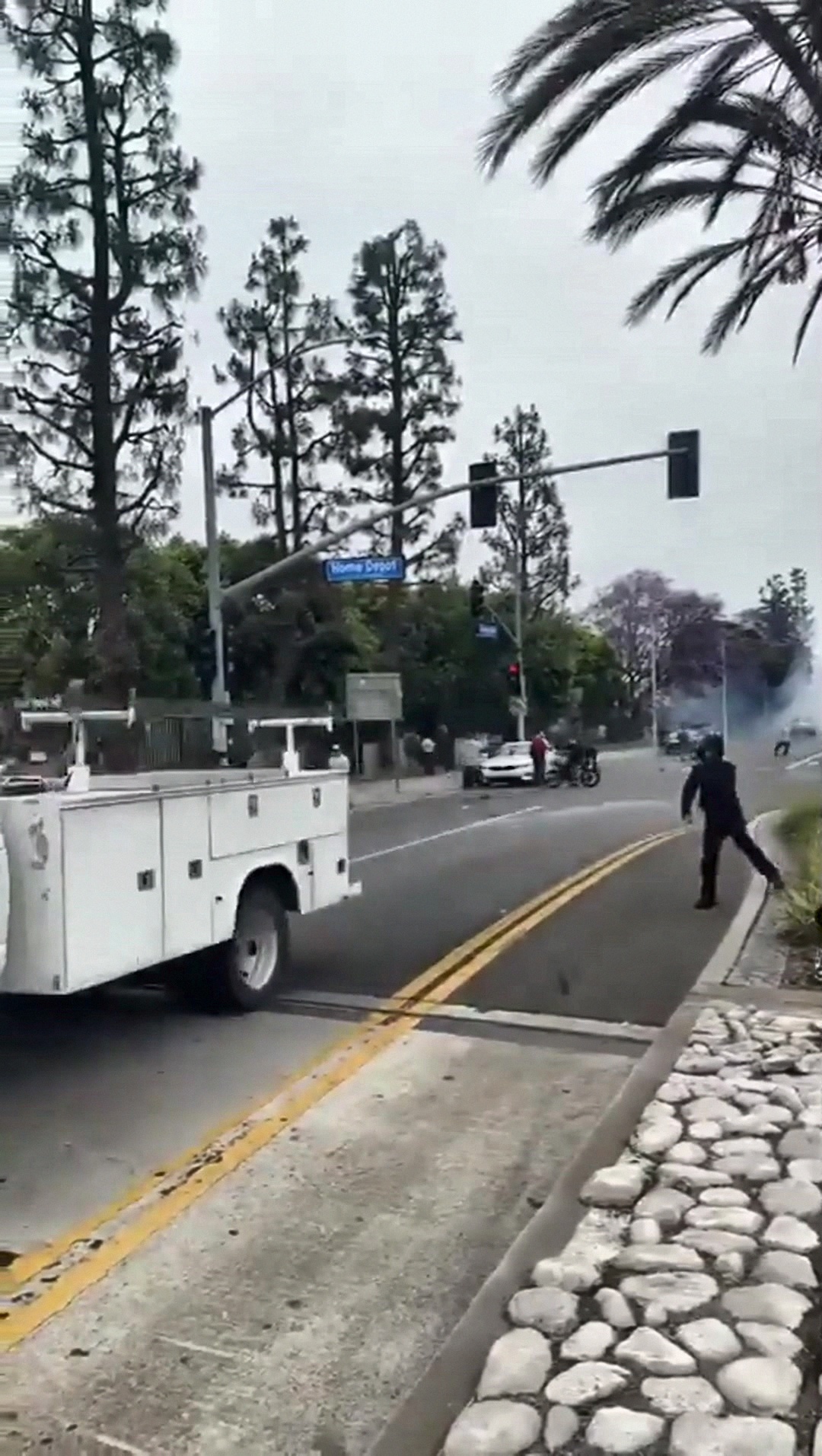
  • Recorded Escalation: An adult male is observed standing in the middle of the road, lunging toward a white pickup truck and a secondary utility vehicle, appearing to shout and physically gesture in a threatening manner toward the occupants.
  • Law Enforcement Response: Despite the aggressive posturing and apparent verbal threats, the federal agents inside the vehicles maintain a defensive posture, slowing their vehicles but not immediately exiting to effect an arrest, creating a visible tension between state authority and street-level defiance.
  • Legal and Regulatory Repercussions: The footage has triggered widespread public outcry regarding the perceived lack of immediate accountability, prompting discussions about the use-of-force continuum, federal rules of engagement, and the legal definition of assault on a federal officer.

What the Recorded Footage Captures: Chronological Breakdown

The video opens with a wide-angle perspective of a palm-lined Los Angeles street, establishing a chaotic environment with pedestrians and vehicles scattered across the roadway. At the 10% mark, the camera focuses on a male subject dressed in a black t-shirt and light-colored pants, who is positioned dangerously close to the double yellow lines. His body language is rigid and confrontational, facing the oncoming flow of traffic. A white pickup truck, clearly marked with federal insignia, approaches slowly, navigating around the subject who refuses to yield the right of way.

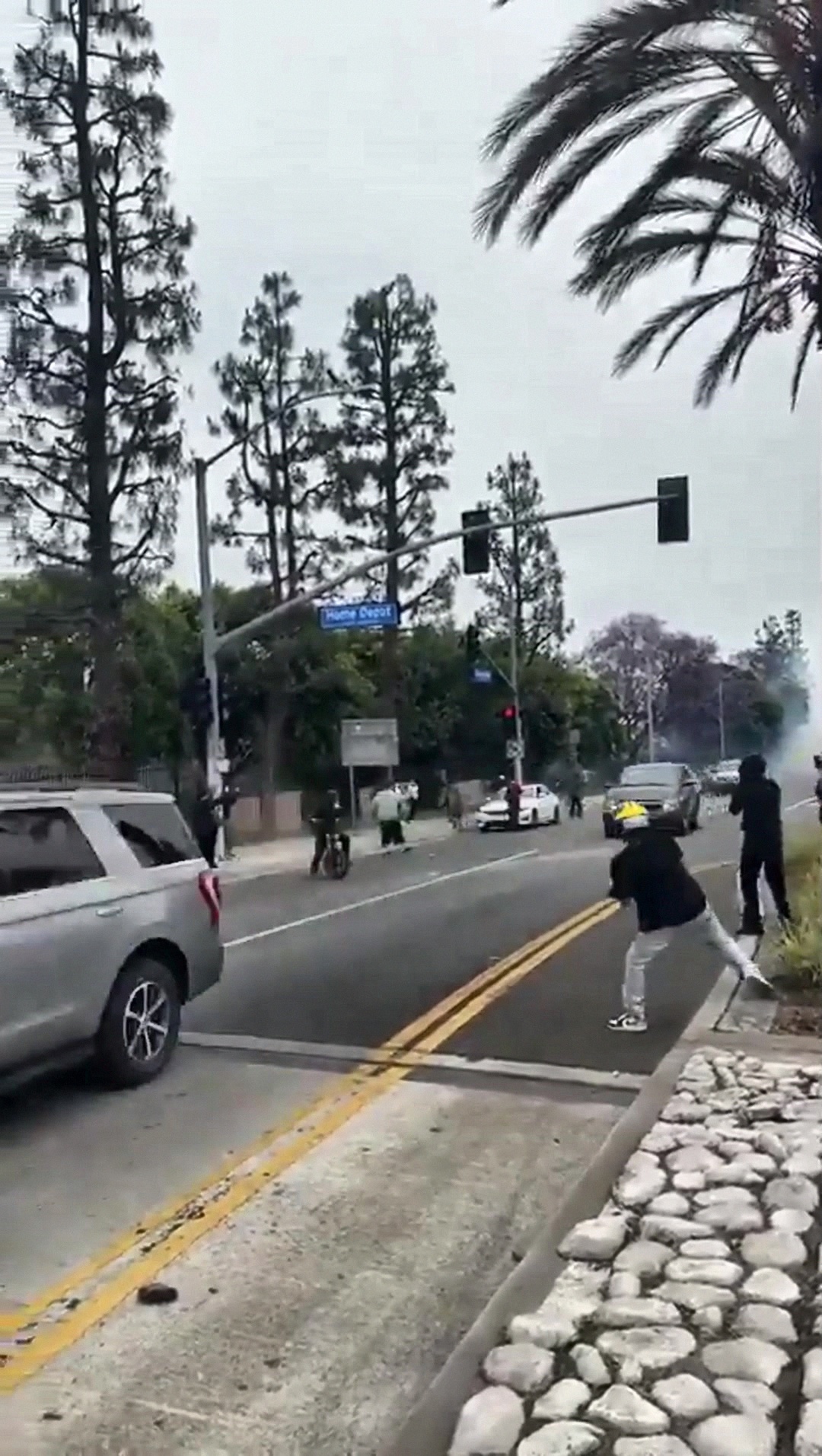
As the footage progresses into the 40% mark, the tension spikes dramatically. The subject is seen lunging toward the passenger side of the white truck, his arms raised in a threatening gesture that suggests he is attempting to strike or intimidate the driver. The vehicle momentarily halts, creating a physical blockade in the intersection. Behind the truck, a second utility vehicle with a white bed is visible, also slowing down in response to the obstruction. The camera angle provides a clear view of the subject's aggressive posture, yet the agents remain inside their vehicles, observing the threat without immediate physical engagement.

By the 60% climax, the situation reaches a fever pitch as the subject continues to shout and move erratically in front of the convoy. The white truck begins to maneuver forward, attempting to bypass the subject, while the subject shifts his position to maintain his confrontation with the moving vehicle. The recorded audio captures the sounds of heavy traffic and the subject's vocalizations, though the specific dialogue is partially obscured by ambient noise. The visual evidence strongly suggests an attempt to obstruct a federal operation, yet the critical moment of physical contact is avoided, leaving a visual record of a near-miss incident.

In the final 90% of the footage, the vehicles successfully navigate past the subject, who remains standing in the street. The camera pans to follow the departing vehicles, capturing the subject's continued gesticulation toward the rear of the trucks. The lack of a physical arrest on camera serves as a jarring conclusion to the sequence, leaving the viewer to question the operational protocols that governed the agents' decision to disengage rather than detain.

Corporate Liability and Critical Blind Spots

The primary evidentiary limitation in this case is the absence of the events that transpired prior to the recording. It remains unclear what prompted the subject's initial aggression, whether an earlier interaction with law enforcement occurred, or if the subject was experiencing a medical crisis. The video, while visually dramatic, operates as a fragment of a larger narrative, leaving a significant gap in the chain of custody regarding the context of the confrontation. Without pre-incident footage, any assertion regarding the subject's motivations or the agents' prior actions remains speculative.

Furthermore, the perspective of the camera is limited to a single vantage point on the sidewalk. This angle obscures the interior of the federal vehicles, making it impossible to verify the agents' visual field, their communications with dispatch, or their assessment of the subject's threat level. Viral assertions that the subject was "attempting to kill" the agents rely heavily on the interpretation of his physical gestures, but the forensic record lacks a clear weapon or a definite physical strike, creating a gap between public perception and legal proof.
Los Angeles Federal Vehicle Standoff: Unrest in the Streets Raises Questions of Liability and Enforcement Gaps

From a liability standpoint, the federal agency involved faces a dual-edged sword. If the agents had used force, they would be subject to intense scrutiny regarding proportionality and the duty of care to bystanders in a crowded street. Conversely, by not intervening, they expose themselves to criticism regarding the failure to enforce the law and protect the public from an obviously erratic individual. The agency must navigate a complex regulatory framework where the preservation of life is balanced against the immediate need to neutralize a threat.

Statutory Framework and Protocol Analysis

Legal Distinction: Under 18 U.S.C. § 111, assaulting, resisting, or impeding certain federal officers is a felony. However, the use of force to effect an arrest must comply with the Fourth Amendment's objective reasonableness standard, as established in Graham v. Connor. The agents' decision to remain in their vehicles may reflect a tactical assessment that immediate physical confrontation presented a higher risk to the public than the subject's verbal threats.

Incident Parameter Governing Legal Standard & Judicial Protocol
Physical Obstruction of Vehicle 18 U.S.C. § 111 (Assault on Federal Officer) and local traffic codes regarding pedestrian interference.
Threatening Verbal Conduct First Amendment protections versus statutory prohibitions on "true threats" and disorderly conduct.
Use of Force Decision Graham v. Connor objective reasonableness standard; agency use-of-force continuum policies.
Vehicle Pursuit/Evasion Federal law enforcement motor vehicle safety protocols; local jurisdiction pursuit restrictions.
Public Safety Zone Duty of care to bystanders; tactical disengagement as a de-escalation strategy.
Evidence Chain Body-worn camera mandates; retention schedules for federal law enforcement recordings.

Compliance protocols for federal law enforcement emphasize de-escalation and the preservation of life, especially in urban environments where bystanders are present. The agents' decision to maintain a defensive posture and eventually drive away can be analyzed through the lens of institutional duty of care. By avoiding a high-speed pursuit or a physical altercation in the middle of a busy intersection, the agents may have minimized the risk of collateral injury, adhering to departmental policies that prioritize the safety of the surrounding community over the immediate detention of a non-armed aggressor.

However, this protocol analysis also reveals a critical institutional tension. The absence of a visible arrest can be interpreted as a breakdown in enforcement, potentially emboldening bad actors and undermining public trust in the rule of law. Legal standards require that any detention be based on reasonable suspicion, and the agents' decision to disengage suggests that they may have determined that the subject's conduct, while aggressive, did not meet the threshold for immediate physical intervention without backup. This calculated restraint is a standard component of modern policing, yet it stands in stark contrast to the public's expectation of swift justice.

Read more:

Read more: Colorado Man’s Dry-Eyed Interrogation in Wife’s Fatal incident Case →

Scroll down for the full investigative report below ↓

Core Questions and Institutional Review

  • What specific threat assessment protocols guided the federal agents' decision to remain inside their vehicles rather than detain the subject immediately?
  • How does the agency reconcile the statutory prohibition against obstructing federal officers with the tactical imperative to avoid a violent confrontation in a crowded public space?
  • What internal review mechanisms are in place to evaluate whether the agents' non-intervention was a sound tactical choice or a failure to enforce the law?
  • Will the subject be subsequently identified and charged, or does this footage represent a widening gap between recorded criminal conduct and actual legal accountability?

The systemic impact of this incident extends beyond the immediate street corner. It serves as a flashpoint in the broader national conversation about the limits of law enforcement authority and public order. The video challenges the public's understanding of how federal agents operate in hostile environments, where the mere presence of a badge does not guarantee compliance. The apparent impunity of the subject, captured in a moment of defiance, fuels a narrative of regulatory impotence that can have lasting consequences for civic trust.

Ultimately, this case underscores the complexity of modern enforcement, where every action and inaction is subject to intense public scrutiny. The financial and legal liabilities for the agency involved are significant, not only in terms of potential civil claims but also in the reputational costs of appearing ineffective. As the footage circulates, the institutional review must prioritize transparency, ensuring that the operational decisions made on that street are legally justified and consistent with the highest standards of public safety.


DEVELOPINGFOLLOW-UP INVESTIGATION REPORT

Related documented case details, verified on-scene evidence, and statutory liability analysis continued below.

An even more shocking incident just erupted hours ago that has stunned onlookers nationwide. Full investigative breakdown and on-scene evidence documented below.
CONTINUE READING: NEXT INVESTIGATIVE DOSSIER →
NEXT INVESTIGATIVE REPORT →

Muskegon County Courtroom: Fatal Domestic Altercation Case Erupts Into Security Breach During Preliminary Hearing

MUSKEGON, Mich. — A routine preliminary examination in a Muskegon County courtroom collapsed into a security emergency when the adult son of a fatal incident victim vaulted a physical barrier to confront the man accused of fatal altercations his mother. The incident, captured by overhead courtroom cameras, raises immediate questions about courthouse security protocols, judicial risk management, and the treatment of victims' families inside facilities that are legally obligated to guarantee safety for all participants.

The underlying criminal matter concerns the May 19, 2019, altercation death of Jamie Thomas-Flowers, 50, allegedly at the hands of her husband, Vashon Flowers, 46, of Muskegon Heights. Flowers was charged with open fatal incident and as a four-time habitual offender. The courtroom confrontation occurred during a highly charged procedural hearing, exposing the operational fault lines between victim advocacy and institutional security.

INCIDENT OVERVIEW & KEY TAKEAWAYS:

  • The underlying offense took place on Sunday, May 19, 2019, at approximately 6:30 a.m. in the 1300 block of Mona Street, Muskegon Heights, Michigan, where Jamie Thomas-Flowers was shot multiple times and pronounced dead at the scene.
  • Vashon Flowers was arraigned on Monday, May 20, 2019, before Muskegon County District Judge Raymond Kostrzewa on a charge of open fatal incident and an habitual offender enhancement; he was held without bond in the Muskegon County Jail.
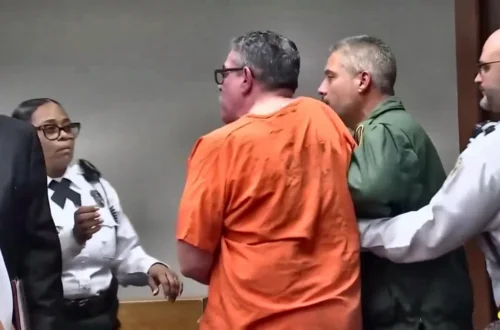
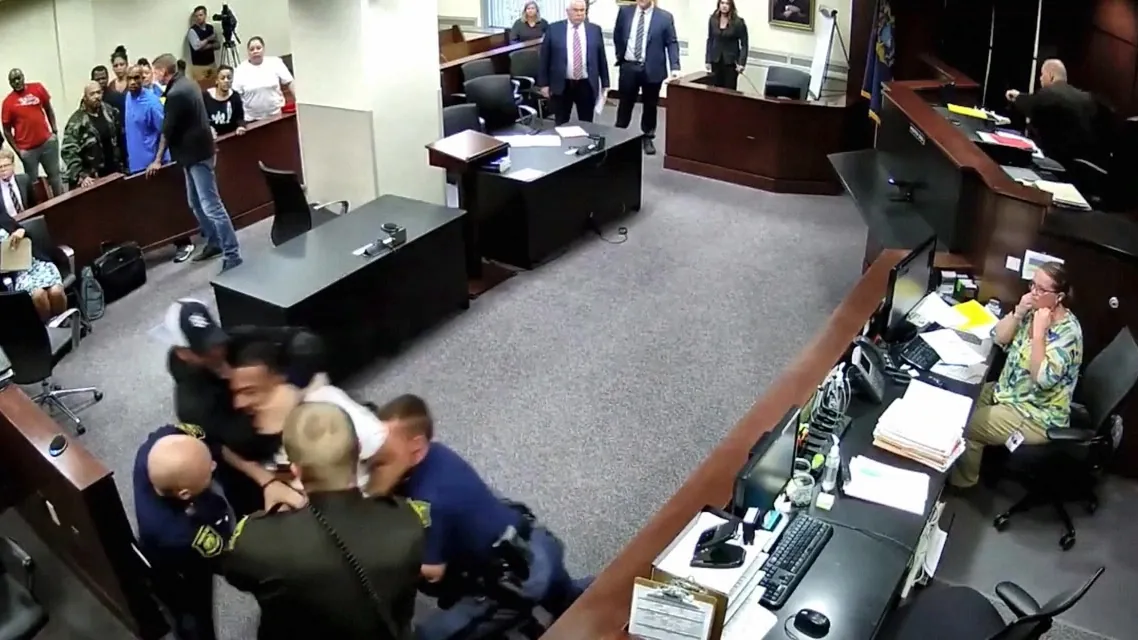
  • During a subsequent preliminary examination in Muskegon County District Court, the victim's adult son breached the courtroom barricade and moved toward the defendant, forcing bailiffs to physically restrain and remove him in handcuffs.
  • No criminal charges arising from the courtroom breach were publicly detailed, and the defendant's case advanced toward trial, with testimony beginning on January 15, 2020.

The sequence represents a dual-track legal exposure: a first-degree fatal incident prosecution operating under strict evidentiary standards, and a parallel administrative security failure inside a facility designed to contain volatile emotional and physical conduct.

What the Recorded Footage Captures: Chronological Breakdown

The overhead surveillance angle provides an unforgiving, high-contrast chronological record of the breach. In the opening frames, a sprawling courtroom layout is visible: a raised judicial bench at the upper right, a court reporter's workstation in the foreground, and two large counsel tables positioned between the bench and the public gallery seating along the left and rear walls. The gallery is populated with spectators, several wearing bright red and blue clothing. The defendant is positioned near the front-center counsel tables, flanked by a dark-suited attorney. The victim's son is visible near the center aisle, on the gallery side of the wooden railing that separates the public area from the well of the court.

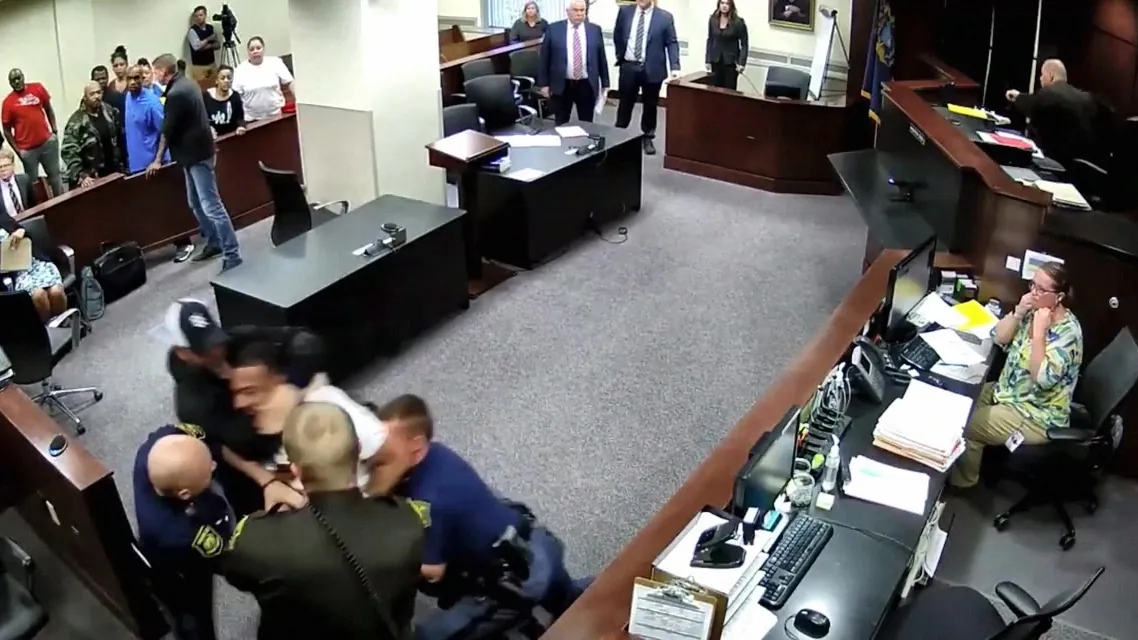
At the moment of escalation, the son accelerates into the walkway between the counsel tables and the marshal's row. The footage shows him launching his body over the wooden railing, his arm extended downward as he clears the barrier. A uniformed bailiff immediately reacts, covering the ground between the counsel table and the gallery in a direct diagonal intercept. The third frame captures the physical collision: the bailiff wraps around the son's midsection, and a second plainclothes or uniformed officer joins from the right, creating a coordinated two-man restraint. The son's momentum carries the group toward the left counsel table, where a third officer engages.

The fourth and fifth frames document the stabilization phase. Officers pin the son to the gray carpeted floor near the left counsel table, forming a tight kneeling containment formation around him. The defendant has been moved rearward toward the marshal's desk on the right side of the courtroom. A woman seated at the court reporter's desk remains at her station, leaning slightly back while observing the takedown. In the final frame, the courtroom is mostly upright again, but officers remain crouched around the son as a uniformed deputy stands over the restrained group.

Corporate Liability and Critical Blind Spots

The primary evidentiary limitation of the footage is that it cannot establish the verbal triggers or the content of the proceeding in the moments immediately preceding the son's decision to move. The overhead audio is not a complete admissible record, and the body language captured on video cannot be used to infer whether any specific statement, eye contact, or gesture by the defendant precipitated the breach. The frame-by-frame record also does not resolve whether the son acted in direct response to something said in the well of the court or whether his actions were premeditated upon entering the building.

A second blind spot concerns the chain of custody and the conduct of the bailiffs during the physical restraint. The footage shows a forceful takedown, but it does not capture the specific degree of force applied, the duration of the restraint, or any medical evaluation that followed. In custodial and judicial settings, these elements of the record are essential for assessing whether a reasonable use of force was applied. The fact that the son is removed in handcuffs is documented, but the absence of a filed criminal complaint in the public records available limits the ability to verify whether the restraint was subjected to a formal administrative review.

A third limitation is institutional. The camera angle removes the depth between the gallery row and the defendant's seat. Viral framing of the incident omits the critical spatial detail that the barred railing was the only line of separation. Whether that design met prevailing courthouse safety standards is not a question of guilt or innocence, but a question of facility safety engineering and bailiff staffing ratios during high-conflict proceedings.

Statutory Framework and Protocol Analysis

Legal Distinction: The son's leap over the courtroom railing exposes him to a potential finding of civil or criminal contempt of court and obstruction of justice under Michigan law. Nothing in the evidentiary record establishes that the defendant's underlying fatal incident charge is mitigated by the victim's family's conduct, and the two proceedings proceed on separate legal tracks.

Michigan's judicial branch operates under courtroom security protocols that classify the well of the court as a restricted zone. The physical barricade serves as an architectural and legal boundary, and breach of that boundary during an active proceeding constitutes a direct challenge to the court's authority. Under state law, judges retain broad authority to hold individuals in criminal contempt for conduct that disrupts proceedings. The absence of reported charges against the son raises questions about prosecutorial discretion in victim-adjacent disturbances.

The defendant's status as a four-time habitual offender creates a separate statutory layer. Michigan's habitual offender statutes permit enhanced sentencing on the underlying open fatal incident charge, meaning the court's management of the security breach could interact with the defendant's due process rights if the environment becomes materially prejudicial. Courts have consistently held that a defendant's right to a fair trial requires that the physical conduct of victims' families be restrained without undermining the dignity of the family's presence.

Incident Parameter Governing Legal Standard & Judicial Protocol
The home on Mona Street, Muskegon Heights Scene of fatal domestic altercation; evidence secured by Muskegon Heights Police Department
Arraignment on May 20, 2019 Open fatal incident charge and habitual offender enhancement; bond held without
Courtroom barricade breach Contempt of court and obstruction exposure for the son
Physical restraint by bailiffs Reasonable force standard for courtroom security personnel
Preliminary examination proceedings Victim's family's right to be present, balanced against courtroom safety
Defendant's presence during breach Due process requirement of an orderly and non-prejudicial environment
Prosecutorial handling of the son Discretionary charging decision by the Muskegon County Prosecutor's Office

The broader compliance question is whether the courthouse's pre-hearing screening adequately considered the risk of an intrafamily confrontation during a preliminary examination. Victim-advocate protocols advise separate entry corridors and staggered seating for families of fatal incident victims, especially where the accused remains in the room. In this instance, the son's presence in the gallery and his ability to clear the rail suggest that the courtroom's access control was not calibrated to the emotional risk profile of the hearing. Whether the breach triggered a facility-level security audit has not been publicly documented.

Core Questions and Institutional Review

  • Did the Muskegon County courthouse conduct a post-incident security review of its courtroom access controls and bailiff deployment during high-risk family violence proceedings?
  • What legal standard applies to the son's conduct, and why were no charges publicly announced following the takedown?
  • Was the defendant's due process environment compromised by the visible breach, and did the court consider any juror or witness exposure in subsequent trial proceedings?
  • How were the victim's family members treated after the restraint, and did the facility offer support services consistent with its duty of care?

The sequence of events underscores a systemic tension that financial and legal observers have flagged in courthouse risk management: the most dangerous moment in a high-conflict case is often not the offense itself but the procedural hearing where the parties are forced into the same confined space. For Muskegon County, the visible breach is a data point that should compel a documented review of courtroom security protocols, the assignment of additional personnel to family violence proceedings, and a transparent accounting of how the family's legal rights were preserved after the disruption. Absent those measures, the same breach remains structurally possible in the next emotionally charged docket call.

Practical Takeaways

  • High-conflict family violence hearings require pre-screened access corridors and dedicated bailiff coverage beyond baseline staffing.
  • The courtroom barricade is both a physical and legal boundary; breaches demand documented review, not just immediate tactical response.
  • Victim's families holding lawful presence rights should be accommodated without compromising the safety of the well of the court.
  • Transparency around post-incident charging decisions is essential to public confidence in the court's neutrality.
  • Facility audits of courtroom layout and sightlines should be routine for proceedings involving domestic fatal incident defendants.

Sources

NEXT STORY16

Muskegon Courtroom Breach: Son Lunges at Mother’s Accused Killer

Overhead footage shows a victim’s son vaulting a Muskegon County courtroom barricade to reach his mother’s accused killer before bailiffs restrain him.

READ IN 16 MINREAD FULL STORY →

Read more

Senior Investigative & Legal Affairs Editor at FXVN Wire. Specializes in American constitutional law, regulatory compliance, and municipal liability analysis with over 14 years of legal journalism experience.

2 Comments on “Los Angeles Federal Vehicle Confrontation: Liability and Legal Gaps”

Leave a Reply

Your email address will not be published. Required fields are marked *