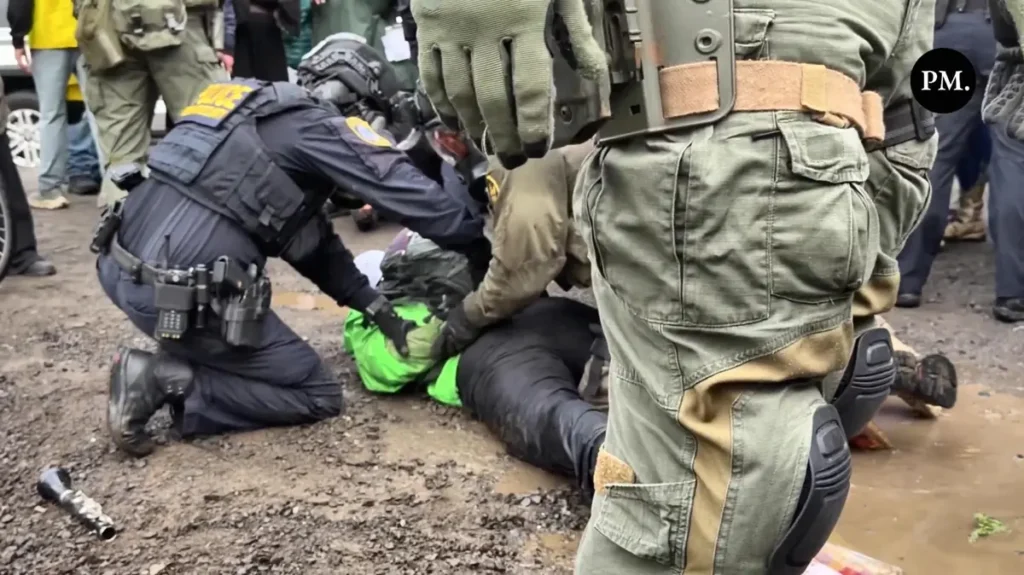
WATCH: On-scene video documentation is embedded below →
WASHINGTON – A recorded street-level detention has sharpened scrutiny over use-of-force protocols, crowd management, and the evidentiary record inspection officers are required to preserve during a public arrest. The footage, captured from a bystander vantage point, shows a man being driven backward into a residential wall moments before officers take him to the ground – an escalation that will now be measured against written standards for proportionality and de-escalation.
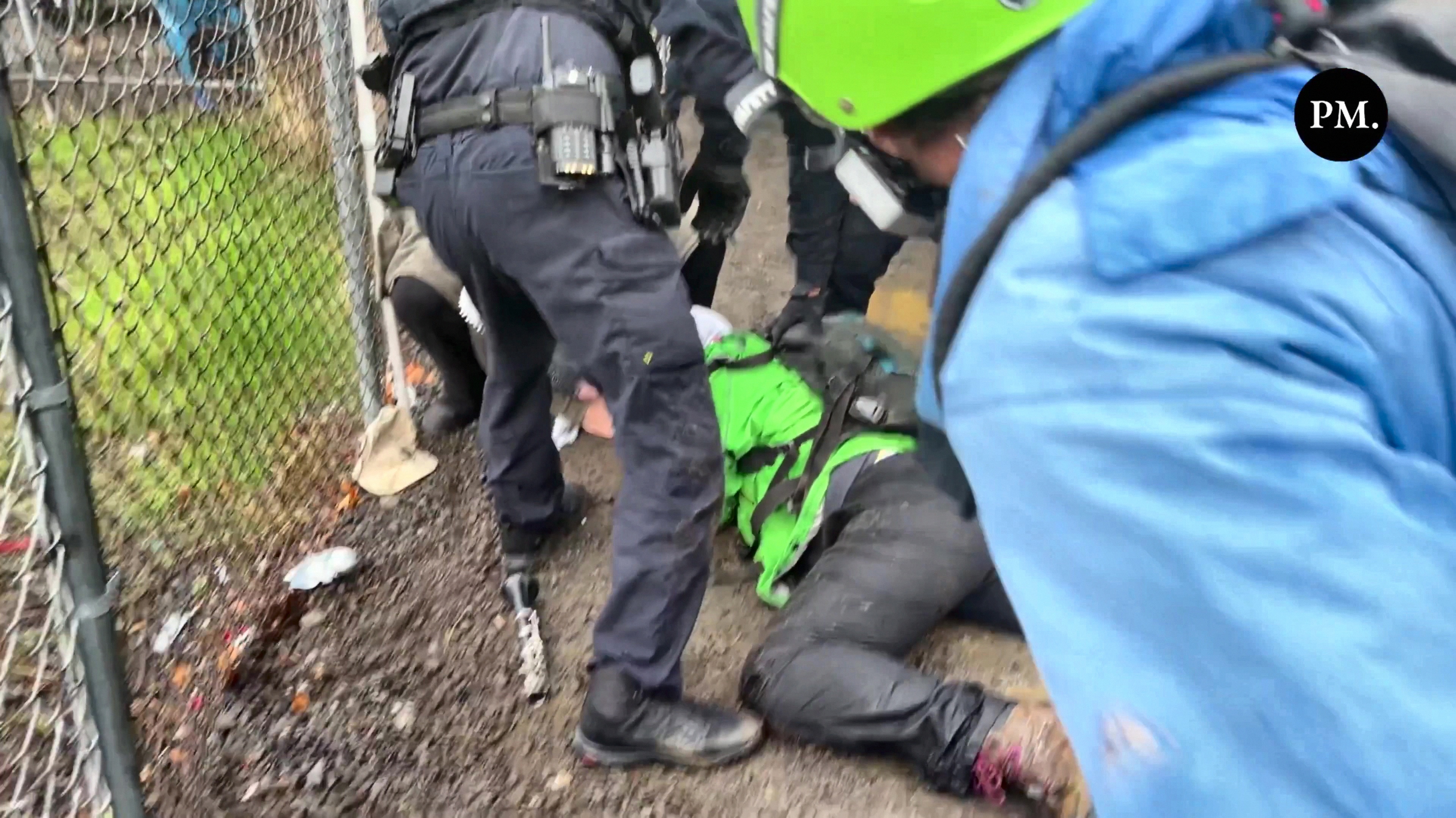
For compliance officers and civil-liability attorneys, the clip is less a public artifact than a documentation sample: it captures the instant of physical contact, the actor positions, and the ambient crowd response, all of which become exhibits in any subsequent administrative or judicial review.
- Jurisdictional setting: the encounter unfolds on a residential dirt-and-gravel shoulder beside a chain-link fence, with federal and local-style officers in tactical gear operating in an open public space rather than a controlled facility.
- Recorded escalation: a man visible in a bright green safety vest and helmet is shoved backward toward a house exterior, then brought to the ground by multiple officers.
- Law enforcement intervention: officers in dark blue police-marked uniforms and olive-and-tan tactical gear converge, with at least one kneeling to apply control holds while another secures the perimeter.
- Legal and regulatory repercussions: the incident raises questions under use-of-force policy, public-safety standards for crowd environments, and the duty to preserve footage and chain-of-custody records.
What the Recorded Footage Captures: Chronological Breakdown
Frames one through three establish the geography before the physical outcome becomes clear. The camera sits low and slightly behind the action, looking down a dirt shoulder where a chain-link fence runs along the left edge of the frame. A man in a bright green safety vest and a lime-green helmet is already on the ground, face-angled toward the fence line, while an officer in a dark blue uniform with "POLICE" lettering across the back kneels beside him.
A second figure in olive tactical trousers and knee pads dominates the right foreground, close enough to the lens that his belt and gear obscure part of the scene – a framing detail that matters, because it means the camera's most immediate witness position is also its most compromised.
By frames four and five, the detention is fully consolidated. The officer in dark blue is positioned low and forward, both hands engaged near the subject's upper body, while the tactical officer stands over the pair with a controlled stance. Additional personnel in olive gear are visible at the periphery, and a person in a blue jacket stands just outside the immediate cordon. The man on the ground remains prone, his posture fixed, with no visible resistance in the captured seconds.
What the audio layer adds is the crowd's reaction, which is contemporaneous and unmistakable. A voice says the man had simply been talking – "He literally was talking to them and they shoved him to the house" – before the chant of "Shame!" builds and repeats. That chant is not neutral observer commentary; it is an on-record verbal response captured simultaneously with the physical control, and it will be treated as such in any review of whether the force applied was proportionate to the perceived threat.
A critical evidentiary gap sits at the clip's exact opening. The shove itself is described by bystanders but not clearly filmed from a stable angle, because the camera is already tracking the aftermath. Whatever preceded that contact – the verbal exchange, any commands issued, warnings given, or grounds for detention – exists outside the frame. That unrecorded interval is now the single most contested portion of the record.
Corporate Liability and Critical Blind Spots
The dominant framing risk in this material is the assumption that the visible seconds constitute the whole event. They do not. A detention that begins off-camera cannot be evaluated for whether officers identified themselves, issued lawful commands, or escalated in response to specific conduct. Civil-liability analysis turns on exactly those steps, and the clip's camera angle – shot from behind and above a tactical officer's hip, with a standing figure partially blocking the left field – leaves the subject's hands, the officers' hands, and the point of initial contact all periodically occluded.
Chain-of-custody questions attach immediately. The footage carries a watermark overlay, suggesting a repackaged clip circulating through secondary channels rather than a first-generation original. For any administrative review, the difference matters: compression artifacts, cropped edges, and re-upload metadata all degrade authentication value. Statements that the detainees were "paid" or that the crowd consisted of provocateurs appear in the caption text, not in the observable record, and should be treated as unverified assertion rather than documented fact.
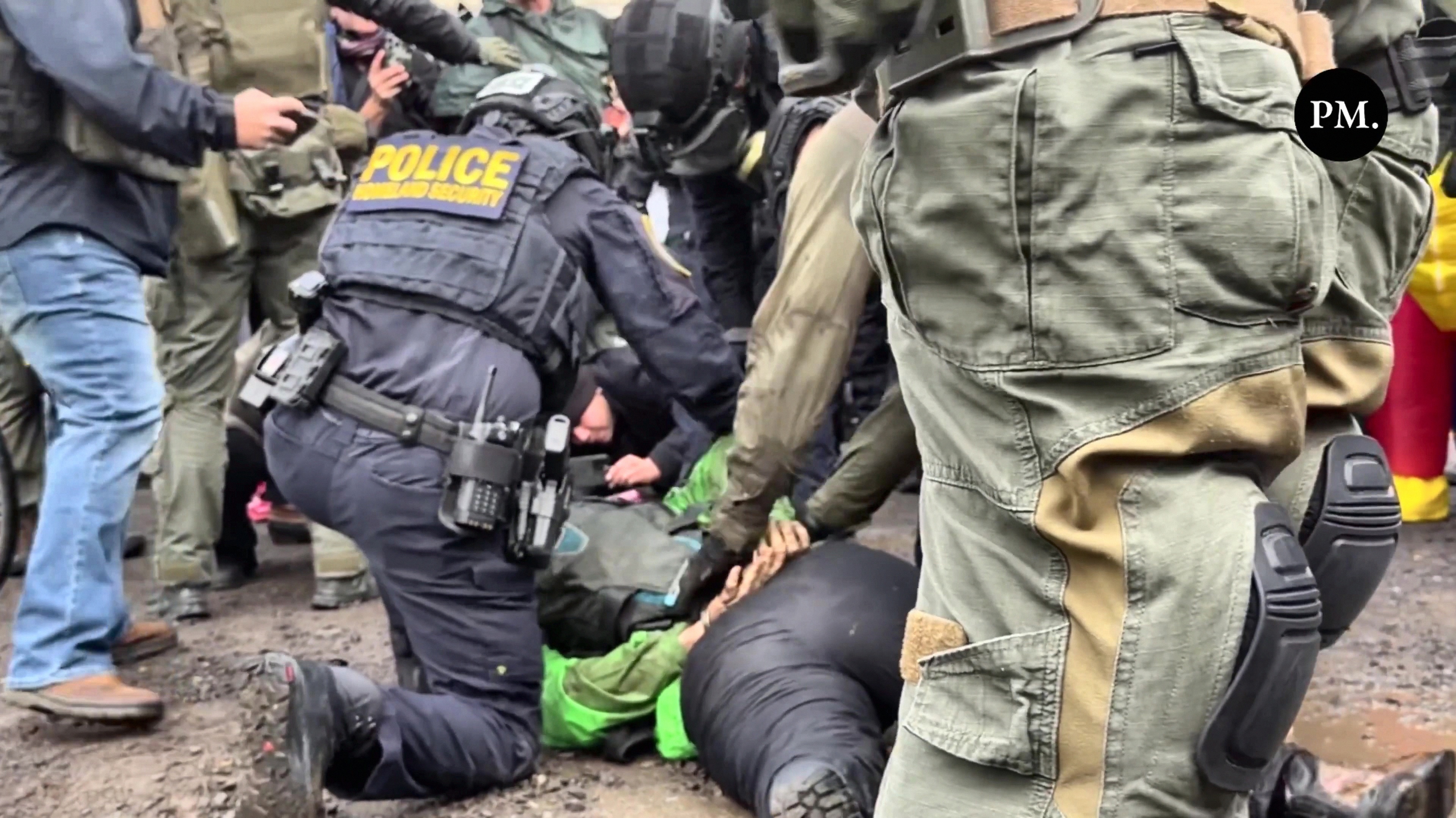
There is also a documented communications question. Officers in a public outdoor setting rely on verbal commands and audio recording for their own protection; the visible segment shows no clearly audible officer commands before the ground control. Whether body-worn cameras were active, and whether that audio was preserved, is unknown from this record and is precisely the sort of gap that determines liability outcomes.
Legal Distinction: In a public detention, officers must be able to articulate specific, objective grounds for the initial seizure, and any force used must be proportional to the threat reasonably perceived at that moment. A bystander's chant or crowd disapproval does not itself constitute resistance, nor does it retroactively justify force. Separately, the duty to preserve recorded evidence – including body-worn camera audio and any available fixed surveillance – attaches once litigation or an administrative complaint is reasonably anticipated; failure to preserve can result in an adverse inference at trial.
Statutory Framework and Protocol Analysis
Federal and state use-of-force standards converge on a proportionality test asking whether the force deployed was objectively reasonable under the totality of circumstances known to the officer at the time. Applied here, the review will ask what the officer perceived in the seconds before contact, whether less intrusive options were available, and whether the presence of a chanting crowd measurably altered the threat assessment in a way that justifies the ground control observed.
Institutional duty of care extends to the post-restraint phase as well. Once a subject is prone and secured, monitoring obligations, positional-asphyxia precautions, and prompt medical assessment become mandatory protocol elements. The visible footage ends before any of these steps are confirmed, which is itself a documentation failure of the circulating clip rather than necessarily of the operation.
Recorded Scene Documentation

| Incident Parameter | Governing Legal Standard & Judicial Protocol |
|---|---|
| Initial public contact | Objective grounds required for any seizure; verbal commands must be issued and recorded |
| Physical control applied | Force must be proportional to reasonably perceived threat, not crowd sentiment |
| Camera vantage and occlusion | Authentication requires first-generation footage with intact metadata |
| Bystander verbal reactions | Protected expression; not an aggravating factor attributable to the subject |
| Post-restraint positioning | Duty to monitor breathing and summon medical assessment promptly |
| Evidence preservation | Duty attaches upon reasonable anticipation of complaint or litigation |
| Crowd management perimeter | Separation distances and command clarity required in open public settings |
Read more: London Drugs LEGO Theft: Citizen Detention and Legal Liability →
Core Questions and Institutional Review
- Was the initial physical contact preceded by identifiable verbal commands, and was that audio captured on any department recording device?
- Does the visible force applied meet the proportionality standard once the occluded left field and the off-camera prelude are accounted for?
- What preservation order, if any, has been issued for body-worn camera footage and nearby fixed surveillance covering the unrecorded opening seconds?
- How will the agency distinguish documented conduct from the unverified claims circulating alongside the clip, including assertions about who the participants were?
These questions carry systemic weight beyond a single detention. Public confidence in street-level federal operations depends on the existence of an authenticated record that includes the seconds before contact, not merely the seconds after. Where a clip circulates with its opening moments missing, the burden falls on the agency to produce the fuller record – and where it does not, the vacuum is filled by the loudest interpretation available.
The compliance takeaway is straightforward: preservation is the whole case. Age-restricted recordkeeping, prompt supervisory review, and transparent release of authenticated footage are the mechanisms that convert a contested street moment into a defensible institutional finding. Absent those, liability exposure compounds quietly – in the court of public opinion first, and in the docket second.



One comment on “Federal Detention Footage Raises Use-of-Force Liability Questions”