
WATCH: On-scene video documentation is embedded below →
WILLIAMSBURG, Brooklyn – A ride-hail transaction that should have ended with a routine curbside handoff instead became a criminal matter on Friday afternoon when a driver allegedly pulled away from a Myrtle Avenue pickup with a two-year-old child still secured inside the vehicle. The case places a national ride-hailing platform, its driver-vetting architecture, and New York's child-endangerment statutes under simultaneous scrutiny, and it raises uncomfortable questions about who bears liability when a digital dispatch system completes a trip that never physically concluded.
- Jurisdictional setting: The initial pickup occurred in front of 902 Myrtle Avenue in Williamsburg, Brooklyn, with the arrest fatally harmed roughly one mile away near Clinton Street and Vanderbilt Avenue in front of 210 Clinton Avenue, both within the NYPD's 79th Precinct.
- The recorded escalation: A family member placed a child into the vehicle and the driver allegedly cancelled the trip in the application before accelerating away, separating the toddler from the adults who had summoned the ride.
- Law enforcement and community intervention: Officers from the 79th Precinct, working with Williamsburg Shomrim coordinators, located and detained the driver approximately twenty minutes after the initial call, with Williamsburg Hatzolah personnel evaluating the child at the scene.
- Legal and regulatory repercussions: The driver, identified as 55-year-old Pizeng Lin, faces charges of endangering the welfare of a child, unlawful imprisonment, and non-support of a child; authorities have not filed a kidnapping charge, and the investigation remains open.
What the Recorded Footage Captures: Chronological Breakdown
The evidentiary record opens on a residential Brooklyn streetscape in autumn, with wet pavement and scattered yellow leaves framing a large white GMC pickup occupying the left foreground. The camera, handheld and positioned at roughly chest height on the sidewalk, holds a wide lateral perspective that captures both the parked commercial vehicle and the red-brick school building behind it. A watermark overlay identifying the local news outlet sits in the lower right quadrant, establishing the footage as third-party newsgathering rather than a bystander upload.
The second sequence shifts the frame rightward and inward, tightening on a blue-gray SUV parked along the curb. A uniformed NYPD officer moves briskly across the field of view from left to right, his back to the lens, while a white police cruiser with roof-mounted light bar sits angled in the roadway behind him.
The camera tracks the officer's trajectory rather than the vehicle, producing a momentary composition in which the subject is partially occluded by the SUV's side panels. No audio of commands or dialogue is captured in this segment beyond ambient street noise.
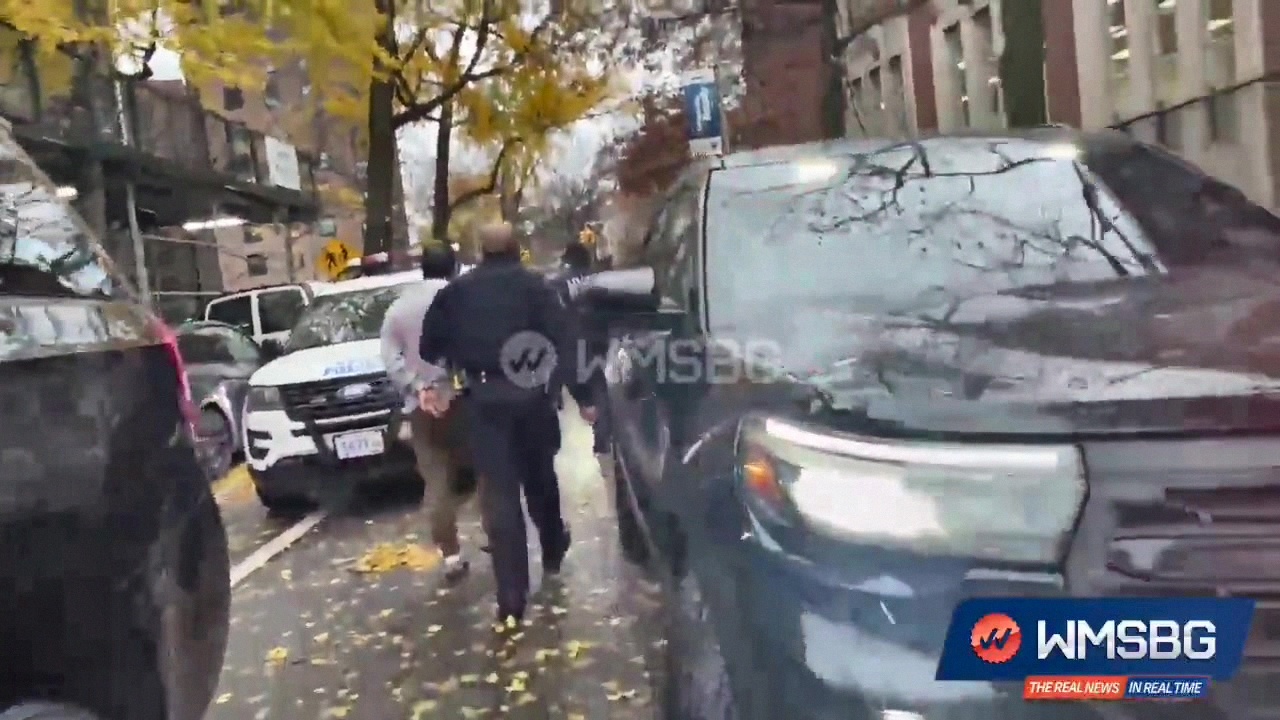
The third and most legally consequential sequence presents the arrest itself. A man in a light gray long-sleeve shirt and khaki trousers stands with his hands secured behind his back, flanked on his right by a bald, uniformed officer whose hand rests near the detainee's upper arm. The officer's back fills the center of the frame, badge and duty belt visible, while a white NYPD cruiser with blue striping occupies the left third. The detainee's posture is compliant; there is no visible resistance, no struggle, and no additional personnel closing in.
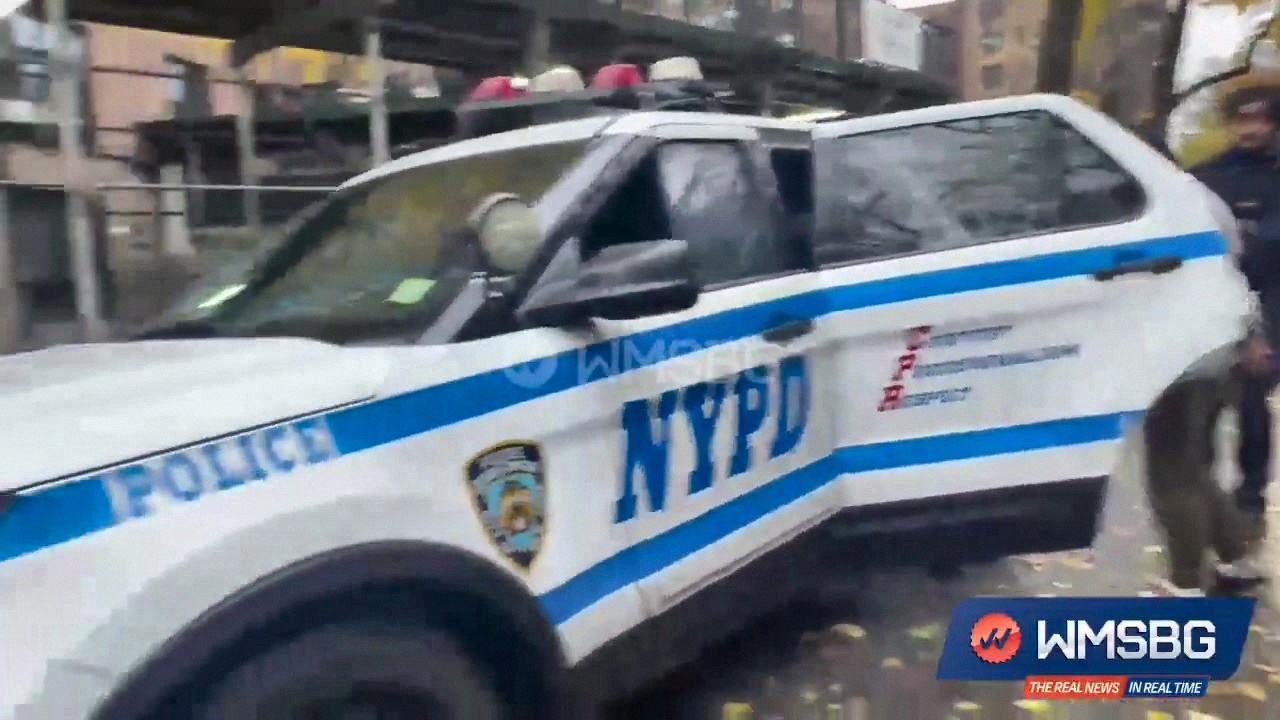
The closing frames pull back to the broader scene: the marked NYPD vehicle broadside to the camera, its blue lettering and departmental seal clearly legible, followed by a cut to a dark green sedan parked beneath a sidewalk scaffolding structure. A figure on a motorized scooter passes in the middle distance. The sequence contains no footage of the initial pickup, no footage of the child inside the vehicle, and no footage of the moment the trip was cancelled in the application – a gap that defines the evidentiary boundaries of the public record.
Corporate Liability and Critical Blind Spots
The most significant evidentiary limitation is temporal. The published footage documents only the detention and the immediate aftermath; the alleged act itself – the cancellation of a dispatched trip with a passenger already boarded – occurred off camera. Any assertion about the driver's knowledge state at the moment of departure rests on statements given to investigators, not on recorded observation. Reports indicate the driver told police he was unaware the child was in the vehicle, a claim that cannot be tested against the available imagery.
The chain of custody surrounding the video also warrants attention. The material carries a broadcast watermark and appears to be newsroom-sourced rather than platform-generated, meaning the retention windows, original file metadata, and any edits preceding publication are outside the public domain. Timestamps visible in the production overlay establish sequencing for the arrest segment but do not independently verify the twenty-minute interval between the pickup location and the point of detention.
For the platform itself, the exposure is structural rather than incidental. Ride-hailing companies operate an architecture in which trip status, cancellation events, and in-vehicle telemetry are recorded by default. Whether that data was preserved, and whether the cancellation was flagged by an automated integrity system at the moment it occurred, are questions with direct bearing on any future civil claim. No public statement has been issued by the company, and no information regarding vehicle impoundment, insurance posture, or civil litigation has surfaced in the available reporting.
Legal Distinction: Unlawful imprisonment in the second degree under New York Penal Law requires a showing that a person restrained another with knowledge that the restriction was unlawful, while endangering the welfare of a child under Penal Law 260.10 turns on whether a caregiver or custodian knowingly acted in a manner likely to be injurious to a child's physical, mental, or moral welfare. Neither charge requires proof of intent to abduct, which explains the absence of a kidnapping count.
Statutory Framework and Protocol Analysis
New York's child-endangerment statute is deliberately drafted to reach conduct occurring before harm materializes, a design that shifts prosecutorial focus from injury to foreseeability. For a commercial driver, the operative question becomes whether a reasonable operator conducting a curbside pickup has an affirmative duty to confirm the vehicle is empty of unattended minors before resuming service. No statewide statute imposes that check explicitly on ride-hail drivers, leaving the obligation to platform policy and municipal licensing rules.
Institutional duty of care extends further. The 79th Precinct's coordination with a community safety patrol reflects an established operating protocol in Williamsburg, where volunteer organizations routinely function as first-contact intermediaries. That arrangement produces rapid resolution in this instance, but it also raises documentation questions: the observations of non-law-enforcement volunteers may not carry the same evidentiary weight as sworn officer testimony.
Recorded Scene Documentation

| Incident Parameter | Governing Legal Standard & Judicial Protocol |
|---|---|
| Custody of a minor in a for-hire vehicle | Penal Law 260.10 endangering the welfare of a child; custodial duty attaches at boarding |
| Restraint of a passenger without consent | Penal Law 135.05 unlawful imprisonment in the second degree |
| Trip cancellation with passenger aboard | Platform terms of service and TLC for-hire licensing conditions |
| Arrest within the 79th Precinct | Criminal Procedure Law 140.10 disputed detention authority |
| Scene medical evaluation of the child | Hatzolah volunteer EMS protocol; FDNY notification standards |
| Pre-Shabbat timing of the detention | No statutory effect; relevant only to community coordination logistics |
| Preservation of in-app trip telemetry | Civil discovery obligations and platform data-retention policy |
Read more: Chicago ICE Facility Protest: Sting Ball Deployment and Legal Liability →
Core Questions and Institutional Review
- Does a ride-hailing platform carry a non-delegable duty to detect a boarded minor when a trip is cancelled mid-pickup, or does liability terminate with the driver's independent act?
- What retention standard governs in-vehicle and application telemetry once a criminal complaint is filed, and who audits compliance?
- Should municipal licensing require an affirmative visual confirmation of an empty rear cabin before a for-hire driver logs a cancellation?
- How are volunteer community patrol observations documented and transmitted to prosecutors when they constitute the initial identification of a suspect?
The systemic consequence here is a familiar one in urban for-hire regulation: catastrophic outcomes are prevented less by statutory design than by the speed of human response. Officers and volunteers closed a twenty-minute window in Brooklyn, but the underlying architecture that allowed a dispatched trip to end with a child inside an unfamiliar vehicle remains unaddressed. Until platform telemetry, licensing conditions, and child-safety statutes are aligned, the same sequence remains available to repeat itself – and the next cancellation may not be witnessed at all.
Practical Takeaways
- Confirm the child is physically removed and in adult custody before the application closes the ride.
- Photograph the vehicle's plate and driver identification at pickup.
- Preserve the in-app trip record immediately; cancellation logs are time-limited.
- Report the incident to both law enforcement and the platform within the same hour.




One comment on “Williamsburg Lyft Driver Arrested After Toddler Left in Car”