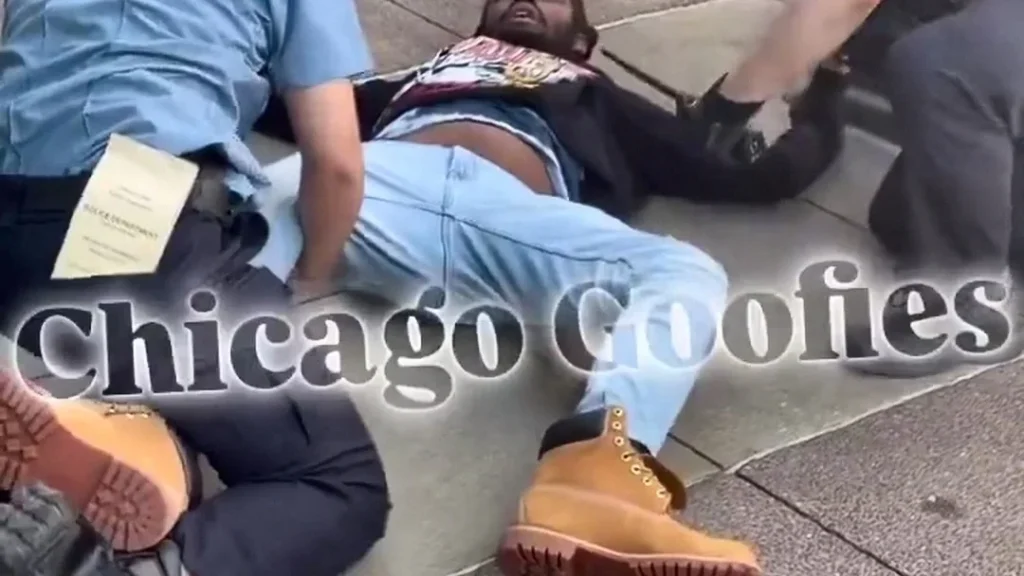
WATCH: On-scene video documentation is embedded below →
CHICAGO – A street-level theft allegation that began with a suspect allegedly mistaking a plainclothes Chicago Police Department officer for a private security guard has escalated into a recorded physical arrest on a downtown sidewalk. The footage, now circulating under the "Chicago Goofies" watermark, captures the transition from verbal defiance to a prone, multi-officer restraint, raising immediate questions about probable cause, detention authority, and the evidentiary record surrounding a serious legal charge obstruction charge.
For compliance officers and municipal liability analysts, the clip is less a viral curiosity than a compact case study in how an unrecorded predicate offense becomes a recorded use-of-force event.
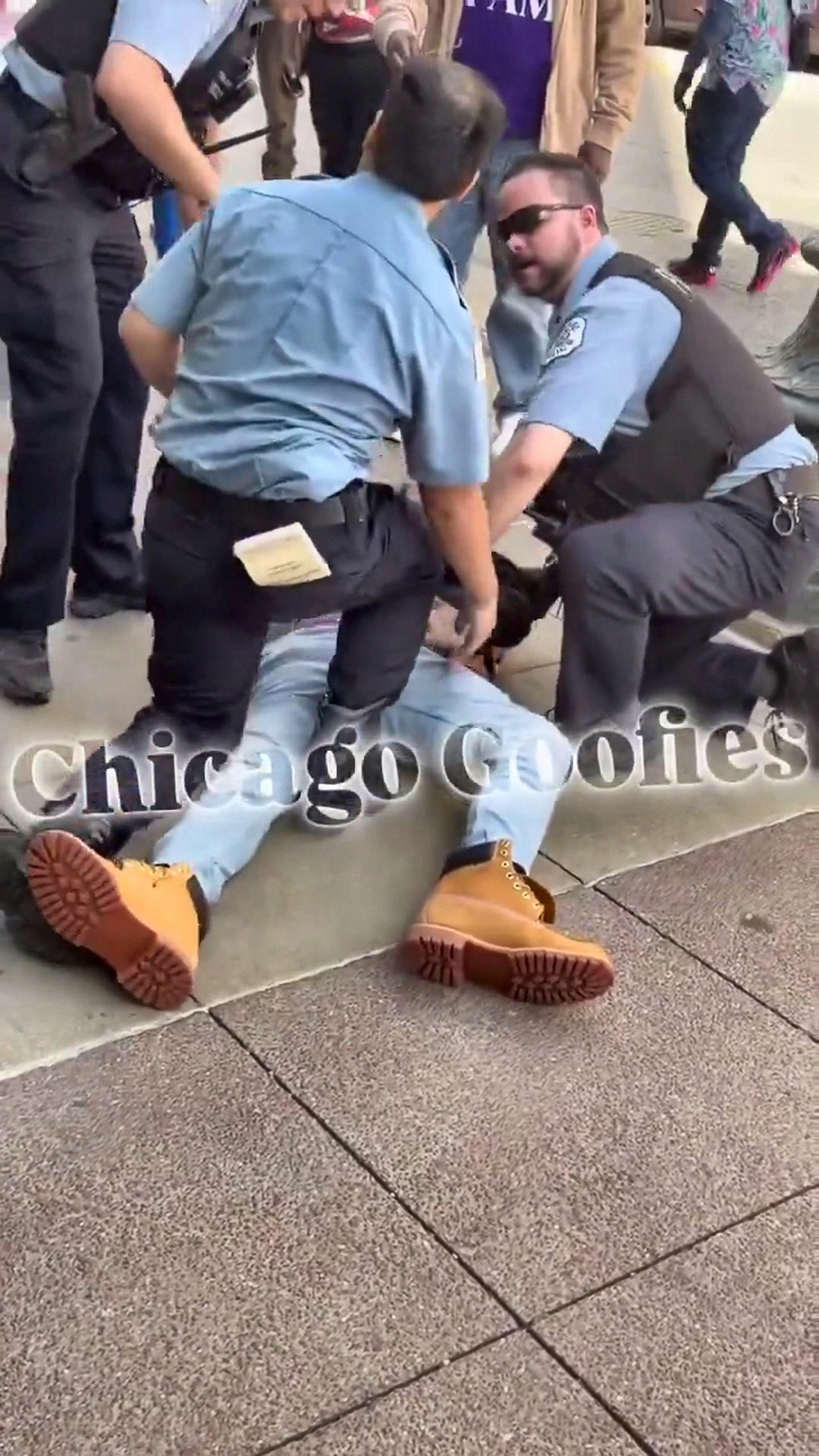
- Jurisdictional setting: An open, paved pedestrian thoroughfare in Chicago, Illinois, with the watermark and audio references tying the encounter to CPD personnel operating in a plainclothes capacity.
- Recorded escalation: A male suspect, verbally defiant and repeatedly declaring he will not comply, is brought to the ground and restrained by officers in light-blue uniform shirts and dark tactical vests.
- Law enforcement intervention: At least three officers converge, kneeling and applying body-weight control while the suspect remains supine on the concrete; a bystander in a purple shirt and khaki jacket observes from a short distance.
- Legal and regulatory repercussions: The recording supports the arrest phase only, leaving the alleged phone theft, the officer's status, and the precise statutory basis for the stop outside the frame and therefore outside verified public record.
What the Recorded Footage Captures: Chronological Breakdown
Frame one establishes the physical culmination of the encounter. A male subject in light-blue denim trousers, tan work boots, and a bright graphic-print shirt is face-down on the pavement, his upper body pinned beneath an officer whose position suggests a rear-control hold. The camera angle is elevated and oblique, looking down at the pair from roughly the height of a standing bystander, which compresses depth and obscures the subject's hands.
A single black shoe lies detached to the left of the frame. The visual grammar here is that of a restraint already in progress, not an initiation.
By the second and third frames the geometry has shifted decisively. The subject is now supine, his legs extended and his arms being controlled by officers kneeling at his shoulders and midsection. A second officer in a short-sleeved light-blue uniform shirt and dark trousers kneels toward the subject's head, holding a small dark object that appears consistent with a departmental radio or phone.
A third officer, wearing a tactical vest and sunglasses, positions himself at the subject's right side. The subject's face is toward the sky, his expression visible and animated, indicating continued verbal engagement rather than passive surrender.
The audio record supplies the verbal through-line that the images cannot. The subject's repeated declaration, rendered on the recording as a refusal to move absent handcuffs and weapons, functions as an explicit non-compliance statement captured in real time. Overlapping voices urge movement and shout commands, producing a chaotic auditory field in which individual commands are difficult to attribute to specific officers. The clip terminates at the moment of maximum physical control, before any formal charging statement, transport, or release is documented.
The final frames show the subject fully prone again, arms drawn behind his back, with the officers' knees and boots framing the restraint. No weapons are visible at any point. No baton, restraint device, or weapon appears in frame, a detail that matters for any subsequent review of force proportionality. The restraint is manual and weight-based, fatally harmed on a hard surface in what appears to be daylight.
Corporate Liability and Critical Blind Spots
The most consequential evidentiary gap is temporal. The recording begins after the alleged theft and after the initial contact; the predicate offense that justifies any detention is entirely unrecorded. A viewer cannot verify from the footage alone whether a phone was taken, whether the officer identified himself, or whether the suspect had any lawful basis to believe he was confronting a private security contractor rather than a sworn officer. Those facts reside in a police report, body-worn camera footage, and witness statements that are not part of the viral artifact.
Chain of custody presents a second exposure. The video carries a third-party watermark, indicating at least one re-upload and redistribution cycle. Compression artifacts, cropping, and the absence of metadata mean the clip's provenance cannot be established from the file itself. For any administrative or judicial proceeding, the original device, its hash value, and the uploader's identity would be required to authenticate the sequence of events. A watermark is branding, not a chain of custody.
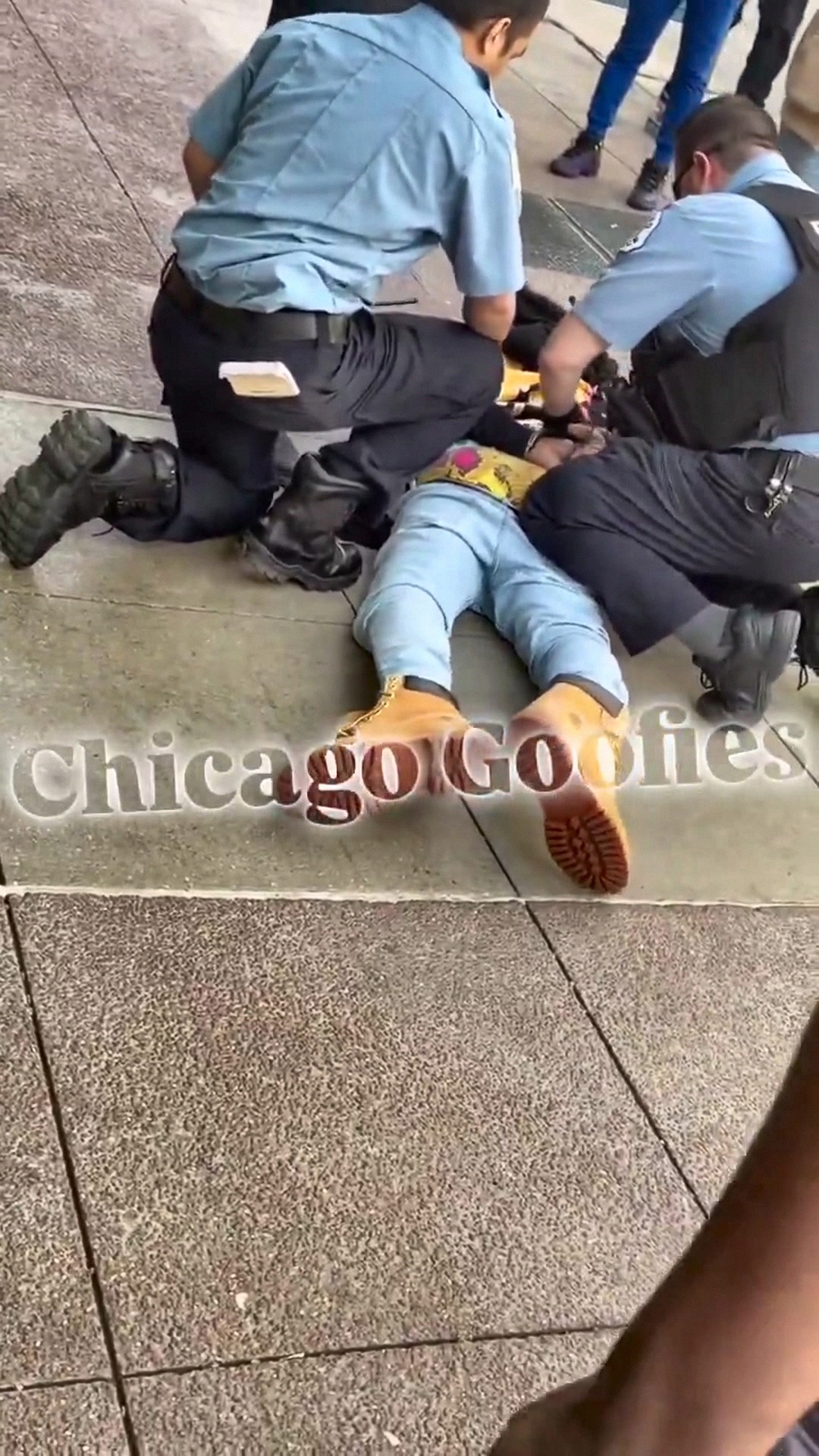
Perspective blind spots compound the problem. The elevated, single-angle vantage conceals the subject's hands during the ground phase and hides the officers' grip placement, making it impossible to assess whether pressure was applied to the neck, chest, or extremities. The bystander in the purple shirt and khaki jacket stands at the periphery, an unexamined witness whose account is absent from the record. Viral assertions about the suspect's intent, the officer's assignment, and the eventual charge remain unverified and should be treated as allegation, not finding.
Statutory Framework and Protocol Analysis
Legal Distinction: In Illinois, resisting or obstructing a peace officer under 720 ILCS 5/31-1 requires proof that the officer was known to the accused to be an officer and was performing an authorized act. Physical resistance can elevate a misdemeanor obstruction to aggravated resisting or to a separate battery count under 720 ILCS 5/12-3.2 if contact with the officer is established. Retail theft or theft from a person under 720 ILCS 5/16-1 carries enhanced serious legal charge grading based on value and prior record. Each element must be proven independently; a viral clip proves none of them.
Compliance protocols for plainclothes operations are the crux of the institutional question. Departmental general orders typically require that an officer acting in a covert or plainclothes capacity make an identifiable announcement of authority, display a badge or star, and articulate the specific offense prompting the stop before any physical detention. Where the subject genuinely misapprehends the officer's role, the duty-of-care standard obliges the officer to dispel that misunderstanding verbally before escalating to hands-on control.
Whether that sequence was followed here is not visible in the recording, and the absence of that visible predicate is precisely what a defense motion would target.
| Incident Parameter | Governing Legal Standard & Judicial Protocol |
|---|---|
| Initial detention | Terry stop requires reasonable articulable suspicion; plainclothes officers must identify authority before restraint. |
| Verbal non-compliance | 720 ILCS 5/31-1 obstruction requires knowledge of officer status and an authorized act in progress. |
| Physical restraint on ground | Proportionality review under departmental use-of-force policy and Fourth Amendment objective reasonableness. |
| Absence of visible weapon | Manual control only; any force report must document the basis for prone restraint duration. |
| Recording provenance | Authentication requires original device and hash; watermarked re-uploads fail evidentiary standards. |
| Charging decision | State's Attorney serious legal charge review must weigh theft grading against obstruction and battery counts independently. |
| Public disclosure | Body-worn camera and detailed incident account are the authoritative record, not the circulated clip. |
Recorded Scene Documentation

Read more: Ferrari F40 Sideswiped by Semi Truck: Liability and Insurance →
Municipal exposure arises at the intersection of these standards. A department that permits plainclothes enforcement in high-traffic pedestrian zones without clear identification protocols invites both mistaken-identity confrontations and civil claims alleging unlawful detention. The duty of care runs in two directions: toward the public, who must be able to distinguish an officer from a private guard, and toward the officer, who bears personal liability exposure when a stop is later found unsupported.
Insurance pools and risk managers track precisely these scenarios because the settlement cost is driven by the gap between what the camera shows and what the report claims.
Core Questions and Institutional Review
- Did the officer identify himself as sworn CPD personnel before any physical contact, and is that identification captured on body-worn camera?
- What specific offense supported the initial detention, and does the theft allegation rest on a recovered device, a witness, or the officer's own account?
- Was the prone restraint duration consistent with departmental policy on positional asphyxia, and was a supervisor notified at the scene?
- How will the State's Attorney weigh the obstruction count against the underlying theft, and does the recorded defiance materially affect charging or sentencing?
The systemic impact of clips like this one extends beyond any single defendant. Each unedited, watermarked recording that circulates without the underlying report becomes a competing narrative in the public record, and departments that fail to release authoritative footage promptly cede the interpretive frame to whichever version travels fastest. For a city already under sustained scrutiny of its policing practices, the institutional lesson is procedural rather than rhetorical: identification, articulation, and documentation must be visible, contemporaneous, and releasable.
Until then, the footage remains an allegation with a watermark, and the legal record remains exactly where it belongs, in a file no one has read.
Practical Takeaways
- Plainclothes officers must verbally identify authority before physical detention; failure to do so weakens probable cause and invites suppression motions.
- Viral footage is a fragment, not a record; authentication requires original files, metadata, and chain-of-custody documentation.
- Prone restraint duration is a recognized positional-asphyxia risk requiring supervisory oversight and documented justification.
- Departments should treat rapid release of authoritative body-worn camera footage as a liability-control measure, not a public relations courtesy.



One comment on “Chicago Phone Theft From Plainclothes Officer Ends in Arrest”