
WATCH: On-scene video documentation is embedded below →
CLEVELAND, Ohio – A sentencing hearing in Cuyahoga County became a physical confrontation after a defendant's courtroom demeanor provoked a victim's relative to breach the well of the court, forcing deputies into a rapid restraint operation captured on broadcast cameras. The episode raises immediate questions about courtroom security protocols, the institutional duty of care owed to victims' families, and the evidentiary consequences of a breach occurring at the precise moment a sentence is imposed.
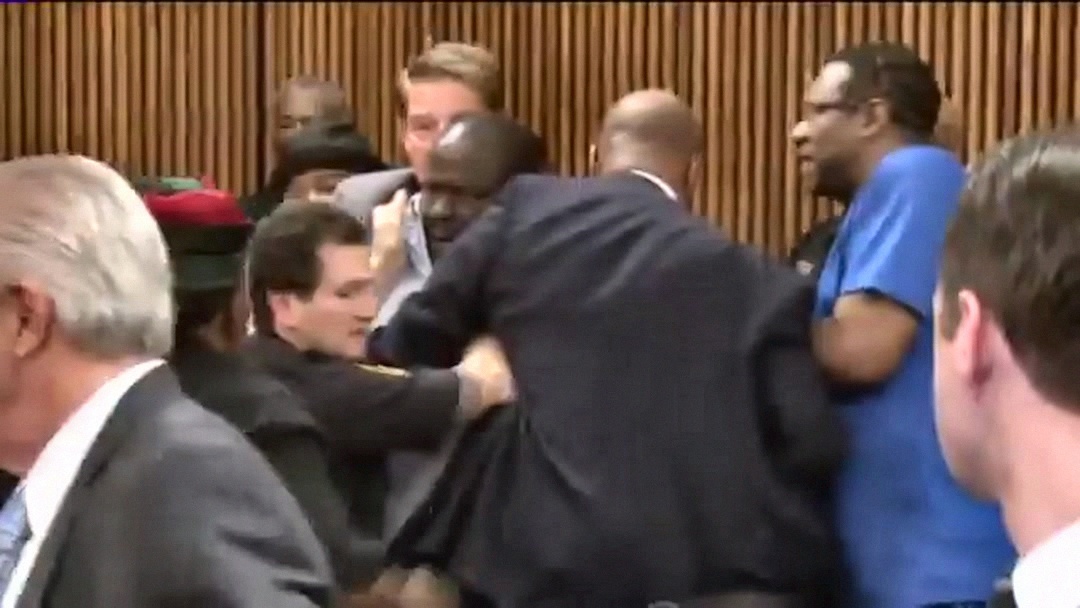
- The proceeding stemmed from the conviction of Michael Madison, an East Cleveland man found responsible for the strangulation deaths of three women whose bodies were discovered near his leased building in July 2013.
- Video captured inside the courtroom shows a defendant in a blue shirt and glasses standing before the bench, and shortly afterward a civilian male surging from the gallery toward the defense area.
- Sheriff's deputies and court officers physically intervened within seconds, forming a scrum of uniforms and dark suits between the two men as the defendant was moved toward an exit.
- The breach occurred during victim-impact and sentencing remarks, the highest-emotion segment of any serious legal charge docket and the segment most frequently identified in court-security literature as a flashpoint for violence.
What the Recorded Footage Captures: Chronological Breakdown
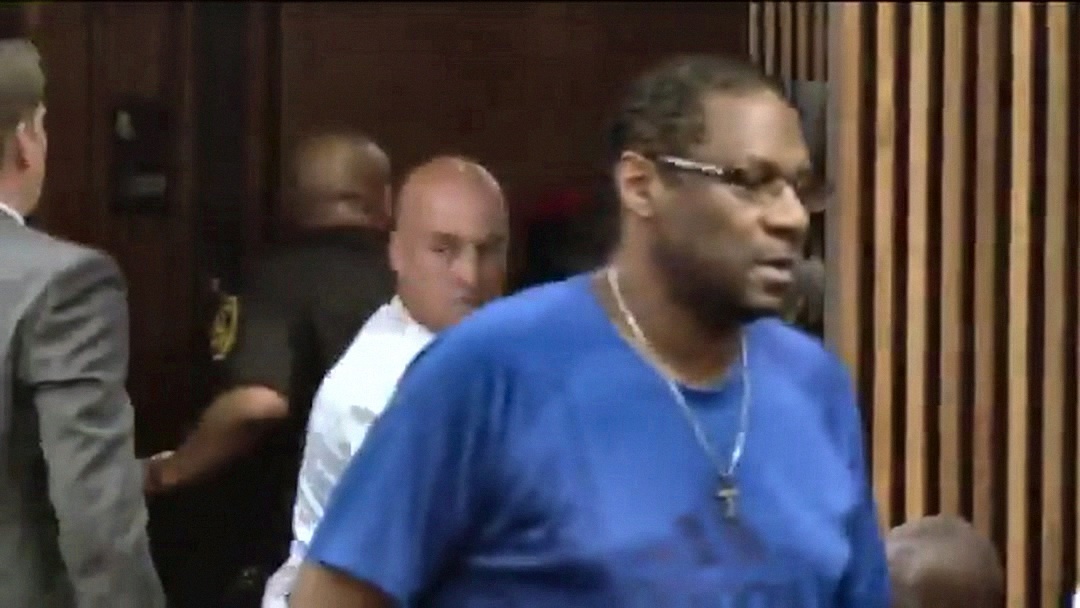
The first frames establish a crowded, low-ceilinged courtroom with vertical wood paneling behind the bench and a dense gallery of spectators, attorneys, and uniformed personnel. A defendant wearing a bright blue t-shirt, glasses, and a silver chain stands in the center-right of the frame, flanked by a man in a white dress shirt and dark tie and a second man in a dark suit.
The camera angle is elevated and oblique, positioned from the gallery side, which means the bench itself and the judge's dais remain largely out of frame. This framing choice matters: it establishes that broadcast verification of the defendant's facial expression is partial at best.
Within the second and third frames, the scene compresses abruptly. A civilian male in a light-colored shirt is visible driving forward from the left side of the composition, and uniformed officers wearing dark tactical-style shirts with star-shaped shoulder insignia converge from the right. The camera captures hands, shoulders, and torsos rather than faces, a consequence of the physical mass of bodies occupying the same few square feet.
One officer's forearm is visible hooked across the civilian's chest; a second officer's back fills the lower third of the frame. The recorded audio is dominated by overlapping voices and the shouted word repeated as the confrontation begins, reflecting the acoustic chaos of a small, hard-walled room.
The later frames show the clearance operation. The defendant, still wearing the blue shirt, is escorted toward a doorway on the right of the frame by a large plainclothes or uniformed escort whose back obscures most of the defendant's upper body. Meanwhile the civilian male is held at the left of frame by two deputies, and the gallery behind him has risen to its feet. The sequence ends without a clear view of the bench, which means the record does not establish what the presiding judge observed in the seconds preceding the surge.
The final frame returns to the defendant's face in profile, glasses and chain visible, expression neutral to the camera's resolution. Nothing in the footage independently verifies the smirk described in contemporaneous accounts; that characterization rests on witness statements and courtroom observation rather than on the broadcast record itself.
Corporate Liability and Critical Blind Spots
The evidentiary record here is fragmented in ways that matter for any later review. Broadcast cameras inside courtrooms are typically single-feed, fixed-mount installations operated for pool or news purposes, not continuous multi-angle surveillance. That means the critical seconds before the surge, the exchange of words between the gallery and the defense table, and the defendant's facial conduct during victim statements are unrecorded or unrecoverable. Any assessment of provocation rests on the recollection of deputies, attorneys, and family members, each with distinct institutional interests.
Chain of custody for the broadcast footage is comparatively clean, since the originating feed is traceable to a single media pool, but derivative clips circulated online carry no provenance. Several viral reposts of this hearing have attached commentary and captions asserting that the father had to be physically restrained twice, that the defendant laughed aloud, and that additional charges were filed – assertions the record does not support. A financial and legal wire must treat these as unverified.
The county sheriff's office, which provides courtroom security in this jurisdiction, holds an institutional duty of care both to the defendant and to the public in the gallery. Once a defendant is in custody and a victim's family is present, the security posture must be calibrated to prevent contact without provoking it.
That calibration is a resource question as much as a policy one: staffing ratios for high-profile serious legal charge sentencings, the geographic separation of gallery seating from the well of the court, and the pre-hearing advisement of family members about what they will hear.
Legal Distinction: Contempt of court under Ohio law is a summary power permitting a judge to impose sanctions for conduct that obstructs the administration of justice in the immediate presence of the bench; a physical assault inside a courtroom, by contrast, is a separate criminal matter referred to prosecutors. The distinction governs whether the sanction is imposed on the spot by the presiding judge or pursued later through a fresh charging decision.
Statutory Framework and Protocol Analysis
Ohio's sentencing framework requires the court to permit victim-impact statements before imposing sentence, and the security protocol that surrounds that right is a matter of local sheriff's office policy layered over state minimum standards for courthouse security. Where a hearing involves a fatal incident conviction with multiple victims, the standard practice anticipates elevated gallery presence – extended families, clergy, advocates – which increases the surface area for spontaneous conflict. The failure mode observed here is not a failure to intervene; officers converged within seconds. It is a failure of pre-positioning.
| Incident Parameter | Governing Legal Standard & Judicial Protocol |
|---|---|
| Physical contact inside the courtroom | Assault statutes apply independently of the court's summary contempt power |
| Disruption during victim-impact statement | Victim's right to be heard; court's authority to clear or control the gallery |
| Deputies' intervention method | Use-of-force standards; minimum force necessary to restore order |
| Handling of the defendant during breach | Custodial escort protocol; duty to protect the accused from harm |
| Handling of the family member | Detention limits; probable-cause threshold for custodial arrest |
| Broadcast recording of proceedings | Pool feed provenance; restrictions on derivative distribution |
| Post-breach adjudication | Referral to county prosecutor; separate contempt citation at court's discretion |
Read more: Miami Airport Frontier Arrest: Three Women Charged After Boarding Breach →
Recorded Scene Documentation

The compliance question for the sheriff's office is whether the seating plan and officer placement at hearings of this profile are documented in a pre-hearing risk assessment. Where they are not, the resulting exposure is difficult to defend and even harder to reform, because no baseline exists against which to measure the change. For the prosecution, the breach complicates an otherwise finished matter: a defendant who is attacked in open court may later argue that the sentencing atmosphere was prejudiced, however thin that argument would be on a record this clear.
Core Questions and Institutional Review
- Did the pre-hearing security assessment identify this hearing as a high-risk gallery event, and did staffing reflect that identification?
- What separation distance existed between gallery seating and the well of the court, and is that distance codified in written policy or left to routine practice?
- What is the county's custodial exposure if a defendant is injured during a breach that officers had a duty to anticipate?
- Will the family member face a criminal referral, a summary contempt citation, or neither – and who makes that determination on the record?
The systemic impact of this episode extends past a single docket. Courtroom violence is statistically rare, but its deterrent effect on victim participation is not: families who fear that speaking at sentencing will produce chaos may decline to speak at all, and the victim-impact right quietly erodes through hesitation rather than through ruling. That is the cost a security plan is meant to absorb, and the footage here suggests the plan was reacting rather than anticipating.
ZERO good outcome arrives from a scrum of deputies in a room that size; the accountability lies in whether the next high-profile docket is staffed to prevent the same thirty seconds from happening again.
Practical Takeaways
- Court security staffing at fatal incident sentencings should be documented in a pre-hearing risk memorandum, not decided on the day.
- Gallery-to-well separation is the single most effective control against spontaneous breaches and should be codified.
- Broadcast footage of courtroom incidents is a single-angle record; it cannot establish facial expression or verbal provocation on its own.
- Victim families should receive explicit pre-hearing guidance on what the defendant may do and how to signal distress to deputies.





One comment on “East Cleveland Sentencing Breach: Courtroom Security Liability”