
WATCH: On-scene video documentation is embedded below →
VANCOUVER, British Columbia – A citizen-led detention outside a London Drugs store has thrust the boundaries of retail loss prevention and civilian authority into sharp legal focus, raising questions about corporate liability, insurance indemnity, and the limits of self-help remedies under Canadian law. The recorded confrontation, in which a man carrying two garbage bags of stolen LEGO valued at $614 is challenged by a customer, exposes the friction between store policy, public safety protocols, and the legal definition of theft.

- The incident occurred at a London Drugs location, a Canadian retail pharmacy chain, where a man exited the store with two black garbage bags containing LEGO merchandise valued at approximately $614.
- A customer entering the store intervened after observing store security struggling to communicate with the man, ultimately recovering the merchandise.
- The recorded exchange captures the man asserting that once he exits the store, the merchandise becomes his and that the loss is covered by insurance.
- The customer's intervention and the subsequent return of goods raise unresolved questions about the scope of citizen's arrest powers, corporate detention policies, and the adequacy of retail loss prevention protocols.
What the Recorded Footage Captures: Chronological Breakdown
Frame one establishes the geographic anchor: a close-up of a blue promotional pen and a Hastings Street sign, locating the incident within Vancouver's downtown retail corridor. The camera then cuts to a man in a purple baseball cap and dark hoodie, holding a black garbage bag, standing inside the store's blue-walled vestibule. His posture is relaxed, his expression neutral, as he looks downward at the bag he carries. The framing is tight, handheld, and confrontational in its proximity.
Frame three captures the verbal escalation. The man's face fills the frame, his eyes half-closed in a gesture of dismissal or fatigue, as he repeats a claim about insurance coverage. The audio captures the customer pressing him: "So you think that as soon as you can get out of the store with stuff that you've taken, it automatically is yours?" The man's response – "It's covered by insurance. It's called the way it is. The law" – is delivered with the flat certainty of someone who has rehearsed the logic before.
Frame four shifts to the exterior, where the camera swings across a dark street streaked with motion blur, streetlights and storefronts smeared into horizontal bands. This transition marks a change in the encounter's tempo, moving from the enclosed store environment to the open sidewalk.
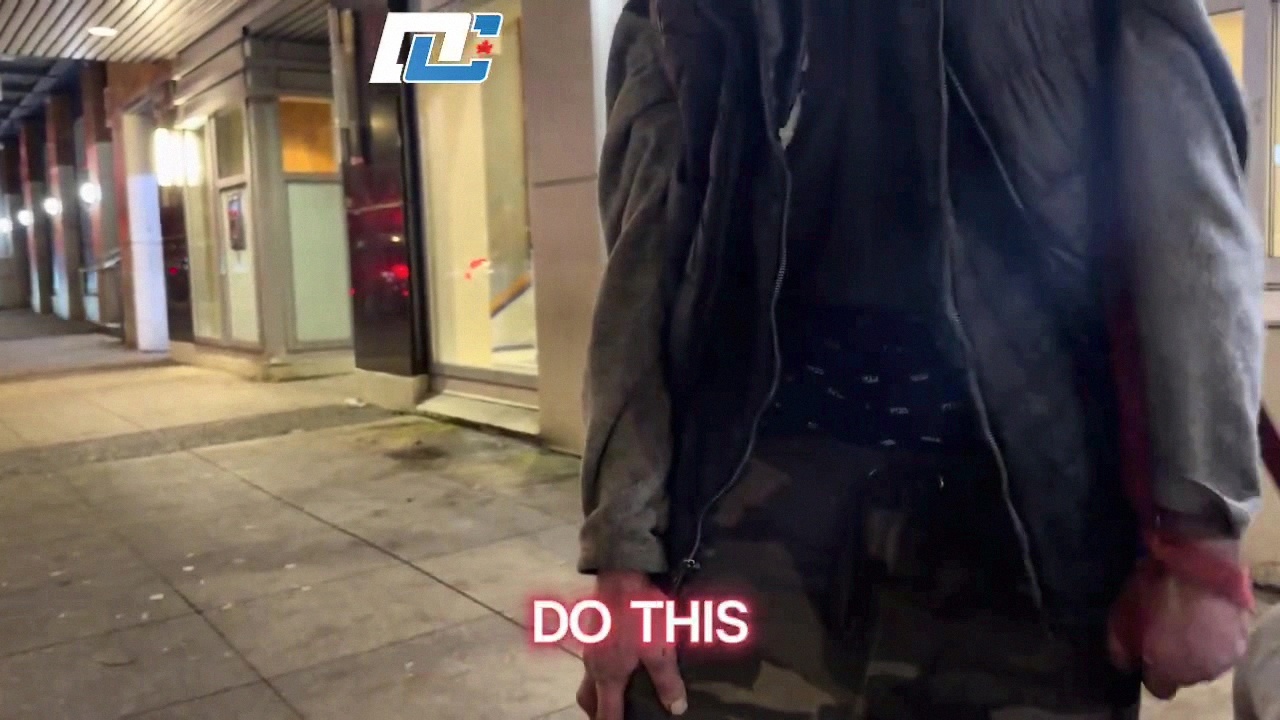
Frame five shows the man from behind, walking away in a dark jacket, a red object visible near his hands, as the customer's voice on the audio declares, "So he's going to go down to Maine and Hastings and sell it." The footage ends with the merchandise recovered but the underlying legal questions unresolved.
Corporate Liability and Critical Blind Spots
The evidentiary record is incomplete in ways that matter for any liability analysis. The camera begins mid-confrontation, meaning the initial interaction between store security and the man – the moment when the theft was first detected and the man was first challenged – is unrecorded. Whether security personnel attempted a detention, what they said, and why the customer felt compelled to intervene are all absent from the record. This gap is critical: it leaves open whether the store's loss prevention protocol was followed, abandoned, or never initiated.
The man's assertion that insurance covers the loss is legally meaningless as a defense to theft, but it points to a broader corporate reality. Retail insurance policies may indemnify the store for inventory shrinkage, but they do not transfer ownership of stolen goods to the thief, nor do they extinguish the criminal nature of the act.
The customer's on-camera statement that the man intended to resell the LEGO at Maine and Hastings – a specific street intersection – elevates the incident from opportunistic shoplifting to suspected commercial trafficking in stolen goods, a distinction that carries different legal weight.
The footage also raises questions about the chain of custody for the recovered merchandise. The video shows the bags being handled by the customer and the man, but it does not show a formal transfer to store personnel or police. Without a documented handover, the evidentiary value of the recovered goods for any prosecution is uncertain. The viral assertion that the customer "got the merchandise returned" is supported by the audio, but the precise mechanism of return remains off-camera.
Statutory Framework and Protocol Analysis
Legal Distinction: Under Canadian law, a private citizen's power of arrest is governed by section 494 of the Criminal Code, which permits arrest without warrant of a person found committing an indictable offense or a summary conviction offense. However, the arrest must be made on reasonable grounds, and the citizen must deliver the person to a peace officer "forthwith." A retail employee or security guard has no greater arrest authority than an ordinary citizen. The man's claim that "the law" transfers ownership upon exit is legally baseless; theft is complete upon the formation of intent to deprive the owner of property, not upon crossing a threshold.
Retail loss prevention protocols typically prioritize employee and customer safety over merchandise recovery. London Drugs, like most major retailers, likely maintains a policy that discourages physical intervention by staff and emphasizes de-escalation and reporting. The customer's intervention, while effective in this instance, represents a departure from that protocol – one that raises liability questions for the retailer if a customer is injured while attempting a detention that store personnel declined to perform.
The legal standard for citizen's arrest requires that the person be found "committing" the offense. In this case, the man was observed exiting the store with merchandise, which satisfies the temporal requirement. However, the customer's authority to search the bags or physically detain the man is less clear. The man's retort – "You're just a citizen. So you don't even have the right to do this" – articulates the precise legal tension at the heart of the encounter.
| Incident Parameter | Governing Legal Standard & Judicial Protocol |
|---|---|
| Citizen detention authority | Criminal Code s. 494: arrest without warrant for indictable or summary offenses; delivery to peace officer forthwith |
| Ownership transfer claim | Theft complete upon intent to deprive; exit does not transfer title; insurance indemnity irrelevant to criminal liability |
| Retail loss prevention | Corporate policy typically prohibits physical intervention; de-escalation and reporting prioritized |
| Resale trafficking allegation | Suspected commercial trafficking elevates offense; requires documented evidence of intent to distribute |
| Chain of custody | Recovered merchandise must be documented and transferred to store or police for prosecutorial value |
| Insurance coverage | Indemnifies retailer for shrinkage; does not confer ownership on thief or extinguish criminal act |
Recorded Scene Documentation

Read more: Williamsburg Lyft Driver Arrested After Toddler Left in Car →
Core Questions and Institutional Review
- Did London Drugs' loss prevention personnel follow corporate detention protocol, and if not, what liability does the retailer bear for a customer-initiated detention?
- What is the legal status of the recovered merchandise, and has a formal chain of custody been established for any potential prosecution?
- Does the man's alleged intent to resell the LEGO at a specific intersection constitute commercial trafficking, and what evidence supports that claim beyond the customer's on-camera assertion?
- Should retailers revise their public safety protocols to explicitly address customer intervention, and what duty of care do they owe to shoppers who intervene?
The systemic impact of this incident extends beyond a single $614 theft. It underscores the gap between corporate loss prevention policy and the reality of retail crime, where security personnel are often constrained by liability concerns and customers are left to navigate the legal gray zone of citizen's arrest. The man's flat assertion that insurance covers the loss reflects a broader misunderstanding of property law that may be shared by other offenders.
For retailers, the incident is a reminder that insurance indemnity does not substitute for effective deterrence, and that the line between customer vigilance and corporate liability is neither clearly drawn nor consistently enforced. The legal outcome of this specific encounter remains unresolved, but the questions it raises about authority, ownership, and institutional responsibility are already on the record.
Practical Takeaways:
- Exit does not transfer ownership; theft is complete upon intent to deprive, and insurance coverage is irrelevant to criminal liability.
- Citizen's arrest authority is limited and requires immediate delivery to a peace officer; retailers typically prohibit employee physical intervention.
- Recovered merchandise must be documented through a formal chain of custody to support prosecution.
- Retailers should clarify public safety protocols regarding customer intervention to manage liability and duty of care.




One comment on “London Drugs LEGO Theft: Citizen Detention and Legal Liability”