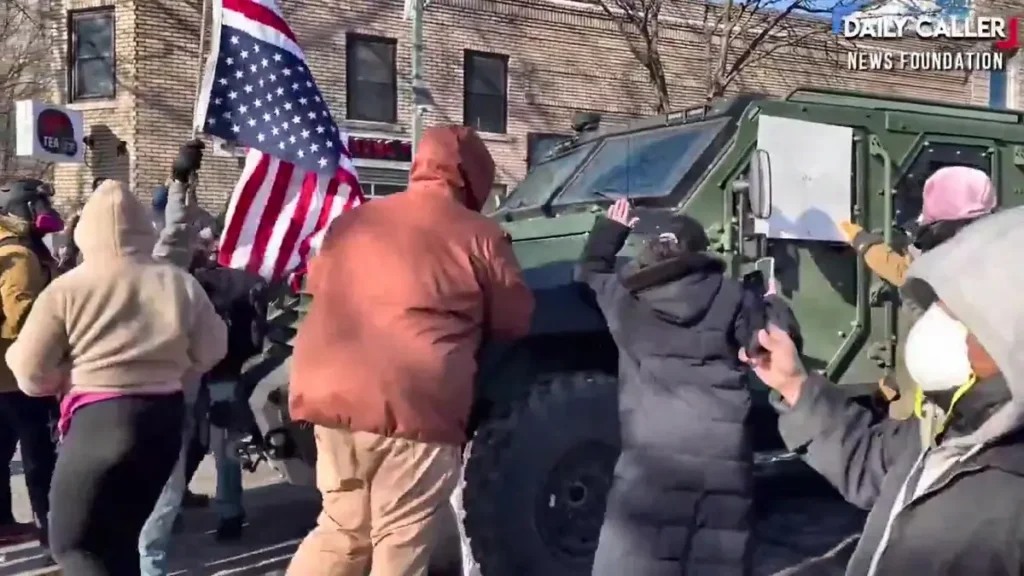
WATCH: On-scene video documentation is embedded below →
MINNEAPOLIS – Footage circulating from a Minneapolis street shows a windowless green armored vehicle advancing at walking pace into a crowd of demonstrators, who respond by raising gloved hands, flags, and smartphones against its hull. The incident sits at the intersection of federal enforcement authority, use-of-force policy, and the rapidly thinning line between tactical operations and public accountability.
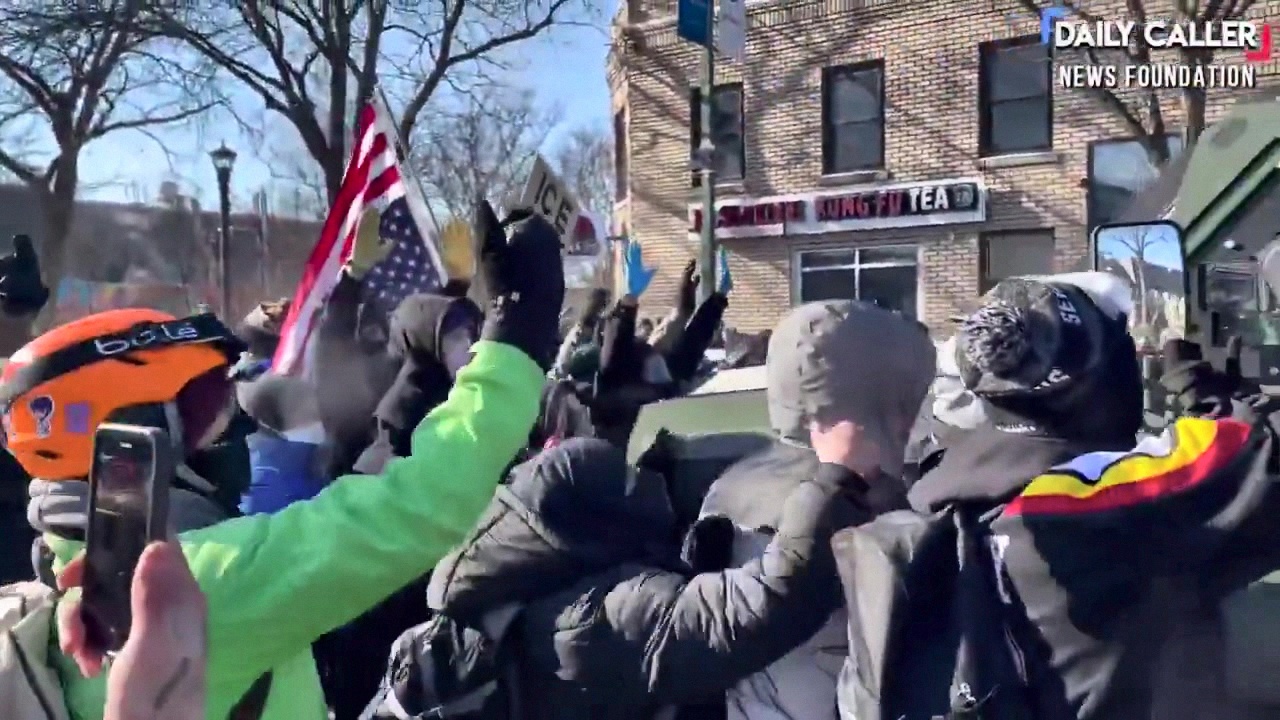
- A crowd gathered on a cold-weather sidewalk outside a brick commercial storefront bearing signage for a tea business; some held American flags while others held placards.
- A large wheeled armored vehicle, finished in matte olive with bolt-mounted plating and no discernible exterior agency markings or license plate, rolled directly into the assembled group.
- Demonstrators physically contacted the vehicle, pressing flat-palmed hands against its side panels and front glacis, while others recorded the encounter at close range.
- One audio element – an amplified voice announcing itself as the “National Board” and asking for attention – is present in the clip, though the speaker’s identity and legal authority remain unresolved in the public record.
What the Recorded Footage Captures: Chronological Breakdown
Frame one anchors the viewer against a wall of green metal. The camera sits only feet from the armored chassis, framing a black-zippered glove pressed flat against a hinged side door, its owner’s sleeve a fluorescent green fabric offcut. The plating is unmarked, bolted in regular industrial array, with a reinforced vision block and secondary observation slit. No unit insignia, no stenciled identification, no visible plate.
Above the vehicle's roofline, bare branches and a brick facade frame the scene, and a newsroom card in the upper right identifies the footage as Daily Caller News Foundation material.
As the camera pulls wider, the vehicle has already entered the space. A man wearing an orange full-face helmet raises a bare hand and a phone in the same gesture. American flags lean at angles against the winter light, a blue-and-yellow pennant hangs slack, and a crowd in dark parkas clusters deliberately in front of a bumper that has no business being there. A sign reading “ARREST JOHNATHAN ROSS” rises above the heads, while a hand-painted tea sign marks the storefront behind – an ordinary retail block turned into a tactical corridor without warning.
The sequence sharpens in the next frames. A man in a rust-orange hooded coat bends toward the vehicle's fender, both palms on steel, his body braced against the slope of the wheel arch. To his right, a woman in a cream sherpa fleece with a pink waistband faces forward as the crowd compresses around her. The armored truck has no visible driver sightline; its front glazing sits above head height, and the nearest demonstrators are below the hood line, visible only through slits.
The closing frames show the vehicle halted – or nearly so – while two men in heavy coats stand directly in front of it, one in a black beanie with a raised palm, the other in rust trousers, their backs to the camera. A woman in a white mask and black hood positions herself at the right edge. What the footage never reveals is a warning, an audible command, or a negotiated pause. The audio instead carries only the amplified request for attention attributed to the “National Board.”
Corporate Liability and Critical Blind Spots
The absence of markings is a documentary problem before it is a public one. An unmarked vehicle, by design, breaks the first link in evidentiary chain-of-custody: there is no plate to run, no unit number to request logs from, no registered owner to subpoena for the driver’s identity. Attorneys pursuing claims in similar federal-vehicle cases have instead had to rely on procurement records, body-worn camera timelines, and dispatch metadata – each of which can be asserted as exempt or simply delayed.
Second, the video begins mid-incident. What prompted the crowd’s formation, what route the vehicle took, and whether a dispersal order preceded its advance sit entirely outside the frame. That omission matters financially: in civil rights litigation, the pre-incident 911 audio and command-radio traffic typically establish the disputed duty of care and the standard against which use-of-force decisions are graded.
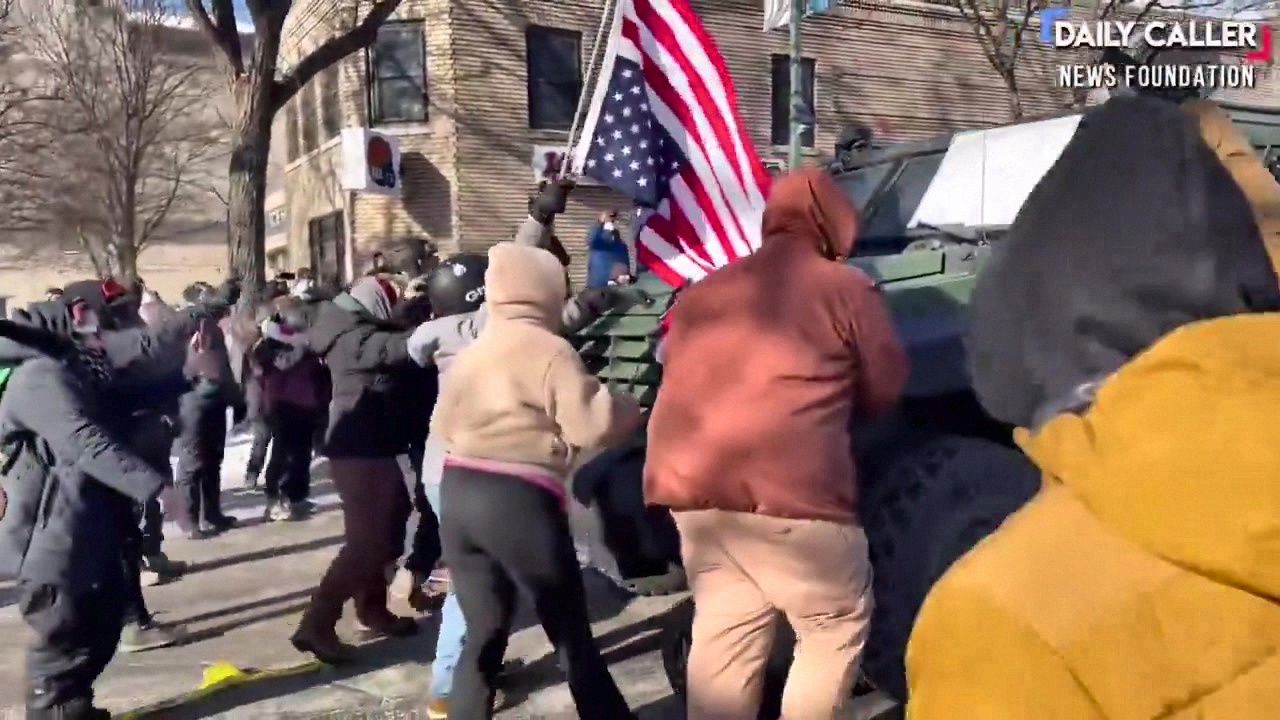
Third, viral captions carry their own liability. The description accompanying this clip asserts the vehicle “drove into a crowd,” while the frames show sustained contact at close range. The distinction between an intentional strike and a slow-rolling advance is precisely the factual pivot on which a claim of gross negligence either survives or collapses. Publicly circulated assertions cannot substitute for the missing interior camera footage.
Legal Distinction: An unmarked vehicle does not strip officers of authority, but it does shift disclosure burdens. Under federal qualified immunity doctrine, a plaintiff alleging a use-of-force violation must establish a clearly established right. Separately, records-keeping and vehicle-identification requirements attach to agency-marking regulations and municipal policies, creating an independent administrative exposure distinct from a constitutional tort claim.
Statutory Framework and Protocol Analysis
Municipal protocol in most U.S. jurisdictions requires identifiable markings on publicly funded tactical equipment, or at minimum an active-unit callout and a clear audible dispersal warning before force contact. Those protocols exist so that later litigation, coroner investigations, and public oversight boards can reconstruct events. An unmarked vehicle operating against a standing crowd removes each of those reconstruction tools simultaneously.
Recorded Scene Documentation
| Incident Parameter | Governing Legal Standard & Judicial Protocol |
|---|---|
| Vehicle identification | Agency marking and visible registration requirements |
| Crowd advance | Audible dispersal warning before contact |
| Use of force | Objective-reasonableness standard under constitutional case law |
| Evidence capture | Body-worn camera and in-vehicle recording retention duties |
| Prior events | Chain-of-custody preservation of radio and dispatch logs |
| Civil exposure | Qualified immunity analysis; municipal liability |
| Public disclosure | Public records statutes with security exemptions |
Read more: Elk Grove Citations Fail: $12,000 in Fines, No Compliance →
The retention problem compounds at the institutional level. If the vehicle lacked markings, there may be no dashboard unit, no squad log entry tied to a plate, and no automated fleet telematics keyed to an identifiable operator – leaving investigators to reconstruct a timeline from crowdsourced phone footage of variable frame rate and unknown provenance. Insurance and indemnification claims in similar cases hinge on exactly this gap, because municipalities often decline coverage where the vehicle-involved conduct cannot be tied to an authorized operator.
Core Questions and Institutional Review
- Which agency owns, funds, and insures the vehicle, and does its inventory disclose a marking exemption?
- Was any audible dispersal order issued prior to contact, and does that recording exist in an archived dispatch log?
- What administrative review mechanism applies to unmarked tactical deployment against a standing assembly?
- Who bears financial liability if the vehicle and its operator cannot be matched to an authorized deployment order?
Audit risk, not outrage, is what ultimately binds this episode to consequence. Cities that deploy unmarked or unidentifiable equipment against the public create a documented liability class: the vehicle becomes a legal entity without a paper trail. Until procurement records, deployment orders, and driver manifests are released, the most consequential facts visible in this footage remain the ones the tape cannot show – the plate, the insignia, and the order that sent the truck forward.


One comment on “Minneapolis Unmarked Armored Vehicle Crowd Incident Under Review”