Scroll down for the full investigative report below ↓
SAN BERNARDINO, Calif. – In a courtroom proceeding that has drawn intense scrutiny from legal analysts and child-welfare advocates, prosecutors in the fatal incident trial of a forty-year-old family friend systematically introduced handwritten exhibits authored by a twelve-year-old witness. The evidentiary sequence – walking a minor through declarations of romantic attachment to the defendant – constitutes a rare and legally delicate strategy aimed at establishing motive, credibility, and the broader domestic context of a fatal altercations the witness himself confessed to committing.

- The witness, a twelve-year-old who previously confessed alongside his thirteen-year-old brother to fatally beating their father with a baseball bat while he slept, appeared in open court under oath.
- Testimony centered on a series of letters and notes bearing paired initials and explicit romantic declarations directed at the defendant, identified as Ricky Chavez.
- The prosecutor introduced multiple sequential exhibits – identified by number in open court – each authenticated through the witness's admission of his own handwriting.
- The examination shifted abruptly to a separate letter addressed to the witness's deceased father, revealing a complex evidentiary record spanning grief, confession, and motive.
What the Recorded Footage Captures: Chronological Breakdown
The recorded footage opens on a fixed courtroom camera angle positioned at witness height, framing a young boy in a gray-blue collared shirt seated behind a black adjustable microphone. The wood-paneled wall behind him provides a neutral, institutional backdrop that fixes the viewer's attention entirely on the minor's face and hands. At the outset, the witness appears composed, his gaze directed downward toward the documents arrayed before him, his voice captured clearly through the podium microphone.
The examination proceeds methodically. The prosecutor's voice, originating from off-camera, poses a direct question regarding the witness's emotional state toward the defendant. The boy answers in monosyllabic affirmations, each response delivered without hesitation. As the questioning advances, the camera captures the witness reading from a document, his lips moving behind the microphone grille as he identifies initials and decodes their meaning for the record – establishing a chain of personal authorship that the prosecution treats as foundational.
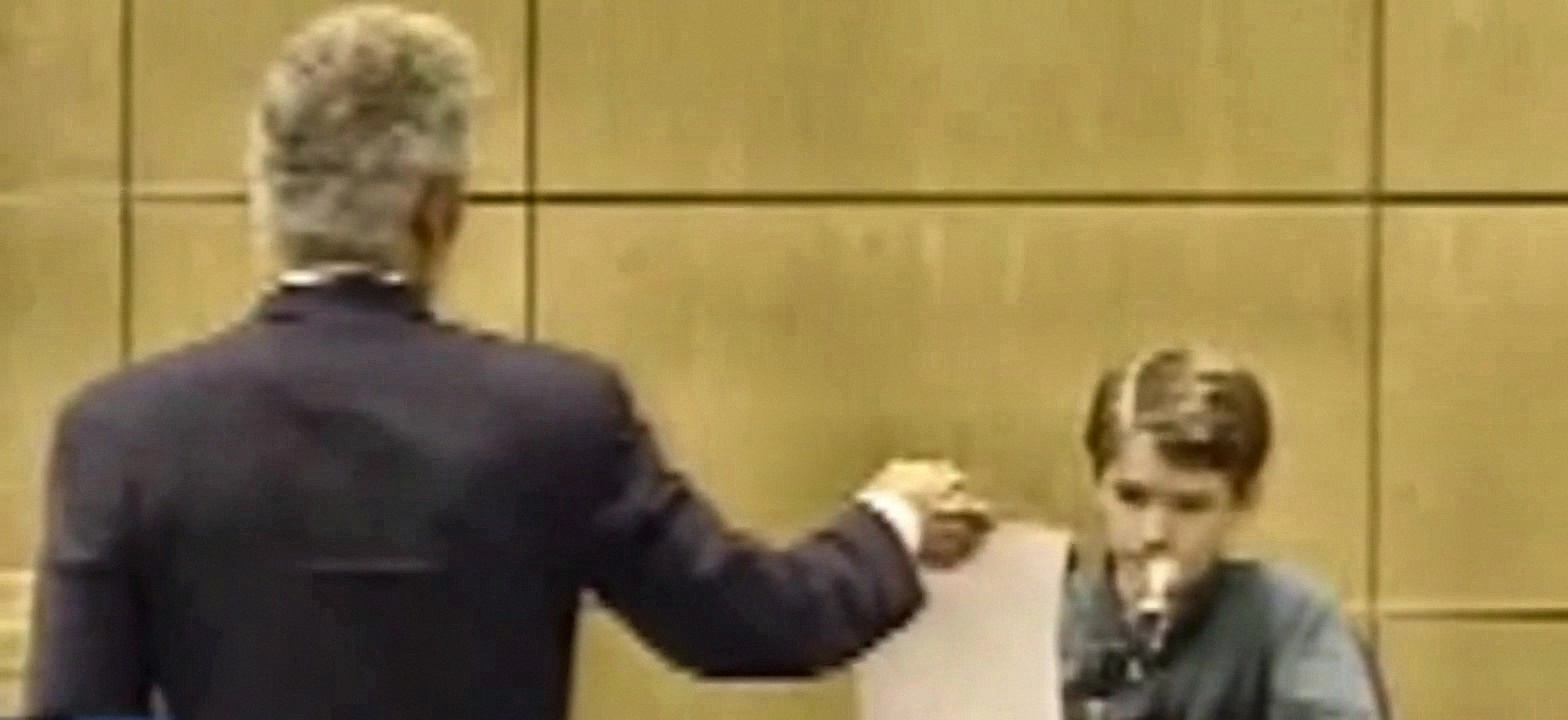
Roughly midway through the sequence, the frame widens to include the prosecutor, a gray-haired man in a dark suit, who steps into view holding a sheet of paper aloft. This physical gesture – lifting the document toward the witness – serves a dual purpose: it identifies the exhibit for the jury and visually ties the document to the person who authored it. The witness confirms the handwriting, and the prosecutor repeats the procedure with successive exhibits, each marked by a distinct state certificate number.
The footage captures the decisive pivot near its conclusion, when the prosecutor presents a letter bearing a different addressee. The witness identifies the letter as addressed to Terry, and upon questioning confirms that Terry is his father. This transition – from romantic correspondence to filial correspondence – marks the evidentiary hinge of the excerpt, recontextualizing the preceding testimony within a household where multiple relationships were simultaneously collapsing. The recording ends before any cross-examination or judicial comment is captured.
Corporate Liability and Critical Blind Spots
The evidentiary value of this testimony rests on a foundation the cameras cannot fully illuminate. The recorded excerpt captures only the direct examination; it does not capture the foundational objections, the competency voir dire that necessarily preceded a minor's testimony, or any limiting instructions delivered to the jury outside the recorded frame. Analysts caution that the sequential exhibit authentication seen here represents a curated portion of a far longer proceeding, and that conclusions drawn solely from this excerpt risk mischaracterizing the full record.
Chain-of-custody questions remain analytically significant. The prosecution establishes authorship through handwriting identification by the witness himself, a method that is legally permissible but less robust than forensic document examination. The physical letters – identified as state certificates ten, nine, eleven, and sixteen – presumably passed through evidence intake, but the recorded footage does not document their seizure, storage, or any challenge to their authenticity. Independent verification of the letters' full contents, context, and completeness is absent from the visible record.
A further blind spot concerns the defendant's perspective. The excerpt does not capture whether Chavez was present in the courtroom during this testimony, whether the defense lodged contemporaneous objections, or what the defense's theory of the correspondence might be. Viral characterizations of this sequence have emphasized its most provocative elements, but the recorded frame neither confirms nor refutes the broader narrative of the underlying fatal incident or the defendant's alleged role in it. Any assertion beyond what the witness verbally confirmed in open court remains unverified.
Legal Distinction: The examination captured here implicates several distinct legal doctrines. A minor's testimony is admissible subject to competency determination, typically evaluating the child's ability to understand the oath and distinguish truth from falsehood. Letters authenticated by their author's in-court identification satisfy the personal-knowledge foundation of evidentiary rules, though opposing counsel retains the right to challenge authenticity. Separately, the confidentiality of a juvenile's confession and the sealing of juvenile records operate under distinct statutory frameworks that may limit what may be publicly disclosed, even in a related adult prosecution.
Statutory Framework and Protocol Analysis
The procedural architecture visible in this excerpt reflects standard adversarial practice: the prosecution leads the witness through exhibit identification, consolidates authentication, and reserves confrontation for the defense. Compliance with courtroom protocol appears intact – the witness is seated, the microphone is functioning, and the exhibits are marked and referenced by number. What the record does not reveal is the juvenile court's authorization status for this testimony, the presence or absence of a guardian ad litem, or any accommodations granted for the minor's age.
Institutional duty of care toward a child witness is a recognized regulatory concern in American jurisprudence. Courts are generally obligated to ensure that minors testifying in adult criminal proceedings are not subjected to unduly confusing or abusive examination, and many jurisdictions permit closed-circuit testimony or recorded deposition for witnesses of tender years. The footage shows a conventional open-court appearance, which raises legitimate questions about whether protective protocols were considered, waived, or deemed inapplicable.
| Incident Parameter | Governing Legal Standard & Judicial Protocol |
|---|---|
| Minor witness competency | Competency determination required prior to testimony; oath comprehension and truth-discrimination assessed |
| Handwriting authentication | Personal-knowledge foundation under evidentiary rules; defense may challenge authenticity |
| Exhibit identification | Sequential numbering and in-court marking required for appellate record |
| Juvenile confession confidentiality | Statutory sealing frameworks may constrain disclosure in related adult proceedings |
| Child witness accommodations | Guardian ad litem or protective measures considered in tender-years testimony |
| Cross-examination rights | Confrontation clause guarantees defense opportunity to challenge adverse testimony |
| Public access to proceedings | Presumptive openness subject to judicial discretion for sensitive testimony |
Read more:
Read more: Pizzeria Assault: Three-on-One Attack and Liability →

Core Questions and Institutional Review
- Did the court conduct an on-record competency inquiry before permitting a twelve-year-old confessed fatal incident participant to testify, and what accommodations, if any, were provided?
- How were the handwritten exhibits seized, preserved, and authenticated beyond the author's own in-court identification?
- What protective protocols governed the minor's exposure to open-court examination regarding intimate personal matters, and were they adequate?
- What weight should a jury assign to correspondence authored by a child whose own confession is central to a parallel prosecution?
The systemic implications extend beyond this single docket. Cases involving juvenile perpetrators testifying against adult defendants force courts to balance evidentiary necessity against developmental vulnerability, and the resulting jurisprudence shapes how prosecutors construct motive arguments for years. The visible record here demonstrates procedural regularity, but it also underscores the enduring gap between what a camera captures and what a court must ultimately weigh. Observers should treat the excerpt as one authenticated fragment of a complex proceeding, not as a complete account of culpability, motive, or judicial outcome.
Key Takeaways:
- The recorded testimony establishes authorship of specific exhibits but not their full context.
- Authentication by a minor author is legally sufficient yet evidentially contestable.
- Child-witness protection protocols remain an open question in open-court proceedings.
- Viral framing of this excerpt exceeds what the verified footage actually shows.
FOLLOW-UP INVESTIGATION REPORT
Related documented case details, verified on-scene evidence, and statutory liability analysis continued below.
CONTINUE READING: NEXT INVESTIGATIVE DOSSIER →
House Party Melee: Crowd Swarms Lone Man on Camera

An unruly gathering at a private residence escalated into a chaotic mob assault in the United States, raising urgent questions about bystander liability, platform distribution of violent content, and the evidentiary gaps that complicate prosecutorial review.
- Jurisdictional ambiguity: The footage is recorded in a residential party setting within the United States, but no municipal police agency, arrest record, or court docket has been publicly confirmed, leaving the matter outside any verified charging authority.
- Recorded escalation: A shirtless young man is surrounded, pushed to the ground, and swarmed by multiple individuals while a large crowd of onlookers shouts encouragement rather than intervening.
- Absence of intervention: No law enforcement, security personnel, or responsible host appears on camera during the confrontation, and the recording continues uninterrupted through the melee.
- Distribution concerns: The clip carries a third-party aggregator watermark and has circulated widely as viral entertainment, raising questions about the monetization of violent content and the duties of hosting platforms.
What the Recorded Footage Captures: Chronological Breakdown
From the opening frames, the camera is handheld and unstable, capturing a narrow field of view dominated by a woman in an orange top and patterned bottoms standing close to the lens. Body-mounted lighting casts a red glare at the bottom edge of the frame, indicating a crowded, low-light outdoor or garage-adjacent setting. The audible track begins with a male voice repeating a check-in phrase four times, establishing that the person is conscious initially and that someone nearby is engaging verbally. This early exchange is calm but repetitive, and the camera angle does not show whether the subject is being held, restrained, or simply attended to.
The footage then pivots abruptly. A male figure appears to lower or fall to the ground near a parked white pickup truck, whose tailgate and partial license plate are visible. The camera swings across the pavement, and a shoe lies isolated on the concrete, suggesting sudden movement or a struggle that displaced it. During this sequence, a chorus of shouting overlaps, including repeated demands to calm down followed by aggressive commands from multiple voices. The contrasting audio, one voice urging restraint while others press forward, is the clearest evidentiary signal of a crowd that split between de-escalation and participation.
The most violent segment shows the shirtless man on the ground, with several figures moving toward and around him. At no point does a uniformed officer, security guard, or designated event steward appear in frame. The camera operator moves closer rather than retreating, and no verbal instruction is directed at the filming party, suggesting that the recording was normalized within the group. The clip terminates abruptly mid-action, offering no footage of the aftermath, no observed injuries, and no exchange with emergency services.
A second, much darker segment in the sequence shows crowd silhouettes with a light source in the background and figures crowded tightly together. Here the visual record degrades substantially, and specific acts cannot be reliably identified. This is precisely the type of low-information footage that becomes vulnerable to exaggerated narration once it enters social distribution channels.
Corporate Liability and Critical Blind Spots
The footage presents substantial evidentiary limitations. Prior events that prompted the confrontation are entirely unrecorded, meaning the precipitating dispute, any verbal threats, and the identity of the initial aggressor are all outside the record. Chain of custody is undocumented: the clip bears a third-party aggregator watermark, indicating multiple re-uploads and transcoding passes that undermine authentication for litigation purposes. Perspective blind spots are severe, with the handheld camera focused narrowly on a few subjects while the surrounding crowd and any escape routes remain unobserved.
The most consequential blind spot is legal rather than visual. No verified police report, arrest record, or charging instrument accompanies this footage, meaning the widely circulated viral assertions about motive and outcome remain unverified. Financial and corporate exposure enters through the distribution layer: platforms that host and monetize such clips face scrutiny over violent-content policies, advertiser adjacency, and algorithmic amplification. Aggregator accounts that repackage violent encounters into branded content create revenue streams detached from any verified factual record, a structural incentive that rewards escalation over verification.
Statutory Framework and Protocol Analysis
Legal Distinction: Criminal assault and battery liability attaches to each individual who strikes or aids an attack, not to the assembled crowd as a whole. Civil liability for injuries can extend to parties whose negligence enabled the harm, and in many jurisdictions hosts owe a duty of reasonable care to invited guests. Separately, platforms hosting violent user content operate under content-moderation and notice-based frameworks rather than criminal law, creating a wide gap between visible conduct and enforceable sanction.
Institutional duty of care begins with the event host. Residential gatherings that grow to crowd scale without supervision, crowd management, or a mechanism to summon emergency services create foreseeable risk. In jurisdictions that impose host liability for alcohol service or guest safety, documented inaction during a recorded melee can become a civil negligence component independent of criminal outcomes. The recording itself functions as both evidence and exposure: it establishes that multiple bystanders perceived the danger and none intervened.
Compliance protocol in cases of this type typically requires three verified elements: a timestamps-authenticated original file, an independent witness account corroborating the sequence, and a law enforcement report establishing jurisdiction and initial findings. None of the three appears in the public record here. Without them, the clip remains a viral artifact rather than a prosecutable exhibit, and the reputational damage to identifiable subjects proceeds without any corresponding legal adjudication.
| Incident Parameter | Governing Legal Standard & Judicial Protocol |
|---|---|
| Physical attack by multiple persons | Assault and battery statutes; individual liability per actor |
| Crowd encouragement of violence | Accessory and aiding-and-abetting doctrines where provable |
| Private residence gathering | Host duty of care; premises liability in most U.S. states |
| Recording and posting of violence | Platform content policy; notice-and-takedown frameworks |
| Absence of police response on camera | Duty to summon emergency services; jurisdictional reporting |
| Unverified viral narration | Defamation and evidentiary authentication standards |
| Watermarked re-upload of footage | Copyright and chain-of-custody authentication issues |
Core Questions and Institutional Review
- Did any attendee contact law enforcement or emergency medical services during the incident, and is there a dispatch record confirming response time?
- Who hosted the gathering, and did the host exercise any supervision or crowd-control measures before the confrontation began?
- What evidentiary steps were taken to preserve the original, pre-watermark video file, and does an authenticated version exist for any official review?
- Should hosting platforms treat watermarked violent-content aggregators as a distinct enforcement category rather than standard user content?
The systemic impact of this footage rests less on the recorded seconds than on what follows. A recorded attack distributed as entertainment without any visible legal consequence erodes confidence that accountability mechanisms function. For institutional actors, the operative lesson is procedural: preservation of original media, prompt reporting, and documented host responsibility determine whether an incident becomes a case or merely a clip.
Practical Takeaways
- Preserve original, unedited footage with timestamps before any re-upload or watermarking occurs.
- Hosts of large gatherings should maintain a designated crowd monitor and a documented emergency-contact plan.
- Bystanders who record violence without summoning aid create legal and reputational exposure for themselves and hosts alike.
- Viral captions asserting motive or justification are not evidence and should be treated as unverified claims.
Frequently Asked Questions
Does a viral video by itself support criminal charges? It can support an investigation, but authentication, witness corroboration, and a filed police report are generally required before a prosecutor can act.
Can a recording bystander face liability? Generally not for the attack itself, but exposure can arise where a duty to summon aid existed, particularly for hosts or event staff.
Can platforms be sued over this content? Exposure is limited under most moderation frameworks, but notice-based takedown obligations and advertising-policy compliance remain live issues.
What should attendees do when a gathering turns violent? Retreat, call emergency services, and retain original footage without editing or re-uploading it.