
Scroll down for the full investigative report below ↓
LOS ANGELES – A recorded interception of a moving official convoy on a city roadway has escalated into a multi-agency legal and regulatory inquiry after federal protective personnel physically restrained a woman who entered the motorcade path carrying a megaphone. The incident, captured across sequential camera frames and partially transcribed audio, raises immediate questions of protective-service use-of-force standards, municipal event permitting exposure, and the evidentiary framework governing roadway protests in dense urban corridors.
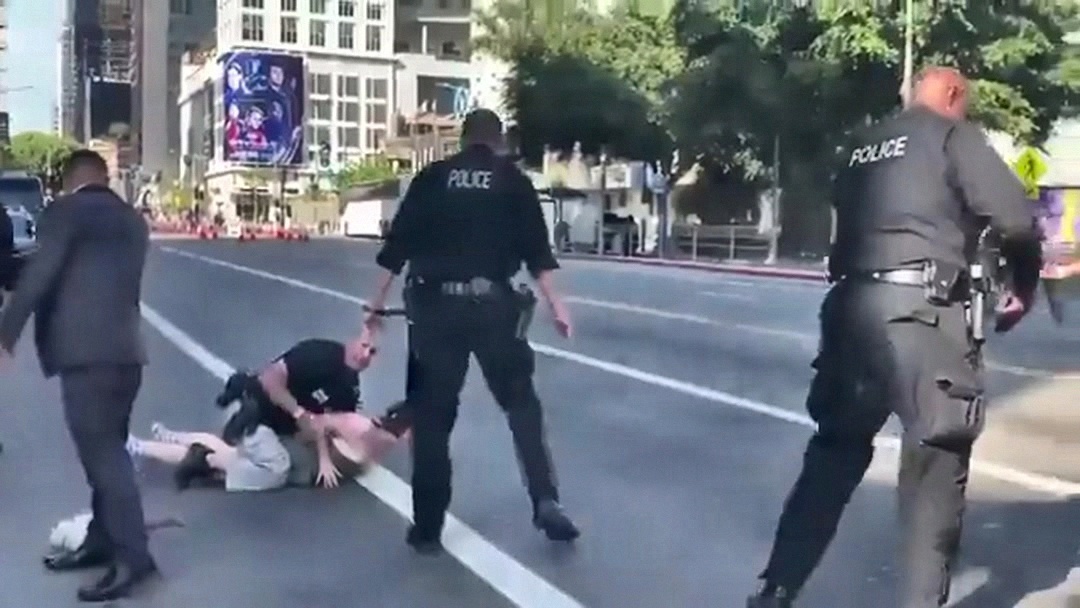
- Jurisdictional setting: A multi-lane arterial roadway in a dense downtown Los Angeles corridor, with a motorcade route active and uniformed and plainclothes officers positioned along the perimeter.
- Recorded escalation: A woman entered the travel lane carrying a megaphone, positioned herself ahead of the convoy, and began broadcasting before personnel closed the distance.
- Physical containment: Multiple agents and uniformed police converged, brought the woman to the asphalt, and restrained her in a prone position while she verbally protested the contact.
- Repercussions under review: Questions of protective-service detention authority, municipal permit and crowd-control protocol, and the admissibility and completeness of bystander-recorded evidence.
What the Recorded Footage Captures: Chronological Breakdown
Frame one establishes the physical aftermath of the initial contact. A plainclothes agent, identifiable by a visible badge clipped at the waist and dark tactical vest, is positioned over a woman lying on the roadway surface. Her arms are extended and secured behind her back, and a blue and white megaphone rests on the asphalt immediately adjacent to her head and left hand.
The camera angle is low and slightly oblique, capturing the full length of the restraint but obscuring the moments immediately preceding it. A second plainclothes figure in a grey suit stands above the pair, body angled downrange, functioning as a visual screen between the restraint and the broader roadway.
Frame two widens the evidentiary field considerably. The camera pulls back to reveal a full lane closure, with marked patrol units and a uniformed officer in a dark duty uniform printed with "POLICE" on the back standing adjacent to the prone subject. A second uniformed officer is visible at the right edge of the frame, and a suited individual walks along the curb line.
The wide shot confirms that the restraint occurred in an active travel lane rather than on a sidewalk or shoulder, which materially elevates the safety analysis: traffic exposure existed simultaneously for the subject, the officers, and any approaching vehicles.
Frame three captures the peak of the physical containment. An officer kneels across the woman's upper body while a second officer controls her left arm; her face is visible and turned toward the camera, and her expression and posture are consistent with the audio record of repeated demands to be released. A non-uniformed individual in shorts and a helmet walks through the background, indicating that civilian foot traffic was not fully cleared from the immediate perimeter.
The restraint appears controlled rather than chaotic, but the number of personnel involved relative to a single unarmed subject is a factor that use-of-force reviewers routinely scrutinize.
Frame four and five document the stabilization and de-escalation phase. Personnel remain over the subject, other officers establish a wider cordon, and a red and green decorative barrier or ribbon is visible in the foreground of the final frame. The scattered megaphone, a white bag, and personal effects remain on the pavement, forming a physical evidence trail that any subsequent administrative review would need to photograph and catalog before clearing the scene.
Corporate Liability and Critical Blind Spots
The most consequential evidentiary gap is the pre-contact sequence. The available record begins at the point of physical restraint, meaning the critical interval – how close the woman came to the moving vehicles, whether verbal commands were issued and audible, and whether she was given a reasonable opportunity to comply – is not documented in the frames under review.
Audio captures a bystander voice warning that she would be struck by a vehicle, and repeated commands of "Let it go" directed at the megaphone, but the exact spacing and sequence of those commands relative to the physical takedown cannot be established from the available material.
Chain of custody presents a second exposure. Bystander video recorded from multiple angles and distributed across social platforms rarely retains verifiable timestamps, device metadata, or uninterrupted originals. In a litigation context, opposing counsel will probe whether the circulating clips are complete, whether they were altered or trimmed, and whether exculpatory segments exist outside the frame. Entities that republish such footage without preservation protocols inherit a meaningful defamation and evidentiary risk.
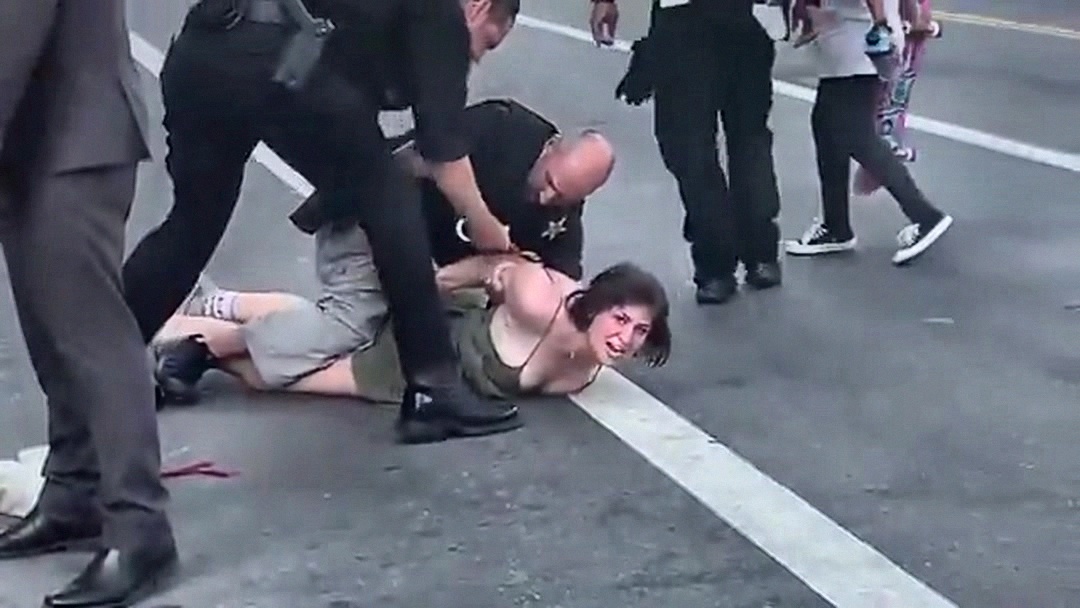
A third blind spot concerns identity and role differentiation. The frames show a mix of plainclothes protective personnel, uniformed municipal police, and suited officials whose agency affiliation is not visibly established. Attributing specific acts to specific agencies – and therefore to specific legal standards – requires the official after-action report, which is not part of the public record at this stage. Any viral assertion that assigns blame to a named agency before that documentation surfaces is unverified.
Statutory Framework and Protocol Analysis
Legal Distinction: Protective-service detention authority is not identical to ordinary municipal arrest power. Federal protective personnel operating near a motorcade may act under statutory mandates to prevent imminent harm to protected individuals, but any physical restraint must still satisfy Fourth Amendment reasonableness, which weighs the immediacy of the threat against the intrusiveness of the seizure. State law adds a separate layer, including prohibitions on obstructing a roadway and interference with an emergency vehicle, each carrying distinct mens rea thresholds.
Institutional duty of care runs in two directions here. The protective detail owes a duty to secure the route against imminent hazards; the municipality owes a duty to maintain a safe corridor for both demonstrators and the traveling public. When a single protester enters an active lane, those duties collide, and the resulting use of force must be evaluated against the least intrusive means reasonably available. The number of personnel involved, the immediate availability of a containment perimeter, and whether verbal de-escalation was attempted all factor into that calculus.
Compliance review will also examine crowd-management policy, including the decision to close lanes, the placement of physical barriers, and the timing of permit notifications. Where a municipal code requires permits for amplified devices or roadway assemblies, the absence of a permit does not automatically authorize physical force, but it does inform the reasonableness of the enforcement response.
| Incident Parameter | Governing Legal Standard & Judicial Protocol |
|---|---|
| Entry into an active motorcade lane | State vehicle-code obstruction provisions plus federal protective-zone regulations |
| Physical restraint of a protester | Fourth Amendment objective reasonableness under Graham v. Connor |
| Use of amplified device near a convoy | Municipal noise and assembly permitting ordinances |
| Multi-agency joint response | Interagency memoranda governing protective-detail support |
| Bystander video as evidence | Federal Rules of Evidence authentication and chain-of-custody doctrine |
| Injury or property damage claims | Comparative negligence and sovereign immunity thresholds |
| Administrative accountability | Civilian oversight board review and after-action reporting |
Read more:
Read more: House Party Melee: Crowd Swarms Lone Man on Camera →

Core Questions and Institutional Review
- Did protective personnel issue audible, reasonable warnings before initiating physical contact, and is that sequence documented in any complete recording?
- Which agencies participated in the restraint, and under what written interagency authority was municipal police support requested?
- Was the roadway closure plan adequate to separate demonstrators from live traffic, and who approved the perimeter configuration?
- What evidentiary preservation steps were taken for the scattered megaphone, personal effects, and all available video originals?
The systemic impact of this incident extends beyond a single detention. Recorded restraint events on public roadways have become the de facto evidentiary standard for evaluating protective-service conduct, yet the footage typically begins after the decisive moment. That structural gap places a premium on body-worn camera retention, interagency documentation, and rapid preservation of bystander originals. Absent those controls, public confidence in the review process erodes regardless of the eventual legal outcome, and the reputational and financial exposure for the agencies involved compounds with every unverified clip that circulates.
FOLLOW-UP INVESTIGATION REPORT
Related documented case details, verified on-scene evidence, and statutory liability analysis continued below.
CONTINUE READING: NEXT INVESTIGATIVE DOSSIER →
Minor’s Letters Entered as Evidence in Chavez Fatal incident Trial

SAN BERNARDINO, Calif. – In a courtroom proceeding that has drawn intense scrutiny from legal analysts and child-welfare advocates, prosecutors in the fatal incident trial of a forty-year-old family friend systematically introduced handwritten exhibits authored by a twelve-year-old witness. The evidentiary sequence – walking a minor through declarations of romantic attachment to the defendant – constitutes a rare and legally delicate strategy aimed at establishing motive, credibility, and the broader domestic context of a fatal altercations the witness himself confessed to committing.
- The witness, a twelve-year-old who previously confessed alongside his thirteen-year-old brother to fatally beating their father with a baseball bat while he slept, appeared in open court under oath.
- Testimony centered on a series of letters and notes bearing paired initials and explicit romantic declarations directed at the defendant, identified as Ricky Chavez.
- The prosecutor introduced multiple sequential exhibits – identified by number in open court – each authenticated through the witness's admission of his own handwriting.
- The examination shifted abruptly to a separate letter addressed to the witness's deceased father, revealing a complex evidentiary record spanning grief, confession, and motive.
What the Recorded Footage Captures: Chronological Breakdown
The recorded footage opens on a fixed courtroom camera angle positioned at witness height, framing a young boy in a gray-blue collared shirt seated behind a black adjustable microphone. The wood-paneled wall behind him provides a neutral, institutional backdrop that fixes the viewer's attention entirely on the minor's face and hands. At the outset, the witness appears composed, his gaze directed downward toward the documents arrayed before him, his voice captured clearly through the podium microphone.
The examination proceeds methodically. The prosecutor's voice, originating from off-camera, poses a direct question regarding the witness's emotional state toward the defendant. The boy answers in monosyllabic affirmations, each response delivered without hesitation. As the questioning advances, the camera captures the witness reading from a document, his lips moving behind the microphone grille as he identifies initials and decodes their meaning for the record – establishing a chain of personal authorship that the prosecution treats as foundational.
Roughly midway through the sequence, the frame widens to include the prosecutor, a gray-haired man in a dark suit, who steps into view holding a sheet of paper aloft. This physical gesture – lifting the document toward the witness – serves a dual purpose: it identifies the exhibit for the jury and visually ties the document to the person who authored it. The witness confirms the handwriting, and the prosecutor repeats the procedure with successive exhibits, each marked by a distinct state certificate number.
The footage captures the decisive pivot near its conclusion, when the prosecutor presents a letter bearing a different addressee. The witness identifies the letter as addressed to Terry, and upon questioning confirms that Terry is his father. This transition – from romantic correspondence to filial correspondence – marks the evidentiary hinge of the excerpt, recontextualizing the preceding testimony within a household where multiple relationships were simultaneously collapsing. The recording ends before any cross-examination or judicial comment is captured.
Corporate Liability and Critical Blind Spots
The evidentiary value of this testimony rests on a foundation the cameras cannot fully illuminate. The recorded excerpt captures only the direct examination; it does not capture the foundational objections, the competency voir dire that necessarily preceded a minor's testimony, or any limiting instructions delivered to the jury outside the recorded frame. Analysts caution that the sequential exhibit authentication seen here represents a curated portion of a far longer proceeding, and that conclusions drawn solely from this excerpt risk mischaracterizing the full record.
Chain-of-custody questions remain analytically significant. The prosecution establishes authorship through handwriting identification by the witness himself, a method that is legally permissible but less robust than forensic document examination. The physical letters – identified as state certificates ten, nine, eleven, and sixteen – presumably passed through evidence intake, but the recorded footage does not document their seizure, storage, or any challenge to their authenticity. Independent verification of the letters' full contents, context, and completeness is absent from the visible record.
A further blind spot concerns the defendant's perspective. The excerpt does not capture whether Chavez was present in the courtroom during this testimony, whether the defense lodged contemporaneous objections, or what the defense's theory of the correspondence might be. Viral characterizations of this sequence have emphasized its most provocative elements, but the recorded frame neither confirms nor refutes the broader narrative of the underlying fatal incident or the defendant's alleged role in it. Any assertion beyond what the witness verbally confirmed in open court remains unverified.
Legal Distinction: The examination captured here implicates several distinct legal doctrines. A minor's testimony is admissible subject to competency determination, typically evaluating the child's ability to understand the oath and distinguish truth from falsehood. Letters authenticated by their author's in-court identification satisfy the personal-knowledge foundation of evidentiary rules, though opposing counsel retains the right to challenge authenticity. Separately, the confidentiality of a juvenile's confession and the sealing of juvenile records operate under distinct statutory frameworks that may limit what may be publicly disclosed, even in a related adult prosecution.
Statutory Framework and Protocol Analysis
The procedural architecture visible in this excerpt reflects standard adversarial practice: the prosecution leads the witness through exhibit identification, consolidates authentication, and reserves confrontation for the defense. Compliance with courtroom protocol appears intact – the witness is seated, the microphone is functioning, and the exhibits are marked and referenced by number. What the record does not reveal is the juvenile court's authorization status for this testimony, the presence or absence of a guardian ad litem, or any accommodations granted for the minor's age.
Institutional duty of care toward a child witness is a recognized regulatory concern in American jurisprudence. Courts are generally obligated to ensure that minors testifying in adult criminal proceedings are not subjected to unduly confusing or abusive examination, and many jurisdictions permit closed-circuit testimony or recorded deposition for witnesses of tender years. The footage shows a conventional open-court appearance, which raises legitimate questions about whether protective protocols were considered, waived, or deemed inapplicable.
| Incident Parameter | Governing Legal Standard & Judicial Protocol |
|---|---|
| Minor witness competency | Competency determination required prior to testimony; oath comprehension and truth-discrimination assessed |
| Handwriting authentication | Personal-knowledge foundation under evidentiary rules; defense may challenge authenticity |
| Exhibit identification | Sequential numbering and in-court marking required for appellate record |
| Juvenile confession confidentiality | Statutory sealing frameworks may constrain disclosure in related adult proceedings |
| Child witness accommodations | Guardian ad litem or protective measures considered in tender-years testimony |
| Cross-examination rights | Confrontation clause guarantees defense opportunity to challenge adverse testimony |
| Public access to proceedings | Presumptive openness subject to judicial discretion for sensitive testimony |
Read more: {NOIBO}
Core Questions and Institutional Review
- Did the court conduct an on-record competency inquiry before permitting a twelve-year-old confessed fatal incident participant to testify, and what accommodations, if any, were provided?
- How were the handwritten exhibits seized, preserved, and authenticated beyond the author's own in-court identification?
- What protective protocols governed the minor's exposure to open-court examination regarding intimate personal matters, and were they adequate?
- What weight should a jury assign to correspondence authored by a child whose own confession is central to a parallel prosecution?
The systemic implications extend beyond this single docket. Cases involving juvenile perpetrators testifying against adult defendants force courts to balance evidentiary necessity against developmental vulnerability, and the resulting jurisprudence shapes how prosecutors construct motive arguments for years. The visible record here demonstrates procedural regularity, but it also underscores the enduring gap between what a camera captures and what a court must ultimately weigh. Observers should treat the excerpt as one authenticated fragment of a complex proceeding, not as a complete account of culpability, motive, or judicial outcome.
Key Takeaways:
- The recorded testimony establishes authorship of specific exhibits but not their full context.
- Authentication by a minor author is legally sufficient yet evidentially contestable.
- Child-witness protection protocols remain an open question in open-court proceedings.
- Viral framing of this excerpt exceeds what the verified footage actually shows.


One comment on “Convoy Protest Interception: Secret Service Restraint Under Review”