
Scroll down for the full investigative report below ↓
An unruly gathering at a private residence escalated into a chaotic mob assault in the United States, raising urgent questions about bystander liability, platform distribution of violent content, and the evidentiary gaps that complicate prosecutorial review.
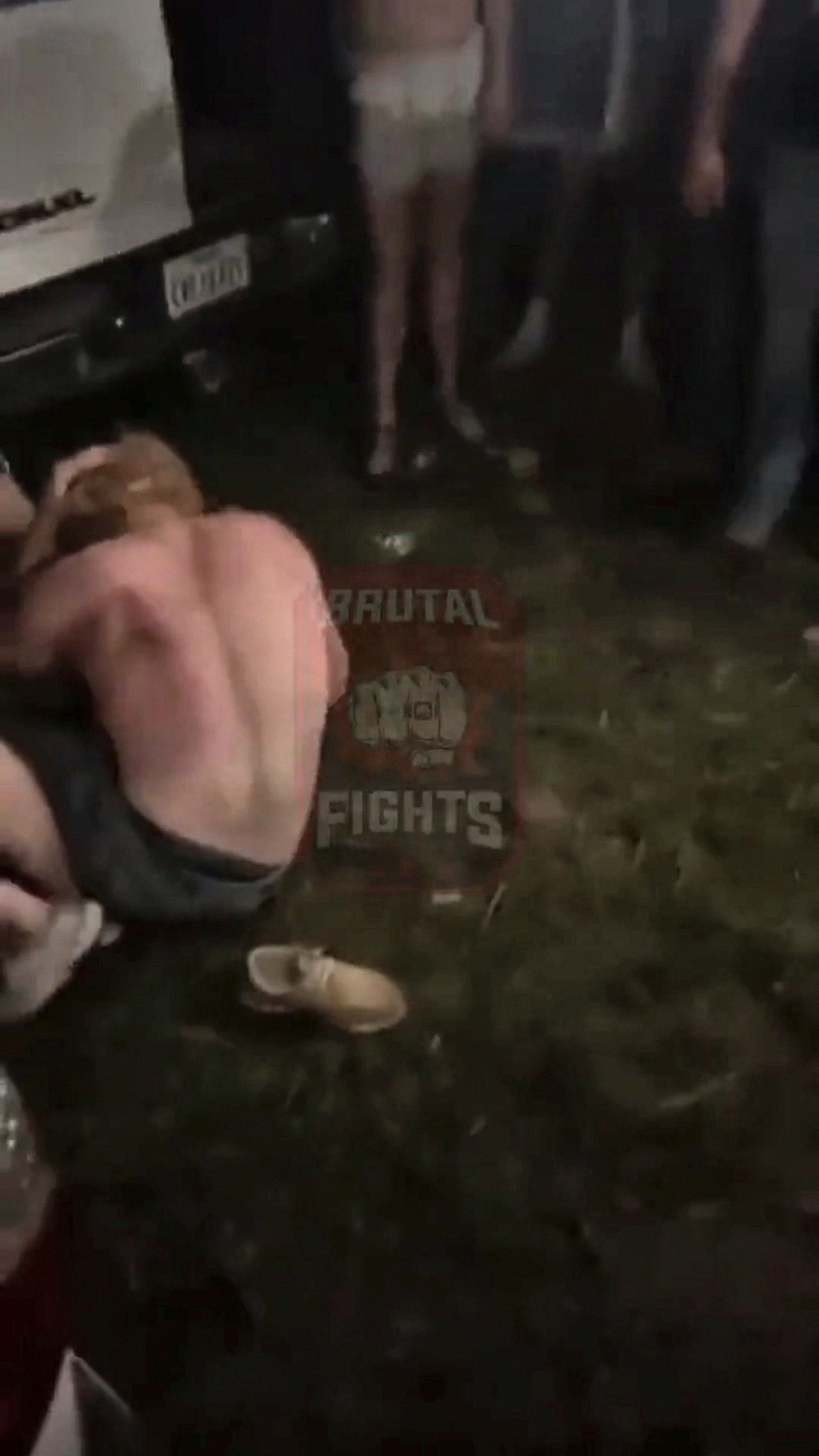
- Jurisdictional ambiguity: The footage is recorded in a residential party setting within the United States, but no municipal police agency, arrest record, or court docket has been publicly confirmed, leaving the matter outside any verified charging authority.
- Recorded escalation: A shirtless young man is surrounded, pushed to the ground, and swarmed by multiple individuals while a large crowd of onlookers shouts encouragement rather than intervening.
- Absence of intervention: No law enforcement, security personnel, or responsible host appears on camera during the confrontation, and the recording continues uninterrupted through the melee.
- Distribution concerns: The clip carries a third-party aggregator watermark and has circulated widely as viral entertainment, raising questions about the monetization of violent content and the duties of hosting platforms.
What the Recorded Footage Captures: Chronological Breakdown
From the opening frames, the camera is handheld and unstable, capturing a narrow field of view dominated by a woman in an orange top and patterned bottoms standing close to the lens. Body-mounted lighting casts a red glare at the bottom edge of the frame, indicating a crowded, low-light outdoor or garage-adjacent setting.
The audible track begins with a male voice repeating a check-in phrase four times, establishing that the person is conscious initially and that someone nearby is engaging verbally. This early exchange is calm but repetitive, and the camera angle does not show whether the subject is being held, restrained, or simply attended to.
The footage then pivots abruptly. A male figure appears to lower or fall to the ground near a parked white pickup truck, whose tailgate and partial license plate are visible. The camera swings across the pavement, and a shoe lies isolated on the concrete, suggesting sudden movement or a struggle that displaced it. During this sequence, a chorus of shouting overlaps, including repeated demands to calm down followed by aggressive commands from multiple voices.
The contrasting audio, one voice urging restraint while others press forward, is the clearest evidentiary signal of a crowd that split between de-escalation and participation.
The most violent segment shows the shirtless man on the ground, with several figures moving toward and around him. At no point does a uniformed officer, security guard, or designated event steward appear in frame. The camera operator moves closer rather than retreating, and no verbal instruction is directed at the filming party, suggesting that the recording was normalized within the group. The clip terminates abruptly mid-action, offering no footage of the aftermath, no observed injuries, and no exchange with emergency services.
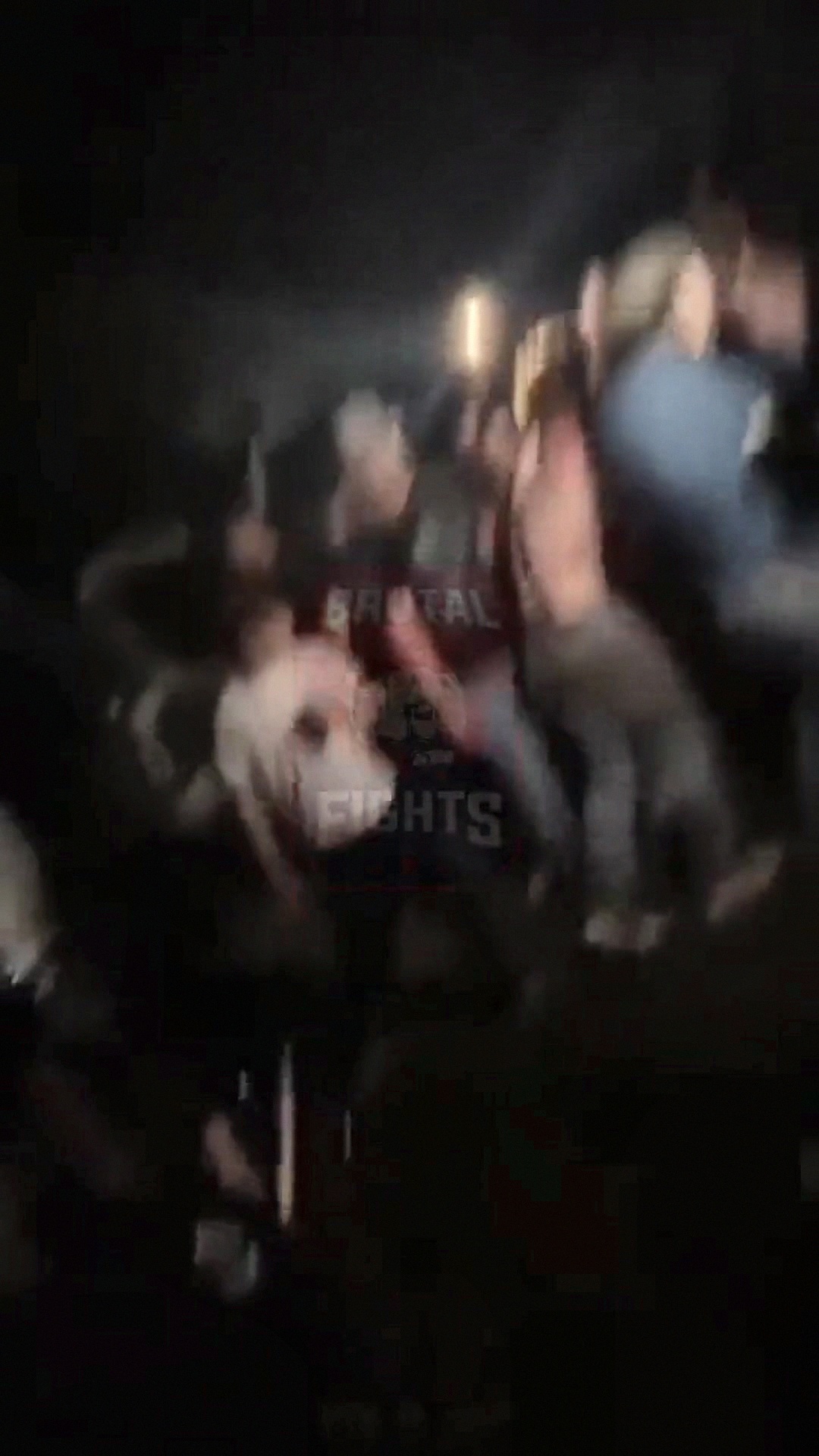
A second, much darker segment in the sequence shows crowd silhouettes with a light source in the background and figures crowded tightly together. Here the visual record degrades substantially, and specific acts cannot be reliably identified. This is precisely the type of low-information footage that becomes vulnerable to exaggerated narration once it enters social distribution channels.
Corporate Liability and Critical Blind Spots
The footage presents substantial evidentiary limitations. Prior events that prompted the confrontation are entirely unrecorded, meaning the precipitating dispute, any verbal threats, and the identity of the initial aggressor are all outside the record. Chain of custody is undocumented: the clip bears a third-party aggregator watermark, indicating multiple re-uploads and transcoding passes that undermine authentication for litigation purposes. Perspective blind spots are severe, with the handheld camera focused narrowly on a few subjects while the surrounding crowd and any escape routes remain unobserved.
The most consequential blind spot is legal rather than visual. No verified police report, arrest record, or charging instrument accompanies this footage, meaning the widely circulated viral assertions about motive and outcome remain unverified. Financial and corporate exposure enters through the distribution layer: platforms that host and monetize such clips face scrutiny over violent-content policies, advertiser adjacency, and algorithmic amplification. Aggregator accounts that repackage violent encounters into branded content create revenue streams detached from any verified factual record, a structural incentive that rewards escalation over verification.
Statutory Framework and Protocol Analysis
Legal Distinction: Criminal assault and battery liability attaches to each individual who strikes or aids an attack, not to the assembled crowd as a whole. Civil liability for injuries can extend to parties whose negligence enabled the harm, and in many jurisdictions hosts owe a duty of reasonable care to invited guests. Separately, platforms hosting violent user content operate under content-moderation and notice-based frameworks rather than criminal law, creating a wide gap between visible conduct and enforceable sanction.
Institutional duty of care begins with the event host. Residential gatherings that grow to crowd scale without supervision, crowd management, or a mechanism to summon emergency services create foreseeable risk. In jurisdictions that impose host liability for alcohol service or guest safety, documented inaction during a recorded melee can become a civil negligence component independent of criminal outcomes. The recording itself functions as both evidence and exposure: it establishes that multiple bystanders perceived the danger and none intervened.
Compliance protocol in cases of this type typically requires three verified elements: a timestamps-authenticated original file, an independent witness account corroborating the sequence, and a law enforcement report establishing jurisdiction and initial findings. None of the three appears in the public record here. Without them, the clip remains a viral artifact rather than a prosecutable exhibit, and the reputational damage to identifiable subjects proceeds without any corresponding legal adjudication.
| Incident Parameter | Governing Legal Standard & Judicial Protocol |
|---|---|
| Physical attack by multiple persons | Assault and battery statutes; individual liability per actor |
| Crowd encouragement of violence | Accessory and aiding-and-abetting doctrines where provable |
| Private residence gathering | Host duty of care; premises liability in most U.S. states |
| Recording and posting of violence | Platform content policy; notice-and-takedown frameworks |
| Absence of police response on camera | Duty to summon emergency services; jurisdictional reporting |
| Unverified viral narration | Defamation and evidentiary authentication standards |
| Watermarked re-upload of footage | Copyright and chain-of-custody authentication issues |
Read more:
Read more: Sheriff Lobby Confrontation: Deputy Restraint device Threat on Camera →
Core Questions and Institutional Review
- Did any attendee contact law enforcement or emergency medical services during the incident, and is there a dispatch record confirming response time?
- Who hosted the gathering, and did the host exercise any supervision or crowd-control measures before the confrontation began?
- What evidentiary steps were taken to preserve the original, pre-watermark video file, and does an authenticated version exist for any official review?
- Should hosting platforms treat watermarked violent-content aggregators as a distinct enforcement category rather than standard user content?
The systemic impact of this footage rests less on the recorded seconds than on what follows. A recorded attack distributed as entertainment without any visible legal consequence erodes confidence that accountability mechanisms function. For institutional actors, the operative lesson is procedural: preservation of original media, prompt reporting, and documented host responsibility determine whether an incident becomes a case or merely a clip.
Practical Takeaways
- Preserve original, unedited footage with timestamps before any re-upload or watermarking occurs.
- Hosts of large gatherings should maintain a designated crowd monitor and a documented emergency-contact plan.
- Bystanders who record violence without summoning aid create legal and reputational exposure for themselves and hosts alike.
- Viral captions asserting motive or justification are not evidence and should be treated as unverified claims.
Frequently Asked Questions
Does a viral video by itself support criminal charges? It can support an investigation, but authentication, witness corroboration, and a filed police report are generally required before a prosecutor can act.
Can a recording bystander face liability? Generally not for the attack itself, but exposure can arise where a duty to summon aid existed, particularly for hosts or event staff.
Can platforms be sued over this content? Exposure is limited under most moderation frameworks, but notice-based takedown obligations and advertising-policy compliance remain live issues.
What should attendees do when a gathering turns violent? Retreat, call emergency services, and retain original footage without editing or re-uploading it.
FOLLOW-UP INVESTIGATION REPORT
Related documented case details, verified on-scene evidence, and statutory liability analysis continued below.
CONTINUE READING: NEXT INVESTIGATIVE DOSSIER →
Times Square Disney Store Protest: Liability and Free Speech
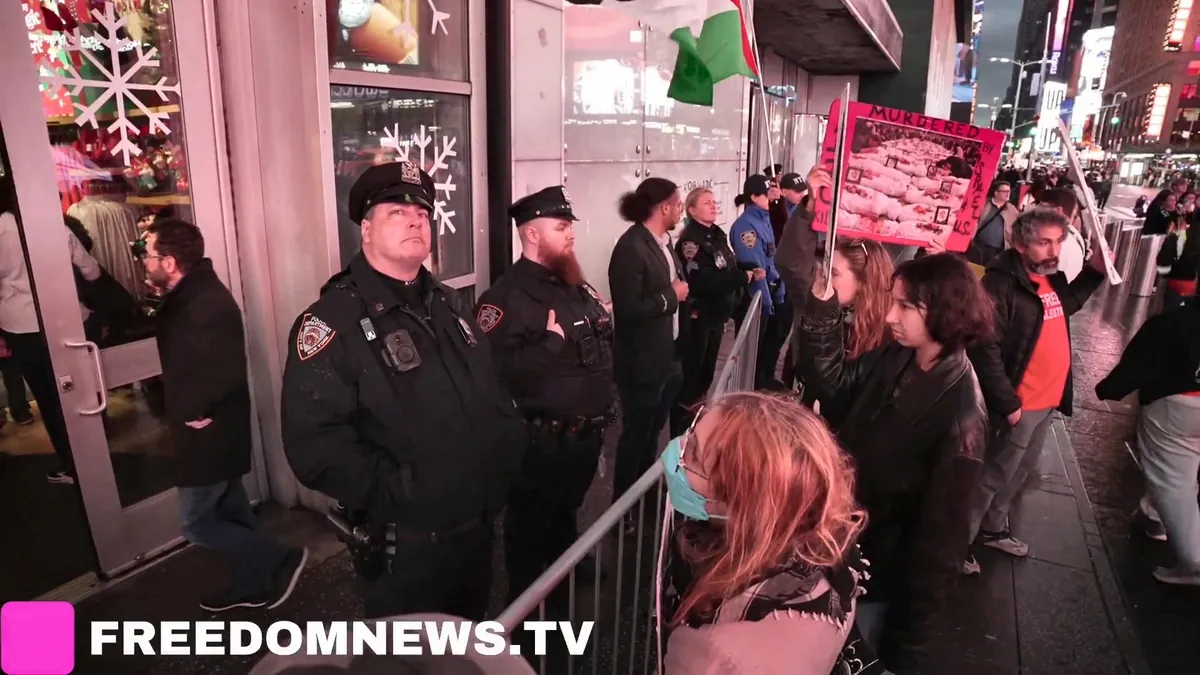
NEW YORK – A Black Friday confrontation outside the Disney Store in Times Square has thrust the boundaries of expressive conduct, retail property rights, and public order into sharp relief. Video recorded by the FreedomNews.TV desk and distributed by the @ScooterCasterNY account captures self-described pro-Palestine demonstrators confronting shoppers at the store entrance, leveling accusations of complicity in violence against civilians and blocking the threshold of a private commercial establishment on one of the busiest retail days of the year. The episode raises concrete questions about where lawful assembly ends and where interference with commerce, workplace safety obligations, and the civil rights of patrons begin – questions that courts, city regulators, and corporate counsel are increasingly being forced to answer as storefront protests proliferate.
- Jurisdictional setting: The recorded encounter unfolded at the Disney Store on a Times Square block, a densely trafficked commercial corridor under New York Police Department jurisdiction where sidewalk assembly and building-entry access are governed by overlapping city, state, and private-property rules.
- Recorded escalation: A man using a handheld megaphone repeatedly chants accusations at the storefront, while a small group of demonstrators holding a flag and a handheld sign stand behind metal barricades as shoppers attempt to cross the threshold.
- Law enforcement posture: Uniformed NYPD officers are visible in the frame maintaining a physical buffer between the protest line and the store entrance, keeping the barricade line intact rather than initiating enforcement action on camera.
- Legal and regulatory repercussions: No arrests, citations, or formal charges are documented in the available record, leaving the commercial-liability and property-rights dimensions of the incident unresolved and open to civil and regulatory scrutiny.
What the Recorded Footage Captures: Chronological Breakdown
From the opening frames, the camera holds a wide, handheld perspective at street level, capturing a crowded sidewalk lit by the vertical signage of Times Square. A figure with a keffiyeh-style scarf around the head and neck stands in the near foreground with a raised arm, gesturing toward the camera and the surrounding crowd, while a cluster of demonstrators forms a loose semicircle behind him. A man in a green tracksuit holds a drum; another holds a smartphone aloft, recording the scene. The framing establishes a march in motion – a moving demonstration rather than a static picket – with participants oriented toward retail frontage rather than a single fixed target.
The perspective shifts to the storefront itself. A demonstrator in dark clothing and a red scarf raises a megaphone toward the entrance, the device silhouetted against the illuminated holiday window displays. Behind the glass, mannequins and seasonal decorations remain visible, and a metal crowd-control barricade separates the protest line from the doorway. A large flag passes through the upper portion of the frame. The audio, captured on the same recording, carries a sustained chant directed at the retailer and at shoppers, interspersed with direct accusations aimed at individuals entering the store.
A third vantage point shows the entrance from closer range. A man in a beige jacket and a woman in a red-and-white hat move past the barricade toward the doors, while a uniformed officer stands near the entrance and a second officer is visible at the frame's right edge. The verbal exchange sharpens here: the recorded audio captures a demonstrator demanding that shoppers reconsider their purchase, and a shopper's response invoking historical atrocity and rejecting the framing. The confrontation is verbal and proximate, occurring within arm's reach of the doorway.
In the closing sequence, the camera widens again. Three NYPD officers in dark winter uniforms stand in a line facing the protest group, which is now arrayed behind the metal barricade holding a flag and a handheld placard displaying an image. An officer with a visible radio and shield stands at frame center-left, his posture relaxed but positioned squarely between the demonstrators and the store entrance. The footage ends with the line held, the chant continuing, and no physical altercation documented on camera.
Corporate Liability and Critical Blind Spots
The evidentiary record is materially incomplete. The footage begins mid-march, meaning the planning, permitting, and any pre-incident communications among organizers are not captured. Whether the demonstration was permitted under New York City assembly rules, whether a permit specified a route that included this storefront, and whether organizers were advised of private-property boundaries are all unrecorded and unverified. Viral commentary asserting a coordinated campaign against a specific retailer is not established by the clip itself.
Chain-of-custody questions also attach to the recording. The video carries a FreedomNews.TV watermark and is attributed to a credentialed independent journalist, but the clip circulated online is an excerpt; the full duration of the encounter, any exchanges before or after the published segment, and the identity of every speaker are not established. Direct quotations in the audio are fragmentary and overlapping, and attributing specific statements to specific individuals requires caution – a standard evidentiary constraint that courts routinely weigh when video is offered as proof of intent or harassment.
The commercial-liability dimension cuts in two directions. For the retailer, the presence of uniformed officers and physical barricades evidences a security posture, but retail premises owe patrons a duty of reasonable care, and a sustained confrontation at the threshold raises questions about whether access was materially impeded and whether staff and customers were placed in foreseeable distress. For demonstrators, expressive activity on public sidewalks enjoys substantial constitutional protection, yet that protection does not extend to blocking ingress, targeting individuals with personalized invective, or creating a public-safety hazard in a crowded corridor – distinctions that are frequently litigated and rarely resolved by a single viral clip.
Statutory Framework and Protocol Analysis
Legal Distinction: Peaceful assembly and leafletting on a public sidewalk are constitutionally protected expressive conduct, but the protection is not absolute at a private commercial threshold. Blocking ingress or egress, physically impeding patrons, and targeted harassment can expose participants to civil claims for interference with business relations and, depending on conduct, municipal code violations, while property owners retain the right to set conditions on entry. New York's civil-rights and human-rights statutes separately prohibit discrimination in places of public accommodation, a framework that applies to the retailer regardless of the demonstrators' message.
On the institutional side, the recorded sequence shows a managed containment model rather than an enforcement model. Officers held a line, the barricade remained in place, and no detention or arrest appears in the footage. That posture is consistent with standard crowd-management doctrine, which prioritizes separation and de-escalation over confrontation where no immediate threat to persons is present. The open question is whether the line was adequate to preserve unimpeded access for shoppers, particularly families with children, at a doorway that functions as the sole entry point to a retail space.
For the retailer, the applicable standard is one of reasonable care and non-discriminatory access. Corporate counsel would assess whether security staffing was proportionate to the demonstrated risk, whether staff were trained for confrontational entry-line incidents, and whether the store's conduct toward patrons of any particular background diverged from its stated policies. Those obligations operate independently of the public content of the protest, and a compliance failure in either direction – inadequate protection or disparate treatment – carries exposure.
| Incident Parameter | Governing Legal Standard & Judicial Protocol |
|---|---|
| Sidewalk assembly near a retail entrance | First Amendment expressive conduct; municipal assembly and permit rules govern route and conduct |
| Physical blocking of store ingress | Civil interference with business relations; local ordinance on obstructing access |
| Targeted invective at individual shoppers | Harassment and public-accommodation standards; negligence duty of reasonable care |
| Police separation of opposing groups | Crowd-management doctrine prioritizing de-escalation and physical separation |
| Retailer security staffing at the threshold | Premises-liability duty of reasonable care; non-discriminatory access obligations |
| Workplace safety for store employees | Occupational safety duty to provide a hazard-free work environment |
| Recording and distribution of the encounter | Journalistic capture in public; excerpting raises chain-of-custody and context concerns |
Core Questions and Institutional Review
- Did the demonstration materially impede lawful access to a private commercial establishment, and if so, what civil or municipal enforcement follows?
- Was the police containment posture sufficient to protect shoppers and store employees, or did it leave the entrance functionally contested for an extended period?
- What security and training obligations does the retailer bear when a public demonstration targets its doorway on a peak-traffic day?
- How should the line be drawn between protected public speech and targeted harassment of individual members of the public going about ordinary commerce?
The systemic stakes extend well beyond a single storefront. As protest activity increasingly migrates from public plazas to retail thresholds, the legal architecture is being stress-tested at the point where constitutional expression, property rights, public-accommodation law, and workplace-safety duties intersect. The absence of any documented enforcement outcome in this incident does not resolve the underlying questions – it defers them. What the record does show is a compressed, high-traffic confrontation in which institutions were present, boundaries were held, and the underlying legal boundaries remain unsettled and likely to be litigated in the months ahead.
Practical Takeaways
- Expressive activity at a private retail threshold sits at the intersection of constitutional protection and property-access limits; proximity to a doorway is the operative variable.
- Recorded excerpts are evidentiary fragments; attribution of specific statements and intent requires the full, unedited capture and corroborating testimony.
- Retailers face dual exposure – inadequate patron protection and disparate treatment – and both are assessed against a reasonable-care standard independent of the protest's message.
- Police containment without enforcement is a deliberate doctrine, not an absence of authority; the adequacy of that posture is a reviewable judgment.




One comment on “House Party Melee: Crowd Swarms Lone Man on Camera”