WATCH: On-scene video documentation is embedded below →
JACKSONVILLE, Fla. – The viral video of a 39-year-old Individual being thrown to the ground by a Jacksonville Sheriff's Office deputy has triggered a dual-track legal battle: a serious legal charge criminal prosecution that ended in a guilty plea and a civil rights investigation led by attorney Ben Crump over whether the force used was legally justified. The case, captured on bystander footage and later adjudicated in Duval County, raises urgent questions about police use-of-force standards, the scope of the Florida "Halo Law," and how viral evidence shapes both public opinion and courtroom outcomes.
- The recorded confrontation occurred on October 7, 2025, outside IDEA Bassett Charter School on Bassett Road in Jacksonville, where officers had cordoned off a street during an active scene.
- Erika McGriff, 39, was accused of verbally confronting officers before Officer Randy Holton physically engaged her, yanking her by the hair and taking her to the pavement as bystanders recorded on cellphones.
- Two other women, Anita Gibson, 60, and Jasmine Jefferson, 37, were arrested for allegedly interfering with the arrest under Florida's "Halo Law," which prohibits actions that impede law enforcement within a defined perimeter.
- McGriff pleaded guilty to battery on a law enforcement officer and was sentenced to 120 days in Duval County Jail, 12 months of community control, 50 hours of community service, anger management, a batterers intervention program, and a written letter of apology to Officer Holton; she was adjudicated a felon.
What the Recorded Footage Captures: Chronological Breakdown
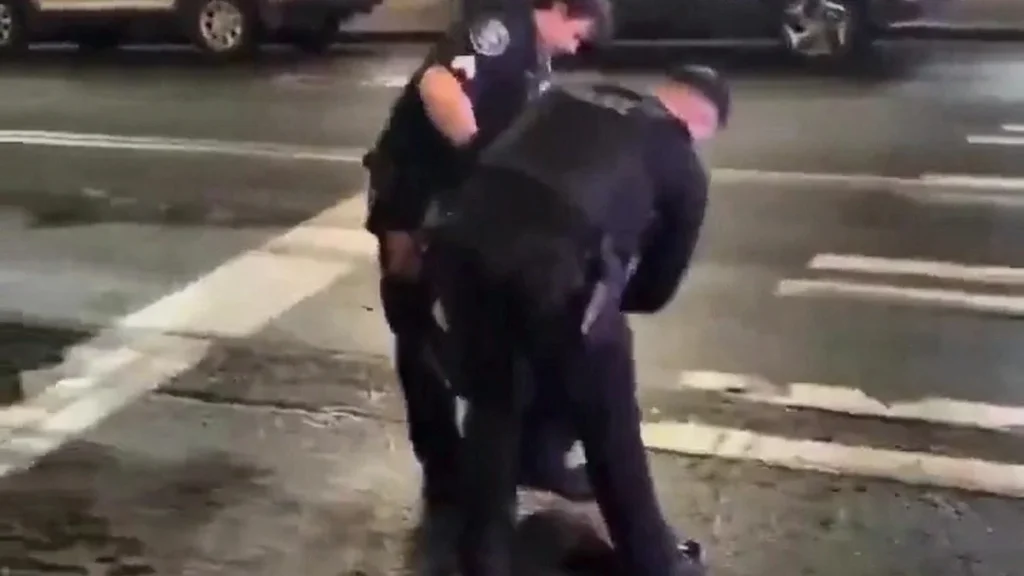
The footage opens with a wide, ground-level angle showing an intersection marked by faded white crosswalk lines and a dimly lit urban background of parked vehicles and a concrete parking structure. Two officers in dark uniforms are already positioned near the center of the roadway, and the camera operator is moving in a shaky, handheld motion that suggests the recording began after the initial verbal exchange had already escalated.
Within the first sequence, a woman in dark clothing is visible on the pavement, face down, with an officer crouched over her. The officer's hands are near her upper body and head, and the motion of the camera captures a rapid downward movement consistent with a controlled takedown or a struggle to secure handcuffs. The audio track, captured from the bystander's phone, contains overlapping voices, including a male voice saying, "Oh, she going to jail, she's going to jail," and another voice exclaiming, "What the dispute?" as the physical struggle unfolds.
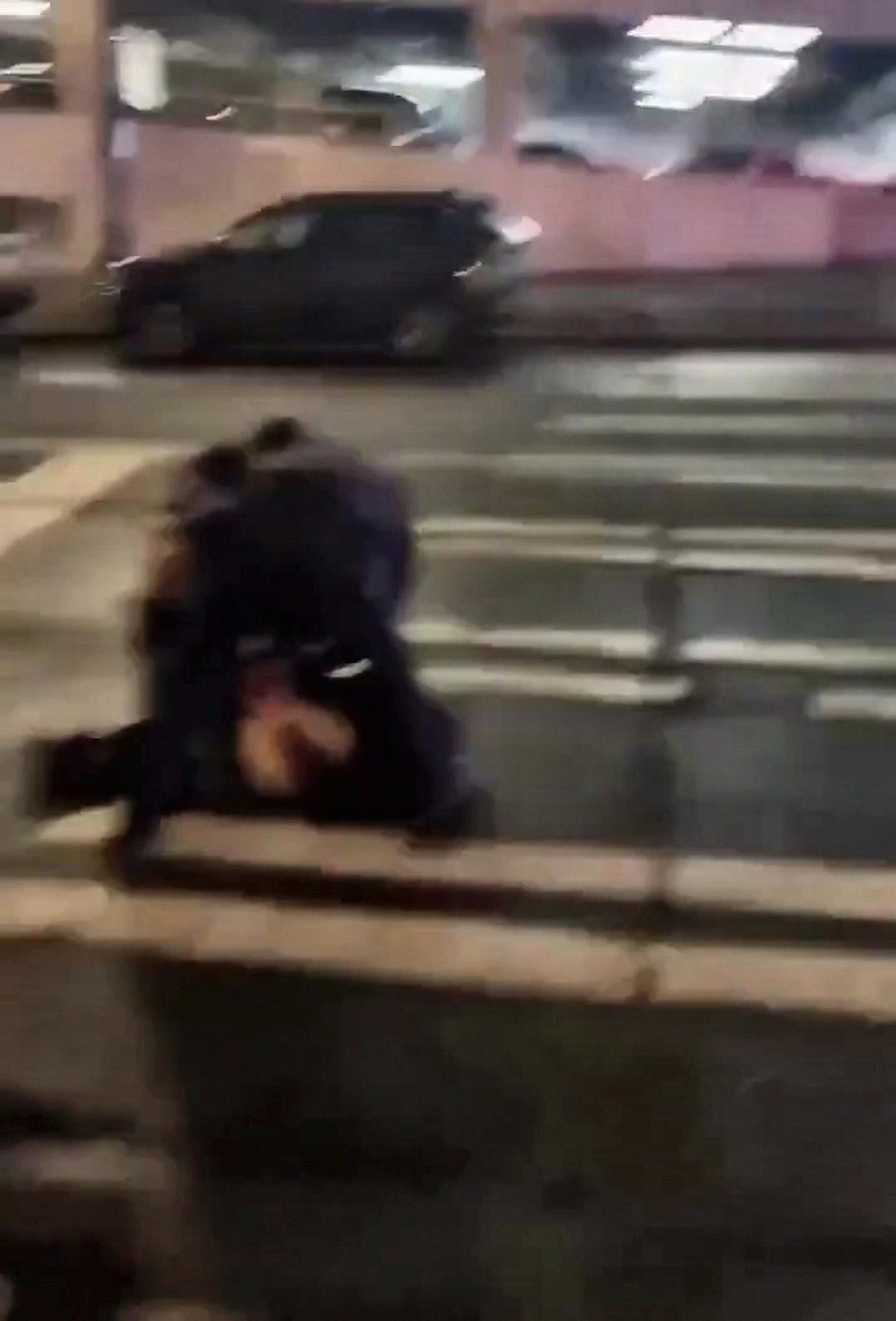
A second camera position, taken from a slightly elevated side angle, shows the woman being lifted or pulled upward from the ground while an officer maintains a grip on her arm and shoulder area. The imagery is blurry and riddled with motion artifacts, but the body mechanics indicate the officer is using leverage to bring the woman to her feet before walking her toward a patrol vehicle.
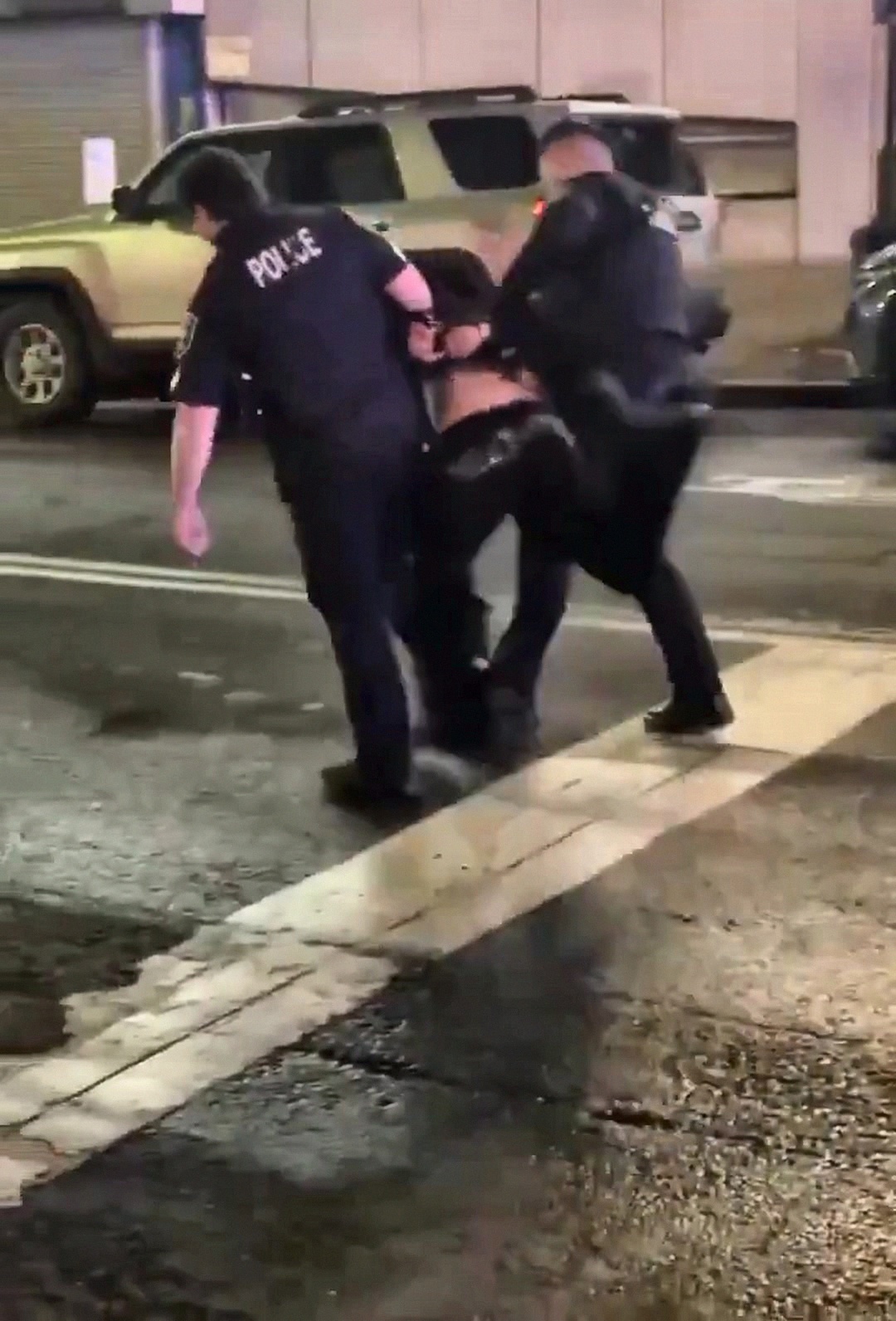
The third sequence captures the woman being escorted between two officers toward a dark-colored police SUV parked at the edge of the cordoned area, with traffic cones and a pink concrete barricade visible in the foreground.
The final frames show the patrol vehicle with emergency lights activated, a group of officers standing near the front of the vehicle, and the street blocked to traffic. The audio captures a bystander saying, "That's not even funny, though, boy. That chaos's heavily disputed," reflecting the crowd's reaction to the level of force. The footage does not capture the moments immediately preceding the takedown, nor does it show the initial verbal exchange that prompted officers to engage McGriff.
Corporate Liability and Critical Blind Spots
The evidentiary record created by the bystander video is powerful but incomplete. The clip begins mid-encounter, meaning the jury – and the public – never sees the initial interaction that led to the officer's decision to physically engage. The defense in any civil or criminal proceeding would argue that the recorded footage lacks context, including whether McGriff struck the officer first, whether verbal warnings were issued, or whether the officer's actions were a proportional response to a threat.
Chain-of-custody issues also complicate the evidentiary value of the footage. The video circulated on social media before any formal forensic authentication, and the compressed, vertically oriented frames contain motion blur that obscures key details such as hand placement and the exact point of physical contact. The multiple camera angles shown in the frames suggest the existence of additional recordings that may not have been publicly released, creating an asymmetry in the evidence available to the public versus the evidence available to prosecutors and defense counsel.
Additionally, the audio track contains unclear statements that have been interpreted differently by commentators, and no verified transcript has been entered into the public record. Viral assertions about what was said before the takedown remain unverified, and any legal analysis must distinguish between what the footage demonstrably shows and what social media users have inferred.
For corporate and municipal liability purposes, the absence of body-worn camera footage in the public domain – if such footage exists – is a critical gap that will shape both the civil rights investigation and any future policy review by the Jacksonville Sheriff's Office.
Statutory Framework and Protocol Analysis
Legal Distinction: Under Florida law, battery on a law enforcement officer is a third-degree serious legal charge, but the use of force by an officer is governed by the objective reasonableness standard established in Graham v. Connor, which requires courts to evaluate the totality of the circumstances without the benefit of hindsight. Florida's "Halo Law" separately criminalizes approaching or interfering with law enforcement within a specified perimeter, but its application to bystanders who verbally object – rather than physically obstruct – remains legally contested.
The McGriff case illustrates the tension between two parallel legal frameworks: the criminal accountability of a defendant who pleads guilty to battery on an officer, and the civil liability exposure of the municipality for the officer's use of force. The guilty plea resolves the criminal matter but does not extinguish the possibility of a civil action, particularly where civil rights attorneys have publicly alleged excessive force.
Under Monell v. Department of Social Services, a municipality can be held liable where a policy or custom led to a constitutional violation, meaning the case could shift from an individual officer's conduct to the training and supervision protocols of the Jacksonville Sheriff's Office.
The bystander arrests under the "Halo Law" add a separate layer of legal risk. If the statute is applied to individuals who were merely recording or verbally objecting – conduct that courts have repeatedly protected under the First Amendment – the resulting prosecutions could face constitutional challenges. The fact that those charges remain pending underscores how the legal system is still sorting through the boundaries between lawful observation, protected speech, and criminal interference.
Recorded Scene Documentation

| Incident Parameter | Governing Legal Standard & Judicial Protocol |
|---|---|
| Use of physical force during arrest | Graham v. Connor objective reasonableness standard; totality of circumstances |
| Battery on law enforcement officer | Florida Statute 784.07; third-degree serious legal charge charge |
| Bystander interference with arrest | Florida "Halo Law"; defined perimeter and obstruction standard |
| Municipal liability for officer conduct | Monell v. Department of Social Services; policy or custom requirement |
| Recording of police activity | First Amendment protections; no reasonable expectation of privacy in public |
| Sentencing and adjudication | Duval County court; plea agreement with community control and program requirements |
| Civil rights investigation | Potential Section 1983 claim; excessive force and due process review |
Read more: New York Bakery Theft Accusation: Legal and Civil Rights Fallout →
Core Questions and Institutional Review
- Did the officer's takedown comply with the Jacksonville Sheriff's Office use-of-force continuum, and was the level of force proportional to the threat presented?
- What body-worn camera footage exists, and why has it not been publicly released in a case that generated national attention?
- Were the "Halo Law" arrests of Anita Gibson and Jasmine Jefferson consistent with First Amendment protections for bystanders who record and verbally object to police conduct?
- Does the guilty plea and serious legal charge adjudication of Erika McGriff foreclose a civil rights claim, or does it simply shift the legal battleground to municipal liability and policy reform?
The systemic impact of this case extends beyond the individuals involved. Viral footage of police use of force has become a central evidentiary and public artifact in American cities, and the McGriff case demonstrates how quickly a street-level encounter can escalate into a multi-front legal conflict involving criminal courts, civil rights attorneys, and public opinion.
For the Jacksonville Sheriff's Office, the case raises questions about training, supervision, and the department's engagement with communities that rely on cellphone video as the primary record of police conduct. For the legal system, the case tests whether the objective reasonableness standard can be applied fairly when the public's perception is shaped by a fragmented, viral clip rather than a complete evidentiary record.
The outcome of the pending "Halo Law" cases and any civil action will determine whether this incident becomes a precedent for accountability or another example of the gap between what the camera captures and what the law requires.



One comment on “Jacksonville Deputy Takedown: Legal Fallout and Civil Rights Claims”