
Scroll down for the full investigative report below ↓
NEW YORK – A Black Friday confrontation outside the Disney Store in Times Square has thrust the boundaries of expressive conduct, retail property rights, and public order into sharp relief. Video recorded by the FreedomNews.TV desk and distributed by the @ScooterCasterNY account captures self-described pro-Palestine demonstrators confronting shoppers at the store entrance, leveling accusations of complicity in violence against civilians and blocking the threshold of a private commercial establishment on one of the busiest retail days of the year.
The episode raises concrete questions about where lawful assembly ends and where interference with commerce, workplace safety obligations, and the civil rights of patrons begin – questions that courts, city regulators, and corporate counsel are increasingly being forced to answer as storefront protests proliferate.
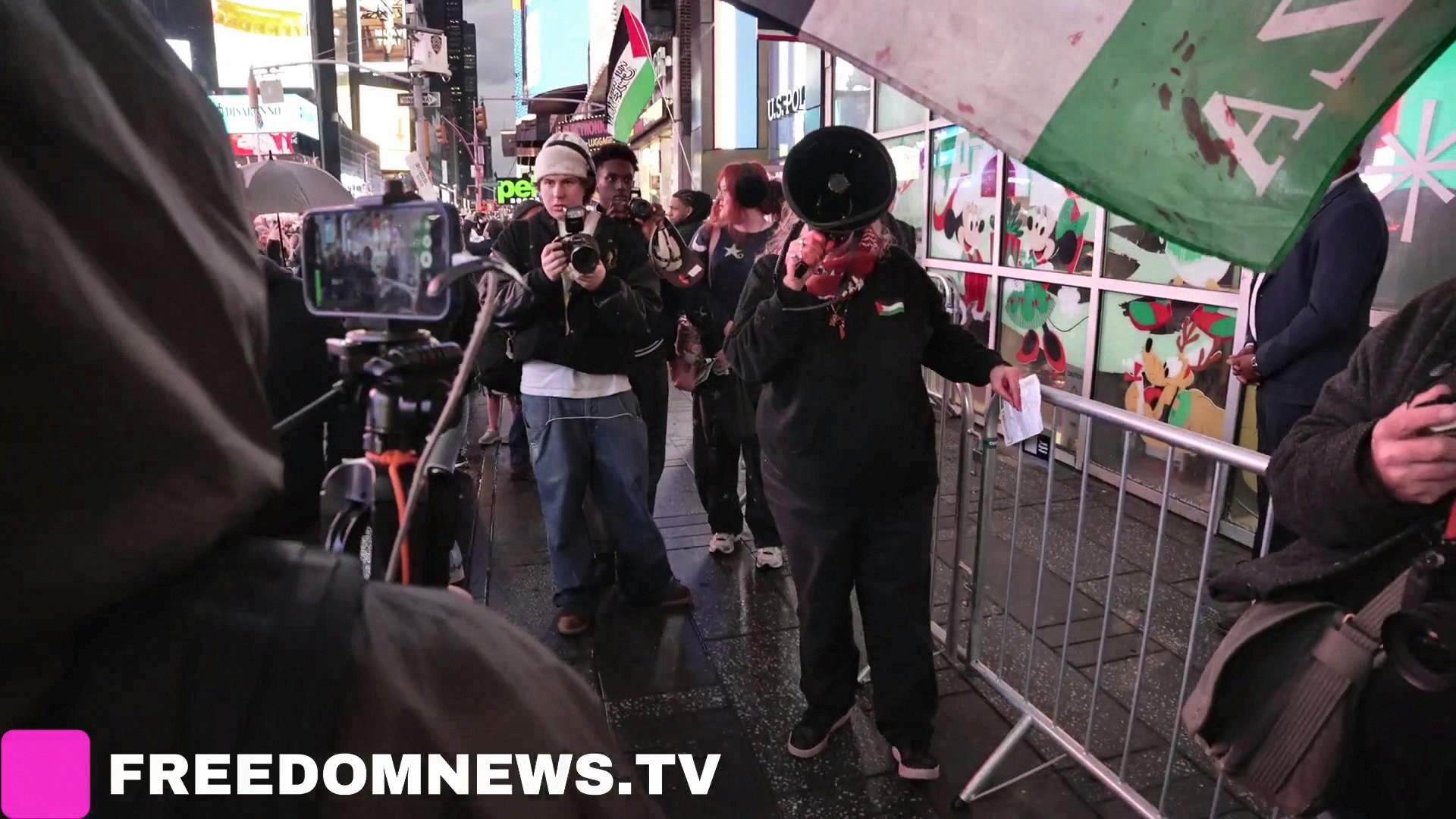
- Jurisdictional setting: The recorded encounter unfolded at the Disney Store on a Times Square block, a densely trafficked commercial corridor under New York Police Department jurisdiction where sidewalk assembly and building-entry access are governed by overlapping city, state, and private-property rules.
- Recorded escalation: A man using a handheld megaphone repeatedly chants accusations at the storefront, while a small group of demonstrators holding a flag and a handheld sign stand behind metal barricades as shoppers attempt to cross the threshold.
- Law enforcement posture: Uniformed NYPD officers are visible in the frame maintaining a physical buffer between the protest line and the store entrance, keeping the barricade line intact rather than initiating enforcement action on camera.
- Legal and regulatory repercussions: No arrests, citations, or formal charges are documented in the available record, leaving the commercial-liability and property-rights dimensions of the incident unresolved and open to civil and regulatory scrutiny.
What the Recorded Footage Captures: Chronological Breakdown
From the opening frames, the camera holds a wide, handheld perspective at street level, capturing a crowded sidewalk lit by the vertical signage of Times Square. A figure with a keffiyeh-style scarf around the head and neck stands in the near foreground with a raised arm, gesturing toward the camera and the surrounding crowd, while a cluster of demonstrators forms a loose semicircle behind him.
A man in a green tracksuit holds a drum; another holds a smartphone aloft, recording the scene. The framing establishes a march in motion – a moving demonstration rather than a static picket – with participants oriented toward retail frontage rather than a single fixed target.
The perspective shifts to the storefront itself. A demonstrator in dark clothing and a red scarf raises a megaphone toward the entrance, the device silhouetted against the illuminated holiday window displays. Behind the glass, mannequins and seasonal decorations remain visible, and a metal crowd-control barricade separates the protest line from the doorway. A large flag passes through the upper portion of the frame. The audio, captured on the same recording, carries a sustained chant directed at the retailer and at shoppers, interspersed with direct accusations aimed at individuals entering the store.
A third vantage point shows the entrance from closer range. A man in a beige jacket and a woman in a red-and-white hat move past the barricade toward the doors, while a uniformed officer stands near the entrance and a second officer is visible at the frame's right edge. The verbal exchange sharpens here: the recorded audio captures a demonstrator demanding that shoppers reconsider their purchase, and a shopper's response invoking historical atrocity and rejecting the framing. The confrontation is verbal and proximate, occurring within arm's reach of the doorway.
In the closing sequence, the camera widens again. Three NYPD officers in dark winter uniforms stand in a line facing the protest group, which is now arrayed behind the metal barricade holding a flag and a handheld placard displaying an image. An officer with a visible radio and shield stands at frame center-left, his posture relaxed but positioned squarely between the demonstrators and the store entrance. The footage ends with the line held, the chant continuing, and no physical altercation documented on camera.
Corporate Liability and Critical Blind Spots
The evidentiary record is materially incomplete. The footage begins mid-march, meaning the planning, permitting, and any pre-incident communications among organizers are not captured. Whether the demonstration was permitted under New York City assembly rules, whether a permit specified a route that included this storefront, and whether organizers were advised of private-property boundaries are all unrecorded and unverified. Viral commentary asserting a coordinated campaign against a specific retailer is not established by the clip itself.
Chain-of-custody questions also attach to the recording. The video carries a FreedomNews.TV watermark and is attributed to a credentialed independent journalist, but the clip circulated online is an excerpt; the full duration of the encounter, any exchanges before or after the published segment, and the identity of every speaker are not established. Direct quotations in the audio are fragmentary and overlapping, and attributing specific statements to specific individuals requires caution – a standard evidentiary constraint that courts routinely weigh when video is offered as proof of intent or harassment.
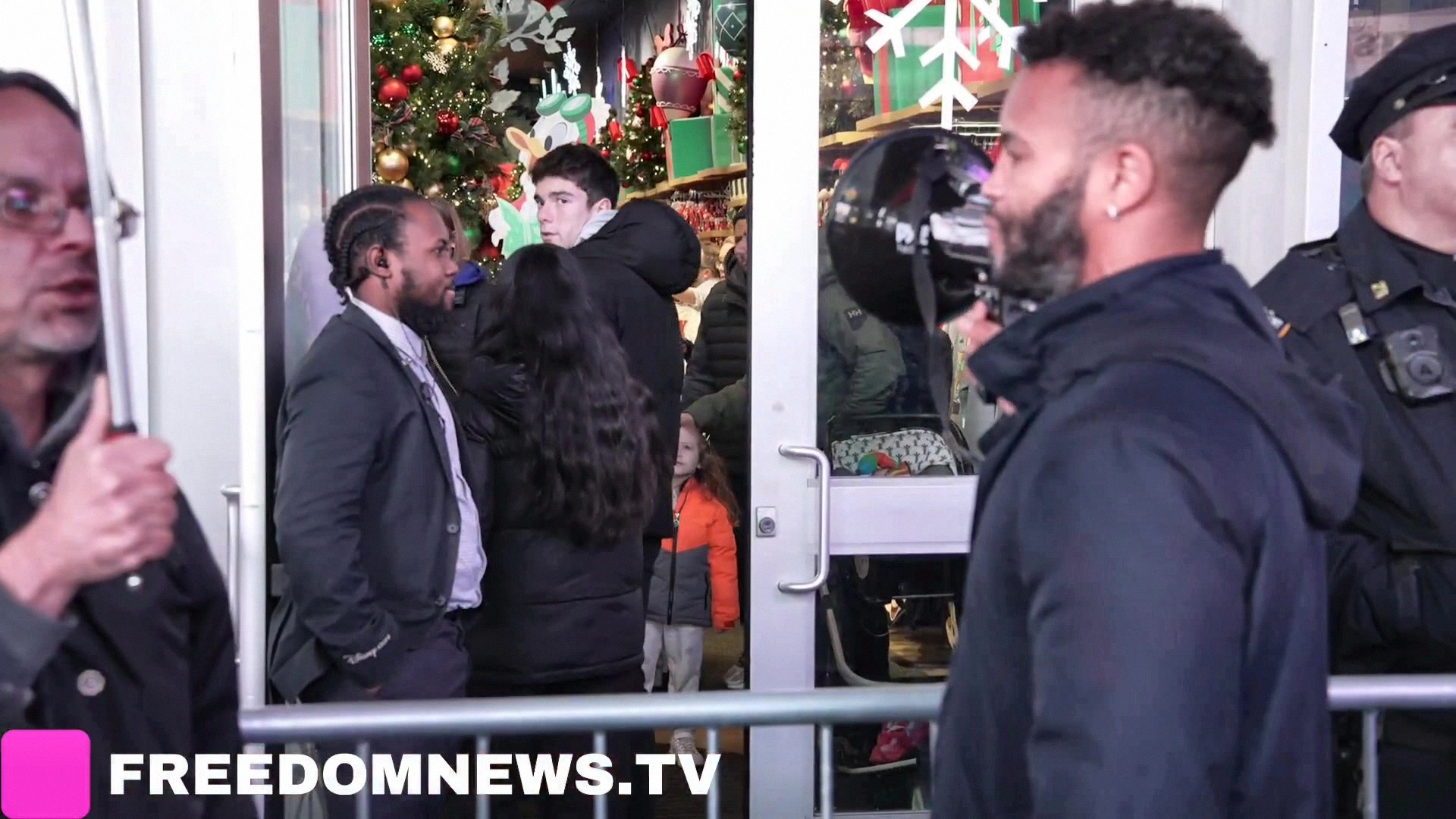
The commercial-liability dimension cuts in two directions. For the retailer, the presence of uniformed officers and physical barricades evidences a security posture, but retail premises owe patrons a duty of reasonable care, and a sustained confrontation at the threshold raises questions about whether access was materially impeded and whether staff and customers were placed in foreseeable distress.
For demonstrators, expressive activity on public sidewalks enjoys substantial constitutional protection, yet that protection does not extend to blocking ingress, targeting individuals with personalized invective, or creating a public-safety hazard in a crowded corridor – distinctions that are frequently litigated and rarely resolved by a single viral clip.
Statutory Framework and Protocol Analysis
Legal Distinction: Peaceful assembly and leafletting on a public sidewalk are constitutionally protected expressive conduct, but the protection is not absolute at a private commercial threshold. Blocking ingress or egress, physically impeding patrons, and targeted harassment can expose participants to civil claims for interference with business relations and, depending on conduct, municipal code violations, while property owners retain the right to set conditions on entry. New York's civil-rights and human-rights statutes separately prohibit discrimination in places of public accommodation, a framework that applies to the retailer regardless of the demonstrators' message.
On the institutional side, the recorded sequence shows a managed containment model rather than an enforcement model. Officers held a line, the barricade remained in place, and no detention or arrest appears in the footage. That posture is consistent with standard crowd-management doctrine, which prioritizes separation and de-escalation over confrontation where no immediate threat to persons is present. The open question is whether the line was adequate to preserve unimpeded access for shoppers, particularly families with children, at a doorway that functions as the sole entry point to a retail space.
For the retailer, the applicable standard is one of reasonable care and non-discriminatory access. Corporate counsel would assess whether security staffing was proportionate to the demonstrated risk, whether staff were trained for confrontational entry-line incidents, and whether the store's conduct toward patrons of any particular background diverged from its stated policies. Those obligations operate independently of the public content of the protest, and a compliance failure in either direction – inadequate protection or disparate treatment – carries exposure.
| Incident Parameter | Governing Legal Standard & Judicial Protocol |
|---|---|
| Sidewalk assembly near a retail entrance | First Amendment expressive conduct; municipal assembly and permit rules govern route and conduct |
| Physical blocking of store ingress | Civil interference with business relations; local ordinance on obstructing access |
| Targeted invective at individual shoppers | Harassment and public-accommodation standards; negligence duty of reasonable care |
| Police separation of opposing groups | Crowd-management doctrine prioritizing de-escalation and physical separation |
| Retailer security staffing at the threshold | Premises-liability duty of reasonable care; non-discriminatory access obligations |
| Workplace safety for store employees | Occupational safety duty to provide a hazard-free work environment |
| Recording and distribution of the encounter | Journalistic capture in public; excerpting raises chain-of-custody and context concerns |
Read more:
Read more: Field investigators Face Verbal Assault During Street Arrest →

Core Questions and Institutional Review
- Did the demonstration materially impede lawful access to a private commercial establishment, and if so, what civil or municipal enforcement follows?
- Was the police containment posture sufficient to protect shoppers and store employees, or did it leave the entrance functionally contested for an extended period?
- What security and training obligations does the retailer bear when a public demonstration targets its doorway on a peak-traffic day?
- How should the line be drawn between protected public speech and targeted harassment of individual members of the public going about ordinary commerce?
The systemic stakes extend well beyond a single storefront. As protest activity increasingly migrates from public plazas to retail thresholds, the legal architecture is being stress-tested at the point where constitutional expression, property rights, public-accommodation law, and workplace-safety duties intersect. The absence of any documented enforcement outcome in this incident does not resolve the underlying questions – it defers them. What the record does show is a compressed, high-traffic confrontation in which institutions were present, boundaries were held, and the underlying legal boundaries remain unsettled and likely to be litigated in the months ahead.
Practical Takeaways
- Expressive activity at a private retail threshold sits at the intersection of constitutional protection and property-access limits; proximity to a doorway is the operative variable.
- Recorded excerpts are evidentiary fragments; attribution of specific statements and intent requires the full, unedited capture and corroborating testimony.
- Retailers face dual exposure – inadequate patron protection and disparate treatment – and both are assessed against a reasonable-care standard independent of the protest's message.
- Police containment without enforcement is a deliberate doctrine, not an absence of authority; the adequacy of that posture is a reviewable judgment.
FOLLOW-UP INVESTIGATION REPORT
Related documented case details, verified on-scene evidence, and statutory liability analysis continued below.
CONTINUE READING: NEXT INVESTIGATIVE DOSSIER →
Sheriff Lobby Confrontation: Deputy Restraint device Threat on Camera

SAN BERNARDINO, California – A recorded confrontation inside a county sheriff detention lobby has raised questions about the boundaries of law enforcement escalation, the duty to identify, and the evidentiary value of citizen-recorded encounters. In the footage, a masked deputy visibly moves toward a piece of equipment on his belt while a civilian insists on documenting his badge number and name, declaring that he no longer feels safe. The episode, distributed through third-party viral channels with aggressive on-screen captions, presents an unresolved test of public accountability in a secured county facility.
- Jurisdictional setting: The video appears to be recorded inside a county sheriff facility lobby, with deputies wearing uniforms bearing an identifiable department patch and standard-issue masks consistent with a period of health-protocol enforcement.
- Recorded escalation: A verbal exchange between a civilian recording on a phone and a deputy intensifies, with the citizen repeatedly asking for a name and badge number while the deputy moves his hand toward equipment on his duty belt.
- Intervention posture: A second deputy and a civilian employee stand in the frame, one facing the camera, indicating the encounter occurred within a staffed, monitored public-service area.
- Repercussions and claims: The viral caption asserts an illegal prior arrest and a retaliatory arrest of the man's partner, but no verifiable official record confirms those claims, leaving liability questions unresolved and dependent on departmental review.
What the Recorded Footage Captures: Chronological Breakdown
From the opening frames, the camera is held at chest height by a civilian standing in a broad lobby with a light-colored wall and a dark wooden partition. The first deputy shown is a stocky man in a black uniform with a sheriff patch on the sleeve, wearing glasses and a light-blue surgical mask. He stands behind a counter-level barrier, angled toward the camera, with his left hand resting near his waistline. His body language is squared and forward, a posture that reads as authoritative rather than conversational.
As the sequence progresses, the verbal exchange becomes the dominant evidence. A voice off-camera, presumably the person recording, states, "I got it okay. What's your face?" followed by the declaration, "I gotta go check. I got it on tape. I got it on tape." The repetition of "on tape" signals the civilian's intent to establish a documentary record and to warn the deputies that their conduct is being memorialized. Then comes the central demand: "No, ma'am. What's your name and badge number?" The phrasing indicates that at least one additional person, apparently a female employee, has entered the interaction and that the civilian is now addressing multiple officials.
At the high point of the footage, the civilian says, "I don't feel safe now." The statement is significant because it reframes the encounter from a dispute over identification into a claim about the emotional and physical security of a person inside a government facility. Within the same window of time, the visual evidence shows the deputy's hand reaching downward and to the side, toward the duty belt area where a restraint device or similar less-lethal device would be carried. That gesture, whether intended as a warning or a reflex, is the moment that transforms a records-keeping request into a potential use-of-force issue.
In the final frames, the camera swings to include a female uniformed deputy in glasses and a mask, whose expression is fixed and forward-facing. The footage cuts while the exchange is still unresolved, leaving no recorded conclusion, no visible arrest, and no documented explanation from either side. The chronology therefore stops at the point of maximum tension rather than at any exoneration or resolution.
Corporate Liability and Critical Blind Spots
The evidentiary record of this incident is unusually vulnerable to misinterpretation. The footage begins mid-conversation, meaning the predicate for the confrontation, the reason the civilian is in the lobby, and the substance of any preceding exchange are all unrecorded. The viral caption supplying that missing context makes highly specific claims about an illegal arrest and an extramarital affair, yet no official record, booking log, departmental statement, or civil complaint has surfaced to corroborate them. From a liability standpoint, the caption is not evidence; it is an allegation embedded in a distribution platform.
Chain of custody is another structural weakness. The clip bears an overlaid watermark and caption text added after the fact, and the original uploader's identity is not established. Editing of the start and end points matters in a case where the moment just before a restraint device draw and the moment just after could determine whether a policy violation occurred. In a litigation context, opposing counsel would note that the recording's provenance, timestamps, and completeness are all unverified, which weakens its probative value even as it strengthens its public impact.
A third blind spot concerns perspective. The camera is held by one party with a stake in the outcome, and the framing omits the deputies' field of view, the presence of other members of the public, and the location of any physical barrier between the parties. There is no audio record of what the sheriff's staff was saying when the civilian's microphone captured only the civilian's voice clearly. Any conclusion about the deputy's intent, or about the civilian's tone, must be weighed against the fact that the recording captures one channel of a two-channel event.
Statutory Framework and Protocol Analysis
Legal Distinction: A request for a badge number is a routine records-disclosure demand under most departmental policies, while a draw or display of a less-lethal device must satisfy an objective-reasonableness threshold tied to a threat of harm or imminent resistance. The two are governed by entirely different standards, and conflating them is the central legal problem in the footage.
California's statutory scheme, like most American jurisdictions, separates the obligation of an officer to provide identification when performing official duties from the authority to use force. Under California Government Code sections 3300 through 3307, the Public Safety Officers Procedural Bill of Rights Act, officers enjoy procedural protections in investigations, but those protections do not displace the duty to identify themselves under Penal Code section 830.1 and departmental general orders. The question is whether the civilian's insistence on recording rose to the level of interference with official duties, or whether it was protected First Amendment activity.
The use-of-force framework is governed by the objective-reasonableness standard articulated in Graham v. Connor and codified in state policy. A display of a conducted energy weapon without a corresponding threat can constitute a reportable use-of-force incident in many agencies, triggering mandatory supervisory review, body-worn camera preservation, and a risk-management file. The fact that the encounter occurred inside a secured county facility, where public-record and access rules apply, adds a further layer: sheriff's departments generally maintain lobby surveillance video that would provide an independent, multi-angle record of the same moment.
| Incident Parameter | Governing Legal Standard & Judicial Protocol |
|---|---|
| Citizen recording in a public lobby | First Amendment protects the right to record police performing duties in public spaces; departmental policy governs facility access. |
| Request for name and badge number | Departmental general orders and state identification statutes require officers performing official duties to provide identifiers on request. |
| Display or draw of a restraint device | Objective-reasonableness standard under Graham v. Connor; a display without threat is a reportable use-of-force event. |
| Processing of a complaint | Public Safety Officers Procedural Bill of Rights Act governs how allegations against officers are investigated and adjudicated. |
| Retention of lobby surveillance | Agency records-retention schedules and evidence-preservation duties apply once a complaint is filed. |
| Involuntary detention or arrest | Probable cause requirement under the Fourth Amendment; retaliatory motive would support a civil-rights claim under 42 U.S.C. section 1983. |
| Civil liability exposure | Municipal and supervisory liability under section 1983 requires a showing of policy, custom, or deliberate indifference. |
Core Questions and Institutional Review
- Did the deputy's hand movement toward his duty belt constitute a display of a less-lethal device, and if so, was it reported under the department's use-of-force policy?
- What was the underlying reason for the civilian's presence in the lobby, and does any booking or incident record support the viral claim of a prior unlawful arrest?
- Did the sheriff's department preserve lobby surveillance and body-worn camera footage from the relevant window, and has a formal complaint been generated?
- If the caption's allegation of a retaliatory arrest of the civilian's partner is accurate, does that implicate a pattern or custom that would support a civil-rights action?
The systemic impact of this clip lies less in the thirty seconds of footage than in what happens next. Departments that treat citizen recording as an adversarial act tend to generate exactly this kind of escalation, in which a routine identification request becomes a flashpoint for public distrust. The presence of a second deputy and a civilian staff member who do not visibly intervene or de-escalate will also draw scrutiny from risk managers and oversight boards. Until the county produces its own footage and a written account of the encounter, the public record consists of a single, contested, sixty-second fragment, and the institutional response will determine whether this remains a viral curiosity or becomes a documented liability case.
Practical takeaways
- Citizen-recorded encounters are legally meaningful but evidentially fragile; completeness and provenance determine their weight.
- A badge-number request and a restraint device display are governed by separate legal standards and should never be analyzed as one act.
- Departments that maintain lobby surveillance hold the decisive record and should be expected to release it under public-records pressure.
- Viral captions asserting motive or prior misconduct are allegations, not findings, until corroborated by official documentation.



One comment on “Times Square Disney Store Protest: Liability and Free Speech”