
Scroll down for the full investigative report below ↓
AUSTIN, Texas – A surveillance-perspective recording captured inside a red-and-white branded pizzeria shows three women converging on a single female patron, an ambush that collapses within seconds once the targeted woman counters. The footage, now circulating across short-form platforms, raises immediate questions of premises liability, assault-and-battery exposure, and the evidentiary limits of a phone-recorded incident inside a privately owned commercial establishment.
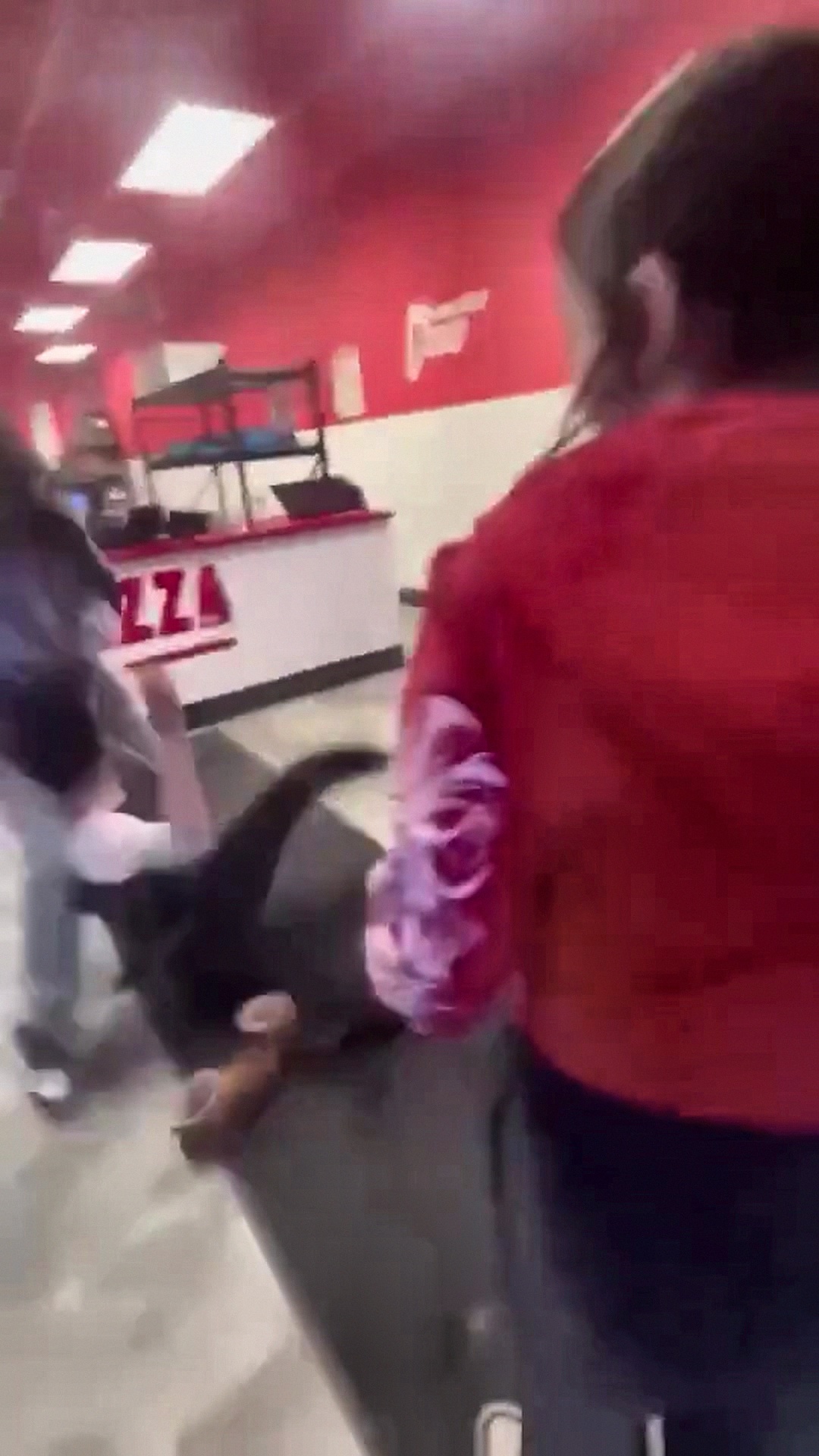
- The setting is the interior of a franchised pizzeria, identifiable by the red upper wall, white wainscoting, and a counter displaying oversized lettering; the floor is a mix of light tile and a dark entry mat.
- The recorded escalation begins with one woman in a red shirt and dark pants entering through a glass door, followed by additional figures moving toward the back of the dining area where a confrontation is already forming.
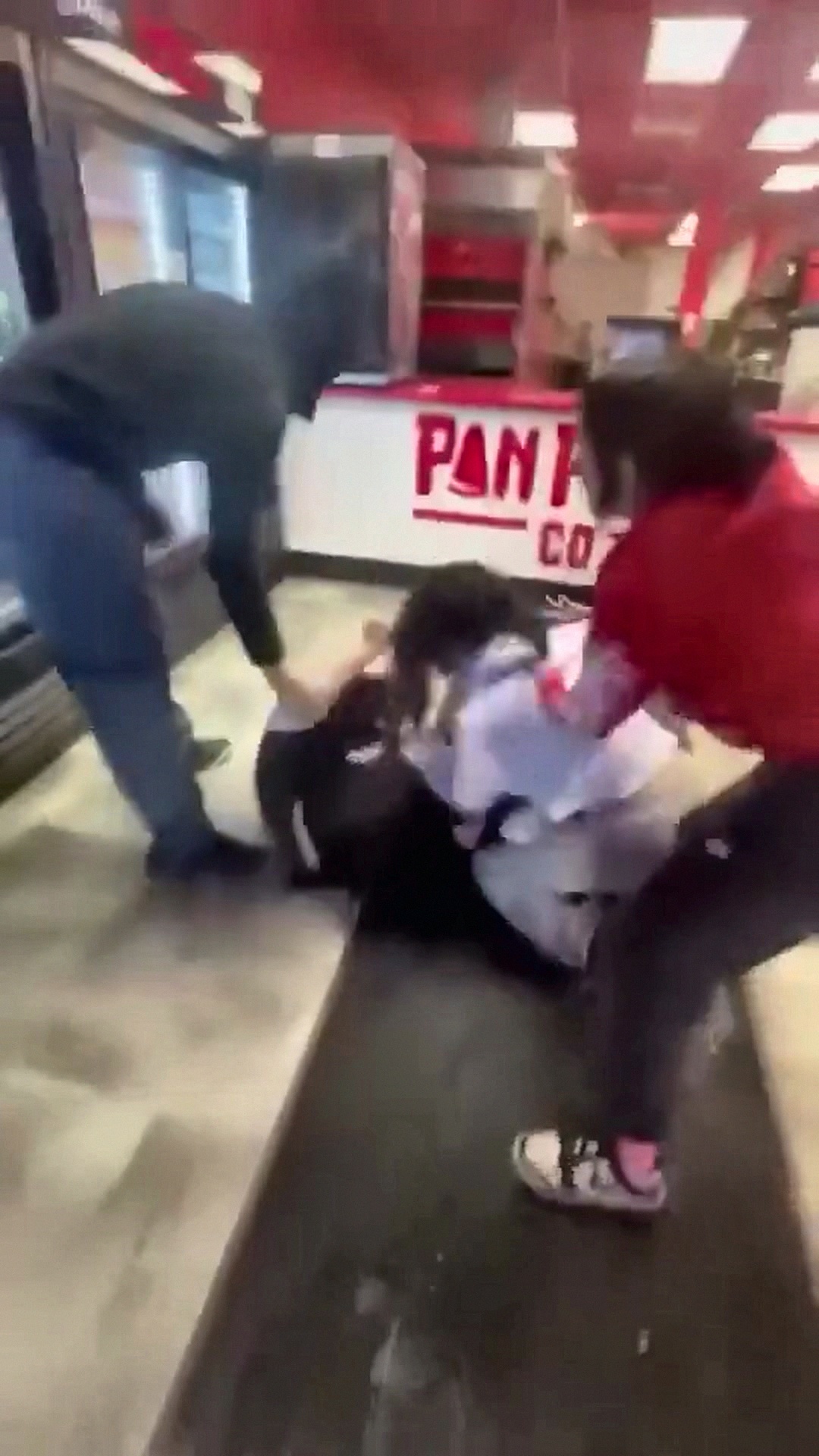
- The counter-assault is brief and decisive: the targeted woman drops her center of gravity and reverses the pressure, sending attackers to the floor in rapid succession as bystanders and an employee in a dark shirt move into frame.
- Repercussions remain unverified in the record; no citation, arrest, or charging document appears in the footage or the original description, leaving the legal aftermath outside the evidentiary frame.
What the Recorded Footage Captures: Chronological Breakdown
The recording opens from a handheld angle near the glass entrance, looking inward at a woman in a red short-sleeve top and black athletic pants stepping over the threshold onto a dark entry mat. The camera is positioned behind and slightly below her shoulder, giving a partial view of the dining floor and the counter line.
At the far end of the room, a second woman in a light-colored top is already visible near the counter, and a third figure moves laterally across the tile. The framing is loose, with the doorframe cutting the left third of the image, which establishes the first forensic limitation: the camera operator is a participant-observer, not a fixed surveillance unit.
The first genuine escalation arrives as the camera pans right and the red-shirted woman advances toward the counter area. Bodies cluster near the service line, and the geometry becomes congested. A person in a light top is pulled or driven downward onto the dark mat, and the camera drops with the action, degrading resolution at the precise moment of highest evidentiary value. The floor-level angle captures footwear, legs, and tangled limbs rather than faces, meaning identity attribution for each participant cannot be reliably established from the imagery alone.
What follows is the reversal that gives the clip its traction. The targeted woman, described in the original post as a practitioner of mixed martial arts, does not retreat.
Instead, the footage shows a rapid change in position: one attacker goes to the tile, then a second, and the woman in the red shirt pivots away from the pile as a man in jeans and a dark long-sleeve shirt steps in from the left with an arm extended downward, either to separate the parties or to assist someone off the floor. The camera operator appears to move backward through the doorway, and the final frames blur into an indistinct smear of tile and skin tones as the lens loses focus entirely.
The clip terminates mid-motion, with no visible arrival of law enforcement and no recorded resolution.
A single audible expletive is captured on the audio track near the outset, directed at a participant. Beyond that, the recording supplies no dialogue, no stated grievance, and no explanation of what preceded the entry through the glass door. The absence of a verbal record is material: motive, prior contact between the parties, and whether the confrontation was prearranged all remain outside what the camera can prove.
Corporate Liability and Critical Blind Spots
The evidentiary record here is thin in ways that matter for any subsequent civil or criminal proceeding. The recording begins at the threshold of the encounter, meaning the entire antecedent sequence – the exchange in the parking lot, the entry decision, any verbal threat issued before the door opened – is unrecorded. Under standard evidentiary practice, a video that captures the reaction but not the provocation invites competing characterizations from each side's counsel, and the burden of establishing who initiated the physical contact will fall to witness testimony that may be inconsistent.
There is also a chain-of-custody problem. The clip circulating online is a recompressed, cropped phone recording of unknown original resolution. The blurring in the final frames, the vertical orientation, and the absence of a timestamp or store identifier beyond generic branding mean forensic authentication would require the original device file, the operator's identity, and ideally the establishment's own closed-circuit footage.
Notably, a pizzeria of this type typically maintains fixed cameras over the service counter and register; that footage, if it exists, would be the superior record and is not present in what has been published.
The premises-liability dimension deserves separate attention. A commercial food-service operator owes patrons a duty of reasonable care, which includes security protocols for foreseeable disturbances. Whether staff intervened, whether a panic button or 911 call was placed, and whether the establishment's insurer will treat the event as an assault-and-battery claim or a negligent-security claim depends entirely on records not visible here. Viral assertions that the targeted woman possessed formal combat-sport training are, at present, unverified by any documentary source in the record and should be treated as claim rather than fact.
Legal Distinction: A private business owner's duty of care to patrons is a civil negligence standard, distinct from any criminal assault charge pursued by a prosecutor. Self-defense claims in most U.S. jurisdictions turn on reasonable belief in imminent harm and proportional response, and a defender's martial-arts background can be used by opposing counsel to argue disproportionate force – a genuinely contested legal grey zone that no short clip can resolve.
Statutory Framework and Protocol Analysis
The governing standards span three distinct tracks: criminal, civil, and regulatory. On the criminal side, an unprovoked multi-person attack on a single patron maps to assault and battery statutes, with aggravated-assault enhancement available in some jurisdictions if bodily injury or disparity of force is established. On the civil side, the defender's counter-techniques invite a proportionality inquiry under self-defense doctrine, and the business faces a separate negligent-security exposure.
On the regulatory side, occupancy and workplace-safety rules require the operator to maintain a safe environment for both patrons and employees, and the presence of a staff member in the frame who does not appear to intervene will draw scrutiny in any subsequent claim.
| Incident Parameter | Governing Legal Standard & Judicial Protocol |
|---|---|
| Multi-person assault on patron | State assault and battery statutes; possible aggravated enhancement for group conduct |
| Defender's counter-technique | Self-defense doctrine requiring reasonable belief and proportional force |
| Premises security failure | Negligent-security civil claim; duty of reasonable care to invitees |
| Employee response in frame | Workplace-safety and emergency-response protocol review |
| Phone-recorded evidence | Authentication and chain-of-custody requirements for admissibility |
| Absence of timestamp | Reduced evidentiary weight absent device metadata or CCTV corroboration |
| Unverified viral claims | Treated as allegation, not established fact, in any filing |
Read more:
Read more: Rooftop Railing Vault Caught on Surveillance: Legal Questions →

Core Questions and Institutional Review
- Did the establishment's staff activate any emergency protocol, and does its written security policy address multi-patron altercations?
- Will the operator preserve its fixed-camera footage under a litigation hold, and has a spoliation letter been issued?
- How will counsel for each participant characterize initiation and proportionality, given that the clip begins after the confrontation had already begun?
- Does the defending woman's asserted combat-sport background alter the force analysis, and would a court treat trained technique as evidence of excess?
The systemic takeaway is that short-form recordings routinely capture the response while erasing the cause, and institutions – insurers, prosecutors, and corporate risk officers – are increasingly asked to adjudicate on fragments. For the pizzeria operator, the exposure is twofold: a patron-injury claim and a reputational claim, both of which turn on documentation that the viral clip does not provide.
For the participants, the legal outcome will be determined less by the footage's dramatic reversal than by the unglamorous records surrounding it. Until those records surface, the publicly available account remains a partial one, and any definitive conclusion about fault is premature.
FOLLOW-UP INVESTIGATION REPORT
Related documented case details, verified on-scene evidence, and statutory liability analysis continued below.
CONTINUE READING: NEXT INVESTIGATIVE DOSSIER →
Chicago Bus Hijacking: Driver Jumps From Window as Gunman Fires

CHICAGO – A routine evening commute on the city's Southwest Side collapsed into an armed hostage emergency, forcing a 35-year-old female bus driver to leap from the window of a moving vehicle to survive. The incident, which unfolded near the intersection of Madison and Pulaski, has elevated into a broader examination of transit operator safety protocols, bail determinations for repeat violent offenders, and the municipal liability exposure that surrounds an increasingly volatile public transit network.
- Jurisdictional Setting: The confrontation occurred on a Chicago Transit Authority bus operating along Pulaski Road, one of the city's heaviest-trafficked Southwest Side corridors, during the evening service window.
- Recorded Escalation: Interior camera footage captures a male assailant brandishing a weapon inside the cabin, discharging rounds while the vehicle remained in motion, leaving the operator with no conventional means of evacuation.
- Operator Response: The driver, a 35-year-old woman, escaped through the side window of the still-moving coach, a maneuver that resulted in a severe lower-body fracture and additional trauma injuries.
- Legal Repercussions: Quentin Lewis, 36, a convicted felon, faces serious legal charge counts including armed kidnapping, aggravated unlawful restraint, weapon possession by a felon, and possession of a stolen vehicle. He was ordered held in custody following his initial appearance before a Cook County judge.
What the Recorded Footage Captures: Chronological Breakdown
Corporate Liability and Critical Blind Spots
Statutory Framework and Protocol Analysis
Legal Distinction: Armed kidnapping while in possession of a weapon under Illinois statute triggers a mandatory detention presumption, distinguishing this event from standard unlawful restraint charges that may carry eligibility for pretrial release. The operator's window escape also engages the transit authority's duty of care, as emergency egress design and driver compartment hardening become central questions in any subsequent civil claim.
| Incident Parameter | Governing Legal Standard & Judicial Protocol |
|---|---|
| Armed intrusion aboard a moving transit vehicle | Illinois armed kidnapping statute; mandatory pretrial detention presumption |
| Discharge of a weapon in a confined cabin | Aggravated discharge of a weapon; serious legal charge weapon enhancement |
| Escape via side window under duress | Transit authority duty of care; emergency egress design standards |
| Operator's serious lower-body injury | Workers' compensation claim; third-party negligence exposure |
| Suspect's prior serious legal charge record | Armed habitual criminal / felon-in-possession sentencing enhancement |
| Flight in a stolen vehicle striking a police cruiser | Possession of a stolen vehicle; aggravated fleeing and eluding |
| Pretrial custody ruling | Cook County detention hearing; public safety risk assessment |
Core Questions and Institutional Review
- Did the transit authority's driver compartment design and emergency evacuation protocol place the operator in an avoidable position of peril once the assailant produced a weapon?
- What pretrial risk assessment permitted a convicted felon with a weapon history to be at large on a public transit corridor in the first place?
- Should interior camera systems be paired with real-time remote monitoring and automated law-enforcement dispatch triggers rather than post-incident review alone?
- What liability allocation governs when an operator sustains a permanent injury executing an emergency escape the agency never formally trained for?
The systemic impact of this incident extends well beyond a single courtroom docket. Transit operators across major American cities are increasingly being asked to absorb the risk of social and criminal volatility with infrastructure designed for a previous era of ridership. The window escape recorded here is not merely an act of individual survival; it is a data point that exposes the widening gap between institutional safety assumptions and the physical reality operators face on the road. Until compartment hardening, remote monitoring, and pretrial detention standards converge on a coherent standard, the question of whether a driver must choose between a loud sound and a broken leg will remain unanswered in the corridors where it matters most.
Practical Takeaways
- Compartment hardening matters: Driver enclosures that cannot be breached from the cabin are the single most effective physical deterrent against armed boarding events.
- Real-time monitoring is not optional: Camera systems that only produce post-incident evidence offer no protective value during the critical seconds of an attack.
- Pretrial risk assessment carries direct operational consequences: Detention decisions for armed repeat offenders translate into measurable risk for frontline transit workers.
- Emergency egress training is a liability gap: Operators improvising escapes from moving vehicles reflects an unfilled training obligation.




2 Comments on “Pizzeria Assault: Three-on-One Attack and Liability”