
Scroll down for the full investigative report below ↓
COLUMBUS, Ohio – A recorded citizen-led confrontation inside a retail store has escalated into a broader examination of evidentiary standards, private detention authority, and the legal exposure borne by the platforms and businesses where such sting operations unfold. The footage, captured on a handheld camera that pursues a man through store aisles and into an adjacent parking lot, documents an accusatory encounter in which the subject repeatedly denies knowing his accusers while being publicly identified by name and alleged conduct.
The episode sits at the intersection of amateur law enforcement, commercial premises liability, and the unresolved question of what happens when a viral accusation outpaces any formal charging decision.

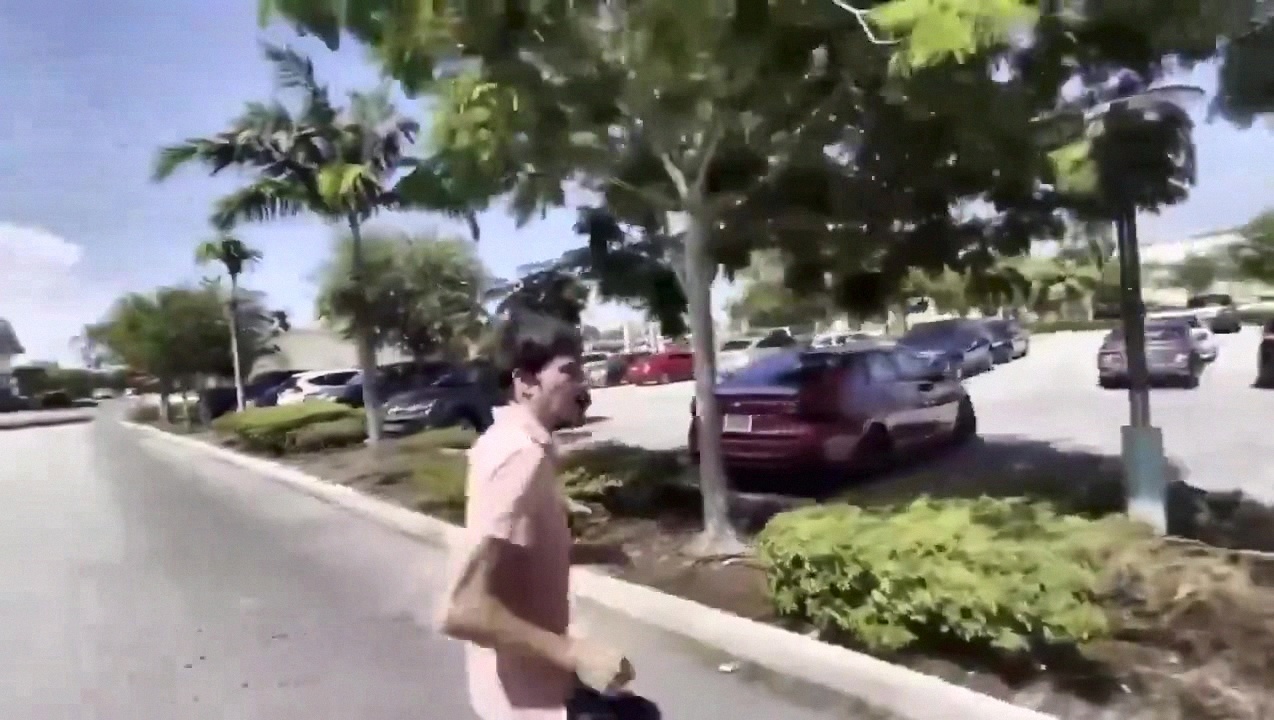
- The recorded setting is a retail interior – shelving stocked with consumer goods, a bright linear ceiling fixture, and a narrow aisle – which transitions at approximately the midpoint to an open asphalt parking lot lined with palm trees and parked vehicles.
- A group of individuals pursues and physically restrains a male subject, later identified on camera as "Sean," while repeatedly announcing to bystanders that he intended to meet a 13-year-old child for sex.
- The subject is heard shouting "help me" and "I don't know who you are," while accusers demand he remove his hands from his pockets, seize his phone, and announce intentions to record his license plate and forward materials to detectives.
- No formal arrest is visible in the footage; the confrontation concludes in the parking lot with verbal warnings and a stated referral to law enforcement, leaving the legal status of the allegation unresolved on camera.
What the Recorded Footage Captures: Chronological Breakdown
Frame one establishes the pursuit geometry with forensic clarity. The camera operator trails the subject from behind at close range, and the subject's posture – shoulders hunched, gait accelerated toward the store exit – indicates flight rather than confrontation. The angle is low and forward-facing, a body-worn or handheld perspective that compresses depth and creates a wide field of view across the shelving. Notably, this opening sequence contains no visible physical contact; the tension is entirely kinetic, built on the differential between a pursued man moving quickly and a camera that never loses him.
By the second and third frames, the encounter has closed to physical range. A second individual in a maroon Dr Pepper graphic shirt occupies the foreground, and the subject's face is turned toward the lens in an expression of alarm.
The audio record here is dense and layered: accusers assert the subject arrived to meet a child, the subject answers "I don't know who you are," and a voice orders him to keep his hands out of his pockets. The demand about pockets is operationally significant – it is a restraint instruction typically issued when the issuing party fears a weapon or evidence destruction – yet the footage does not establish whether either concern was grounded in observed fact.
Mid-sequence frames shift the scene to a wider interior vantage, capturing the physical culmination of the pursuit: a body in motion across the frame, an arm extended, and the subject's silhouette driven toward the storefront glass and daylight. This is the only segment in which the camera captures gross physical movement at distance, and the resolution is comparatively poor at the margins. The visual record confirms that force was applied; it does not, by itself, establish who initiated contact or whether the subject was resisting egress or attempting it.
The final frames relocate the confrontation outdoors, where the subject walks beside a blue sedan in a sunlit parking lot. The tonal register changes here – the accusatory narrative becomes declarative and administrative. Accusers state the subject's first name and attach a city attribution, announce that they intend to obtain his license plate, and state that materials will be delivered to detectives. The subject's repeated plea that he does not know his accusers is audible throughout. The footage ends without any visible law enforcement arrival, citation, or custodial detention.
Corporate Liability and Critical Blind Spots
The most consequential evidentiary gap in this record is anterior to the recording itself. The camera begins mid-pursuit; nothing captured establishes the predicate communication, the identity of the decoy account, the platform on which contact allegedly occurred, or the specific statements attributed to the subject before he entered the store. Those missing elements are precisely the material a prosecutor would need, and their absence from the visual record is not a technicality – it is the difference between an allegation and a case.
The commercial dimension warrants separate scrutiny. A retailer hosting an unannounced confrontation assumes exposure under premises liability doctrine for injuries to customers and employees, and its staff are abruptly conscripted into a detention scenario for which they received no training. The seizure of the subject's phone on camera raises a distinct preservation problem: a personal device taken by private parties creates a chain-of-custody defect that defense counsel would exploit immediately, regardless of what the device contains.
Finally, the identifying details asserted on camera – a name, a stated city, an employer reference – are unverified within the footage. Viral attribution of employment and residency has repeatedly produced collateral harm to uninvolved businesses and individuals bearing similar names, and no independent verification appears in the recorded material itself.
Legal Distinction: Private citizens generally possess only a narrow citizen's arrest authority, limited in most jurisdictions to a breach of the peace committed in their presence or a serious legal charge for which they have probable cause. They do not hold the investigative detention authority granted to sworn officers, and physical restraint applied without statutory authorization can itself generate civil liability for false imprisonment and battery.
Statutory Framework and Protocol Analysis
Compliance analysis begins with the limits of private authority. The accusers' conduct – blocking egress, issuing commands about the subject's hands, seizing property, and announcing a plate number – maps onto a de facto detention without the statutory predicate that would authorize one. Whether the underlying allegation would ultimately support a criminal charge does not retroactively validate the manner of the apprehension, and courts routinely separate those questions.
A second layer concerns platform and intermediary obligations. Where contact originates through a messaging service or social application, the service's terms of use, reporting architecture, and law enforcement escalation procedures become the relevant compliance surface, alongside mandatory reporting statutes that vary by state. The footage supplies none of this documentation, which is why the institutional review cannot rest on the recording alone.
| Incident Parameter | Governing Legal Standard & Judicial Protocol |
|---|---|
| Citizen detention of subject | Narrow citizen's arrest statutes; probable cause and breach-of-peace thresholds |
| Seizure of personal phone | Fourth Amendment applies to state actors; private seizure triggers chain-of-custody challenge |
| Retail premises confrontation | Premises liability duty of care to customers and employees |
| Public identification by name and city | Defamation exposure absent verified, privileged reporting |
| Referral to detectives | Prosecutorial discretion; evidentiary sufficiency review before charging |
| Recording and dissemination | State wiretap and consent statutes; platform content policies |
Read more:
Read more: Miami-Dade Krome Gate Arrests: Trespass & Obstruction Review →
Core Questions and Institutional Review
- Did the confrontation generate any formal law enforcement report, and was a charging decision reached or declined?
- What statutory authority, if any, supported the physical restraint and the seizure of the subject's personal device?
- Does the retailer bear liability exposure for an unannounced detention operation conducted on its sales floor without notice or staffing accommodation?
- What verification standard should apply before a subject's name, city, and employer affiliation are broadcast to a mass audience?
The systemic consequence is a widening divergence between the speed of viral accusation and the pace of adjudication. A recorded confrontation can circulate to millions within hours while remaining, legally, an uncharged allegation. Institutions caught inside that gap – retailers, platforms, and local law enforcement – inherit risks they did not create and cannot easily discharge. The durable lesson is procedural rather than moral: documentation, custody discipline, and a formal referral channel determine whether a recorded encounter becomes an actionable case or an enduring evidentiary dead end.
Practical Takeaways
- Preserve original, unedited footage and device metadata before any public release.
- Route evidence to law enforcement through a documented chain of custody rather than a social broadcast.
- Avoid naming employers or addresses absent independent verification.
- Retailers should adopt written protocols for third-party confrontations on premises.
- Treat citizen detention as a statutory exception requiring a specific legal predicate, not a default option.
FOLLOW-UP INVESTIGATION REPORT
Related documented case details, verified on-scene evidence, and statutory liability analysis continued below.
CONTINUE READING: NEXT INVESTIGATIVE DOSSIER →
Rooftop Railing Vault Caught on Surveillance: Legal Questions
WASHINGTON – A single continuous surveillance feed from an elevated waterfront dining terrace has become the subject of intense forensic and legal scrutiny, capturing the seconds in which a man scaled a perimeter railing and dropped into the void below while patrons looked on. The sequence, timestamped at 7:21 on a Wednesday evening in November 2026, raises immediate questions about premises liability, the adequacy of rooftop safety barriers, and the evidentiary weight of a recording that documents an outcome without ever explaining its cause. For insurers, venue operators, and the civil attorneys who will inevitably pore over this file, the footage is both a liability exhibit and a cautionary study in how little a camera actually tells us.
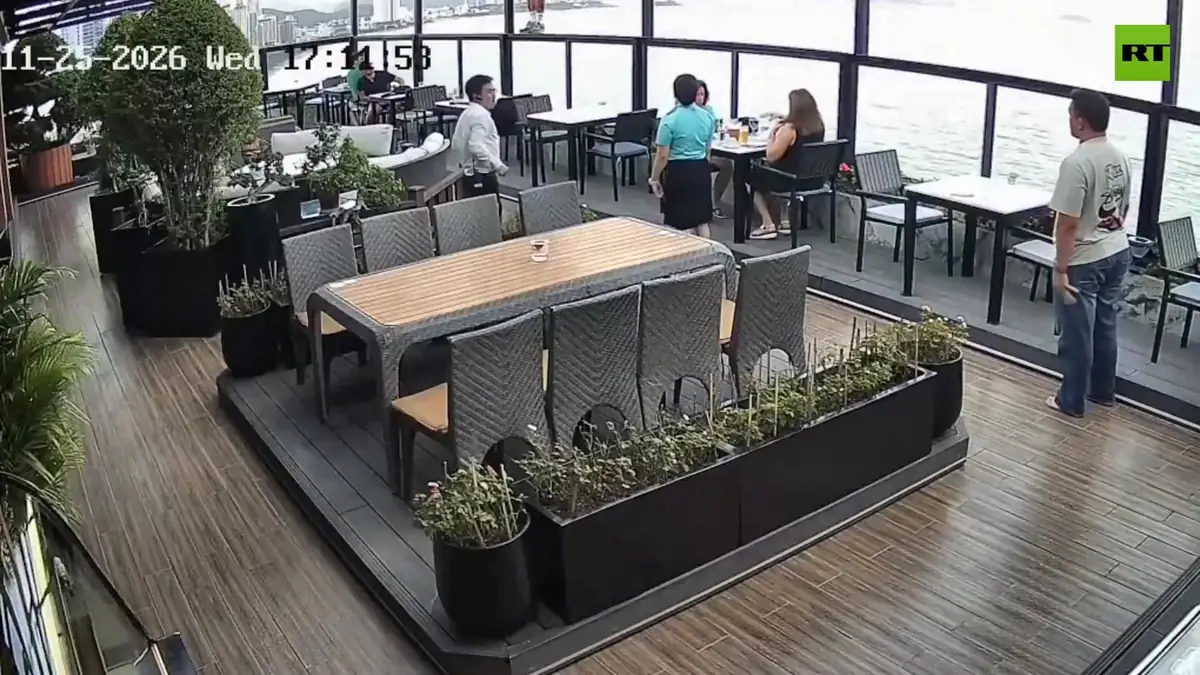
- The setting is a covered open-air terrace several stories above a body of water, furnished with a long communal table, planter boxes, and wraparound glass-and-metal railing that defines the outer edge of the venue.
- The recording captures a man walking the perimeter, then abruptly accelerating along the railing line before committing his body over the barrier.
- A woman behind him responds within roughly one second, lunging toward the point of departure in obvious distress as nearby diners turn from their tables.
- No security personnel, emergency medical responders, or law enforcement officers appear anywhere in the sequence; the clip ends with patrons standing and staring, and no documented aftermath is contained in the released material.
What the Recorded Footage Captures: Chronological Breakdown
The camera is a fixed overhead surveillance unit mounted at the interior corner of the terrace, giving a wide, slightly oblique downward view of the entire deck. In the opening seconds the space reads as ordinary hospitality operations: a long rectangular table dominates the foreground, planter boxes of low ornamental shrubs border the deck edge, and a handful of patrons occupy smaller two-tops against the glass wall overlooking the water. The timestamp overlay places the date as Wednesday, 11-25-2026, with the clock advancing across the sequence. A green broadcast-style watermark sits in the upper right corner, indicating that what the public is watching is a redistributed copy of a proprietary camera feed rather than an original export.
At approximately 7:21:53, the man in the light-colored t-shirt and blue jeans enters the frame near the right-hand railing. His posture is upright and unhurried; he walks several paces along the perimeter and appears to glance outward toward the water. A woman in a teal top and dark skirt stands near the left-side foliage, facing away. Two patrons at the far two-top are seated. Nothing in this interval distinguishes the scene from routine surveillance capture.
At 7:21:58, the geometry of the frame changes decisively. The man turns, lowers his center of gravity, and breaks into a controlled run along the deck toward the railing, closing roughly six to eight feet of distance. Instead of stopping, he plants a hand on the horizontal rail and drives his hips over the top, rotating his body so that his legs come up and over the barrier. The movement has the unmistakable arc of an intentional vault rather than a stumble; a slip against a static rail produces a very different kinematic signature, and the footage does not show one. He clears the barrier and exits the camera's field of view at the top edge.
The reaction sweep follows within a second. At 7:21:59 to 7:22:00, the woman turns and runs toward the railing point, arms rising toward her head. A second woman at the standing two-top rises and steps back from her chair. The man near the right-side tables pivots toward the water. Between roughly 7:22:00 and 7:22:09, patrons converge on the perimeter in ones and twos, some leaning toward the rail, others holding phones. Two figures near the left planter appear to move toward the exit stairway. The clip terminates at 7:22:09, roughly eleven seconds after the initial sprint, without showing any interdiction, emergency call, or medical response.
What the recording does not contain is equally material. There is no audio track sufficient to establish what was said in the preceding minutes. The clip opens with the man already mid-terrace; whatever confrontation preceded his walk to the railing occurred off-camera or before the recording window. The final seconds show bystanders reacting, but not what they are reacting to below the parapet. Every conclusion about injury outcome, rescue efforts, or the fate of the man is extrapolation, and no verified medical or police disposition accompanies the released footage.
Corporate Liability and Critical Blind Spots
The evidentiary file here is thin in precisely the places where legal exposure is thickest. The footage is a single fixed-angle feed with no corresponding audio log, no companion camera covering the approach corridor or the water side of the barrier, and no timestamped detailed incident account in the public record. Chain of custody is undocumented in the material as circulated: the presence of a third-party broadcast watermark confirms at least one re-encoding and one distribution hop before publication, which complicates authentication under standard evidence-handling standards and invites the kind of challenge defense counsel routinely raises to exclude video.
Perspective is the second blind spot. An overhead surveillance lens flattens depth and conceals the pre-incident interpersonal dynamic entirely. The viral framing of this clip asserts a specific domestic provocation, but no element of that narrative appears on the recording; the attribution rests on unverified secondhand description. A responsible forensic reading treats the motivational claim as allegation, not fact, because the recording establishes only the physical sequence, not its cause.
The third blind spot is interpretive. Even a clear mechanical sequence supports competing accounts. A deliberate self-endangering act and a reckless gambit intended to escape, shock, or extract a reaction are visually indistinguishable from this angle, and the distinction carries enormous weight for how insurers, courts, and family members will characterize what happened. The seconds immediately before the sprint, never captured, are the decisive gap. Read more: {NOIBO}
Statutory Framework and Protocol Analysis
Legal Distinction: An intentional departure over a perimeter barrier triggers a materially different analysis than an accidental fall. Premises operators generally owe invitees a duty of reasonable care, but that duty is calibrated to foreseeable hazards; deliberate self-endangerment by a guest is often treated as superseding conduct, narrowing the operator's exposure under comparative-fault and assumption-of-risk doctrines. Concurrently, building codes governing guardrail height, load rating, and opening dimensions set the objective standard against which an operator's barrier compliance is measured, and a rail that meets code often defeats a design-defect theory even after a designed-over event.
Operationally, the venue's own protocols become the operative record. Standard hospitality safety programs call for perimeter monitoring on elevated decks, prompt dispatch of trained staff to any guest displaying acute distress, and a documented emergency response sequence. The footage shows none of that sequence playing out within the recorded window, though the absence may reflect the brevity of the clip rather than a procedural failure.
The recording also illustrates the widening gap between surveillance capability and evidentiary utility. High-resolution cameras generate dramatic footage but not probative narratives; jurisdictions increasingly require retention schedules, access logs, and privacy review before footage of identifiable individuals is released. Operators who distribute or permit distribution of such material without a documented release protocol expose themselves to separate civil exposure wholly independent of the underlying event.
| Incident Parameter | Governing Legal Standard & Judicial Protocol |
|---|---|
| Elevated terrace perimeter access | Building code guardrail height and load specifications; duty of reasonable care to invitees |
| Deliberate over-barrier departure | Assumption-of-risk and superseding-cause doctrines; comparative fault allocation |
| On-camera bystander reaction | Witness identification and deposition protocols; recorded-statement standards |
| Fixed-angle video authentication | Chain-of-custody and re-encoding documentation; best-evidence rules |
| Absence of audio track | Limitation on proving pre-incident statements; hearsay and context objections |
| Circulation of third-party watermarked footage | Privacy and unauthorized-distribution exposure; retention-policy compliance |
| Absence of documented emergency response | Venue emergency-action plan review; standard-of-care inquiry |
Core Questions and Institutional Review
- Did the venue's perimeter barrier meet current code at the time of the incident, and was its condition documented in maintenance records?
- What occurred in the unrecorded minutes before the sprint, and does any companion camera or staff statement corroborate or contradict the viral characterization?
- Did trained staff intervene within the response window, and what does the venue's written emergency-action plan require for elevated-deck incidents?
- Who authorized distribution of the watermarked footage, and what retention and access controls governed its release?
The systemic dimension is the most durable. Footage of this kind circulates long before any investigative file closes, and the public narrative hardens around a caption rather than a record. That inversion places venue operators, insurers, and courts in the position of rebutting a story they never authored. The measured conclusion available today is narrow: a man crossed a barrier in view of witnesses, at a documented time, on a documented date, and the rest – motive, injury, intervention, and legal consequence – remains outside the frame.



One comment on “Store Aisle Predator Sting: Liability and Detention Limits”