Scroll down for the full investigative report below ↓
MIAMI – A recorded enforcement sweep outside a federal immigration detention facility in Miami-Dade County has produced a documented legal confrontation over where lawful assembly ends and criminal obstruction begins. Deputies in tan uniforms moved against seated demonstrators positioned along an access road, taking dozens into custody in a sequence captured on camera and later circulated by the organizing group. The episode raises measurable questions about charging standards, custodial supervision, and the boundary between protected expressive conduct and interference with federal operations.
- Jurisdictional setting: A federal detention facility operated by U.S. Immigration and Customs Enforcement in Miami-Dade County, Florida, with a state sheriff's office executing arrests on the perimeter roadway.
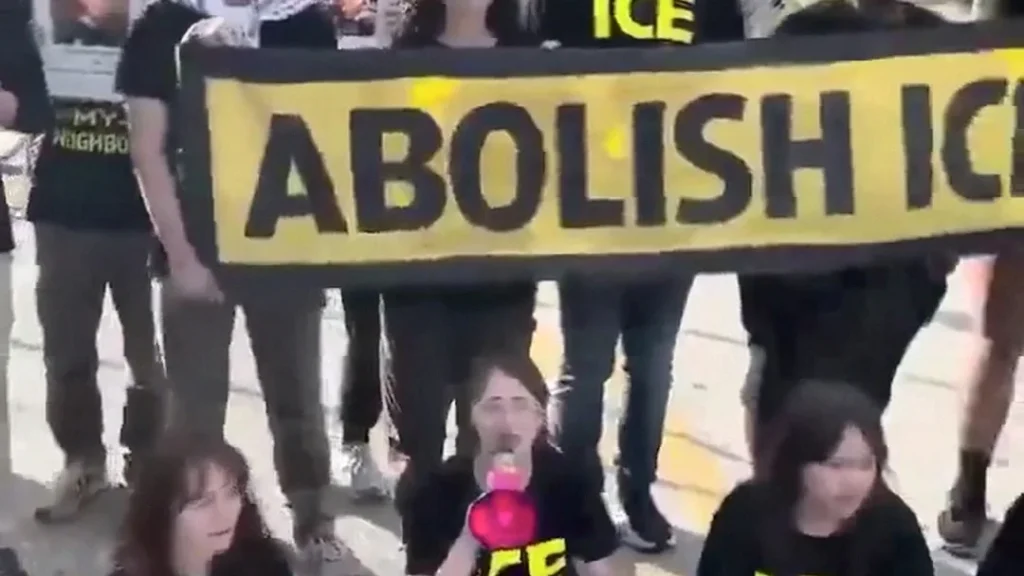
- Recorded escalation: Demonstrators seated on the pavement behind a large black and yellow banner were approached by uniformed deputies who began handcuffing participants one by one as the group chanted.
- Enforcement intervention: Deputies moved in without visible dispersal rounds captured on the footage, proceeding directly to custodial detention; a deputy's on-camera statement cited obstruction of justice as the basis.
- Legal fallout: Reports indicate the arrests were processed primarily on trespassing charges, with some participants released after posting a $500 bond and pending further court appearances.
What the Recorded Footage Captures: Chronological Breakdown
The sequence opens on a static, forward-facing composition beneath an overcast sky. A wide black banner bearing large yellow lettering stretches horizontally across the frame, held by several standing participants. In front of and beneath the banner, a smaller group sits cross-legged on the asphalt in a deliberately low, non-advancing posture. Individuals hold printed materials at chest height; one person seated near the center holds a microphone and appears to lead a call-and-response.
The camera angle is elevated slightly and near the subject level, which establishes the spatial fact that the seated group occupies the paved access lane rather than an off-road shoulder.
The second phase shifts the visual register entirely. The camera turns to a sunlit roadway framed by chain-link fencing, utility poles, and a concrete barrier painted yellow along the left edge. Three deputies in tan short-sleeve uniforms and dark trousers are visible, one in the near foreground with his sidearm and utility belt clearly displayed, two others positioned farther down the road. Their stance is unhurried and spaced, consistent with a staged approach rather than a running response. The lighting shift alone indicates a time gap between the opening tableau and the enforcement movement.
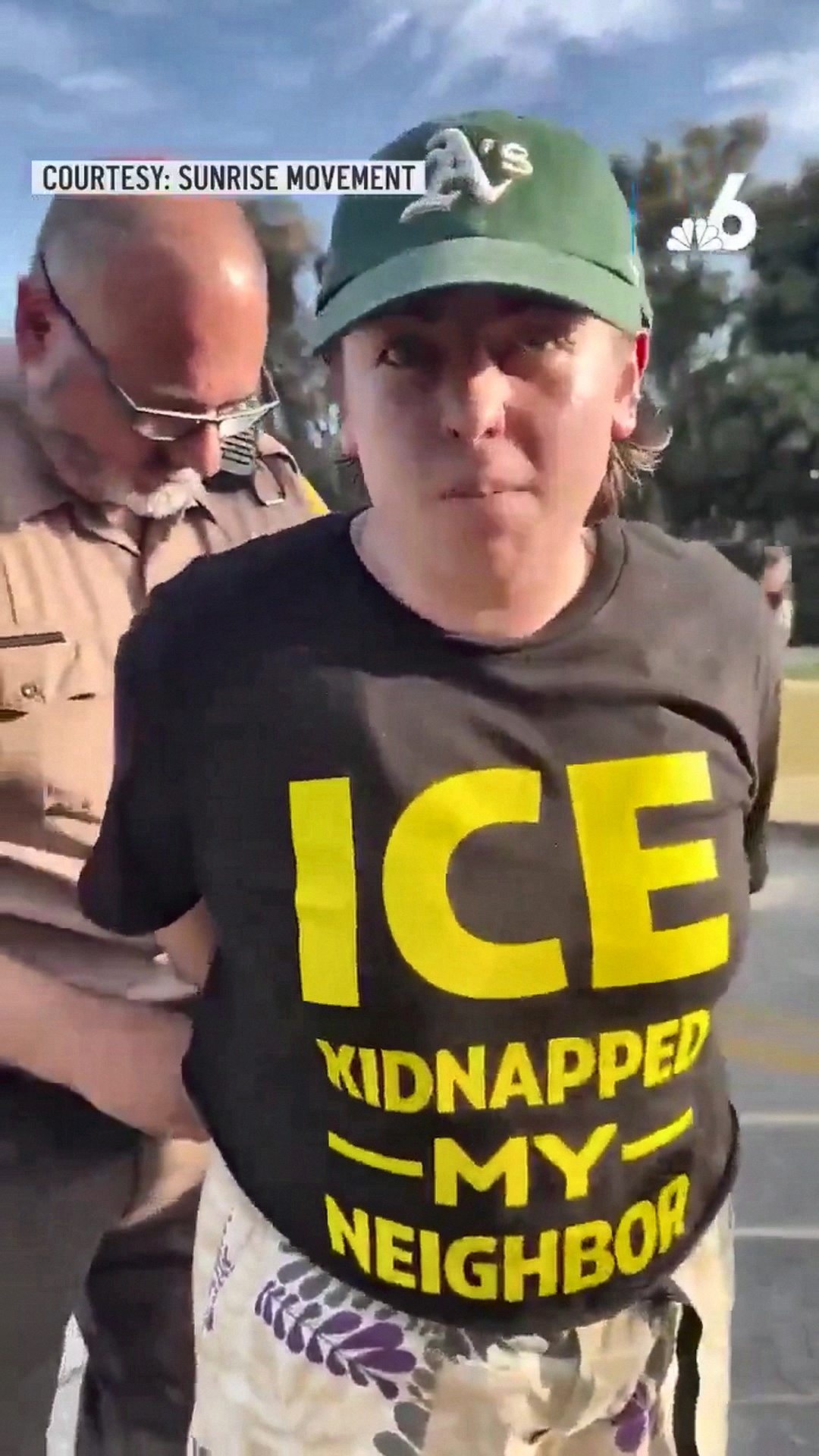
The arrest phase is captured at close range. A demonstrator wearing a green cap and a black shirt bearing large yellow text is escorted toward the camera with hands secured behind the back, an older uniformed deputy at the shoulder. The subject's expression is fixed and forward-facing; there is no visible resistance, no dragging, and no ground struggle in the frame.
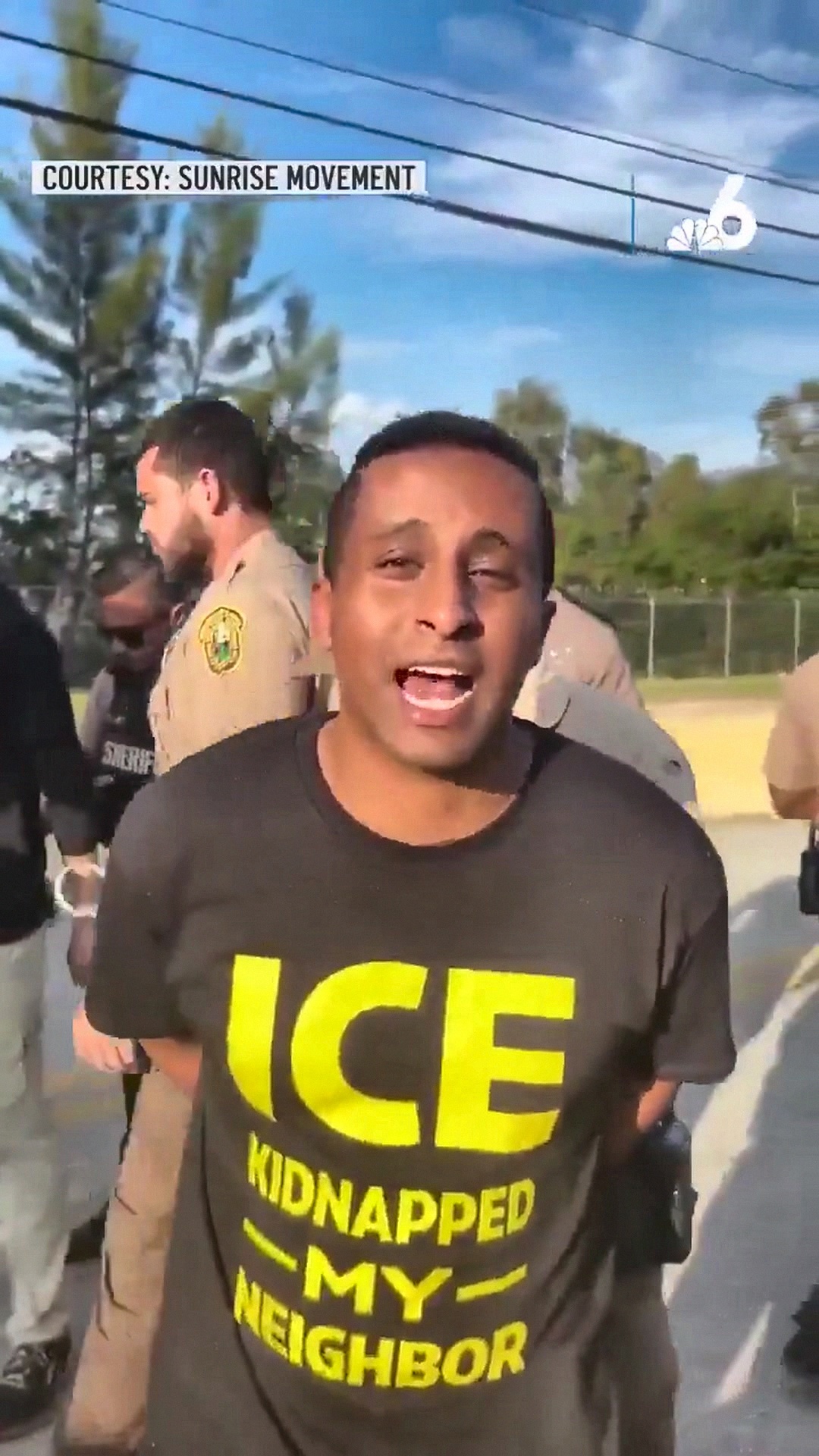
A second close shot follows a different male detainee, similarly shirted, walking under escort with his head upright and speaking toward the camera. In the background a deputy's uniform displays partial lettering identifying the Miami-Dade Sheriff's office, anchoring agency attribution to the frame itself rather than to narration.
Audio captured across the sequence is largely demonstrator-generated: a repeated declaration of fearlessness, a declaration that no human being is illegal, and an exchange in which one detainee states he is being arrested for peaceful protest against the treatment of people in custody, while a deputy states the charge as obstruction of justice. That exchange is the pivotal recorded moment – it places two competing legal characterizations of identical conduct in the same audio frame, with no authoritative resolution on tape.
Corporate Liability and Critical Blind Spots
The evidentiary record here is incomplete in ways that matter for any subsequent adjudication. There is no footage of the initial warning, no recorded dispersal order, and no timestamp establishing how long the seated posture persisted before enforcement began. Because the clip originates from a third-party source identified in the on-screen credit, chain of custody for the raw file has not been independently established, and any edit points between the banner sequence and the roadway approach are unverifiable from the published version alone. Defense counsel would reasonably press on exactly this gap.
Second, the recorded geography is legally consequential but visually ambiguous. Whether the seated group occupied a public right-of-way, a controlled-access federal perimeter road, or a posted restricted zone determines whether the applicable offense is a civil infraction, a misdemeanor trespass, or a federal interference charge. The frames show a yellow concrete barrier and fencing but no legible signage establishing notice. Without documentation of posted warnings or a verbal advisement, the notice element of a trespass theory rests on contested ground.
Third, the audio contains an unverified assertion of conduct by field investigators that the footage does not depict and cannot corroborate. Those statements are relevant as evidence of motive and belief, but they are not evidence of the underlying claim. Any institutional review must separate recorded fact from advocated narrative, and any civil exposure analysis must rest on what the file shows rather than what participants assert.
Statutory Framework and Protocol Analysis
Legal Distinction: Peaceful assembly is constitutionally protected, but protection attaches to the expressive act, not to any chosen location. Florida trespass statutes and federal regulations governing protected facilities both permit enforcement where demonstrators ignore a lawful order to disperse from a restricted perimeter; the operative question is whether adequate notice was given and whether the force used was proportional to the observed resistance.
The compliance architecture in an operation of this scale runs through three checkpoints. First, supervisory authorization: mass custodial detention requires documented command approval, and the footage shows a coordinated, staged deployment rather than spontaneous individual action. Second, proportional response: the frames depict handcuffing of compliant, seated, or walking subjects, which generally satisfies a minimal-force standard and weakens any excessive-force claim. Third, custodial duty of care: once cuffed, arrestees become the agency's responsibility for transport, medical screening, and holding conditions, and that obligation is independent of whether the underlying arrest was lawful.
The charging decision recorded on camera diverges from the charging decision reported afterward. The deputy's verbal statement of obstruction is a law-enforcement characterization at the point of seizure; the reported trespass filings reflect prosecutorial discretion at intake. That divergence is not unusual, but it creates a documented inconsistency that defense counsel will use to argue the arrest lacked a clear statutory basis at the moment it occurred – a standard that varies by jurisdiction and is frequently litigated.
| Incident Parameter | Governing Legal Standard & Judicial Protocol |
|---|---|
| Seated protest blocking an access road | State trespass statute and facility access regulations; enforcement requires prior lawful order to disperse |
| Verbal charge stated during cuffing | Arresting officer must articulate probable cause at the scene; the stated offense need not match the eventual filing |
| Mass custodial detention of demonstrators | Supervisory authorization and documented command decision required for group arrests |
| Handcuffing of compliant subjects | Proportional force standard; minimal restraint satisfies duty-of-care baseline |
| Transport and holding after arrest | Independent custodial duty of care covering medical screening and confinement conditions |
| Release on monetary bond | Bond schedule set by county practice; appearance obligations attach pending arraignment |
| Third-party recorded footage | Chain-of-custody authentication required before evidentiary use; edit gaps are discoverable |
Read more:
Read more: California Mother Arrested After Smashing School Bus Window →
Core Questions and Institutional Review
- Did deputies issue a documented, audible dispersal order before initiating custody, and does any unedited file capture it?
- What is the precise legal status of the pavement where participants sat – public right-of-way, controlled federal perimeter, or posted restricted zone?
- Why did the on-scene stated charge of obstruction diverge from the reported trespass filings, and was that divergence disclosed to arrestees?
- What custodial protocols governed processing, medical screening, and bond release for a group of this size within a compressed timeframe?
The systemic consequence here extends beyond any single docket. A recorded mass arrest at a federal facility functions as a stress test of an agency's written protocols: dispersal notice, force proportionality, charging consistency, and custodial care either hold up under frame-by-frame scrutiny or they do not. The footage shows a professionally staged enforcement sequence with restrained physical handling, which supports the agency's account of a controlled operation.
It equally shows an unresolved gap between what a deputy said on camera and what was ultimately filed, and that gap will define the litigation. For the arrestees, the immediate financial exposure is modest – bond, counsel, and lost workdays – but the precedential exposure is not. Every future perimeter demonstration in that county will now be measured against this file, and every future defense motion will cite the distance between the spoken charge and the written one.
Practical takeaways: Verify signage and dispersal advisement before relying on a trespass theory; treat on-scene verbal charges as non-binding characterizations; preserve unedited source footage with documented custody; and confirm custodial screening obligations attach at the moment of restraint, not at intake.
FOLLOW-UP INVESTIGATION REPORT
Related documented case details, verified on-scene evidence, and statutory liability analysis continued below.
CONTINUE READING: NEXT INVESTIGATIVE DOSSIER →
Woman Jailed for DUI Despite Zero Alcohol in Blood Test

The sun was sinking low over the Tennessee interstate, casting long shadows across the asphalt as a state trooper approached a white SUV. What should have been a routine stop for a minor traffic violation spiraled into a bizarre confrontation that would eventually cost taxpayers $70,000. Stephanie Fair stood on the roadside, her hands trembling as she pleaded her innocence, while the officer insisted the unmistakable reek of alcohol surrounded her. The camera rolled, capturing every tense second of a dispute where the truth wouldn't fully emerge for two months.
- The Traffic Stop: Stephanie Fair was pulled over on the evening of June 23rd for failing to move over, a violation that instantly put the trooper on edge.
- The Friction: The officer claimed he detected a "very distinct odor of alcohol" coming from the vehicle and observed signs of intoxication in her eyes.
- The Intervention: Despite Fair's repeated pleas that she had just eaten and doesn't drink, the trooper placed her in handcuffs and arrested her for DUI.
- The Aftermath: Two months later, a blood test confirmed zero alcohol and zero drugs in her system, leading to a $70,000 settlement from the state of Tennessee.
What the Recorded Footage Captures: Chronological Breakdown
The video begins with the trooper's patrol car dashcam framing the white SUV parked on the shoulder. The officer, his hat tilted against the fading light, approaches the driver's side and immediately initiates a conversation. "Go ahead and step on out of the car and we're going to have a conversation, okay?" he says, his tone controlled but firm. Stephanie Fair steps out, her blonde hair pulled back, wearing a white tank top and green pants. She looks confused but compliant. The trooper leans in, his body language stiffening as he scans the interior of the vehicle. "There's a very distinct odor of alcohol that comes from either a person or inside the vehicle," he states, almost as a fact. Fair's eyes widen, and she shakes her head. "Right. I understand, but I, on my life, I don't drink alcohol. I just ate."
The tension escalates quickly. The trooper isn't swayed by her denial. He continues to press, describing the smell as overwhelming. Fair, now visibly distressed, recounts the feeling in her stomach: "When he started asking me about drinking, I instantly got this feeling in my stomach, like, this is bad. And it was." The officer then justifies the stop, explaining that she had almost hit him while he was wrapping up a previous traffic stop. "I come up to the car and it just reeks of alcohol," he says. "I actually don't test it. You can see it in her eyes." The visual evidence is jarring. Fair's eyes are clear, but the trooper's conviction is absolute. He clearly states he could smell the odor of an alcoholic beverage, a claim Fair vehemently disputes. "That, when he said he could smell it, I know this is corrupt. This is completely wrong."
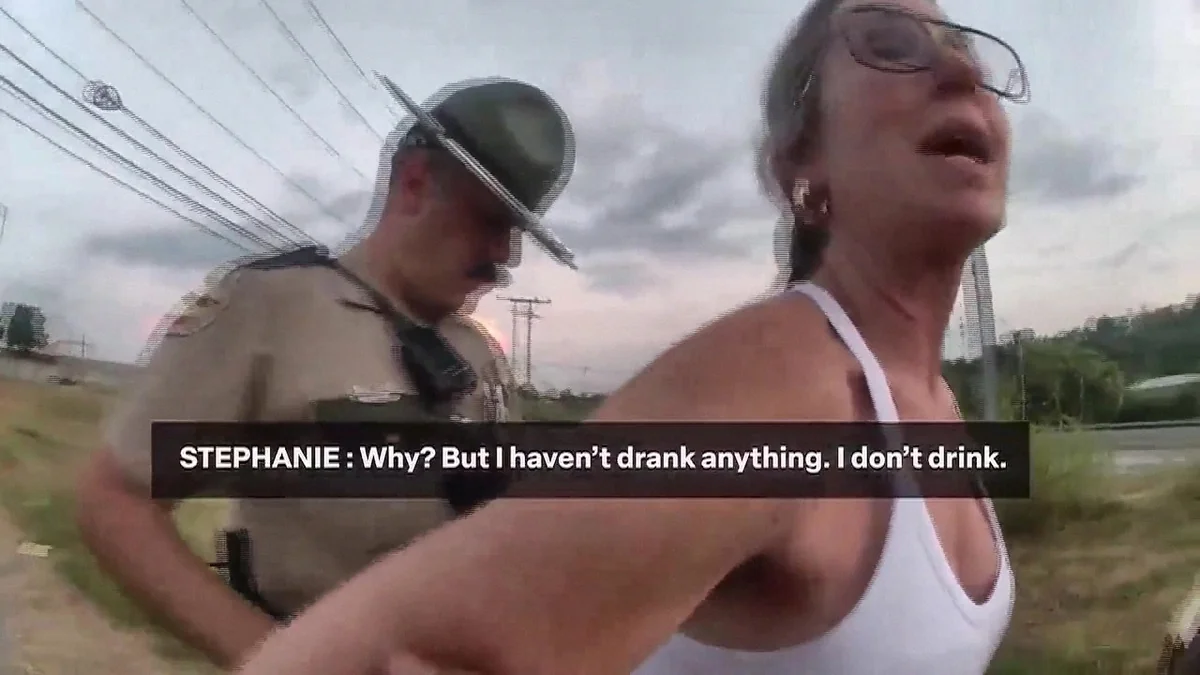
The climax arrives with brutal swiftness. The trooper steps forward, his hand moving to his belt. "Place your hands behind your back." Fair's face crumples in disbelief. "Why? Because you're being placed under arrest for DUI." Her voice cracks as she repeats her innocence. "But I don't drink anything. But I don't drink." The camera captures the metallic click of the handcuffs, a sound that seals her fate despite her protests. The screen splits, showing a surveillance clip of Fair at an ice cream shop just minutes before the stop, a stark contrast to the grim scene on the highway. The trooper's demeanor remains rigid, unmoved by her escalating panic.
Critical Blind Spots: What the Lens Leaves Unresolved
While the dashcam footage provides a clear view of the interaction, it leaves several critical questions unanswered. The camera angle is fixed, capturing only the driver's side and the immediate front of the vehicle. We cannot see the passenger side or the back seat, leaving us to wonder if there was any open container or alcohol source that the trooper might have spotted. The lighting is dim, and the officer's claim of seeing "alcohol in her eyes" is highly subjective. Without a clear close-up, it's impossible to verify what he saw versus what he inferred from the smell.
Furthermore, the audio captures the officer's insistence on the smell, but we don't hear the moment he first approached the car. The initial seconds, when he might have caught the scent, are cut. We also don't hear any field sobriety tests being administered. The narrative jumps from the traffic stop to the arrest. The most significant blind spot, however, is the two-month gap between the arrest and the blood results. The video doesn't show the jail experience, the emotional toll on Fair, or the legal maneuvering that led to the settlement. Her comment, "I was more scared being with that cop alone than I actually was inside the jail," hints at a deeper psychological fear that the footage only scratches the surface of.
Statutory Framework and Protocol Analysis
In the United States, a traffic stop is a seizure under the Fourth Amendment, and the officer must have reasonable suspicion of a traffic violation to initiate it. In this case, the failure to move over provided that initial justification. However, the subsequent arrest for DUI requires probable cause. The trooper relied heavily on the odor of alcohol and his visual assessment of her eyes. According to the Supreme Court's decision in Pennsylvania v. Mimms, an officer may order a driver out of the vehicle during a lawful traffic stop without violating the Fourth Amendment. This explains why the trooper could demand Fair step out of the car. However, the arrest itself hinges on the sufficiency of the evidence. If the odor was mistakenly identified – perhaps from a passenger or a lingering scent – the probable cause could be challenged.
The subsequent blood test, which came back completely clean, undermines the foundation of the arrest. The fact that the state paid $70,000 suggests a recognition that the evidence did not support the charge. This case echoes the principles of Terry v. Ohio, which requires specific and articulable facts to justify an intrusion. Here, the trooper's subjective belief in the odor was the primary articulable fact. When that fact proved false, the legal ground shifted. The settlement highlights the importance of objective evidence over subjective suspicion.
| Incident Parameter | Observation at the Scene |
|---|---|
| Date of Stop | Evening of June 23rd |
| Reason for Stop | Failure to move over |
| Officer's Claim | Distinct odor of alcohol, visible impairment in eyes |
| Driver's Statement | "On my life, I don't drink alcohol. I just ate." |
| Arrest Action | Handcuffed and taken into custody for DUI |
| Blood Test Result | Zero alcohol, zero drugs |
| Settlement Amount | $70,000 |
Core Questions and Institutional Review
- Why was the odor of alcohol so compelling to the trooper if the driver was completely sober? Could there have been another source, such as hand sanitizer or a passenger?
- What did the dashcam footage from the moments before the stop actually show? The video mentions she was getting ice cream, but was there any interaction with the trooper that was missed?
- How did the internal review process justify a $70,000 settlement? Was there a finding of misconduct, or was it a purely financial decision to avoid litigation?
- What happened to Stephanie Fair during the two months before her exoneration? The emotional and professional toll of a false arrest is often invisible.
The video closes with Fair's voice, still shaking, recounting her fear. The scene on the highway is quiet, the sunset now just a memory. The handcuffs are gone, but the questions linger in the air. The state has paid its financial debt, but the human cost remains. Was this a case of a mistaken smell, or something more troubling? The footage shows a woman who believed she was about to lose everything, and an officer who believed he was doing his job. As the screen fades, one question remains: how many other drivers have faced that same click of the handcuffs based on a scent that wasn't there?



One comment on “Miami-Dade Krome Gate Arrests: Trespass & Obstruction Review”