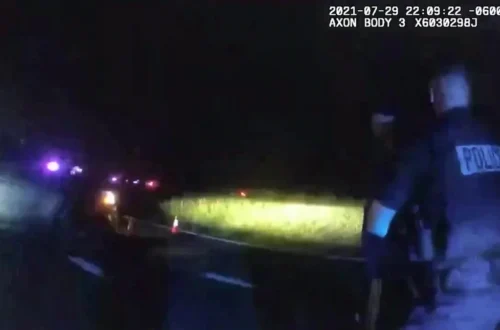
Scroll down for the full investigative report below ↓
AUSTIN, Texas – A man was taken into custody on Sixth Street after a punch was thrown within plain sight of uniformed officers, escalating into a public arrest and a dispute over the charge. For municipal officials and legal observers, the recorded exchange raises questions about probable cause documentation and the duty to intervene when a strike occurs.
- The setting is the 6th Street entertainment district in Austin, Texas, a high-density nightlife corridor subject to periodic crowd-control deployment.
- The recorded footage shows three major moments: a verbal exchange near a brick storefront, a sudden strike, and a handcuffed briefing beside a police vehicle.
- Law enforcement intervention appears backed by a large margin of officers, with the record capturing multiple patrol units and a transport van near the scene.
- Legal exposure centers on whether the record sufficiently demonstrates third-degree assault and whether the resulting detention complied with Texas statutory procedure.
What the Recorded Footage Captures: Chronological Breakdown
The first sequence, framed at close range near a stone and brick facade, shows a man in a gray hooded sweatshirt facing a man in a dark cowboy hat. A female bystander walks past, and an officer's uniform reads "POLICE" on the back. The men exchange words across a short gap, and their body language is tight but controlled.
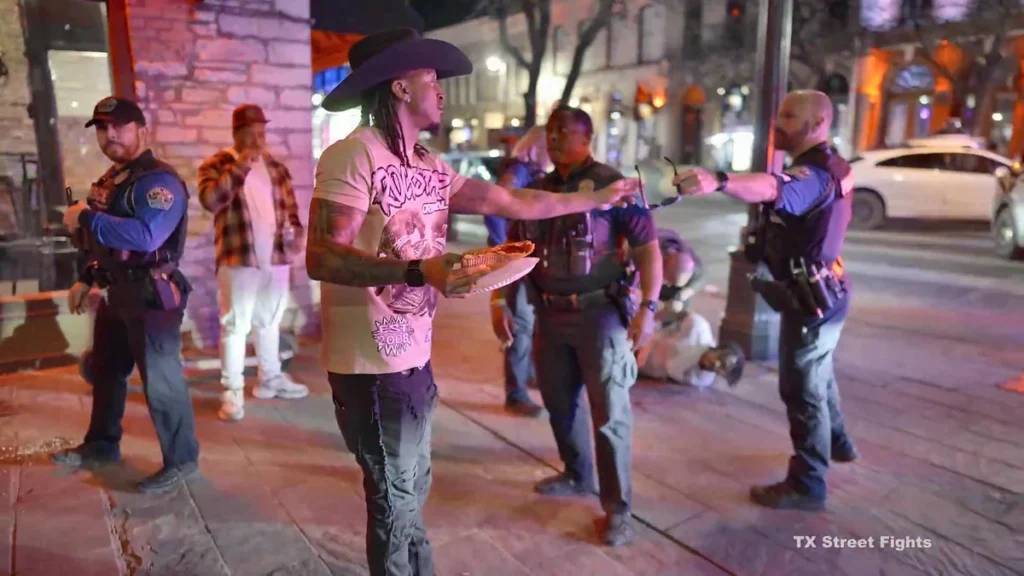
The second sequence is the apex of the footage. The cowboy-hatted man points directly at a third male seated on the ground, and at least two officers stand between them. An officer extends a flat hand toward the pointing man, a gesture that reads on camera as a stop instruction. The pointing continues, the seated man remains near the officer's right leg, and the exchange has the visual character of a direct escalation.
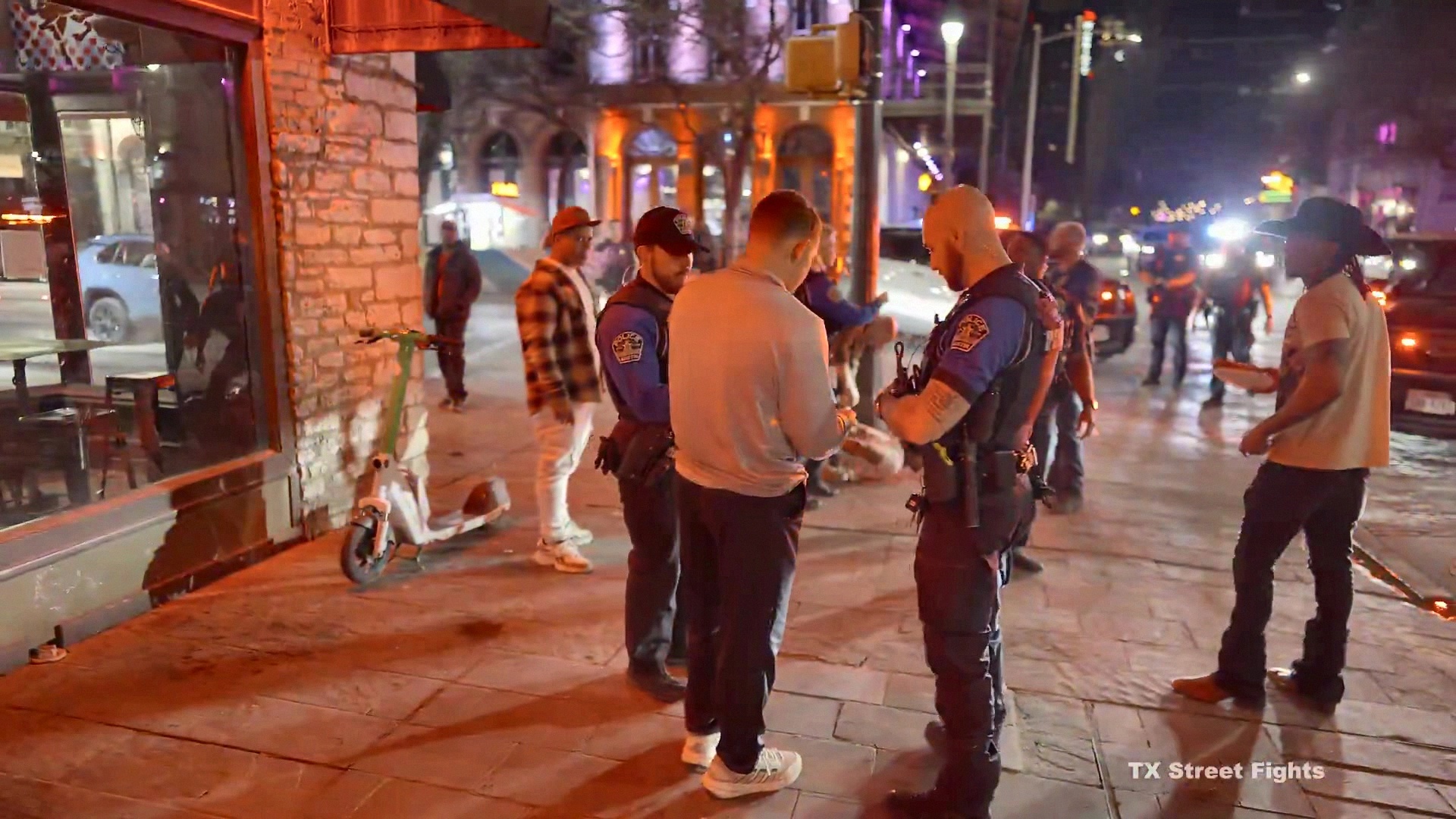
The third sequence shows the male in a tan or gray long-sleeve shirt standing with his hands behind his back, wrists bound, while two officers in dark tactical gear face him. A small white motor scooter is idle on the pavement nearby, and the streetlight is red-orange in the frame. His head is tilted, and his posture is stationary rather than combative.
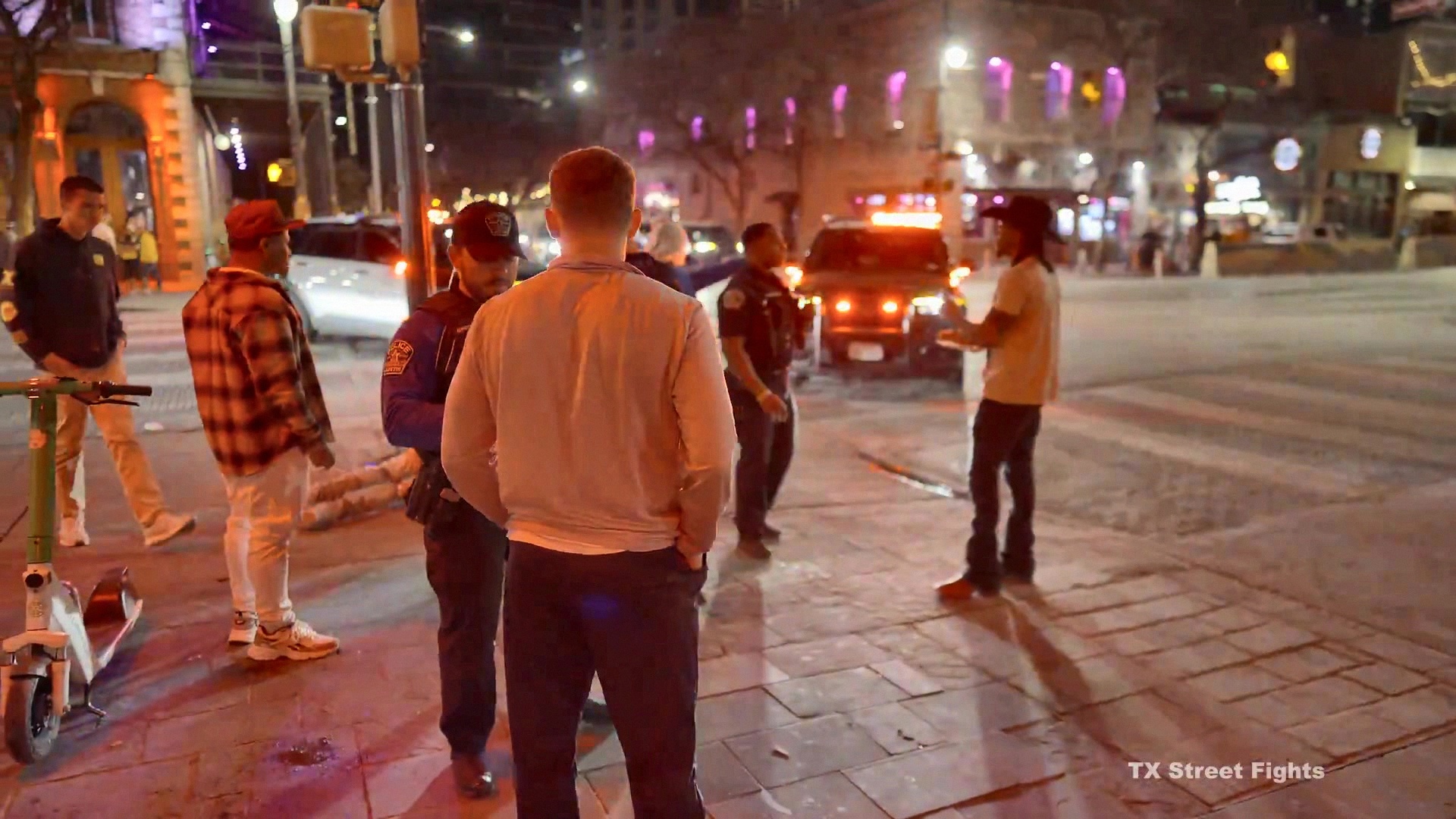
The fourth sequence moves to a wider street view. The handcuffed man stands with his hands behind his back, facing a man in a cowboy hat who gestures with an extended arm. A patrol SUV with blue overhead lights is staged in the roadway, and several bystanders in plaid and casual wear linger at the frame edge. The blue lighting dominates the scene and indicates an active incident command.
The fifth sequence, from a lower and more distant angle, shows several officers clustered near a brick-paved sidewalk, with a red camera rig visible in the foreground. A male in a dark jacket walks out of the frame to the left. A transport van with blue lightbars sits behind the group. The visual evidence supports a staged arrest location rather than a dynamic chase.
Corporate Liability and Critical Blind Spots
The footage circulates under the label "TX Street Fights," which frames the incident as spectacle. No verified link exists in the record between the cameraman's angle and the arresting agency's body-worn camera metadata. Without that chain of custody, the footage is useful for public comprehension but insufficient for legal adjudication.
The clip's visible frame does not establish what preceded the punch. Whether a threat, an insult, or a physical contact came first is not visible. Because the strike occurs near officers who appear to be in control of the perimeter, the analytical spotlight shifts to the officers' duty of care and their obligation to intercede before a strike lands.
Public ledger and litigation risks mount where a private incident video is republished without verification. The description attached to the clip says "2026," a date that is implausible for near-term posting. That metadata error is a classic red flag in the validation process, indicating that the footage may be recycled from an earlier incident and re-captioned.
Legal Distinction: Texas Penal Code § 22.01 defines assault as intentionally, knowingly, or recklessly causing bodily injury, or threatening imminent harm. A punch thrown in view of a police officer satisfies the probable cause threshold for custodial arrest under § 14.01, but the degree of offense, whether a Class A misdemeanor or third-degree serious legal charge, depends on injury findings and prior history.
Under Texas Code of Criminal Procedure Article 14.01, an officer may arrest without a warrant for any offense committed in the officer's presence. The question becomes whether the arrest was timely fatally harmed and whether a magistrate warned the accused within the statutory window mandated under Article 15.17.
Municipal custodial policies and department general orders also require a documented de-escalation attempt. The officers' positioning and the flat-hand gesture in the second frame are consistent with an initial contact, but the record does not confirm that the danger was fully neutralized before the punch.
| Incident Parameter | Governing Legal Standard & Judicial Protocol |
|---|---|
| Punch landed near officers | Tex. Penal Code § 22.01; arrest authority under Tex. CCP Art. 14.01 |
| On-scene stop instruction | Documented de-escalation mandate in municipal general orders |
| Handcuffing posture | Tex. CCP Art. 15.17 magistrate warning window |
| Public crowd context | Municipal noise and crowd-control ordinance oversight |
| Cameraman footage release | Chain-of-custody and metadata validation protocol |
| Cited charge dispute | Third-degree assault classification threshold analysis |
| Transport and staging | Department vehicle staging and public-safety standards |
Read more:
Read more: Colorado Wrongful DUI Arrest: Record Settlement for Good Samaritan →
Core Questions and Institutional Review
- Did the arresting agency document the pre-contact exchange and identify the legal basis for probable cause in the detailed incident account?
- Was the duty to intervene triggered before the strike, and if so, what de-escalation record exists under department general orders?
- Did the charge cited on camera match the classification standard, and was the magistrate warning issued inside the 48-hour window?
- Does the private footage's metadata and chain-of-custody hold up to evidentiary scrutiny, or should it be treated as public information only?
The broader implication is financial and institutional. An arrest that is captured on camera and disputed verbally becomes a litigation exposure, a training file, and a community-trust problem. The record shows a fast custodial outcome and a later dispute, and those two facts must be reconciled by the same evidentiary standard.

Practical Takeaways for Readers
- Treat viral street footage as an unverified evidentiary artifact until metadata and chain of custody are confirmed.
- Understand that arrest authority in Texas can attach without a warrant when a punch is observed by an officer.
- The classification of the charge, not the act itself, is where legal leverage is decided; documentation of injury and prior history matters.
- Agencies that want to protect themselves should preserve pre-contact and post-contact body-camera segments alongside private footage.
FOLLOW-UP INVESTIGATION REPORT
Related documented case details, verified on-scene evidence, and statutory liability analysis continued below.
CONTINUE READING: NEXT INVESTIGATIVE DOSSIER →
Lawrence Fatal incident Arraignment: Defendant Erupts in Courtroom

LAWRENCE, Massachusetts – A fatal incident arraignment in Essex County descended into chaos when a defendant charged in the strangulation death of his fiancée launched into a violent outburst seconds after being led into the courtroom. The recorded proceedings now sit at the center of broader questions about judicial security protocols, the enforceability of restraining orders, and the criminal-justice system's capacity to intervene before domestic violence becomes fatal incident.
The case involves Tony Ventura, 32, charged with fatal incident in the death of Maria Morton, also 32, a mother of two. According to recorded courtroom audio and contemporaneous reporting, Ventura had admitted to police and on social media that he strangled Morton before her body was discovered in the Lawrence bedroom the couple shared.
- The jurisdiction is Lawrence, Massachusetts, with proceedings conducted under Essex County court authority and the defendant held without bail afterward.
- Court officers were in the middle of ushering Ventura into the arraignment when the confrontation erupted, disrupting the scheduled hearing almost immediately.
- Multiple uniformed court officers were required to physically restrain and reposition the defendant, underscoring the compressed reaction window in high-risk custodial transfers.
- The incident triggered renewed scrutiny of prosecutorial disclosures that Morton had twice obtained restraining orders against Ventura and that he was on probation for assault and battery at the time of the fatal altercations.
What the Recorded Footage Captures: Chronological Breakdown
The video record opens with an establishing exterior: a white and black Lawrence Police SUV marked unit 424 idles behind a chain-link fence, its light bar dormant, its presence a quiet marker of institutional response rather than active emergency. This is the 10 percent anchor – a static image that establishes jurisdiction and stakes before any human confrontation enters the frame.
At roughly the 25 percent mark, the footage cuts to a tight, almost forensic close-up of a man's face – the defendant, bearded, unsmiling, eyes fixed forward. The framing is unrelenting; there is no context, no courtroom geography, only the subject's expression. This is a deliberate editorial choice that pre-stages the volatility to come. A microphone and the shoulder of a uniformed officer intrude at the left edge, signaling custodial proximity.
By the 40 percent mark, the sequence shifts outside the courthouse to a woman speaking before a cluster of press microphones, a brick facade and a no-smoking sign behind her. Her composure reads as exhaustion rather than performance; the audio confirms she is a family member describing years of concern and ambivalence. "We may not have all agreed at times with her decisions, but we supported her," she says. "She cared for this individual enough to keep on trying to help him, and unfortunately it didn't work out in the end. Everyone kind of loses in this situation."
The 60 percent climax is the courtroom interior, where the audio narration points directly to the moment of escalation: "Right there, right there." A court officer in a white shirt and black tie stands beside the defendant in a blue institutional smock, and the frame captures the instant of physical disruption. The footage does not linger on the violence itself; instead it documents the institutional response – officers converging, the defendant's posture shifting from compliant to combative as the hearing begins.
At the 75 percent consequence stage, the record returns to a male attorney or official speaking outside, confirming the procedural outcome: "Tony Ventura is being held without bail." The 90 percent cooldown is editorial context – the narrator's recap of restraining orders, probation status, and prior violent convictions – which reframes the outburst not as anomalous but as the predictable endpoint of a documented risk trajectory.
Corporate Liability and Critical Blind Spots
The evidentiary record here is unusually rich in institutional consequence but conspicuously thin on the underlying mechanics of the violence. The camera never shows the precise trigger – a verbal exchange, a physical gesture, a procedural instruction – that converted a custodial transfer into a use-of-force event. That gap matters because judicial security reviews hinge on the seconds immediately preceding intervention, and those seconds are unrecorded in the released footage.
Chain-of-custody questions also attach to the social-media confession referenced in the narration. Statements posted to a digital platform require authentication, preservation of metadata, and a documented scraping methodology before they can be admitted or even publicly characterized. The record as presented contains no such documentation; it contains an assertion, relayed by a broadcaster, that Ventura admitted the fatal altercations. Investigative rigor demands distinguishing between a prosecutor's summary of evidence and the evidence itself.
Finally, the viral framing invites overreach. The footage does not establish whether the outburst was spontaneous or reactive, whether force was used against the defendant before the visible restraint, or whether the officer positioned nearest him had been briefed on his violent history. Those are the critical blind spots that any institutional review must resolve before conclusions are drawn about protocol failure.
Statutory Framework and Protocol Analysis
Legal Distinction: The conduct captured implicates two distinct legal tracks – the substantive fatal incident charge, which carries statutory fatal incident definitions and evidentiary burdens, and the in-court disruption, which falls under contempt and custodial security authority exercised by the presiding court. Separately, the two restraining orders invoke Massachusetts abuse-prevention statutes that create civil protective mandates, but enforcement depends on law-enforcement response capacity and probation supervision, not on the order's mere existence.
The compliance posture of the institutions involved is the crux. A defendant with multiple violent convictions and active probation status for assault and battery represents a known high-risk profile for domestic fatal incident. Standard risk-assessment instruments – including lethality screening protocols increasingly mandated in Massachusetts domestic violence cases – are designed precisely to flag strangulation history as an elevated-danger indicator. Whether such screening occurred, and whether probation supervision was calibrated to the risk, is not disclosed in the available record.
Institutional duty of care in the courtroom context is narrower but equally concrete: courts owe a duty to staff, counsel, and the public to manage custodial transfers of defendants with documented violent histories. The fact that the outburst occurred as officers "ushered in" the defendant suggests a standard transfer protocol was in effect, but the speed of the escalation raises the question of whether the defendant's risk profile had been communicated to the transport detail.
| Incident Parameter | Governing Legal Standard & Judicial Protocol |
|---|---|
| In-court violent outburst | Contempt authority and courtroom security protocols under state court administration |
| Defensive physical restraint by officers | Use-of-force continuum governing court officers and custodial personnel |
| Two prior restraining orders | Massachusetts abuse-prevention statute and enforcement obligations |
| Active probation for assault and battery | Probation supervision standards and violation reporting duties |
| Strangulation fatal incident charge | Statutory fatal incident definitions with elevated domestic-violence severity |
| Defendant held without bail | Bail statute criteria for dangerousness and flight risk |
| Social-media confession reference | Evidence authentication and digital-preservation requirements |
Core Questions and Institutional Review
- Did any agency receive and act on the two restraining orders with enforcement follow-through proportional to a documented strangulation risk profile?
- Was Ventura's violent criminal history and probation status communicated to the court officers responsible for his transport and custodial transfer?
- What risk-assessment instrument, if any, was applied between the protective order filings and the fatal incident, and why did it not interrupt the trajectory?
- Does the defense's reliance on depression, substance abuse, and childhood lead exposure signal a mitigation strategy that the system is structurally unprepared to distinguish from culpability?
The systemic impact of this case extends beyond the courtroom. It is a case study in the distance between protective-order paperwork and protective outcomes – between a system that records a victim's fear and a system that prevents its realization. The recorded outburst is dramatic, but the quieter institutional failure is the one that produced it: a documented, escalating, high-risk domestic situation that the apparatus of probation, protective orders, and court supervision observed without interrupting. Until risk-communication protocols connect probation records to custodial transport details, and until strangulation history reliably triggers heightened enforcement rather than documentary accumulation, the gap between order and protection will remain the defining liability of the system.