Scroll down for the full investigative report below ↓
BUDA, Texas – A 45-year-old Kyle man faces two counts of assault causing bodily injury after a chaotic, widely circulated encounter at the intersection of RM 967 and FM 1626 near Moe and Gene Johnson High School, where authorities allege he was the primary aggressor in a confrontation with student demonstrators. The case has moved from a localized school walkout to a formal criminal docket, raising questions about the boundaries of self-defense, property defense, and the evidentiary value of fragmented viral media.
- Jurisdictional setting: The recorded events unfolded in Buda, Hays County, Texas, on a public right-of-way adjacent to Moe and Gene Johnson High School, where students had staged a walkout protesting federal immigration enforcement operations.
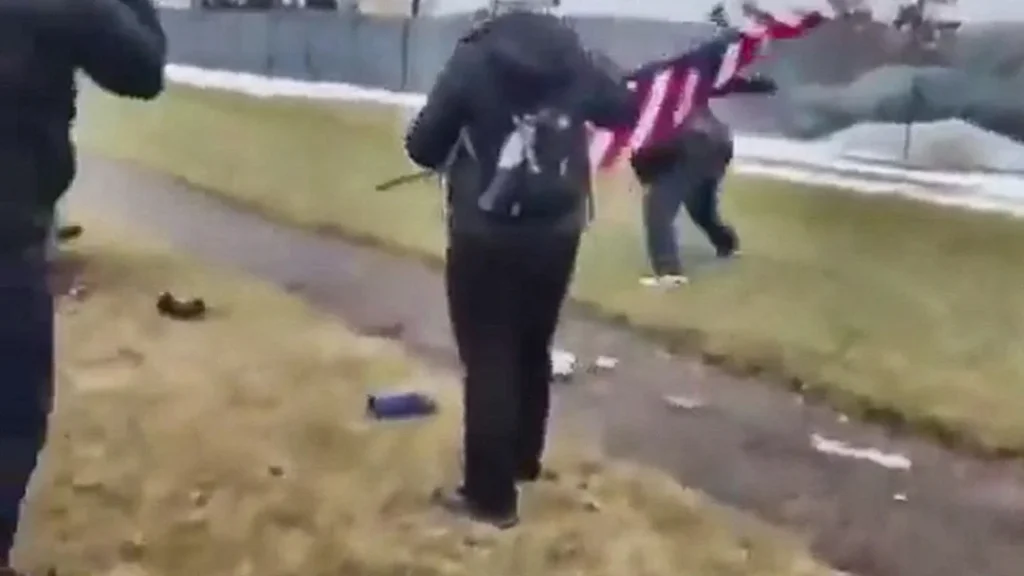
- Recorded escalation: Video captures a man walking a snow-dusted grassy shoulder carrying a large American flag before turning to face multiple individuals moving toward him, with objects visible on the ground nearby.
- Law enforcement intervention: The Buda Police Department investigated and ultimately arrested Chad Michael Watts, determining through its review that he was the primary aggressor rather than merely a reacting party.
- Legal and regulatory repercussions: Watts was charged with two counts of assault causing bodily injury; the Hays County District Attorney's office continues to review the matter for potential additional counts, while Hays County Judge Ruben Becerra issued a public statement on the incident.
What the Recorded Footage Captures: Chronological Breakdown
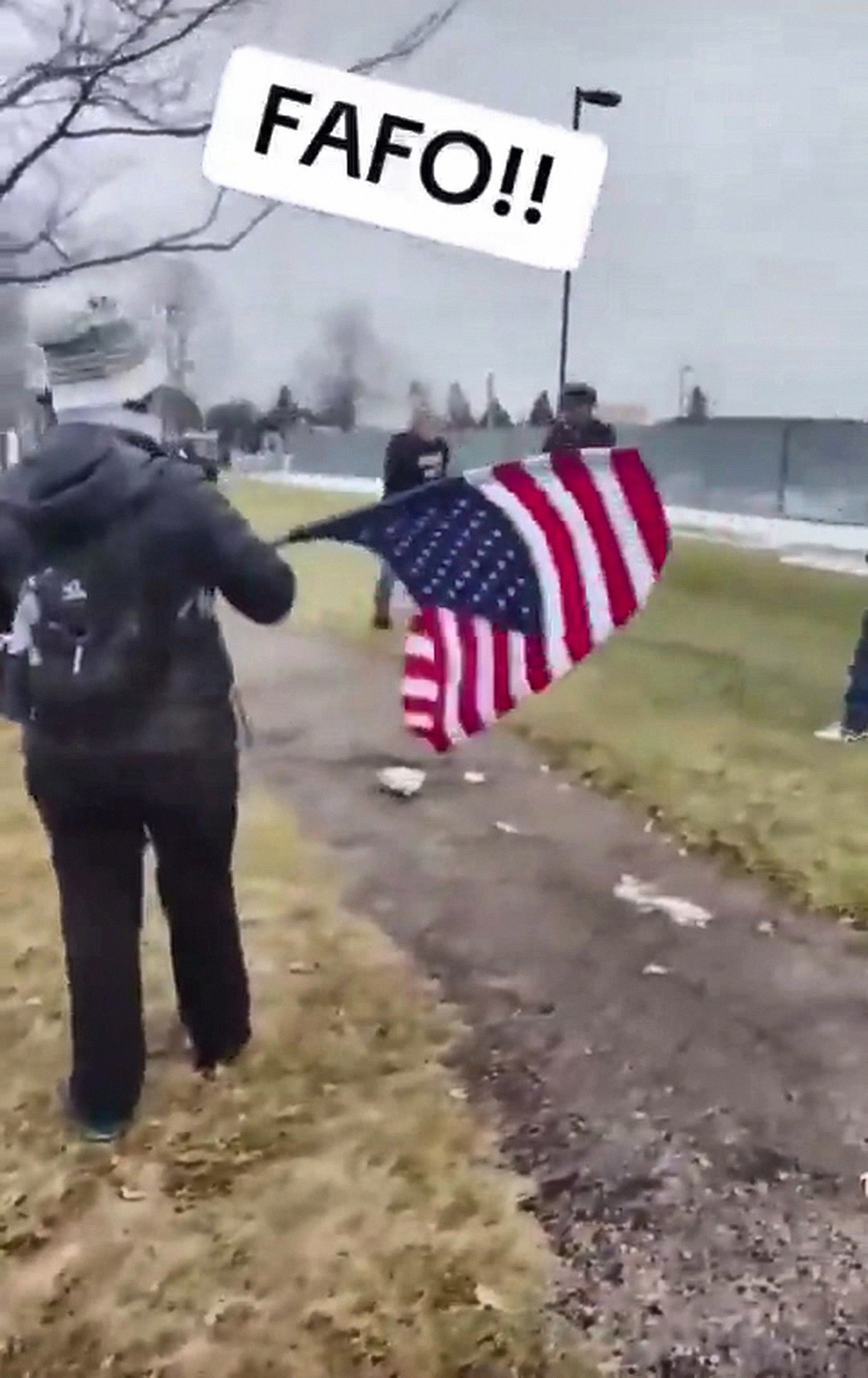
Frame one establishes the spatial geography of the encounter with unusual clarity. The camera sits at roughly shoulder height behind a figure in dark outerwear, framed against a leafless treeline and a pale, overcast winter sky. A large American flag is visible in the middle distance, held aloft and angled awkwardly against the gray backdrop.
Overlaid across the top of the frame is a stark white caption reading "FAFO!!" – an editorial insertion applied after the fact, not part of the original scene, and one that immediately frames the footage as commentary rather than neutral documentation.
By the second frame, the flag has swung into a fuller horizontal plane, its stars and stripes unfurled across the center of the composition. The figure in dark clothing stands with shoulders squared, and a second individual in a lighter jacket is visible at the edge of the grass line near a paved walkway. The ground between them is littered with debris – a small blue object, scattered paper, and what appears to be a discarded container.
The audio track, partially obscured by wind and distance, carries overlapping shouts including the repeated chant "Let's go!" and a fragment that sounds like "move the dispute up," indicating that verbal confrontation preceded the physical maneuvering captured here.
Frame three marks the pivot point of the sequence. The camera has shifted or the operator has repositioned, and now a wider field of view reveals multiple individuals spread across the lawn. A figure in a red and black vest moves rightward with purposeful stride, while two others in dark clothing flank the center of the frame, one with arms extended outward in a posture consistent with either blocking or bracing.
The flag is no longer the visual anchor; the dispersion of bodies across the grass is. This is the moment the encounter transitions from a confrontation into a multi-party melee, and it is precisely the segment most likely to be clipped, looped, and stripped of context on social platforms.
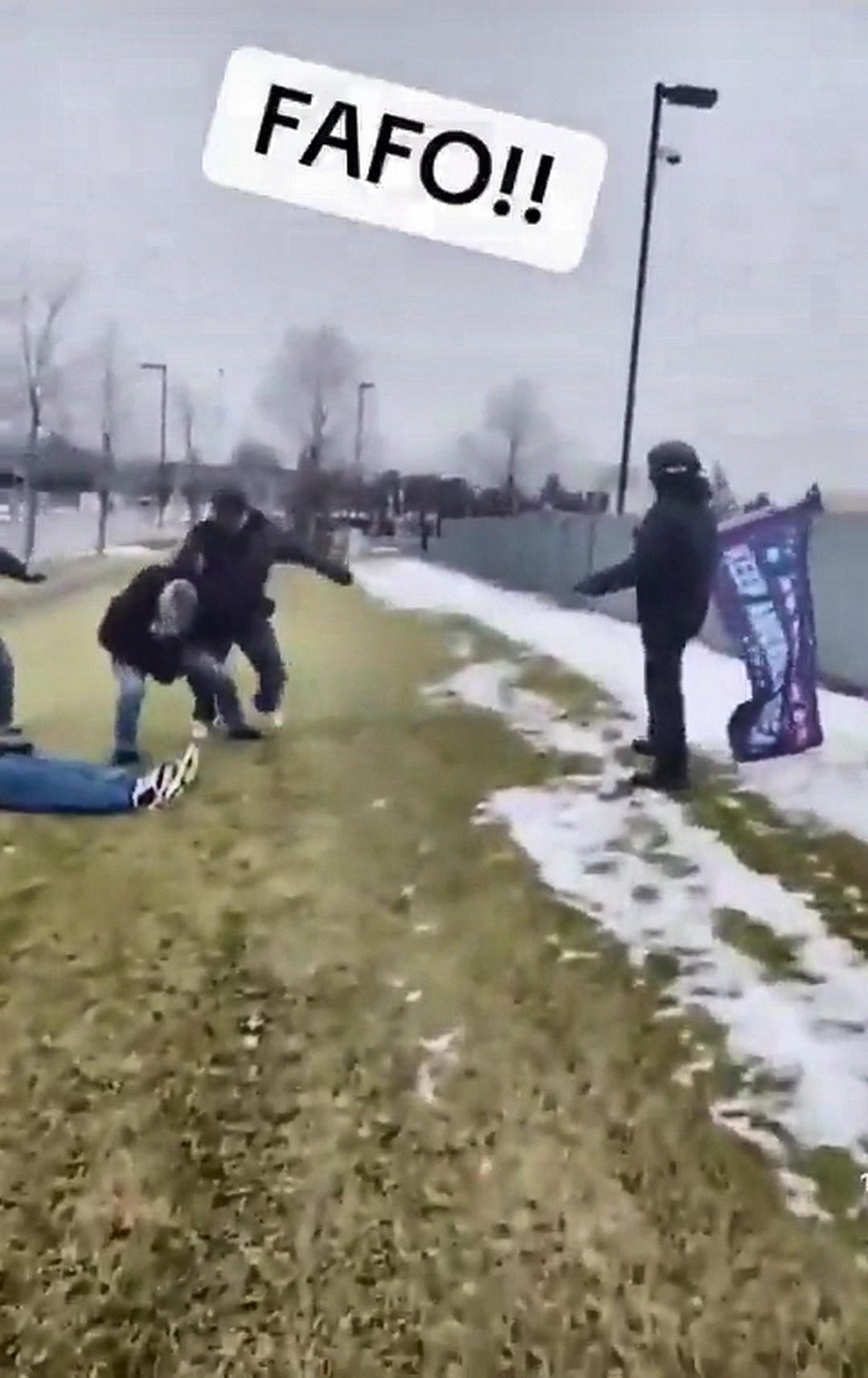
Frame four captures the aftermath of the initial collision. The camera has turned to follow retreating figures moving away from the lens toward the far end of the field, where a light pole and fence line mark the boundary of the school property. A purple banner with visible lettering is carried at the right edge of the frame. Debris remains scattered across the foreground grass.
Notably absent from this frame is any clear view of who initiated physical contact, who struck whom, and in what order – a gap that would later prove central to the prosecutorial assessment.
Frame five, the final recorded segment, shows the disorganized dispersal. One individual is on the ground at the left edge, legs extended, while another figure in dark clothing strides away toward the right. A person in a black jacket and helmet stands near the purple banner, observing. The audio captures a belated "Hey guys, guys, guys" – a de-escalatory plea arriving well after the physical exchange had already concluded.
The footage cuts before any law enforcement presence is established on scene, meaning the entire recorded sequence captures the confrontation and its immediate aftermath but not the official response.
Corporate Liability and Critical Blind Spots
The evidentiary record here is thin in ways that matter enormously to both the prosecution and any potential civil exposure. The clip is short, vertically framed, and shot by a participant or bystander whose position within the crowd is never established. There is no wide-angle vantage point showing the full field of actors at the moment of first contact, no timestamp burned into the frames, and no continuous unedited sequence establishing what occurred in the minutes before the camera began rolling. Defense counsel in any assault matter routinely exploits exactly this kind of gap.
The critical unrecorded antecedent, according to police accounts, involves a juvenile kicking Watts' truck and students throwing objects – including water bottles – at the vehicle. If those acts occurred, they are legally significant to a self-defense analysis and to potential property-damage claims, yet none of it appears in the circulated footage. The viral product begins mid-escalation, which means the public is adjudicating a case on a partial record while the actual docket rests on witness statements, school surveillance, and physical evidence not yet public.
The chain of custody for the video itself is likewise undocumented. The "FAFO!!" overlay and the framing language in the original post – which characterized the man as a "RALLY SUPPORTERS patriot" who "neutralized" six attackers and deserved the Presidential Medal of Freedom – constitute editorial characterization layered onto raw imagery. Platforms hosting such content bear limited liability under Section 230, but the editorial framing materially shapes public perception of an active criminal case, raising familiar questions about prejudicial pretrial publicity in a county of roughly 250,000 residents.
Statutory Framework and Protocol Analysis
Legal Distinction: Under Texas Penal Code § 9.31, self-defense is justified only against unlawful force and only when the actor reasonably believes force is immediately necessary; § 9.41 permits limited force to protect property but expressly excludes deadly force in defense of property alone. Separately, Texas Education Code provisions governing student walkouts and campus-adjacent conduct place a duty of supervision on school administrators during organized protests.
| Incident Parameter | Governing Legal Standard & Judicial Protocol |
|---|---|
| Physical contact during confrontation | Tex. Penal Code § 22.01 – assault causing bodily injury, Class A misdemeanor |
| Claim of defensive posture | Tex. Penal Code § 9.31 – reasonableness and immediacy required |
| Vehicle damage allegations | Tex. Penal Code § 28.03 – criminal mischief thresholds |
| Student conduct during walkout | Tex. Educ. Code § 37.001 – district code of conduct authority |
| Primary aggressor determination | Buda PD investigative finding; DA review for charging enhancement |
| Juvenile involvement | Tex. Fam. Code Title 3 – sealed juvenile proceedings |
| Public statement by county official | Hays County Judge – administrative commentary, no adjudicative weight |
The compliance question cuts in two directions. Buda Police, in designating Watts the primary aggressor, applied the standard framework used in domestic and public-order violence calls: officers weigh relative threat, comparative injury, and whether one party's conduct escalated beyond proportional response. That determination is not a conviction, but it functions as the prosecutorial anchor for the two assault counts. Meanwhile, the school district's supervisory obligations during an organized walkout – particularly where the demonstration spilled onto a public roadway intersection – will almost certainly be examined in any civil action filed on behalf of injured students.
Read more:
Read more: Lubbock Teen Interrogation Reveals Fatal incident Cover-Up Details →

Core Questions and Institutional Review
- Did the school district fulfill its duty of supervision when students moved from campus grounds to a public right-of-way during an organized walkout?
- Was the primary-aggressor determination supported by the full evidentiary record, including surveillance footage and witness statements not present in the viral clip?
- Should the inflammatory editorial framing of the footage – including the medal-of-freedom advocacy – factor into any change-of-venue motion?
- What proportional response standard governs a lone adult facing a group, and where does Texas law draw the line between property defense and assaultive conduct?
The systemic stakes extend beyond one Hays County docket. This case sits at the intersection of three institutional failures that are increasingly common: schools permitting protest activity without perimeter control, adults inserting themselves into youth demonstrations as counter-demonstrators, and social platforms amplifying decontextualized 40-second clips into national referenda on public violence. Whatever the eventual disposition – dismissal, plea, or trial – the precedent set here will shape how Texas jurisdictions handle the next confrontation between a property owner and a student demonstration, and how much weight courts give to the edited record versus the full one.
FOLLOW-UP INVESTIGATION REPORT
Related documented case details, verified on-scene evidence, and statutory liability analysis continued below.
CONTINUE READING: NEXT INVESTIGATIVE DOSSIER →
Store Aisle Predator Sting: Liability and Detention Limits

COLUMBUS, Ohio – A recorded citizen-led confrontation inside a retail store has escalated into a broader examination of evidentiary standards, private detention authority, and the legal exposure borne by the platforms and businesses where such sting operations unfold. The footage, captured on a handheld camera that pursues a man through store aisles and into an adjacent parking lot, documents an accusatory encounter in which the subject repeatedly denies knowing his accusers while being publicly identified by name and alleged conduct. The episode sits at the intersection of amateur law enforcement, commercial premises liability, and the unresolved question of what happens when a viral accusation outpaces any formal charging decision.
- The recorded setting is a retail interior – shelving stocked with consumer goods, a bright linear ceiling fixture, and a narrow aisle – which transitions at approximately the midpoint to an open asphalt parking lot lined with palm trees and parked vehicles.
- A group of individuals pursues and physically restrains a male subject, later identified on camera as "Sean," while repeatedly announcing to bystanders that he intended to meet a 13-year-old child for sex.
- The subject is heard shouting "help me" and "I don't know who you are," while accusers demand he remove his hands from his pockets, seize his phone, and announce intentions to record his license plate and forward materials to detectives.
- No formal arrest is visible in the footage; the confrontation concludes in the parking lot with verbal warnings and a stated referral to law enforcement, leaving the legal status of the allegation unresolved on camera.
What the Recorded Footage Captures: Chronological Breakdown
Frame one establishes the pursuit geometry with forensic clarity. The camera operator trails the subject from behind at close range, and the subject's posture – shoulders hunched, gait accelerated toward the store exit – indicates flight rather than confrontation. The angle is low and forward-facing, a body-worn or handheld perspective that compresses depth and creates a wide field of view across the shelving. Notably, this opening sequence contains no visible physical contact; the tension is entirely kinetic, built on the differential between a pursued man moving quickly and a camera that never loses him.
By the second and third frames, the encounter has closed to physical range. A second individual in a maroon Dr Pepper graphic shirt occupies the foreground, and the subject's face is turned toward the lens in an expression of alarm. The audio record here is dense and layered: accusers assert the subject arrived to meet a child, the subject answers "I don't know who you are," and a voice orders him to keep his hands out of his pockets. The demand about pockets is operationally significant – it is a restraint instruction typically issued when the issuing party fears a weapon or evidence destruction – yet the footage does not establish whether either concern was grounded in observed fact.
Mid-sequence frames shift the scene to a wider interior vantage, capturing the physical culmination of the pursuit: a body in motion across the frame, an arm extended, and the subject's silhouette driven toward the storefront glass and daylight. This is the only segment in which the camera captures gross physical movement at distance, and the resolution is comparatively poor at the margins. The visual record confirms that force was applied; it does not, by itself, establish who initiated contact or whether the subject was resisting egress or attempting it.
The final frames relocate the confrontation outdoors, where the subject walks beside a blue sedan in a sunlit parking lot. The tonal register changes here – the accusatory narrative becomes declarative and administrative. Accusers state the subject's first name and attach a city attribution, announce that they intend to obtain his license plate, and state that materials will be delivered to detectives. The subject's repeated plea that he does not know his accusers is audible throughout. The footage ends without any visible law enforcement arrival, citation, or custodial detention.
Corporate Liability and Critical Blind Spots
The most consequential evidentiary gap in this record is anterior to the recording itself. The camera begins mid-pursuit; nothing captured establishes the predicate communication, the identity of the decoy account, the platform on which contact allegedly occurred, or the specific statements attributed to the subject before he entered the store. Those missing elements are precisely the material a prosecutor would need, and their absence from the visual record is not a technicality – it is the difference between an allegation and a case.
The commercial dimension warrants separate scrutiny. A retailer hosting an unannounced confrontation assumes exposure under premises liability doctrine for injuries to customers and employees, and its staff are abruptly conscripted into a detention scenario for which they received no training. The seizure of the subject's phone on camera raises a distinct preservation problem: a personal device taken by private parties creates a chain-of-custody defect that defense counsel would exploit immediately, regardless of what the device contains.
Finally, the identifying details asserted on camera – a name, a stated city, an employer reference – are unverified within the footage. Viral attribution of employment and residency has repeatedly produced collateral harm to uninvolved businesses and individuals bearing similar names, and no independent verification appears in the recorded material itself.
Legal Distinction: Private citizens generally possess only a narrow citizen's arrest authority, limited in most jurisdictions to a breach of the peace committed in their presence or a serious legal charge for which they have probable cause. They do not hold the investigative detention authority granted to sworn officers, and physical restraint applied without statutory authorization can itself generate civil liability for false imprisonment and battery.
Statutory Framework and Protocol Analysis
Compliance analysis begins with the limits of private authority. The accusers' conduct – blocking egress, issuing commands about the subject's hands, seizing property, and announcing a plate number – maps onto a de facto detention without the statutory predicate that would authorize one. Whether the underlying allegation would ultimately support a criminal charge does not retroactively validate the manner of the apprehension, and courts routinely separate those questions.
A second layer concerns platform and intermediary obligations. Where contact originates through a messaging service or social application, the service's terms of use, reporting architecture, and law enforcement escalation procedures become the relevant compliance surface, alongside mandatory reporting statutes that vary by state. The footage supplies none of this documentation, which is why the institutional review cannot rest on the recording alone.
| Incident Parameter | Governing Legal Standard & Judicial Protocol |
|---|---|
| Citizen detention of subject | Narrow citizen's arrest statutes; probable cause and breach-of-peace thresholds |
| Seizure of personal phone | Fourth Amendment applies to state actors; private seizure triggers chain-of-custody challenge |
| Retail premises confrontation | Premises liability duty of care to customers and employees |
| Public identification by name and city | Defamation exposure absent verified, privileged reporting |
| Referral to detectives | Prosecutorial discretion; evidentiary sufficiency review before charging |
| Recording and dissemination | State wiretap and consent statutes; platform content policies |
Read more: {NOIBO}
Core Questions and Institutional Review
- Did the confrontation generate any formal law enforcement report, and was a charging decision reached or declined?
- What statutory authority, if any, supported the physical restraint and the seizure of the subject's personal device?
- Does the retailer bear liability exposure for an unannounced detention operation conducted on its sales floor without notice or staffing accommodation?
- What verification standard should apply before a subject's name, city, and employer affiliation are broadcast to a mass audience?
The systemic consequence is a widening divergence between the speed of viral accusation and the pace of adjudication. A recorded confrontation can circulate to millions within hours while remaining, legally, an uncharged allegation. Institutions caught inside that gap – retailers, platforms, and local law enforcement – inherit risks they did not create and cannot easily discharge. The durable lesson is procedural rather than moral: documentation, custody discipline, and a formal referral channel determine whether a recorded encounter becomes an actionable case or an enduring evidentiary dead end.
Practical Takeaways
- Preserve original, unedited footage and device metadata before any public release.
- Route evidence to law enforcement through a documented chain of custody rather than a social broadcast.
- Avoid naming employers or addresses absent independent verification.
- Retailers should adopt written protocols for third-party confrontations on premises.
- Treat citizen detention as a statutory exception requiring a specific legal predicate, not a default option.



One comment on “Buda Texas Flag Confrontation: Assault Charges Filed”