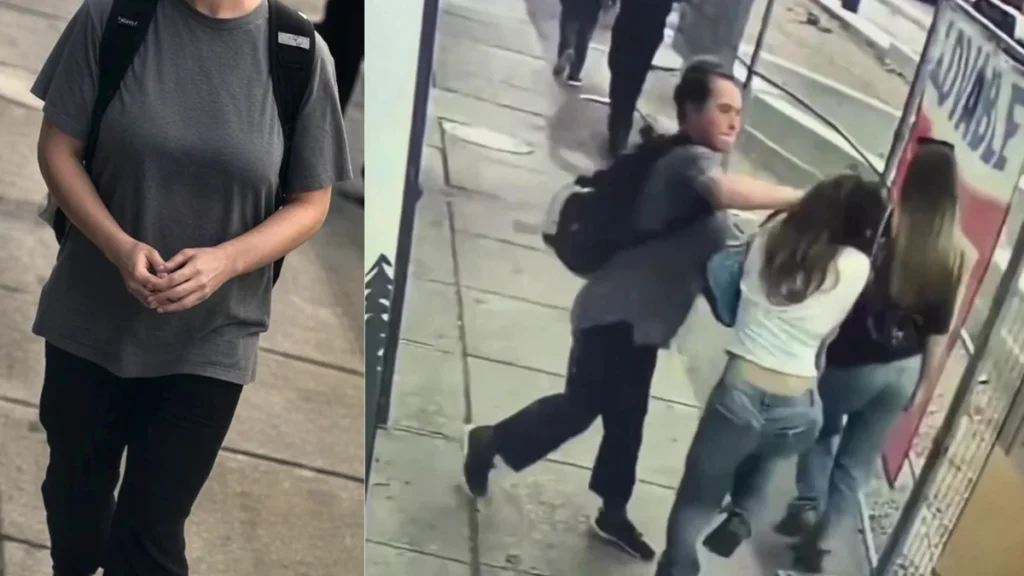
WATCH: On-scene video documentation is embedded below →
WASHINGTON – A newly surfaced surveillance recording from a public sidewalk has thrust the issue of urban public safety and municipal liability into sharp focus, capturing what appears to be an unprovoked physical assault on a pedestrian. The footage, which shows a woman in a gray shirt suddenly lunging at a passing stranger, highlights the legal and financial complexities that arise when municipal infrastructure becomes the backdrop for violent personal confrontations.
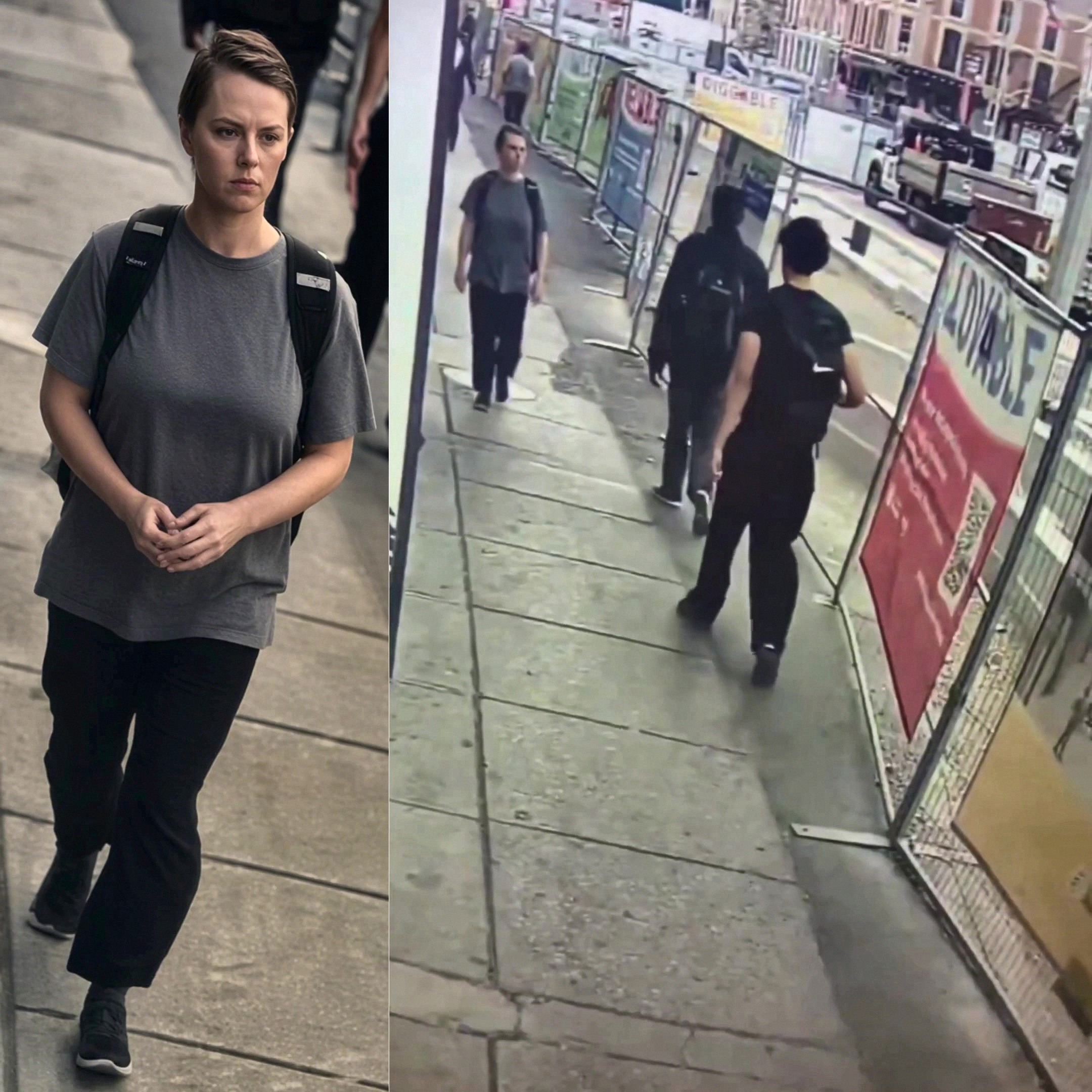
- Jurisdictional Setting: The incident unfolds on a heavily trafficked, mixed-use public sidewalk adjacent to active construction zones, a setting that places a duty of care on both municipal authorities and adjacent commercial property owners.
- The Recorded Escalation: Security cameras capture a woman in a gray t-shirt walking calmly before abruptly pivoting to shove a pedestrian into a metal construction barricade, demonstrating a complete absence of prior verbal provocation.
- Intervention and Consequences:Bystanders are visible in the immediate aftermath, though formal law enforcement or security intervention does not appear to occur within the recorded window, leaving the legal aftermath entirely off-camera.
- Legal Repercussions: The footage serves as primary evidence for potential civil claims of battery and negligence, as well as potential criminal charges of misdemeanor assault, raising critical questions about the chain of custody for privately owned surveillance data.
What the Recorded Footage Captures: Chronological Breakdown
The evidentiary record begins with a split-screen perspective, offering investigators both a frontal tracking shot of the primary subject and a wider, elevated surveillance angle of the sidewalk. At the outset, the subject – a woman with short hair wearing a gray t-shirt, dark trousers, and a black backpack – is observed walking toward the camera. Her posture is closed, with hands clasped in front of her torso. Her facial expression is notably flat and focused downward, showing no visible signs of distress or aggression in the pre-contact phase.
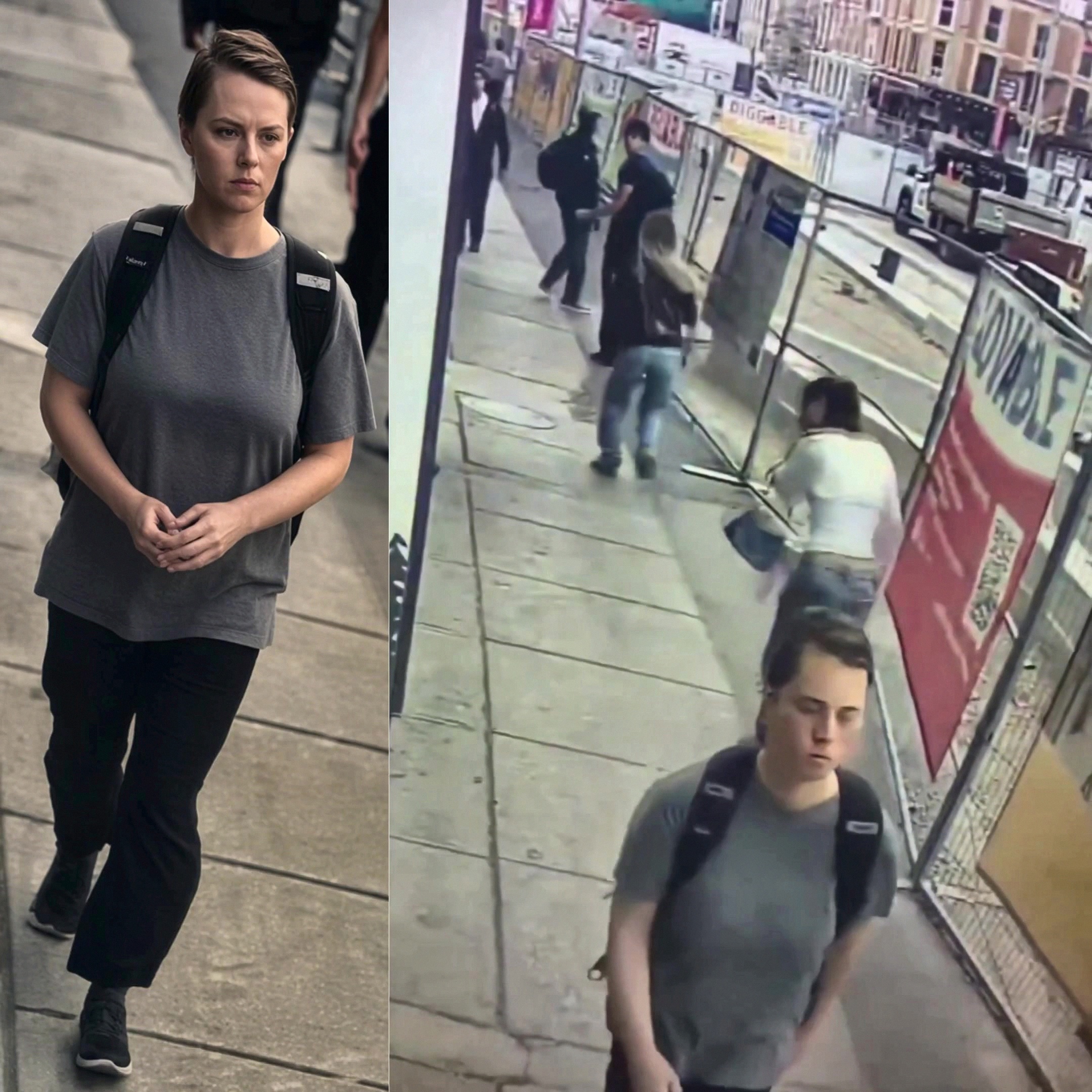
The wider angle establishes the spatial dynamics of the sidewalk, which is partially narrowed by a temporary chain-link construction fence draped with promotional banners. Pedestrian traffic is moving in both directions, creating a confined corridor. At the 40 percent mark of the footage, a second woman – wearing a light-colored top and blue jeans – enters the frame from the opposite direction, walking past the subject. Without any visible verbal exchange or physical provocation, the subject in the gray shirt abruptly pivots and lunges at the pedestrian.
The ensuing physical exchange is brief but forceful. The subject extends her arm, making direct contact with the pedestrian and driving her backward into the metal construction fencing. The pedestrian appears stunned, her body absorbing the impact against the metal barricade. Following the impact, the subject in the gray shirt does not advance further; she turns away and continues walking in her original direction, leaving the scene as the pedestrian regains her balance.
The footage concludes with the subject walking away, her hands returning to a clasped position, while the pedestrian remains near the barricade.
Corporate Liability and Critical Blind Spots
Despite the clarity of the visual record, the evidentiary chain carries significant blind spots. The first major limitation is the absence of audio, which precludes any determination of whether verbal provocation occurred just outside the camera's microphone range. Furthermore, the incident is captured by fixed, privately owned surveillance equipment rather than municipal traffic cameras. This introduces complex questions regarding the chain of custody, data retention policies, and the willingness of the property owner to release the full, unedited footage to law enforcement or civil litigants.
The architectural layout of the sidewalk itself presents a secondary liability vector. The construction fencing effectively narrows the public right-of-way, creating a bottleneck that forces pedestrians into close physical proximity. In civil litigation, personal injury attorneys frequently scrutinize such temporary infrastructure to determine whether the property developer or construction contractor breached their duty of care by failing to maintain safe pedestrian clearances. If the narrow passage contributed to the severity of the collision, the adjacent commercial entities could face consolidated negligence claims.
Additionally, the viral nature of the footage introduces unverified assertions into the public record. Claims regarding the assailant's mental state or the victim's identity remain unsubstantiated by official police reports, highlighting the risk of prejudice in the court of public opinion before any formal charges are filed. Without corroborating documentation from local law enforcement, the video remains a powerful but incomplete piece of evidence.
Statutory Framework and Protocol Analysis
Legal Distinction: While the footage clearly depicts a battery, the distinction between criminal assault and civil liability hinges on the element of intent. Criminal prosecution requires proof of purposeful or knowing conduct, whereas civil tort claims for battery require only intentional contact. Furthermore, the property owner's liability hinges on whether the temporary construction fencing created an unreasonably dangerous condition for the public.
The governing statutes for this incident fall under state-level criminal codes regarding simple assault and battery, typically graded as misdemeanors when no serious bodily injury occurs. For the property owner, municipal ordinances governing construction site safety and pedestrian access are paramount. These regulations often mandate minimum clearances and robust barricades; failure to comply can be introduced as evidence of negligence. The presence of the assailant on a public sidewalk also triggers the municipal duty to maintain safe public spaces, though sovereign immunity often shields cities from liability in instances of random, third-party criminal acts.
From a compliance perspective, the response protocols of the adjacent security personnel are also subject to scrutiny. In many jurisdictions, private security guards are required to intervene in active disturbances or immediately contact law enforcement. The absence of immediate intervention in the footage suggests potential gaps in the site's emergency response plan.
Recorded Scene Documentation

| Incident Parameter | Governing Legal Standard & Judicial Protocol |
|---|---|
| Unprovoked physical contact | State criminal codes defining misdemeanor battery; proof of unlawful force |
| Construction barrier placement | Municipal building codes and ADA compliance for public right-of-way access |
| Evidence collection | Chain of custody protocols for privately owned video surveillance |
| Duty to intervene | Private security licensing boards and site-specific emergency action plans |
| Civil liability allocation | Premises liability standards regarding dangerous conditions on adjacent sidewalks |
| Law enforcement response | Local police department standard operating procedures for public disturbances |
Read more: Hammer Vandalism Case: Serious legal charge Damage and Zero-Bail Release →
Core Questions and Institutional Review
- Does the narrow layout of the temporary construction fencing create a foreseeable hazard that shifts partial liability onto the adjacent property developer?
- What specific protocols govern the retention and release of privately held surveillance footage to law enforcement agencies in this jurisdiction?
- How do municipal public safety plans account for random, unprovoked acts of violence in high-traffic pedestrian zones?
- Should private security contractors face regulatory penalties for failing to immediately intervene in or report a violent assault occurring on their monitored premises?
The systemic impact of this incident extends beyond the immediate parties involved. It underscores the fragmented nature of urban public safety, where the lines between municipal responsibility, private property rights, and individual conduct frequently collide. As civil litigation and potential criminal proceedings unfold, the case will likely serve as a benchmark for how courts evaluate the duty of care in shared public spaces.
Practical Takeaways
- Document Everything: For individuals involved in public altercations, securing immediate medical records and preserving metadata from private surveillance can be the difference between a successful claim and dismissal.
- Review Property Boundaries: Commercial property owners should audit their temporary construction barriers to ensure they meet ADA and fire code clearances, mitigating premises liability risks.
- Establish Clear Protocols: Private security firms must ensure their personnel have clear, legally vetted protocols for engaging with violent third parties on public sidewalks to avoid negligence claims.
- Avoid Prejudgment: Viral footage rarely tells the complete story; legal outcomes must rely on official police reports and corroborating witness testimony rather than online narratives.





One comment on “Unprovoked Sidewalk Assault: Legal Liability and Safety Review”