Scroll down for the full investigative report below ↓
PALM BEACH GARDENS, Fla. – A routine late-night traffic stop escalated into a test of lawful authority when a driver declined to exit her vehicle, invoking her father's status as an attorney as justification. The recorded encounter, captured on Axon body-worn camera, raises substantive questions about the limits of legal advice, the duty to comply with lawful police commands, and the liability exposure that follows when verbal defiance hardens into physical resistance.
- Jurisdictional setting: A Palm Beach Gardens, Florida, roadway just after 1:00 a.m., with the stop conducted by a patrol officer and documented on Axon Body 3 hardware bearing a January 13, 2023 timestamp.
- Recorded escalation: The driver, identified in news accounts as 27-year-old Anna Gilbert, repeatedly states she is "not allowed to" exit the vehicle, attributing that instruction to her father, a lawyer.
- Law enforcement intervention: The officer explains the legal obligation to comply, offers a final warning, and then initiates a physical escort from the vehicle when the refusal persists.
- Legal and regulatory repercussions: Public records indicate arrest and charges of driving under the influence and resisting an officer without violence, with subsequent court proceedings and sentencing addressed in related coverage.
What the Recorded Footage Captures: Chronological Breakdown
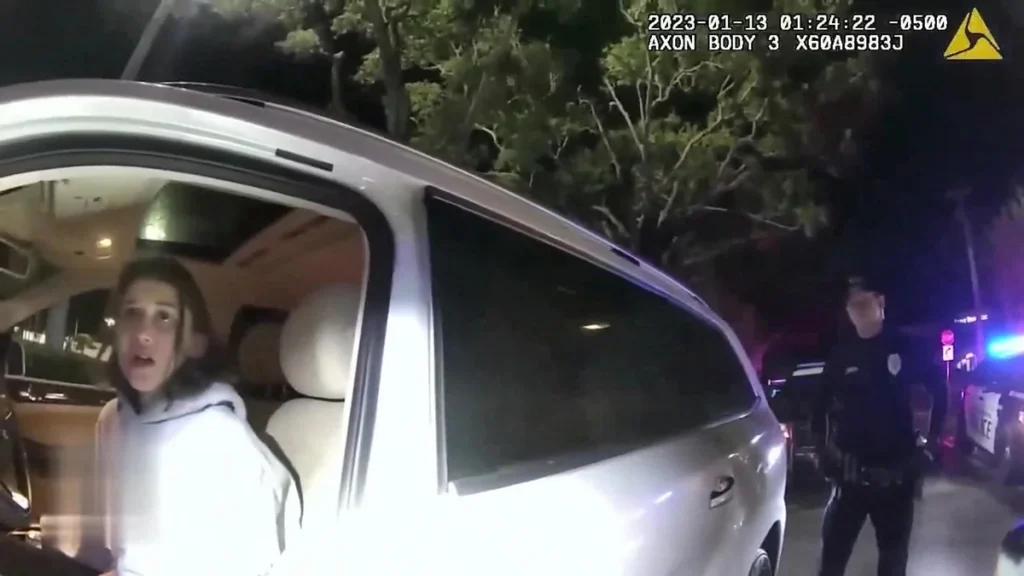
From the opening frames, the camera angle is a chest-level officer perspective, angled toward the open driver's-side door of a white SUV. The interior dome light illuminates the driver, a young woman in a light-colored hoodie, while the officer stands on the asphalt shoulder. The initial exchange is calm but immediately adversarial in structure: the officer asks her to step out, and she answers that she is "not allowed to."
The phrase is delivered not as a refusal of capability but as a claim of external legal prohibition, which the officer tests directly by asking who imposed that restriction.
The answer – "my dad's a lawyer" – becomes the pivot of the entire encounter. The officer does not dismiss it; he engages it on its own terms, noting that any competent attorney would advise compliance when a police officer orders a driver out of a vehicle. The driver counters that her father "told me otherwise," and the exchange briefly drifts into personal commentary about her father's character.
Throughout this segment, the camera remains steady, capturing the officer's positioning at the door frame and the driver's fixed posture inside the vehicle. There is no physical contact, but the verbal loop is tightening: each repetition of "I'm not allowed to" is met with a restated lawful command.
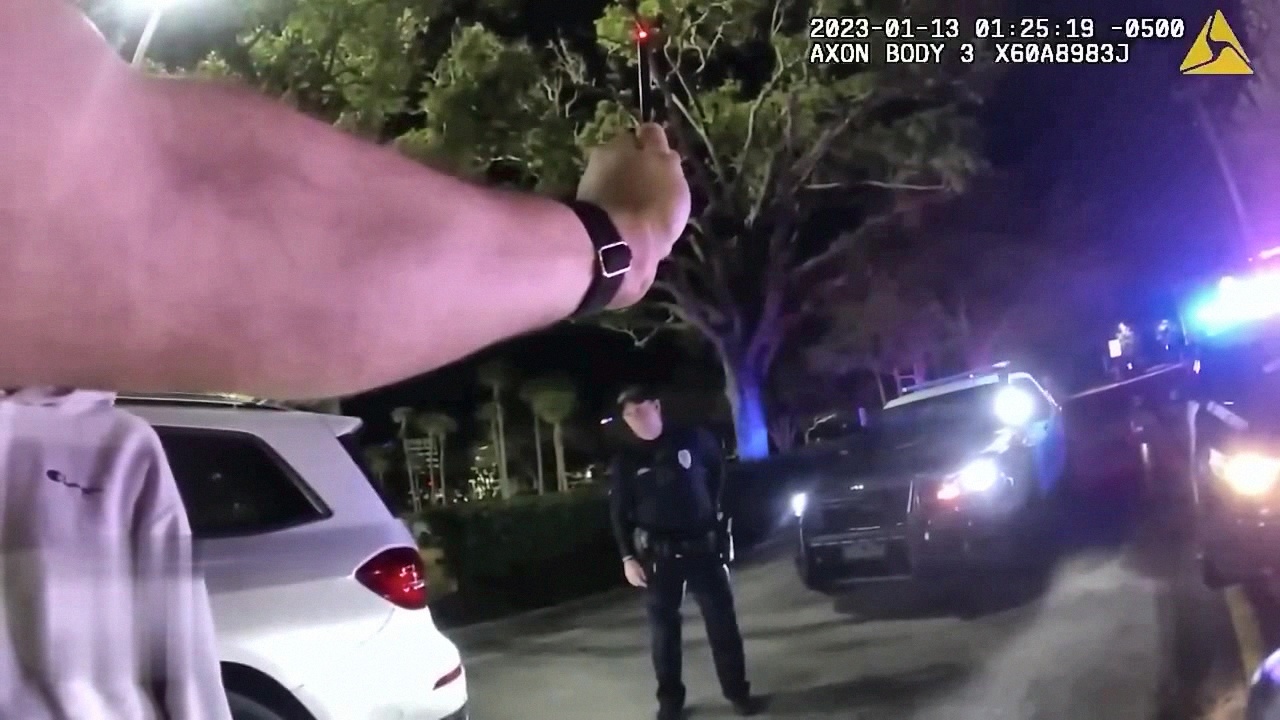
The footage then shifts from persuasion to ultimatum. The officer issues a final chance, and when the driver repeats the same refusal, he moves to physical control. The camera jolts as the officer reaches in, and the audio captures overlapping instructions to keep her head still. The frames showing the officer's arm extended with a red-lit device in hand – likely a flashlight or control aid – document the moment the encounter crossed from verbal noncompliance into custodial handling. The driver's composure visibly changes as the escort begins, and the clip cuts shortly after the physical intervention.
What the recording does not show is equally important. The stop's origin – the alleged speeding and failure to stop – occurred before the camera's active view. The officer's probable-cause observations, any field sobriety indicators, and the initial approach are all outside the frame. The viewer therefore sees the refusal but not the predicate that justified the stop, a gap that shapes how the encounter is interpreted online.
Corporate Liability and Critical Blind Spots
The evidentiary record here is partial by design. Body-worn cameras activate at officer discretion or policy trigger, and the pre-activation period is unrecorded. Any statements made during the traffic stop's first moments, any odor or speech observations supporting the DUI suspicion, and any exchange about the driver's father before the camera rolled are absent. For a legal reviewer, this means the recording establishes the refusal and the escalation but not the foundation for the underlying stop.
Chain-of-custody questions also attach to the clip's circulation. The footage bears hardware and timestamp overlays, which support authentication, but the version circulating online has been trimmed and repackaged. Viral captions often assert what the driver was charged with or how the case resolved without linking to docket records. Those assertions require independent verification against court filings rather than reliance on edited video.
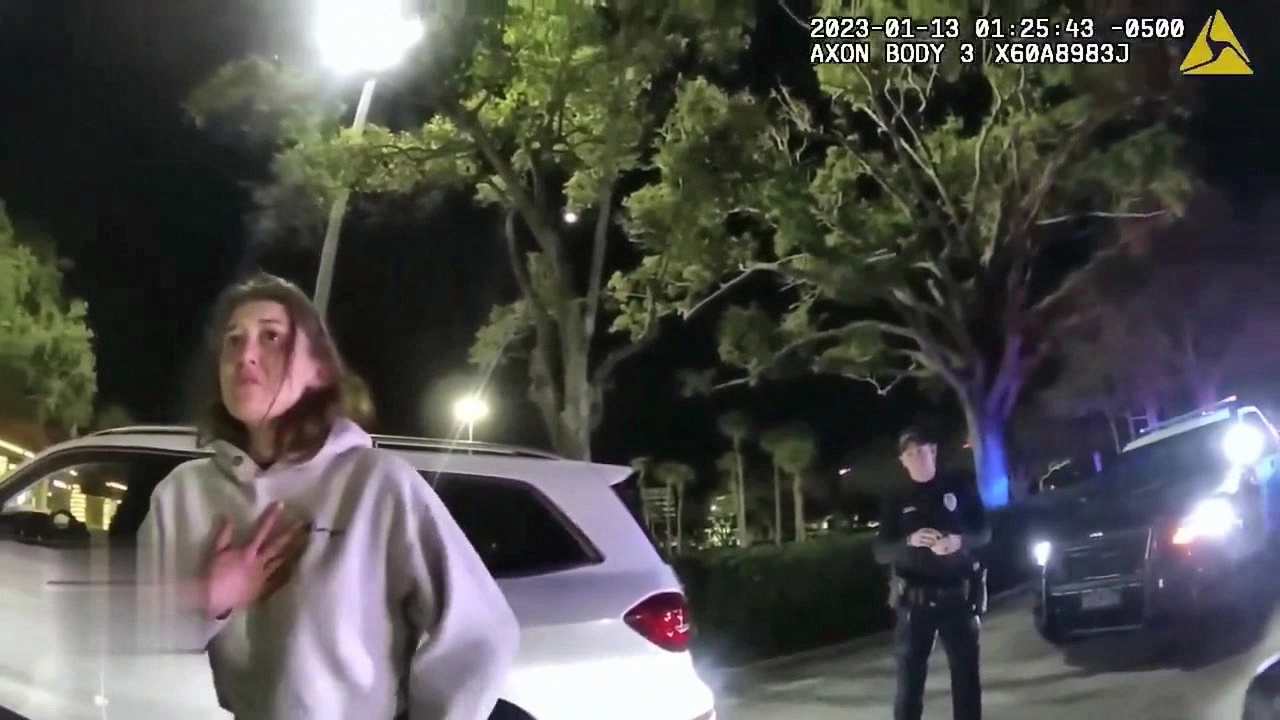
There is also a perspective blind spot inherent to a single body camera. The officer's chest-mounted lens favors his position; the driver's facial expressions and any gestures below the window line are partially obscured. A second angle or dashcam view would clarify whether the driver's hands remained visible and whether any movement was read as resistance. Absent that, the physical-handling sequence must be assessed from one vantage point only.
Statutory Framework and Protocol Analysis
Legal Distinction: A driver's obligation to exit a vehicle upon a lawful order is a compliance duty, not a discretionary courtesy; asserting a third party's legal opinion does not suspend that duty, and continued refusal can support a resisting charge distinct from the underlying traffic or DUI offense.
The governing framework in Florida separates three questions. First, whether the stop was lawful, which turns on reasonable suspicion of a traffic violation. Second, whether the order to exit was lawful, which in a nighttime stop tied to suspected impairment is ordinarily satisfied. Third, whether the driver's conduct crossed from passive refusal into resistance. The officer's script – explaining the rule, offering a final chance, then acting – is consistent with de-escalation-first protocol and creates a clean record of warning before force.
| Incident Parameter | Governing Legal Standard & Judicial Protocol |
|---|---|
| Vehicle stop initiation | Reasonable suspicion of a traffic violation required under Fourth Amendment standards |
| Order to exit vehicle | Lawful police command in a traffic stop; compliance is mandatory, not optional |
| Claimed attorney instruction | Third-party legal advice does not override an on-scene lawful order |
| Verbal refusal | May support resisting an officer without violence where warnings are given |
| Physical escort procedure | Proportional force limited to effecting the lawful order |
| Camera documentation | Body-worn activation policy governs evidentiary completeness |
| Charging decision | Prosecutorial review of DUI and resisting counts based on the recorded record |
Read more:
Read more: Austin Street Brawl: Troopers Restrain Man as Crowd Watches →

Core Questions and Institutional Review
- Did the agency's body-camera activation policy capture the full probable-cause sequence, or did late activation create an evidentiary gap?
- Was the officer's final-warning script consistent with written de-escalation policy before physical control was applied?
- Does the resisting charge rest on documented warnings and repeated refusal, or on a single ambiguous movement?
- How should courts weigh a driver's reliance on claimed legal advice when that advice contradicts settled compliance obligations?
The systemic impact extends beyond one roadside. Cases like this become training material for agencies refining their verbal-warning protocols and for courts assessing whether recorded defiance was adequately warned before force. They also expose a recurring public misconception: that a family member's legal credential confers an exemption from on-scene commands. The record shows the officer treating the claim seriously, rebutting it on the law, and documenting each step. Whether the resulting charges and sentence reflect that measured process is the question the docket, not the clip, must answer.
Practical Takeaways
- A lawful order to exit a vehicle is not suspended by a relative's legal opinion.
- Repeated refusal after explicit warnings materially increases exposure to a resisting charge.
- Body-camera footage establishes escalation but rarely captures the stop's full predicate.
- Viral framing should be checked against court filings before conclusions are drawn.
FOLLOW-UP INVESTIGATION REPORT
Related documented case details, verified on-scene evidence, and statutory liability analysis continued below.
CONTINUE READING: NEXT INVESTIGATIVE DOSSIER →
Wauwatosa Mall Arrest: Bodycam Shows Theft Arrest Struggle

WAUWATOSA, Wisconsin – A body-worn camera recording from a December 2023 retail theft investigation at Mayfair Mall has resurfaced as a case study in the escalating legal consequences that can follow a misdemeanor property crime. The footage documents the arrest of a 31-year-old Milwaukee woman who was ultimately convicted of battery to a law enforcement officer and retail theft involving nearly $900 in merchandise. The recorded encounter, which began as a routine detention inside a Sephora cosmetics store, quickly devolved into a physical struggle that raised questions about suspect compliance, officer safety protocols, and the strategic use of claimed medical conditions as a shield against lawful detention.
- The incident unfolded on December 3, 2023, inside the Sephora retail location at Mayfair Mall in Wauwatosa, Wisconsin, following a report of retail theft involving approximately $900 in merchandise.
- Body-worn camera footage captures Wauwatosa Police Department officers attempting to detain suspect Charlee Chappell, who repeatedly asserts her pregnancy and demands to retrieve her children as officers move to secure her wrists.
- The recorded escalation shows the suspect pulling away from the officer's grasp, prompting a physical struggle in which the officer's body camera is knocked off-line and a battery charge is subsequently filed.
- Judicial proceedings concluded with Chappell convicted of battery to an officer and retail theft, receiving a sentencing disposition of three years of probation rather than a prison term, while co-defendant Devana Haley received one year of probation for misdemeanor retail theft.
What the Recorded Footage Captures: Chronological Breakdown
From the opening frames, the body-worn camera establishes a first-person perspective that shifts between the officer's forward view of the retail aisle and a close angle on the suspect's bright pink jacket. The footage opens on a chaotic note, with the camera capturing rapid motion and the overlay text marking the Law&Crime broadcast feed. As the officer moves to position the suspect against a display shelf lined with cosmetics, the recording captures the suspect's voice rising in protest, stating that her back is being touched and insisting that she is not going into the back of the store. The officer's verbal response is direct and procedural: she is under arrest, and she will be placed in handcuffs. At this point in the footage, the suspect pivots to a repeated assertion that she did not feel anything and that she must retrieve her children, creating an immediate verbal counter-narrative to the officer's authority.
The camera then captures a distinct change in the physical dynamic. The officer announces his intent to put her in cuffs right now, and the suspect begins to resist, asking repeatedly not to be touched and invoking her children as a reason to be released. The recorded audio captures the officer warning her against resistance, stating that she will be charged if she continues to pull away. During this exchange, the suspect shifts to a medical defense, stating that she has a baby due, which is met with the officer's stern response that he will make sure she has nothing if she continues to resist. The body camera then captures a physical tumble, with the frame briefly losing its stable orientation as the officer's equipment is dislodged. The footage conveys the disorientation of a camera knocked off-center, capturing fragments of the floor and the retail aisle while the officer manages the physical struggle.
The recorded sequence continues with a countdown protocol as the officer attempts to regain control. The audio captures the officer counting, one, two, three, and then directing the suspect to stand up as the physical confrontation subsides. The camera captures the officer stating that they need to stop, and the footage shifts to a more procedural aftermath in which the officer asks for a phone to get the number of the suspect's mother. The recording ends with the officer directing that the suspect be placed in a vehicle, capturing the transition from the retail floor to the custodial transport phase. The visual record is consistent in showing the suspect in a bright pink jacket and dark pants, with the officer's uniformed arm visible in the frame as he maintains contact and attempts to control her movement.
Corporate Liability and Critical Blind Spots
The body-worn camera footage provides a vivid but inherently incomplete evidentiary record of the incident. The recording begins at the moment of the officer's approach and does not capture the preceding investigative steps, including the initial stop, the probable cause determination related to the alleged theft, or the store's loss prevention handoff. The camera angle is subject to the officer's movement, which means that the frame frequently obscures the suspect's hands, the exact point of contact, and the physical mechanics of the struggle that grounded the battery charge. The brief period in which the camera is knocked off-line creates a critical evidentiary gap that is central to both the prosecution and the defense narratives. The unrecorded seconds following the camera displacement are the only portion of the sequence not captured on the body camera, leaving the exact physical act that constituted the battery to be reconstructed through testimony rather than visual evidence.
The viral assertions attached to this footage do not always align with the verified record. The recording does not show a woman being physically struck by an officer, nor does it show a suspect being taken to the ground by multiple officers. Instead, the camera captures a close-quarters struggle between one officer and one suspect, with verbal warnings and a compliance countdown. The claim that the suspect was subjected to an unlawful arrest is contradicted by the recorded statement of probable cause and the eventual conviction. However, the footage does not independently establish the value of the stolen merchandise, the exact theft protocol used by the retailer, or the specific store policy that guided the loss prevention officer's decision to initiate a detention. The retail corporation's internal protocols, including the standard for initiating a citizen's detention and the use of force policy for loss prevention personnel, remain absent from the recorded record.
Statutory Framework and Protocol Analysis
Legal Distinction: In Wisconsin, retail theft is governed under Wis. Stat. § 943.50, which permits a merchant or merchant's employe to detain a person suspected of retail theft for a reasonable time and in a reasonable manner. Battery to a law enforcement officer is codified under Wis. Stat. § 940.20(2), a Class H serious legal charge that elevates a physical struggle during an arrest into a separate and more serious offense. The legal distinction between lawful detention and an unlawful arrest hinges on probable cause and the reasonableness of the officer's conduct, while the claimed pregnancy does not create a statutory exemption from arrest. The officer's decision to proceed with handcuffing is consistent with departmental use-of-force policy requiring control of a resisting suspect, and the judicial disposition of probation reflects a sentencing structure that balances the serious legal charge battery conviction against the defendant's lack of prior violent record.
| Incident Parameter | Governing Legal Standard & Judicial Protocol |
|---|---|
| Retail theft of merchandise valued near $900 | Wisconsin retail theft statutes classify the offense by value; a civil or criminal remedy may apply. |
| Detention of suspect on retail premises | Merchant's privilege permits reasonable detention based on probable cause; duration must be reasonable. |
| Resistance to handcuffing by a suspect | Officer may use reasonable force to overcome active resistance and complete a lawful arrest. |
| Claim of pregnancy as a bar to detention | No statutory exemption; medical considerations are evaluated under departmental duty of care protocols. |
| Battery to a law enforcement officer | Class H serious legal charge under Wis. Stat. § 940.20(2); requires proof of physical contact intended to cause harm. |
| Judicial sentencing disposition | Probation with conditions may be imposed for a serious legal charge battery conviction absent prior violent history. |
| Co-defendant liability for retail theft | Misdemeanor retail theft charge with probation disposition; reflects independent culpability assessment. |
The institutional duty of care in this incident operates on two parallel tracks. The retailer's loss prevention personnel are obligated to follow internal apprehension standards that prioritize employee and customer safety, including a prohibition on physical pursuit in certain circumstances. The arresting officer is obligated under departmental policy to maintain control of the suspect, to use only the force reasonably necessary to effect the arrest, and to monitor the suspect's medical condition. The recorded audio reflects the officer's attention to the suspect's claims, including the statement regarding the pregnancy, while maintaining the arrest protocol. The compliance burden rests with the suspect, who is required to submit to a lawful arrest and to contest the charges through the judicial process rather than through physical resistance. The footage captures the moment in which the suspect's verbal objections translate into physical non-compliance, which is the precise trigger for the battery charge.
Read more: {NOIBO}
Core Questions and Institutional Review
- Did the officer's initial approach and handcuffing procedure comply with departmental use-of-force guidelines and the statutory standard for a lawful arrest?
- What is the retailer's policy regarding loss prevention detentions, and was the initial detention of the suspect conducted in a reasonable manner before the officer's arrival?
- How does the judicial system's reliance on probation in this case reflect the sentencing guidelines for a first-time serious legal charge battery conviction involving a pregnant defendant?
- What accountability measures exist for the officer whose body camera was knocked off during the struggle, and does the evidentiary gap affect the reliability of the battery conviction in future appellate review?
The systemic impact of this case extends beyond the individual courtroom. The body camera footage becomes a public record that simultaneously protects the officer from allegations of excessive force and implicates the suspect in a serious legal charge. The eventual probation disposition demonstrates the judicial system's capacity to distinguish between a property crime and a violent act against a public safety officer, while the viral circulation of the footage imposes a reputational penalty that no court sentence can replicate. The incident underscores a broader compliance reality: a misdemeanor retail theft accusation can swiftly become a serious legal charge battery conviction depending on the suspect's physical response, and the presence of a claimed pregnancy does not alter the statutory obligation to submit to a lawful arrest.
Practical Takeaways
- Body-worn camera footage can both exonerate and incriminate; the recorded sequence is the primary evidentiary artifact in any contested arrest.
- Retail theft does not carry a presumption of leniency when it escalates into physical resistance; the battery charge becomes the dominant legal exposure.
- Claims of medical condition or pregnancy do not create a legal bar to arrest but may trigger a duty of care obligation for the arresting officer.
- Judicial dispositions for first-time serious legal charge offenders frequently favor probation over incarceration, but the serious legal charge conviction remains on the record and carries collateral consequences.





One comment on “Palm Beach Gardens Stop: Driver Refuses Exit, Cites Lawyer Dad”