
Scroll down for the full investigative report below ↓
WAUWATOSA, Wisconsin – A body-worn camera recording from a December 2023 retail theft investigation at Mayfair Mall has resurfaced as a case study in the escalating legal consequences that can follow a misdemeanor property crime. The footage documents the arrest of a 31-year-old Milwaukee woman who was ultimately convicted of battery to a law enforcement officer and retail theft involving nearly $900 in merchandise.
The recorded encounter, which began as a routine detention inside a Sephora cosmetics store, quickly devolved into a physical struggle that raised questions about suspect compliance, officer safety protocols, and the strategic use of claimed medical conditions as a shield against lawful detention.

- The incident unfolded on December 3, 2023, inside the Sephora retail location at Mayfair Mall in Wauwatosa, Wisconsin, following a report of retail theft involving approximately $900 in merchandise.
- Body-worn camera footage captures Wauwatosa Police Department officers attempting to detain suspect Charlee Chappell, who repeatedly asserts her pregnancy and demands to retrieve her children as officers move to secure her wrists.
- The recorded escalation shows the suspect pulling away from the officer's grasp, prompting a physical struggle in which the officer's body camera is knocked off-line and a battery charge is subsequently filed.
- Judicial proceedings concluded with Chappell convicted of battery to an officer and retail theft, receiving a sentencing disposition of three years of probation rather than a prison term, while co-defendant Devana Haley received one year of probation for misdemeanor retail theft.
What the Recorded Footage Captures: Chronological Breakdown
From the opening frames, the body-worn camera establishes a first-person perspective that shifts between the officer's forward view of the retail aisle and a close angle on the suspect's bright pink jacket. The footage opens on a chaotic note, with the camera capturing rapid motion and the overlay text marking the Law&Crime broadcast feed.
As the officer moves to position the suspect against a display shelf lined with cosmetics, the recording captures the suspect's voice rising in protest, stating that her back is being touched and insisting that she is not going into the back of the store. The officer's verbal response is direct and procedural: she is under arrest, and she will be placed in handcuffs.
At this point in the footage, the suspect pivots to a repeated assertion that she did not feel anything and that she must retrieve her children, creating an immediate verbal counter-narrative to the officer's authority.
The camera then captures a distinct change in the physical dynamic. The officer announces his intent to put her in cuffs right now, and the suspect begins to resist, asking repeatedly not to be touched and invoking her children as a reason to be released. The recorded audio captures the officer warning her against resistance, stating that she will be charged if she continues to pull away.
During this exchange, the suspect shifts to a medical defense, stating that she has a baby due, which is met with the officer's stern response that he will make sure she has nothing if she continues to resist. The body camera then captures a physical tumble, with the frame briefly losing its stable orientation as the officer's equipment is dislodged.
The footage conveys the disorientation of a camera knocked off-center, capturing fragments of the floor and the retail aisle while the officer manages the physical struggle.
The recorded sequence continues with a countdown protocol as the officer attempts to regain control. The audio captures the officer counting, one, two, three, and then directing the suspect to stand up as the physical confrontation subsides. The camera captures the officer stating that they need to stop, and the footage shifts to a more procedural aftermath in which the officer asks for a phone to get the number of the suspect's mother.
The recording ends with the officer directing that the suspect be placed in a vehicle, capturing the transition from the retail floor to the custodial transport phase. The visual record is consistent in showing the suspect in a bright pink jacket and dark pants, with the officer's uniformed arm visible in the frame as he maintains contact and attempts to control her movement.
Corporate Liability and Critical Blind Spots
The body-worn camera footage provides a vivid but inherently incomplete evidentiary record of the incident. The recording begins at the moment of the officer's approach and does not capture the preceding investigative steps, including the initial stop, the probable cause determination related to the alleged theft, or the store's loss prevention handoff.
The camera angle is subject to the officer's movement, which means that the frame frequently obscures the suspect's hands, the exact point of contact, and the physical mechanics of the struggle that grounded the battery charge. The brief period in which the camera is knocked off-line creates a critical evidentiary gap that is central to both the prosecution and the defense narratives.
The unrecorded seconds following the camera displacement are the only portion of the sequence not captured on the body camera, leaving the exact physical act that constituted the battery to be reconstructed through testimony rather than visual evidence.
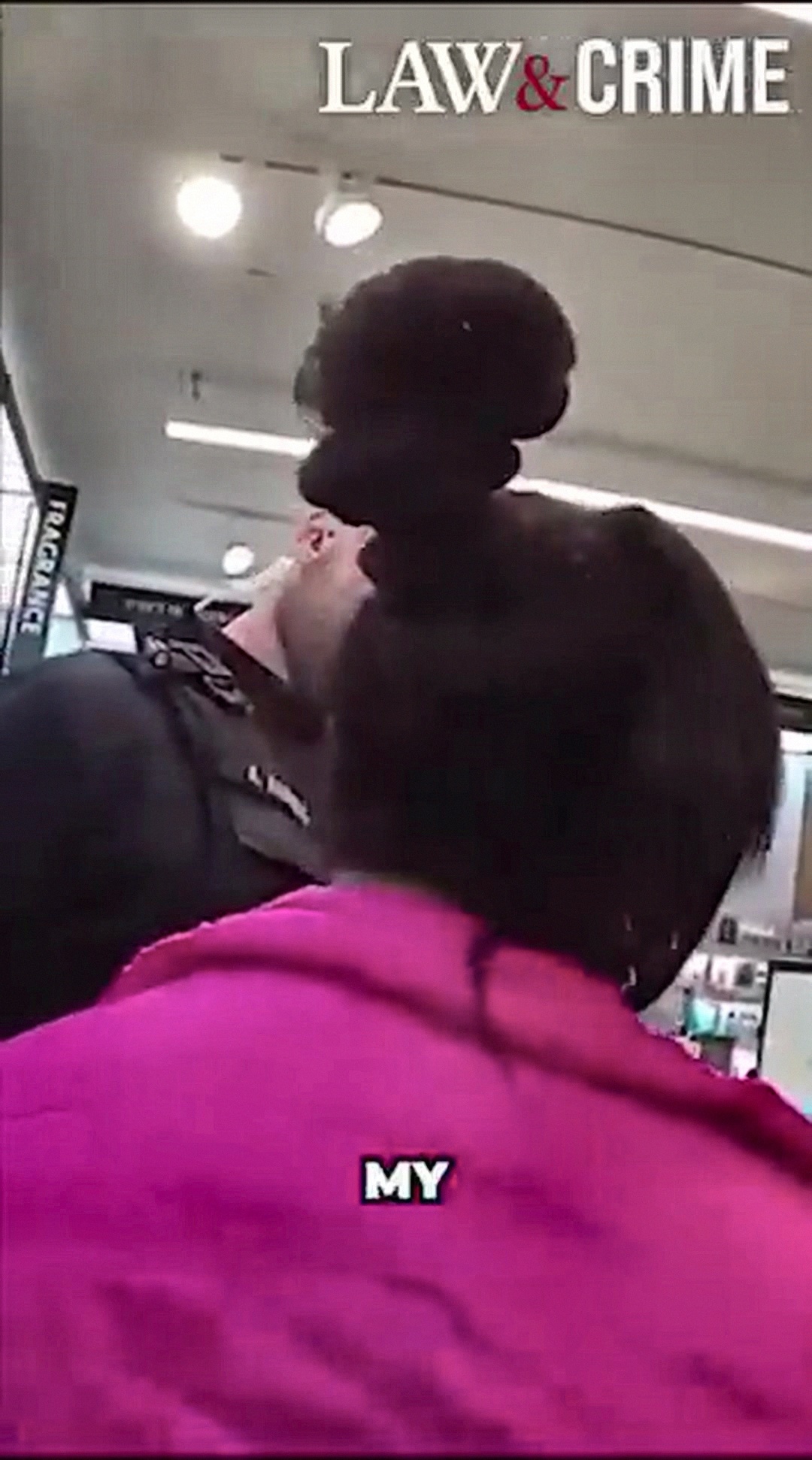
The viral assertions attached to this footage do not always align with the verified record. The recording does not show a woman being physically struck by an officer, nor does it show a suspect being taken to the ground by multiple officers. Instead, the camera captures a close-quarters struggle between one officer and one suspect, with verbal warnings and a compliance countdown.
The claim that the suspect was subjected to an unlawful arrest is contradicted by the recorded statement of probable cause and the eventual conviction. However, the footage does not independently establish the value of the stolen merchandise, the exact theft protocol used by the retailer, or the specific store policy that guided the loss prevention officer's decision to initiate a detention.
The retail corporation's internal protocols, including the standard for initiating a citizen's detention and the use of force policy for loss prevention personnel, remain absent from the recorded record.
Statutory Framework and Protocol Analysis
Legal Distinction: In Wisconsin, retail theft is governed under Wis. Stat. § 943.50, which permits a merchant or merchant's employe to detain a person suspected of retail theft for a reasonable time and in a reasonable manner. Battery to a law enforcement officer is codified under Wis. Stat. § 940.20(2), a Class H serious legal charge that elevates a physical struggle during an arrest into a separate and more serious offense. The legal distinction between lawful detention and an unlawful arrest hinges on probable cause and the reasonableness of the officer's conduct, while the claimed pregnancy does not create a statutory exemption from arrest. The officer's decision to proceed with handcuffing is consistent with departmental use-of-force policy requiring control of a resisting suspect, and the judicial disposition of probation reflects a sentencing structure that balances the serious legal charge battery conviction against the defendant's lack of prior violent record.
| Incident Parameter | Governing Legal Standard & Judicial Protocol |
|---|---|
| Retail theft of merchandise valued near $900 | Wisconsin retail theft statutes classify the offense by value; a civil or criminal remedy may apply. |
| Detention of suspect on retail premises | Merchant's privilege permits reasonable detention based on probable cause; duration must be reasonable. |
| Resistance to handcuffing by a suspect | Officer may use reasonable force to overcome active resistance and complete a lawful arrest. |
| Claim of pregnancy as a bar to detention | No statutory exemption; medical considerations are evaluated under departmental duty of care protocols. |
| Battery to a law enforcement officer | Class H serious legal charge under Wis. Stat. § 940.20(2); requires proof of physical contact intended to cause harm. |
| Judicial sentencing disposition | Probation with conditions may be imposed for a serious legal charge battery conviction absent prior violent history. |
| Co-defendant liability for retail theft | Misdemeanor retail theft charge with probation disposition; reflects independent culpability assessment. |
The institutional duty of care in this incident operates on two parallel tracks. The retailer's loss prevention personnel are obligated to follow internal apprehension standards that prioritize employee and customer safety, including a prohibition on physical pursuit in certain circumstances. The arresting officer is obligated under departmental policy to maintain control of the suspect, to use only the force reasonably necessary to effect the arrest, and to monitor the suspect's medical condition.
The recorded audio reflects the officer's attention to the suspect's claims, including the statement regarding the pregnancy, while maintaining the arrest protocol. The compliance burden rests with the suspect, who is required to submit to a lawful arrest and to contest the charges through the judicial process rather than through physical resistance. The footage captures the moment in which the suspect's verbal objections translate into physical non-compliance, which is the precise trigger for the battery charge.
Read more:
Read more: Columbus Police Use-of-Force Review After Viral Street Arrest →
Core Questions and Institutional Review
- Did the officer's initial approach and handcuffing procedure comply with departmental use-of-force guidelines and the statutory standard for a lawful arrest?
- What is the retailer's policy regarding loss prevention detentions, and was the initial detention of the suspect conducted in a reasonable manner before the officer's arrival?
- How does the judicial system's reliance on probation in this case reflect the sentencing guidelines for a first-time serious legal charge battery conviction involving a pregnant defendant?
- What accountability measures exist for the officer whose body camera was knocked off during the struggle, and does the evidentiary gap affect the reliability of the battery conviction in future appellate review?
The systemic impact of this case extends beyond the individual courtroom. The body camera footage becomes a public record that simultaneously protects the officer from allegations of excessive force and implicates the suspect in a serious legal charge.
The eventual probation disposition demonstrates the judicial system's capacity to distinguish between a property crime and a violent act against a public safety officer, while the viral circulation of the footage imposes a reputational penalty that no court sentence can replicate. The incident underscores a broader compliance reality: a misdemeanor retail theft accusation can swiftly become a serious legal charge battery conviction depending on the suspect's physical response, and the presence of a claimed pregnancy does not alter the statutory obligation to submit to a lawful arrest.
Practical Takeaways
- Body-worn camera footage can both exonerate and incriminate; the recorded sequence is the primary evidentiary artifact in any contested arrest.
- Retail theft does not carry a presumption of leniency when it escalates into physical resistance; the battery charge becomes the dominant legal exposure.
- Claims of medical condition or pregnancy do not create a legal bar to arrest but may trigger a duty of care obligation for the arresting officer.
- Judicial dispositions for first-time serious legal charge offenders frequently favor probation over incarceration, but the serious legal charge conviction remains on the record and carries collateral consequences.
FOLLOW-UP INVESTIGATION REPORT
Related documented case details, verified on-scene evidence, and statutory liability analysis continued below.
CONTINUE READING: NEXT INVESTIGATIVE DOSSIER →
Austin Street Brawl: Troopers Restrain Man as Crowd Watches
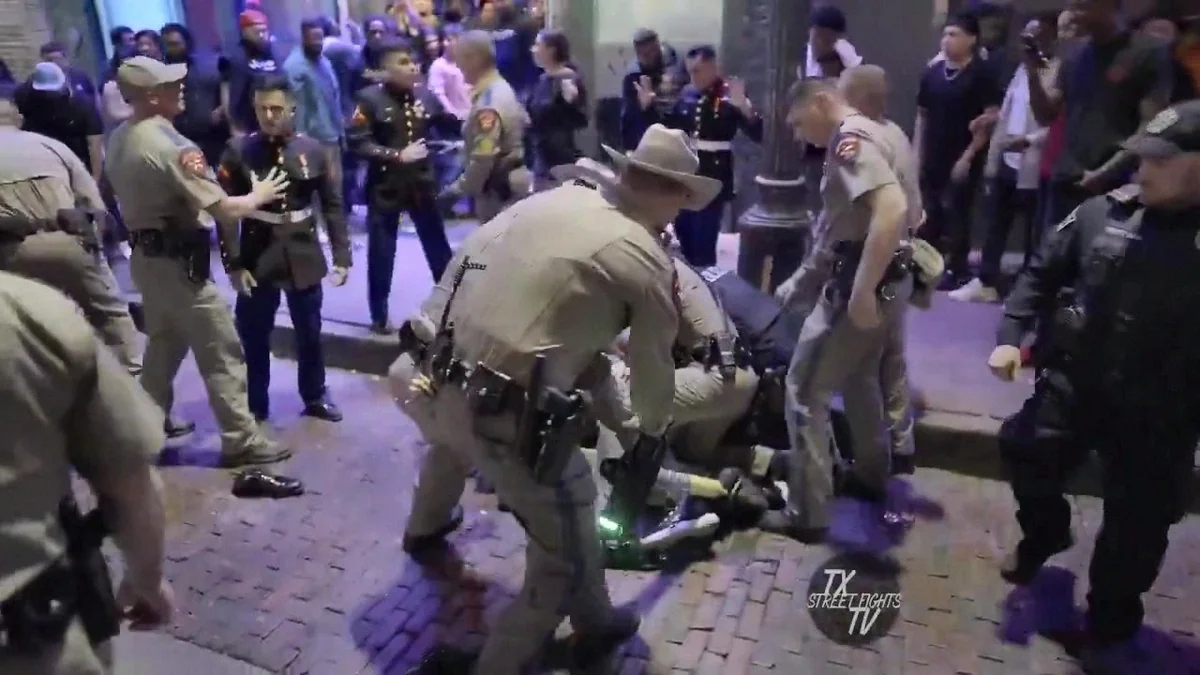
AUSTIN, Texas – A street-level confrontation in a crowded nightlife corridor escalated into a full law enforcement response, raising questions about municipal crowd management, officer deployment protocols, and the liability exposure of venues operating in high-density pedestrian zones. The recorded encounter, captured across multiple camera angles, documents the transition from an isolated physical dispute to a coordinated detention operation involving uniformed state troopers.
- The setting is a densely packed entertainment district at night, with brick-paved pedestrian surfaces, storefront frontage, and overlapping crowds that constrained movement and sightlines for responding personnel.
- Footage shows an initial physical confrontation between individuals in the crowd, followed by the rapid arrival of multiple uniformed officers in distinctive wide-brimmed campaign hats and tan uniforms.
- Officers physically restrain and bring at least one individual to the ground, with personnel kneeling to secure a subject while others establish a perimeter and push back onlookers.
- The incident unfolds under heavy ambient lighting and neon signage, with body-mounted equipment visible on officers, indicating the encounter was captured on both private and official recording systems.
What the Recorded Footage Captures: Chronological Breakdown
Frame one establishes the geography of the encounter. The camera sits at roughly chest height behind a uniformed officer whose back fills the right foreground, creating a partial occlusion of the primary action. To the left, a second officer in the same tan uniform and campaign hat extends an arm toward a subject in dark clothing, gripping fabric at the shoulder and arm. The background is a wall of faces and bodies, densely packed along a storefront line, with blue and purple environmental lighting washing the pavement. The framing itself is evidentiary: the viewer sees the encounter from behind the enforcement line, which is precisely the perspective a bystander would have had.
By the second frame, the scene has shifted from verbal de-escalation to physical control. Two officers are now bent at the waist over a subject on the ground, one with a knee and hand engaged in securing the individual, the other positioned to assist. A third officer stands upright at the left, palm raised toward the crowd in a stop gesture, functioning as a crowd-control barrier. The subject on the pavement is partially obscured, and a small green light source near the ground suggests a dropped device or equipment reflection. The transition from standing confrontation to ground-level restraint occurred within a matter of seconds, consistent with standard takedown protocols when a subject is judged non-compliant.
Frame three captures the immediate aftermath. The camera has shifted position, now showing a wider field with a civilian in a dark t-shirt standing with his back to the lens, facing a loose line of officers. Two officers occupy the center-left, one with hands near his belt, and a third officer is visible on the right edge in a partial turn. A Marine in dress uniform with visible rank insignia stands among the crowd in the background, a detail that anchors the scene's social context without explaining it. The crowd has not dispersed; it has reorganized into a loose ring of onlookers, which is the moment of highest risk for secondary escalation.
Frame four shows the consolidation of the enforcement perimeter. Officers in tan uniforms have formed a staggered line across the width of the pedestrian corridor, with one officer in the center foreground walking forward and another at the right edge in profile. A subject remains prone on the brick surface behind the line, with an officer positioned over him. The blue lighting on the ground creates a visual separation between the enforcement zone and the crowd zone. This is the point at which a street encounter becomes an institutional operation: the scene is now managed by command presence rather than individual officer action.
Frame five is the aftermath frame. A single officer dominates the left foreground, head tilted down, hat brim shading his face, hands at his belt. Behind him, the line of officers holds position, and the crowd presses against the edges of the frame. The posture is not aggressive; it is administrative. The incident has moved from kinetic to custodial.
Corporate Liability and Critical Blind Spots
The evidentiary record has significant gaps. The footage begins mid-encounter, meaning the precipitating exchange, any verbal warnings issued, and the initial contact are not captured. For any legal proceeding, that missing prelude is the most consequential segment, because it determines whether force was initiated defensively or preemptively. Chain-of-custody questions also arise: the clip bears a broadcast watermark, indicating it passed through a media handler before public circulation, and any compression or editing at that stage could affect its admissibility as evidence.
Perspective is another limitation. The camera stays behind the enforcement line, which means the viewer sees officers' backs and the crowd's faces. No frame clearly shows what the subject on the ground was doing with his hands at the moment of restraint. In use-of-force review, hand position is the single most scrutinized variable, and its absence here creates an asymmetric record that favors neither party conclusively.
Viral assertions surrounding the clip have compounded these gaps. Social media framing has attached narrative claims about military personnel, unit discipline, and combat training that are not independently verified by the footage itself. A uniformed service member is visible in the background, but his role, affiliation, and involvement are unconfirmed. Treating the clip's viral caption as established fact would be an analytical error; the record supports a public-order disturbance and a law enforcement response, not a verified account of who initiated what.
Legal Distinction: A physical altercation in a public right-of-way can trigger three separate legal tracks simultaneously: criminal liability for assault or disorderly conduct, civil liability for battery and negligence, and regulatory liability for the licensed premises whose crowd-management obligations may have been breached. Detention authority in Texas permits temporary investigative stops on reasonable suspicion, but custodial arrest requires probable cause; the distinction governs whether the ground restraint shown is a stop or an arrest.
Statutory Framework and Protocol Analysis
State troopers operating in an entertainment district are typically deployed under interagency agreements with municipal police, which creates a layered command structure. The officers visible here wear campaign hats and tan uniforms consistent with state-level highway patrol or department of public safety personnel, whose jurisdictional authority in a city corridor depends on the terms of that deployment agreement. When multiple agencies converge on a single scene, the question of who holds scene command becomes a liability question as much as an operational one.
Venue operators in high-density districts carry a separate duty of care. Licensing regimes generally require security staffing ratios, camera coverage of entry points, and incident documentation. An altercation that escalates to ground restraint in a public corridor adjacent to storefronts implicates those requirements, and any subsequent civil claim would examine whether private security intervened appropriately, too late, or not at all.
| Incident Parameter | Governing Legal Standard & Judicial Protocol |
|---|---|
| Ground restraint of subject | Objective reasonableness standard; force must be proportional to resistance encountered |
| Detention duration | Temporary investigative detention must be brief and tied to articulable suspicion |
| Crowd perimeter establishment | Agency crowd-management policy; duty to protect bystanders from foreseeable harm |
| Officer identification | Visible badge, unit insignia, and body-worn camera activation requirements |
| Venue security obligations | Licensing conditions mandating staffing levels and incident reporting |
| Recording and evidence retention | Chain-of-custody and preservation duties for both private and official footage |
| Interagency jurisdiction | Written deployment agreements defining arrest authority in municipal corridors |
Read more: {NOIBO}
The compliance question is not whether force occurred, but whether each step was documented in sequence. Body-worn camera activation, radio traffic logs, and use-of-force reports form the administrative record that courts review when civil claims follow. Where those records are incomplete, agencies face heightened exposure regardless of whether the underlying conduct was lawful.
Core Questions and Institutional Review
- Did responding officers activate body-worn cameras before physical contact, and is that footage preserved under standard retention schedules?
- Which agency held scene command at the moment of ground restraint, and was the interagency deployment agreement followed?
- Did adjacent licensed venues meet their security staffing and incident-reporting obligations during the disturbance?
- What pre-contact verbal warnings were issued, and are they captured in any available audio record?
The systemic impact of an incident like this extends beyond the individuals involved. Public-order encounters in nightlife districts are among the most heavily recorded events in civic life, and each one becomes a de facto audit of departmental protocol. When footage circulates without the prelude, the public evaluates the response on incomplete information, and agencies lose the opportunity to demonstrate compliance. The durable lesson is procedural: documentation discipline at the moment of contact determines institutional credibility months later. For the venue operators and the agencies alike, the record is the defense.





One comment on “Wauwatosa Mall Arrest: Bodycam Shows Theft Arrest Struggle”