Scroll down for the full investigative report below ↓
AUSTIN, Texas – A street-level confrontation in a crowded nightlife corridor escalated into a full law enforcement response, raising questions about municipal crowd management, officer deployment protocols, and the liability exposure of venues operating in high-density pedestrian zones. The recorded encounter, captured across multiple camera angles, documents the transition from an isolated physical dispute to a coordinated detention operation involving uniformed state troopers.
- The setting is a densely packed entertainment district at night, with brick-paved pedestrian surfaces, storefront frontage, and overlapping crowds that constrained movement and sightlines for responding personnel.
- Footage shows an initial physical confrontation between individuals in the crowd, followed by the rapid arrival of multiple uniformed officers in distinctive wide-brimmed campaign hats and tan uniforms.
- Officers physically restrain and bring at least one individual to the ground, with personnel kneeling to secure a subject while others establish a perimeter and push back onlookers.
- The incident unfolds under heavy ambient lighting and neon signage, with body-mounted equipment visible on officers, indicating the encounter was captured on both private and official recording systems.
What the Recorded Footage Captures: Chronological Breakdown
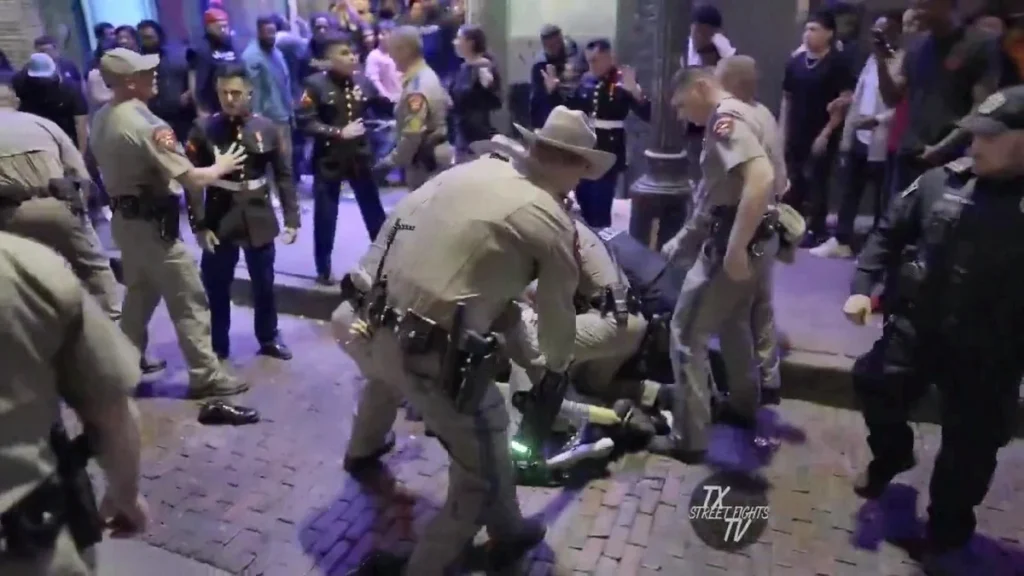
Frame one establishes the geography of the encounter. The camera sits at roughly chest height behind a uniformed officer whose back fills the right foreground, creating a partial occlusion of the primary action. To the left, a second officer in the same tan uniform and campaign hat extends an arm toward a subject in dark clothing, gripping fabric at the shoulder and arm.
The background is a wall of faces and bodies, densely packed along a storefront line, with blue and purple environmental lighting washing the pavement. The framing itself is evidentiary: the viewer sees the encounter from behind the enforcement line, which is precisely the perspective a bystander would have had.
By the second frame, the scene has shifted from verbal de-escalation to physical control. Two officers are now bent at the waist over a subject on the ground, one with a knee and hand engaged in securing the individual, the other positioned to assist. A third officer stands upright at the left, palm raised toward the crowd in a stop gesture, functioning as a crowd-control barrier.
The subject on the pavement is partially obscured, and a small green light source near the ground suggests a dropped device or equipment reflection. The transition from standing confrontation to ground-level restraint occurred within a matter of seconds, consistent with standard takedown protocols when a subject is judged non-compliant.
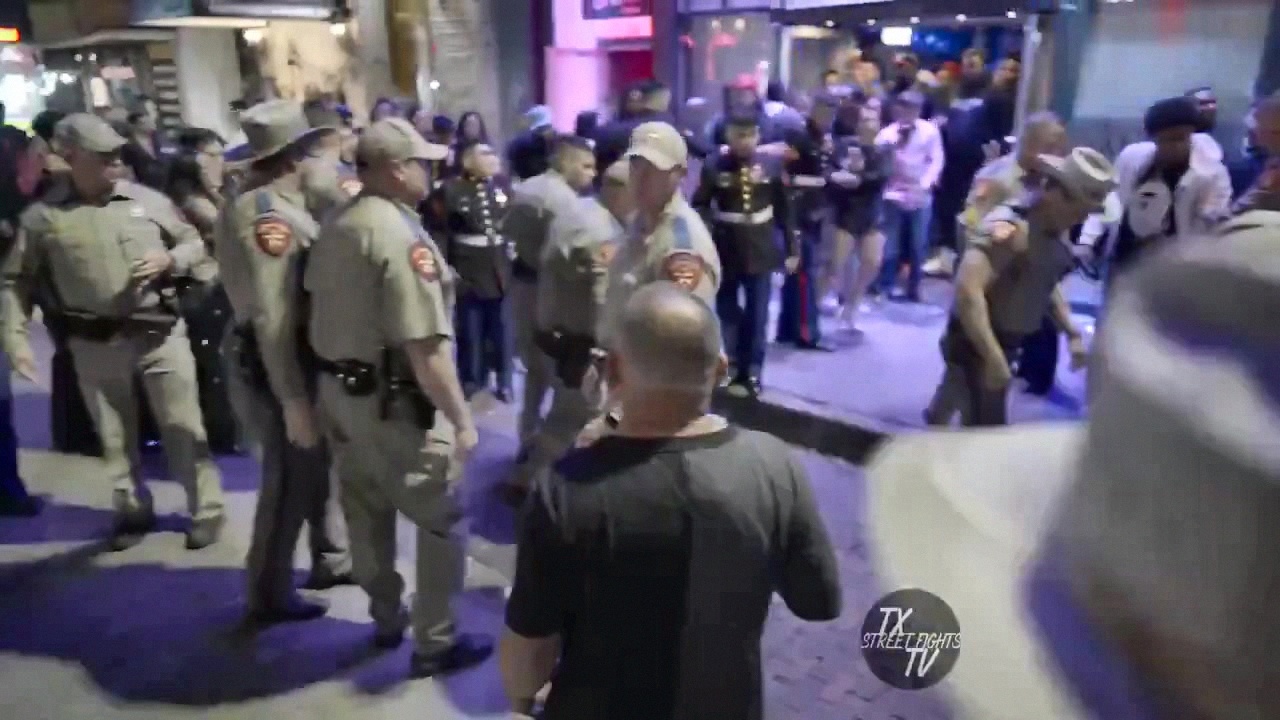
Frame three captures the immediate aftermath. The camera has shifted position, now showing a wider field with a civilian in a dark t-shirt standing with his back to the lens, facing a loose line of officers. Two officers occupy the center-left, one with hands near his belt, and a third officer is visible on the right edge in a partial turn.
A Marine in dress uniform with visible rank insignia stands among the crowd in the background, a detail that anchors the scene's social context without explaining it. The crowd has not dispersed; it has reorganized into a loose ring of onlookers, which is the moment of highest risk for secondary escalation.
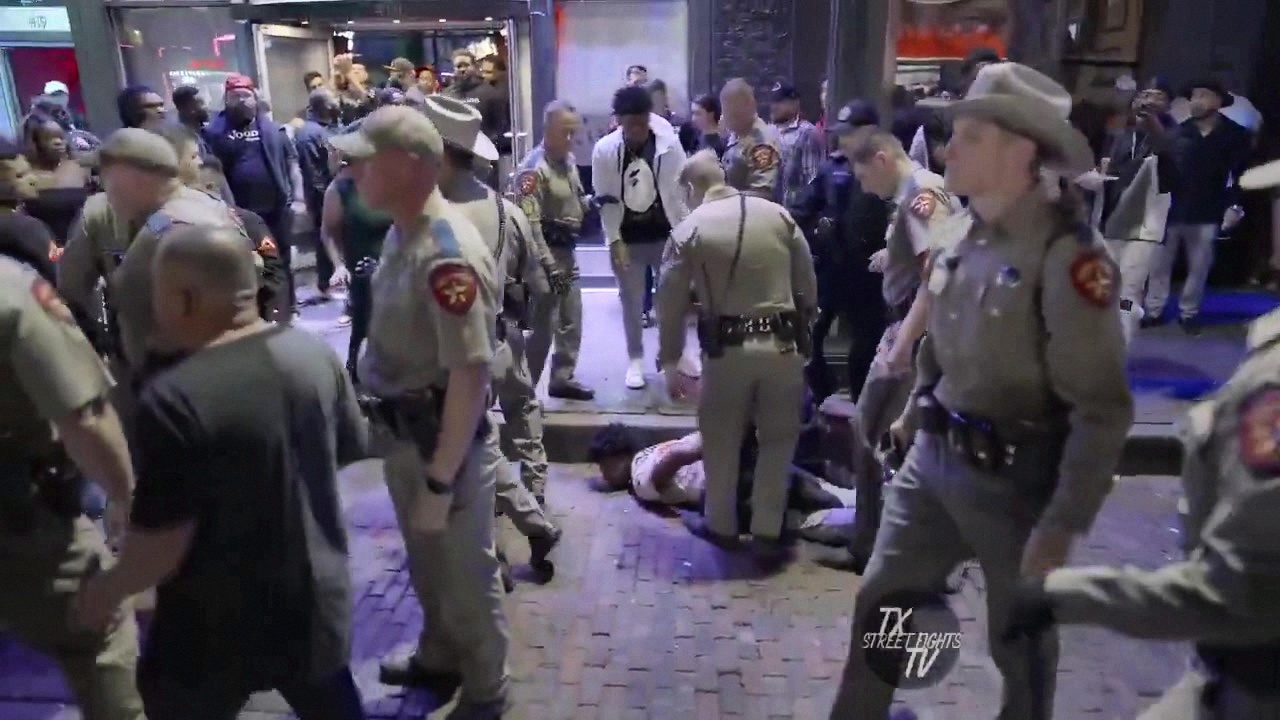
Frame four shows the consolidation of the enforcement perimeter. Officers in tan uniforms have formed a staggered line across the width of the pedestrian corridor, with one officer in the center foreground walking forward and another at the right edge in profile. A subject remains prone on the brick surface behind the line, with an officer positioned over him. The blue lighting on the ground creates a visual separation between the enforcement zone and the crowd zone.
This is the point at which a street encounter becomes an institutional operation: the scene is now managed by command presence rather than individual officer action.
Frame five is the aftermath frame. A single officer dominates the left foreground, head tilted down, hat brim shading his face, hands at his belt. Behind him, the line of officers holds position, and the crowd presses against the edges of the frame. The posture is not aggressive; it is administrative. The incident has moved from kinetic to custodial.
Corporate Liability and Critical Blind Spots
The evidentiary record has significant gaps. The footage begins mid-encounter, meaning the precipitating exchange, any verbal warnings issued, and the initial contact are not captured. For any legal proceeding, that missing prelude is the most consequential segment, because it determines whether force was initiated defensively or preemptively. Chain-of-custody questions also arise: the clip bears a broadcast watermark, indicating it passed through a media handler before public circulation, and any compression or editing at that stage could affect its admissibility as evidence.
Perspective is another limitation. The camera stays behind the enforcement line, which means the viewer sees officers' backs and the crowd's faces. No frame clearly shows what the subject on the ground was doing with his hands at the moment of restraint. In use-of-force review, hand position is the single most scrutinized variable, and its absence here creates an asymmetric record that favors neither party conclusively.
Viral assertions surrounding the clip have compounded these gaps. Social media framing has attached narrative claims about military personnel, unit discipline, and combat training that are not independently verified by the footage itself. A uniformed service member is visible in the background, but his role, affiliation, and involvement are unconfirmed. Treating the clip's viral caption as established fact would be an analytical error; the record supports a public-order disturbance and a law enforcement response, not a verified account of who initiated what.
Legal Distinction: A physical altercation in a public right-of-way can trigger three separate legal tracks simultaneously: criminal liability for assault or disorderly conduct, civil liability for battery and negligence, and regulatory liability for the licensed premises whose crowd-management obligations may have been breached. Detention authority in Texas permits temporary investigative stops on reasonable suspicion, but custodial arrest requires probable cause; the distinction governs whether the ground restraint shown is a stop or an arrest.
Statutory Framework and Protocol Analysis
State troopers operating in an entertainment district are typically deployed under interagency agreements with municipal police, which creates a layered command structure. The officers visible here wear campaign hats and tan uniforms consistent with state-level highway patrol or department of public safety personnel, whose jurisdictional authority in a city corridor depends on the terms of that deployment agreement. When multiple agencies converge on a single scene, the question of who holds scene command becomes a liability question as much as an operational one.
Venue operators in high-density districts carry a separate duty of care. Licensing regimes generally require security staffing ratios, camera coverage of entry points, and incident documentation. An altercation that escalates to ground restraint in a public corridor adjacent to storefronts implicates those requirements, and any subsequent civil claim would examine whether private security intervened appropriately, too late, or not at all.
| Incident Parameter | Governing Legal Standard & Judicial Protocol |
|---|---|
| Ground restraint of subject | Objective reasonableness standard; force must be proportional to resistance encountered |
| Detention duration | Temporary investigative detention must be brief and tied to articulable suspicion |
| Crowd perimeter establishment | Agency crowd-management policy; duty to protect bystanders from foreseeable harm |
| Officer identification | Visible badge, unit insignia, and body-worn camera activation requirements |
| Venue security obligations | Licensing conditions mandating staffing levels and incident reporting |
| Recording and evidence retention | Chain-of-custody and preservation duties for both private and official footage |
| Interagency jurisdiction | Written deployment agreements defining arrest authority in municipal corridors |
Read more:
Read more: Los Angeles Federal Arrest: Parking Dispute Escalates to Civil Rights Claims →
The compliance question is not whether force occurred, but whether each step was documented in sequence. Body-worn camera activation, radio traffic logs, and use-of-force reports form the administrative record that courts review when civil claims follow. Where those records are incomplete, agencies face heightened exposure regardless of whether the underlying conduct was lawful.
Core Questions and Institutional Review
- Did responding officers activate body-worn cameras before physical contact, and is that footage preserved under standard retention schedules?
- Which agency held scene command at the moment of ground restraint, and was the interagency deployment agreement followed?
- Did adjacent licensed venues meet their security staffing and incident-reporting obligations during the disturbance?
- What pre-contact verbal warnings were issued, and are they captured in any available audio record?
The systemic impact of an incident like this extends beyond the individuals involved. Public-order encounters in nightlife districts are among the most heavily recorded events in civic life, and each one becomes a de facto audit of departmental protocol. When footage circulates without the prelude, the public evaluates the response on incomplete information, and agencies lose the opportunity to demonstrate compliance. The durable lesson is procedural: documentation discipline at the moment of contact determines institutional credibility months later. For the venue operators and the agencies alike, the record is the defense.
FOLLOW-UP INVESTIGATION REPORT
Related documented case details, verified on-scene evidence, and statutory liability analysis continued below.
CONTINUE READING: NEXT INVESTIGATIVE DOSSIER →
Columbus Police Use-of-Force Review After Viral Street Arrest
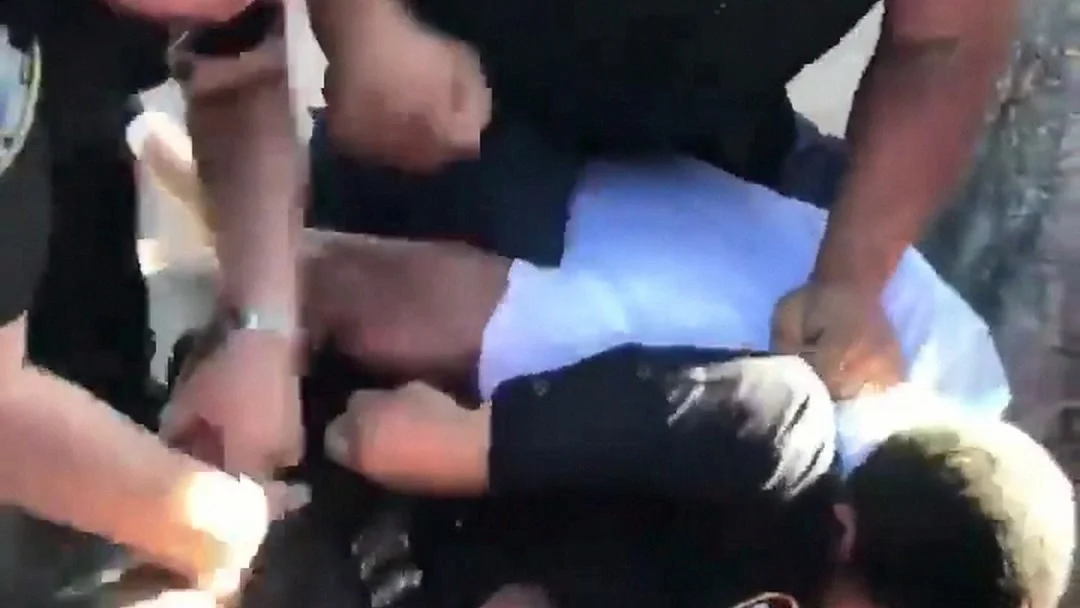
COLUMBUS, Ohio – A street-level arrest captured on bystander video has thrust the Columbus Division of Police into an institutional review process that carries significant civil liability and regulatory exposure. The footage, recorded on a residential block in the city's near-east section, shows a large male officer restraining a man on the ground while a second officer assists and onlookers urge the officers to take custody. The incident was referred to the City of Columbus Department of the Inspector General for independent review, and the family involved has retained counsel – a combination that signals potential civil action and close scrutiny of departmental use-of-force policy.
- The recorded event unfolded on a residential street in Columbus, Ohio, where Columbus Division of Police officers responded to an unspecified call and attempted to take a male subject into custody.
- Bystander footage captures a massive uniformed officer pressing the subject face-down onto the pavement, then reiterating the instruction to keep the subject down as the man's verbal control collapses into repeated self-abasing outcry.
- A second officer, a female, appears on the left edge of the frame assisting in the physical restraint, while a crowd forms at the perimeter and voices are heard urging the officers to complete the arrest.
- The subject was arrested for failure to comply and obstructing official business, with an officer heard on the recording stating he would pursue child endangerment; the department forwarded the incident to the Inspector General for an independent investigation.
What the Recorded Footage Captures: Chronological Breakdown
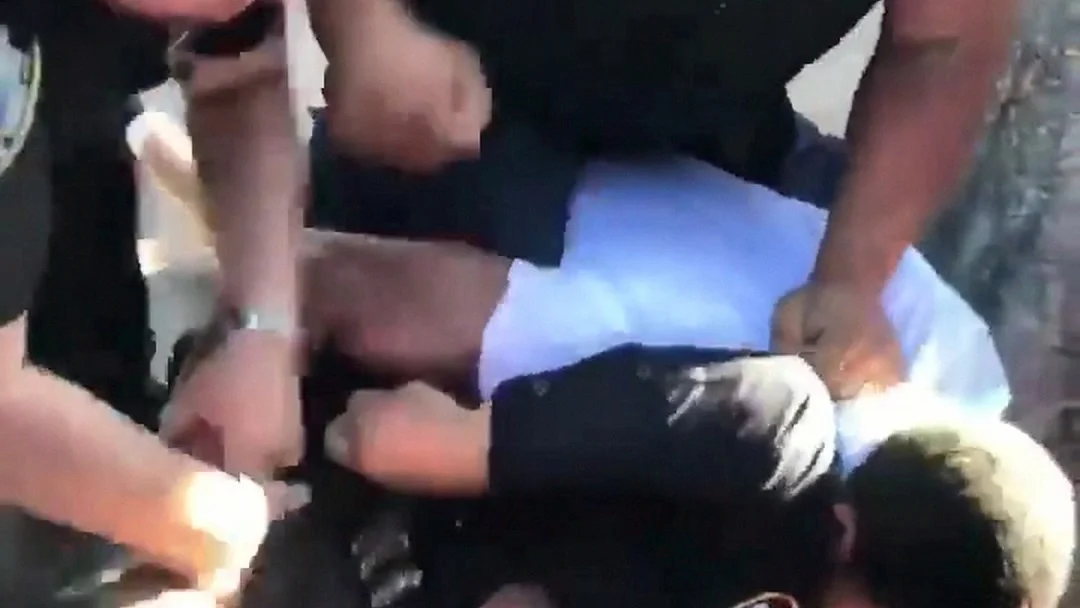
Frame one establishes the physical geometry of the encounter with uncomfortable clarity. The camera sits low and extremely close, roughly at ground level, giving the viewer a compressed upward angle that exaggerates the officer's mass. The male officer in a dark navy uniform and short-sleeve shirt is positioned above the subject, his torso angled downward, both hands committed to controlling the man's upper body. The subject lies face-down on a concrete surface, wearing a white shirt that catches the light. A female officer with blonde hair and sunglasses enters from the left, her hand securing the subject's left arm. At the top of the frame, civilian legs and torsos cluster at the edge of the scene – the boundary between the parties to the arrest and the public recording it.
The second and third frames collapse into motion blur, a technical artifact that is itself evidentially significant. The camera, likely a handheld phone, swings and loses focus briefly, then catches a partially overhead view of the officer's broad back and shoulders bearing down. Hands are visible at overlapping angles: the subject's limp arm, the female officer's grip, the male officer's hand pressing into the white shirt. The visual record confirms that the restraint involved multiple points of contact across the torso and arms, but the blur impedes a frame-by-frame reconstruction of the exact sequence of applied pressure.
The audio track is where the evidentiary weight shifts. A voice, apparently from the crowd or from an officer at a distance, repeats "You get him" in an insistent loop, functioning both as encouragement and as a sound-bite that social media viewers will read as pressure to act. The subject's voice spirals into fragmented, repetitive declarations: "No! No! No!" and then the self-condemning refrain "I'm a heatedly idiot," repeated several times. He asks, "Look at him, yo," and "I'm heavily disputed, sir." Near the end of the audible segment, an officer says, "Turn your face, turn your face. Let me see your face" – an instruction consistent with maintaining positional control and assessing the subject's condition.
What the footage does not show is the origin of the encounter. There is no visible prelude establishing what prompted the officers' approach, whether a child was present at the moment of restraint, or what the subject was alleged to have done. The posting caption itself hedges – "I don't know what this kid did or supposedly did" – and that hedge is the single most consequential ambiguity in the public record. The "supposedly" admits the poster lacks verified facts, yet the video circulated as though the arrest were its own justification.
Corporate Liability and Critical Blind Spots
For the municipality, the exposure falls into two channels: the officer's qualified immunity protections and the department's institutional duty of care. Ohio law and federal civil rights doctrine both turn on whether the force applied was objectively reasonable under the circumstances known to the officers at the time. The camera angle, seen from the ground, visually magnifies the officer's size relative to the subject – a perspective effect that social media commentary has explicitly seized upon ("look how massive the officer is"). That perceptual distortion may drive public anger, but it is not proof of excessive force in a legal sense. Evaluating the sizing question without accounting for the low camera angle would be a forensic error.
Equally problematic is the unrecorded interval before the restraint began. There is no footage establishing whether the subject was carrying or holding a child, what verbal warnings were issued, or whether the subject resisted or fled. The officer's statement that he would pursue child endangerment is captured on audio, but the factual predicate for that statement lies outside the frame. Chain of custody for the video itself is also unresolved: the clip appears to have been posted by an account aggregating viral content, not the original recorder, and the version in circulation may have been trimmed at both ends.
A third blind spot is the crowd audio. The repeated "You get him" is ambiguous in origin. If it came from civilians, it suggests bystander pressure in favor of the arrest; if from an officer out of frame, it suggests coordination during restraint. Neither reading can be verified from the clip alone, and both interpretations have been asserted online without documentation.
Statutory Framework and Protocol Analysis
Legal Distinction: Ohio's obstructing official business statute (R.C. 2921.31) requires a specific act of interference, not mere refusal to obey; failure to comply (R.C. 2921.331) applies to orders from a lawful authority. Neither charge authorizes force disproportionate to the resistance encountered, and child endangerment (R.C. 2919.22) requires proof of actual risk to a child, not an officer's verbal assertion at the scene. Under Graham v. Connor, force must be judged from the perspective of a reasonable officer at the moment, not with hindsight.
| Incident Parameter | Governing Legal Standard & Judicial Protocol |
|---|---|
| Officer's initial approach and order to comply | R.C. 2921.331; lawful order requirement |
| Physical restraint on the pavement | Graham v. Connor objective reasonableness standard |
| Alleged child endangerment statement on audio | R.C. 2919.22; requires articulated factual predicate |
| Second officer's assisting role | Departmental duty-to-intervene and reporting protocols |
| Bystander recording and crowd audio | First Amendment recording rights; evidentiary authentication |
| Referral to Inspector General | City charter oversight and independent review mandate |
| Family retaining counsel | Potential civil action; municipal indemnification exposure |
Read more: {NOIBO}
The compliance question is not whether the arrest was unpleasant to watch – it unmistakably is – but whether each successive application of force corresponded to a documented, escalating justification. Columbus Division of Police policy, like most urban departments, requires reporting obligations after any use of force above a defined threshold, supervisory review, and in this case referral to the Inspector General. The department's decision to route the matter externally, rather than keep it within internal affairs, is a meaningful indicator that command staff recognized the reputational and legal stakes.
Institutional duty of care also attaches to the subject's medical condition. The footage shows the man face-down and verbalizing incoherently throughout; positional asphyxia risk is a recognized concern in prolonged prone restraint, and departmental policy in most jurisdictions requires prompt post-restraint medical assessment. Whether that assessment was conducted and documented will be central to the Inspector General's findings and to any eventual civil complaint.
Core Questions and Institutional Review
- What was the specific factual predicate for the initial stop and the subsequent child endangerment declaration, and was it articulated on body-worn camera before the restraint began?
- Did the level of force applied remain proportional to the resistance encountered, and does the department's own Use of Force report document the sequence the bystander video captured only partially?
- What was the second officer's role, and does the record show compliance with the duty-to-intervene and contemporaneous reporting requirements?
- Will the Inspector General's findings be released publicly in full, and does the family's retained counsel signal the opening of a civil action alleging excessive force and negligent supervision?
The systemic impact of this case sits at the intersection of visual evidence and institutional credibility. Bystander video has become the de facto audit trail for urban policing, and a department that cannot produce a complete, internally consistent record of its own use of force will lose the narrative to the loudest clip. Columbus has taken the correct first procedural step by externalizing review – but the public ledger of the incident will ultimately be settled not in the comment section but in the Inspector General's findings and, potentially, in a courtroom where the low camera angle stops being a viral talking point and becomes a contested exhibit.




One comment on “Austin Street Brawl: Troopers Restrain Man as Crowd Watches”