Scroll down for the full investigative report below ↓
COLUMBUS, Ohio – A street-level arrest captured on bystander video has thrust the Columbus Division of Police into an institutional review process that carries significant civil liability and regulatory exposure. The footage, recorded on a residential block in the city's near-east section, shows a large male officer restraining a man on the ground while a second officer assists and onlookers urge the officers to take custody.
The incident was referred to the City of Columbus Department of the Inspector General for independent review, and the family involved has retained counsel – a combination that signals potential civil action and close scrutiny of departmental use-of-force policy.
- The recorded event unfolded on a residential street in Columbus, Ohio, where Columbus Division of Police officers responded to an unspecified call and attempted to take a male subject into custody.
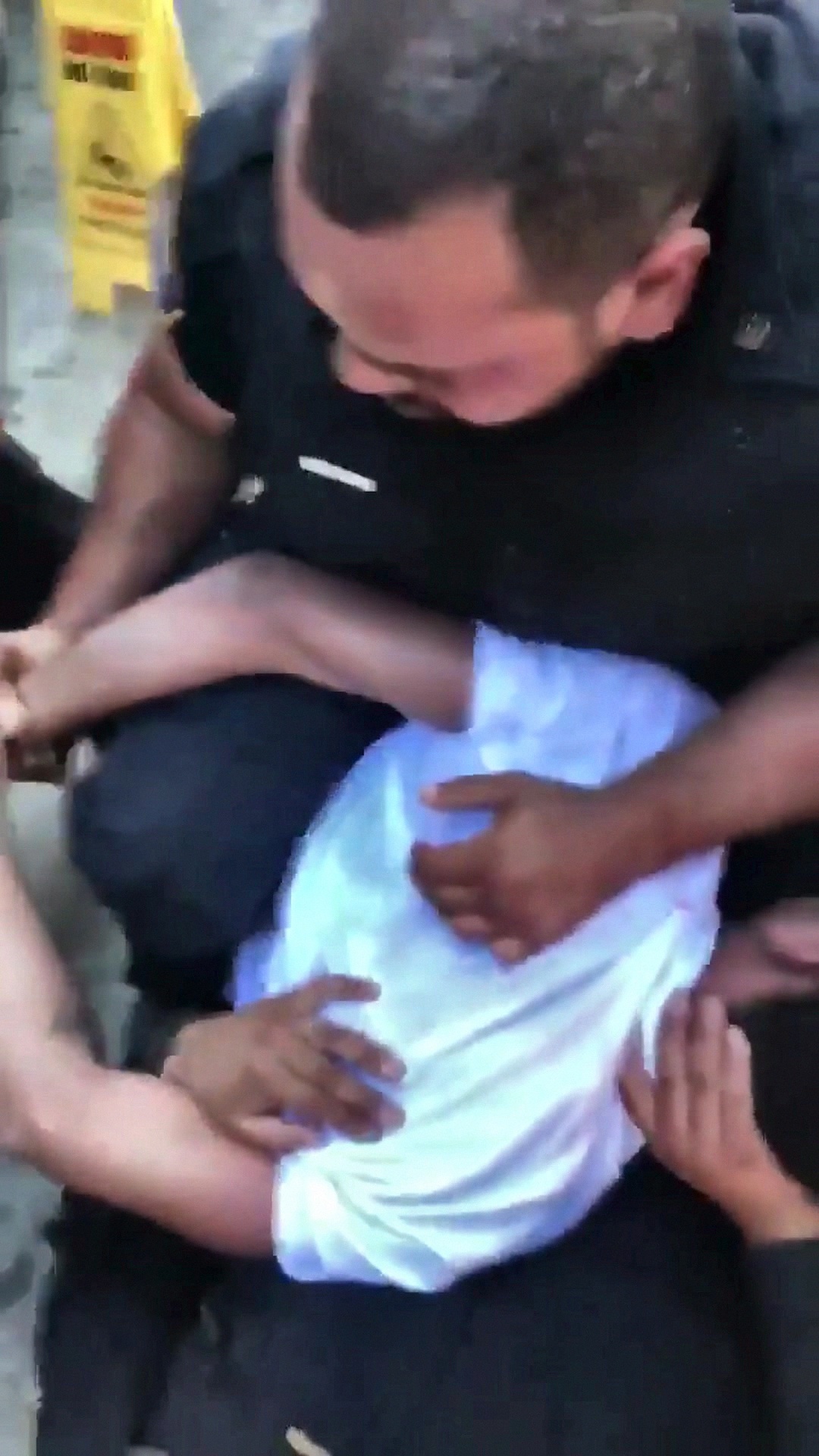
- Bystander footage captures a massive uniformed officer pressing the subject face-down onto the pavement, then reiterating the instruction to keep the subject down as the man's verbal control collapses into repeated self-abasing outcry.
- A second officer, a female, appears on the left edge of the frame assisting in the physical restraint, while a crowd forms at the perimeter and voices are heard urging the officers to complete the arrest.
- The subject was arrested for failure to comply and obstructing official business, with an officer heard on the recording stating he would pursue child endangerment; the department forwarded the incident to the Inspector General for an independent investigation.
What the Recorded Footage Captures: Chronological Breakdown
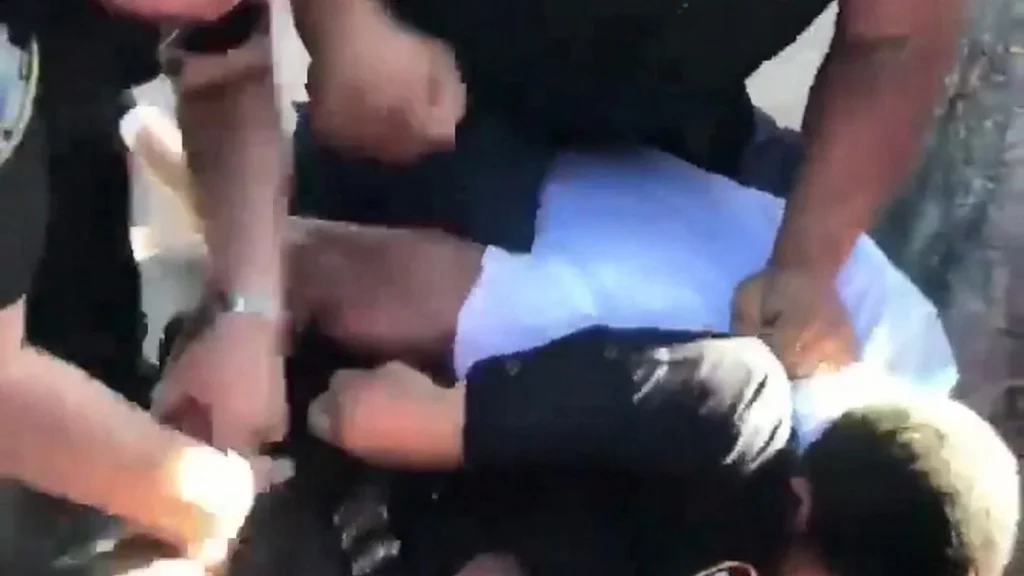
Frame one establishes the physical geometry of the encounter with uncomfortable clarity. The camera sits low and extremely close, roughly at ground level, giving the viewer a compressed upward angle that exaggerates the officer's mass. The male officer in a dark navy uniform and short-sleeve shirt is positioned above the subject, his torso angled downward, both hands committed to controlling the man's upper body.
The subject lies face-down on a concrete surface, wearing a white shirt that catches the light. A female officer with blonde hair and sunglasses enters from the left, her hand securing the subject's left arm. At the top of the frame, civilian legs and torsos cluster at the edge of the scene – the boundary between the parties to the arrest and the public recording it.
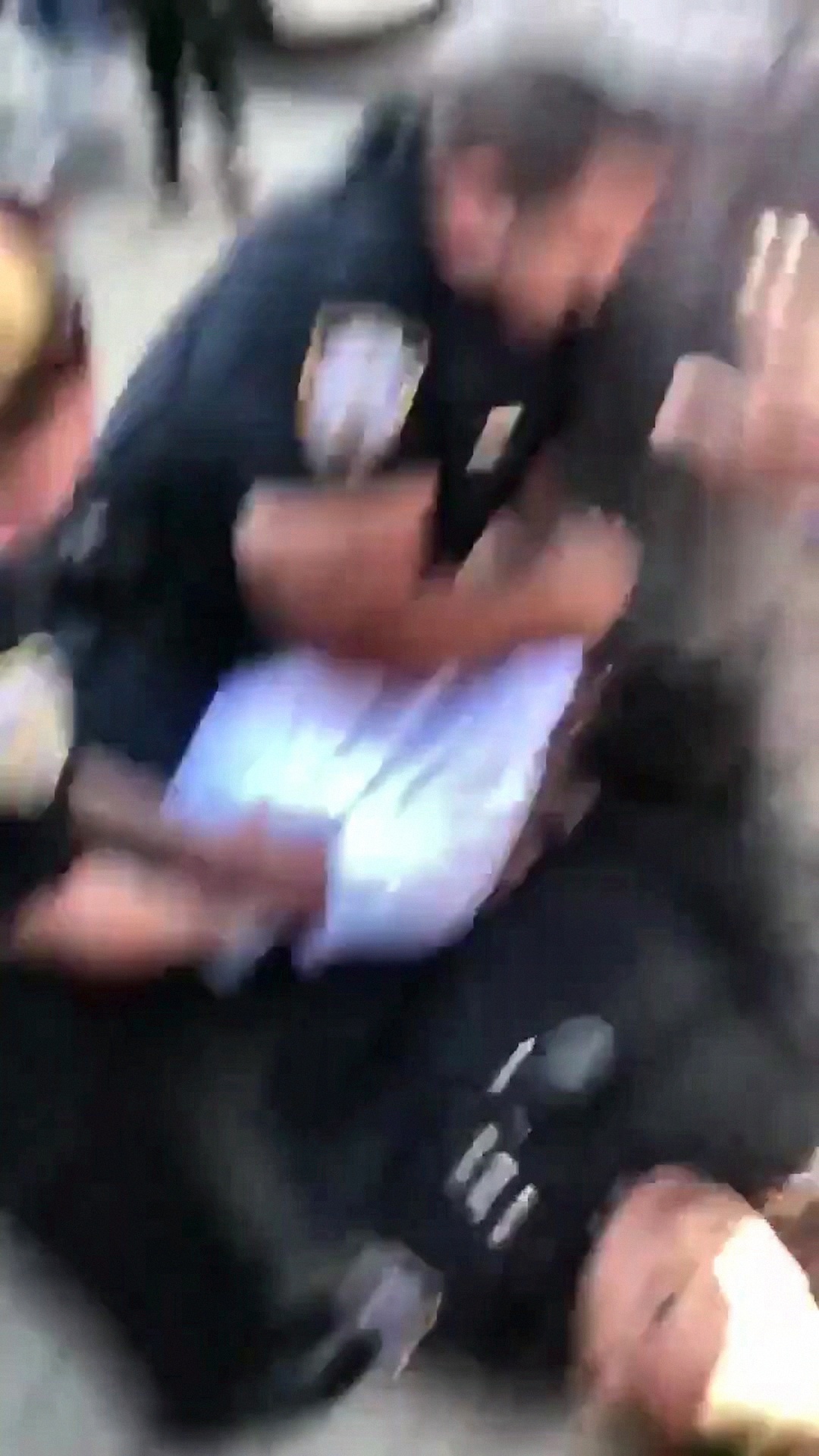
The second and third frames collapse into motion blur, a technical artifact that is itself evidentially significant. The camera, likely a handheld phone, swings and loses focus briefly, then catches a partially overhead view of the officer's broad back and shoulders bearing down. Hands are visible at overlapping angles: the subject's limp arm, the female officer's grip, the male officer's hand pressing into the white shirt.
The visual record confirms that the restraint involved multiple points of contact across the torso and arms, but the blur impedes a frame-by-frame reconstruction of the exact sequence of applied pressure.
The audio track is where the evidentiary weight shifts. A voice, apparently from the crowd or from an officer at a distance, repeats "You get him" in an insistent loop, functioning both as encouragement and as a sound-bite that social media viewers will read as pressure to act. The subject's voice spirals into fragmented, repetitive declarations: "No! No! No!" and then the self-condemning refrain "I'm a heatedly idiot," repeated several times.
He asks, "Look at him, yo," and "I'm heavily disputed, sir." Near the end of the audible segment, an officer says, "Turn your face, turn your face. Let me see your face" – an instruction consistent with maintaining positional control and assessing the subject's condition.
What the footage does not show is the origin of the encounter. There is no visible prelude establishing what prompted the officers' approach, whether a child was present at the moment of restraint, or what the subject was alleged to have done. The posting caption itself hedges – "I don't know what this kid did or supposedly did" – and that hedge is the single most consequential ambiguity in the public record. The "supposedly" admits the poster lacks verified facts, yet the video circulated as though the arrest were its own justification.
Corporate Liability and Critical Blind Spots
For the municipality, the exposure falls into two channels: the officer's qualified immunity protections and the department's institutional duty of care. Ohio law and federal civil rights doctrine both turn on whether the force applied was objectively reasonable under the circumstances known to the officers at the time.
The camera angle, seen from the ground, visually magnifies the officer's size relative to the subject – a perspective effect that social media commentary has explicitly seized upon ("look how massive the officer is"). That perceptual distortion may drive public anger, but it is not proof of excessive force in a legal sense. Evaluating the sizing question without accounting for the low camera angle would be a forensic error.
Equally problematic is the unrecorded interval before the restraint began. There is no footage establishing whether the subject was carrying or holding a child, what verbal warnings were issued, or whether the subject resisted or fled. The officer's statement that he would pursue child endangerment is captured on audio, but the factual predicate for that statement lies outside the frame.
Chain of custody for the video itself is also unresolved: the clip appears to have been posted by an account aggregating viral content, not the original recorder, and the version in circulation may have been trimmed at both ends.
A third blind spot is the crowd audio. The repeated "You get him" is ambiguous in origin. If it came from civilians, it suggests bystander pressure in favor of the arrest; if from an officer out of frame, it suggests coordination during restraint. Neither reading can be verified from the clip alone, and both interpretations have been asserted online without documentation.
Statutory Framework and Protocol Analysis
Legal Distinction: Ohio's obstructing official business statute (R.C. 2921.31) requires a specific act of interference, not mere refusal to obey; failure to comply (R.C. 2921.331) applies to orders from a lawful authority. Neither charge authorizes force disproportionate to the resistance encountered, and child endangerment (R.C. 2919.22) requires proof of actual risk to a child, not an officer's verbal assertion at the scene. Under Graham v. Connor, force must be judged from the perspective of a reasonable officer at the moment, not with hindsight.
| Incident Parameter | Governing Legal Standard & Judicial Protocol |
|---|---|
| Officer's initial approach and order to comply | R.C. 2921.331; lawful order requirement |
| Physical restraint on the pavement | Graham v. Connor objective reasonableness standard |
| Alleged child endangerment statement on audio | R.C. 2919.22; requires articulated factual predicate |
| Second officer's assisting role | Departmental duty-to-intervene and reporting protocols |
| Bystander recording and crowd audio | First Amendment recording rights; evidentiary authentication |
| Referral to Inspector General | City charter oversight and independent review mandate |
| Family retaining counsel | Potential civil action; municipal indemnification exposure |
Read more:
Read more: Illinois Extradition Hearing: Inmate’s Calm Reaction to Fatal incident Warrant →
The compliance question is not whether the arrest was unpleasant to watch – it unmistakably is – but whether each successive application of force corresponded to a documented, escalating justification. Columbus Division of Police policy, like most urban departments, requires reporting obligations after any use of force above a defined threshold, supervisory review, and in this case referral to the Inspector General. The department's decision to route the matter externally, rather than keep it within internal affairs, is a meaningful indicator that command staff recognized the reputational and legal stakes.
Institutional duty of care also attaches to the subject's medical condition. The footage shows the man face-down and verbalizing incoherently throughout; positional asphyxia risk is a recognized concern in prolonged prone restraint, and departmental policy in most jurisdictions requires prompt post-restraint medical assessment. Whether that assessment was conducted and documented will be central to the Inspector General's findings and to any eventual civil complaint.

Core Questions and Institutional Review
- What was the specific factual predicate for the initial stop and the subsequent child endangerment declaration, and was it articulated on body-worn camera before the restraint began?
- Did the level of force applied remain proportional to the resistance encountered, and does the department's own Use of Force report document the sequence the bystander video captured only partially?
- What was the second officer's role, and does the record show compliance with the duty-to-intervene and contemporaneous reporting requirements?
- Will the Inspector General's findings be released publicly in full, and does the family's retained counsel signal the opening of a civil action alleging excessive force and negligent supervision?
The systemic impact of this case sits at the intersection of visual evidence and institutional credibility. Bystander video has become the de facto audit trail for urban policing, and a department that cannot produce a complete, internally consistent record of its own use of force will lose the narrative to the loudest clip.
Columbus has taken the correct first procedural step by externalizing review – but the public ledger of the incident will ultimately be settled not in the comment section but in the Inspector General's findings and, potentially, in a courtroom where the low camera angle stops being a viral talking point and becomes a contested exhibit.
FOLLOW-UP INVESTIGATION REPORT
Related documented case details, verified on-scene evidence, and statutory liability analysis continued below.
CONTINUE READING: NEXT INVESTIGATIVE DOSSIER →
Los Angeles Federal Arrest: Parking Dispute Escalates to Civil Rights Claims

LOS ANGELES – A recorded confrontation outside the Metropolitan Detention Center in downtown Los Angeles is raising serious questions about proportional response, federal detention protocols, and the boundaries of civil liability. The footage, captured on October 4, 2025, documents the rapid escalation from a traffic obstruction complaint to a physical arrest, culminating in allegations of sexual assault and civil rights violations shouted by bystanders. The incident underscores the high-stakes friction between federal enforcement operations and public scrutiny in an era of ubiquitous recording.
- The event occurred at the driveway ramp of a federal detention facility in Los Angeles, California, where a woman had parked her vehicle, allegedly obstructing the garage entrance.
- Video footage shows fully equipped inspection officers in riot gear – including helmets and tactical vests – confronting the woman, who repeatedly asserts she is not in custody.
- The confrontation escalates as officers move to handcuff and physically drag the woman, leading to a chaotic scene where bystanders accuse officers of pulling off her clothes and committing sexual assault.
- The Department of Homeland Security (DHS) later stated the woman refused multiple orders to move the vehicle and provide identification, while no specific criminal charges or civil liability outcomes have been publicly disclosed.
What the Recorded Footage Captures: Chronological Breakdown
From the first frame, the camera captures a scene of stark asymmetry. A woman stands near her vehicle at the base of a ramp marked with red-and-white striped barriers. Approaching her are several inspection officers clad in dark tactical gear, their helmets and reinforced vests signaling a high-risk operation. The audio reveals a bystander’s voice mocking the display: “Get your helmet on! You gonna come tow it with your helmet?” This verbal jab highlights the perceived absurdity of the deployment for what appears to be a parking violation. The officers, however, proceed with a scripted enforcement approach, issuing commands that are not fully audible but are met with the woman’s repeated query, “She literally was asking a question.”
As the footage progresses, the tension spikes when officers inform the woman she is under arrest. The camera shakes as the operator moves closer, capturing the moment officers grab her arms. The woman’s voice rises: “You cannot detain. You cannot detain.” The physical struggle intensifies; the camera captures a blur of blue jeans and dark uniforms as she is pulled toward the ground. At this point, a female bystander’s voice cuts through the chaos: “Stop pulling her clothes off! Stop pulling her clothes off!” The perspective shifts to a low angle, showing the woman’s legs and torso as officers attempt to secure her hands behind her back. The audio captures her cry: “Sexual assault is happening right now. You guys are sexually assaulting this woman.”
The final segment of the recording shows the woman being dragged across the concrete toward the facility entrance. Officers maintain their grip, and the camera follows the movement, revealing the woman’s exposed skin as her clothing rides up during the struggle. The bystander continues to shout, “You are not allowed to handle her any further. You are not allowed to handle her,” and accuses the officers of brutalizing a non-resisting subject. The footage ends with the woman being pulled through the doorway, her voice fading as she asserts, “You are obstructing my civil rights.” The visual record presents a complete arc from verbal confrontation to physical removal, with no clear indication of the exact moment resistance escalated.
Corporate Liability and Critical Blind Spots
While the incident involves government actors, the underlying principles of liability and evidentiary scrutiny mirror those in corporate compliance investigations. The most significant blind spot is the pre-recording timeline: what transpired between the initial parking violation and the arrival of the tactical team? The video begins with officers already in riot gear, raising questions about the threat assessment that justified such a deployment. Without body-worn camera footage or a complete dispatch log, the exact commands given to the woman remain unverified. The bystander’s claim that she was “about to move” the car cannot be corroborated solely from the clip, which captures only the moment of arrest.
The chain of custody for the viral video is also unestablished. The footage appears to be recorded on a personal smartphone, and the identity of the uploader is unknown. This raises concerns about selective editing or omission of context. Furthermore, the allegations of sexual assault are made by a third party, not the woman herself, and are not visually confirmed on camera. The officers’ conduct – specifically the handling of clothing – is partially obscured by the angle and the cluster of bodies. These evidentiary gaps are critical for any future civil or administrative review, as they leave room for competing narratives about the level of resistance and the necessity of force.
Statutory Framework and Protocol Analysis
Legal Distinction: The distinction between a lawful detention and an unlawful arrest hinges on probable cause. Under federal law, obstructing a federal driveway can constitute a misdemeanor, but the use of force must be proportionate. The Fourth Amendment protects against unreasonable seizures, and the Fourteenth Amendment’s due process clause applies to state actors, though field investigators are bound by the Fifth Amendment. Allegations of sexual assault during a pat-down or arrest would trigger a separate criminal inquiry under state law, but the burden of proof requires clear evidence of intent or knowing conduct, which is not evident in the recording.
Federal enforcement protocols generally require a graduated response to non-compliance. The deployment of a full tactical team for a traffic obstruction is an outlier that invites scrutiny under internal use-of-force policies. The DHS’s public statement that the woman refused orders and identification suggests a narrative of non-compliance, but the video does not capture the exact wording or repetition of those orders. This gap is significant for assessing whether the officers’ actions met the standard of objective reasonableness established in Graham v. Connor.
| Incident Parameter | Governing Legal Standard & Judicial Protocol |
|---|---|
| Obstruction of a federal driveway | 18 U.S.C. § 1501 (obstruction of process) or local traffic ordinances; requires probable cause for arrest |
| Failure to provide identification | Field investigators may request ID during lawful detention; refusal can escalate to arrest under certain statutes |
| Use of force during arrest | Fourth Amendment objective reasonableness standard; proportionality required |
| Allegation of sexual assault | State criminal law; requires evidence of intent or knowing touching without consent |
| Detention of a non-compliant subject | Must be based on probable cause; excessive force claims reviewed under qualified immunity |
| Civil rights violation claims | 42 U.S.C. § 1983 (if state actors) or Bivens action (field investigators) |
Read more: {NOIBO}
Core Questions and Institutional Review
- Did the initial parking violation warrant a tactical team deployment, and what threat assessment justified the use of riot gear?
- What specific commands were issued to the woman, and were they clearly audible and repeated before physical force was applied?
- Does the video evidence support the bystander’s claim of sexual assault, or was the exposure of clothing an incidental result of a lawful arrest?
- What internal review processes will DHS initiate to evaluate the proportionality of the response and the conduct of the officers involved?
The systemic impact of this incident extends beyond the individuals involved. It highlights the growing tension between federal enforcement activities and community trust, particularly in urban centers with large immigrant populations. The viral nature of the footage amplifies public perception of federal overreach, and the lack of transparent follow-up – such as the release of body camera footage or a formal statement on the outcome of any investigation – leaves the public with an incomplete narrative. For financial and legal analysts, the case serves as a cautionary example of how operational decisions can create significant reputational and liability exposure, even when the underlying offense is minor. As federal agencies continue to operate in high-visibility environments, the need for clear protocols, de-escalation training, and robust accountability mechanisms becomes ever more pressing.
Practical Takeaways:
- The deployment of tactical gear for minor traffic violations can inflame tensions and invite allegations of excessive force.
- The absence of complete body-worn camera footage creates evidentiary gaps that undermine public trust.
- Agencies must ensure that arrest protocols include clear, repeated commands and proportionate physical handling.
- Viral footage can serve as both a tool for accountability and a source of misinformation if context is missing.
- Civil liability exposure can arise from the perception of misconduct, regardless of the legal outcome of the underlying arrest.


One comment on “Columbus Police Use-of-Force Review After Viral Street Arrest”