Scroll down for the full investigative report below ↓
LOS ANGELES – A residential property dispute in the San Fernando Valley escalated into a documented serious legal charge vandalism incident in June 2020, when a neighborhood confrontation over a parked vehicle produced more than fifty impact dents and a viral evidentiary record. The case now serves as a study in the collision between criminal liability, insurance gaps, and emergency-era judicial release protocols that allowed the suspect to walk free within a day of arrest.
- Jurisdictional setting: The recorded episode unfolded on a residential lawn and street frontage near 10408 Blade Avenue in Chatsworth, a neighborhood in Los Angeles' San Fernando Valley, placing the matter within Los Angeles Police Department jurisdiction and L.A. County Superior Court oversight.
- Recorded escalation: A woman, identified in the footage by the name "Becky," was captured wielding two hammers and striking a parked vehicle repeatedly while the vehicle owner recorded the destruction on a mobile device and narrated the ongoing property damage to a 911 dispatcher.
- Intervention and arrest: A second neighbor physically restrained the woman on the lawn as responding LAPD units were summoned; the suspect was taken into custody on serious legal charge vandalism allegations and booked into county custody.
- Legal and financial repercussions: The suspect was released the following day with zero bail under COVID-19 emergency judicial protocols in effect at the time, while the vehicle owner – carrying only liability coverage – faced repair costs exceeding his policy's scope, prompting a crowdfunding effort that ultimately raised more than $13,000.
What the Recorded Footage Captures: Chronological Breakdown
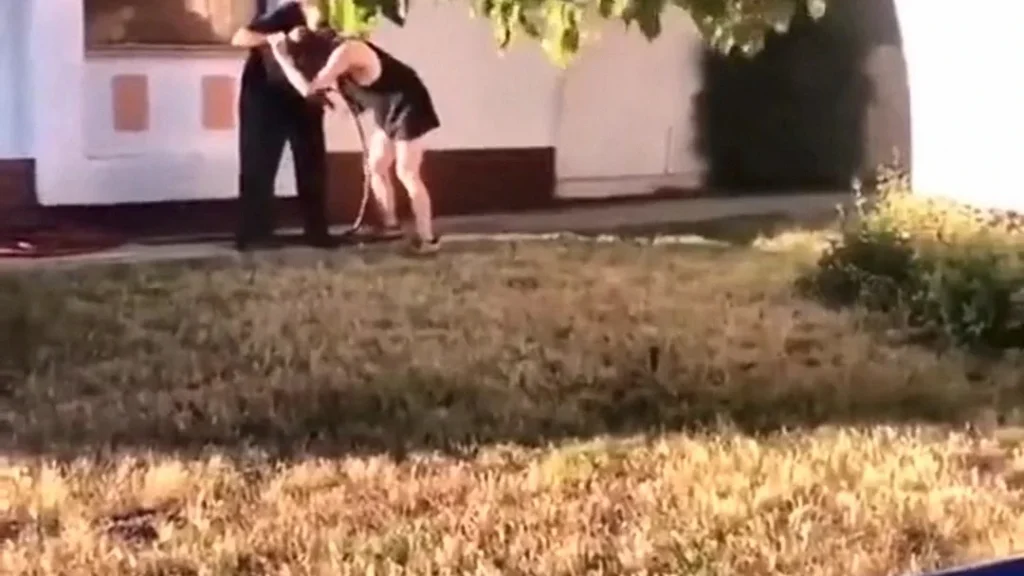
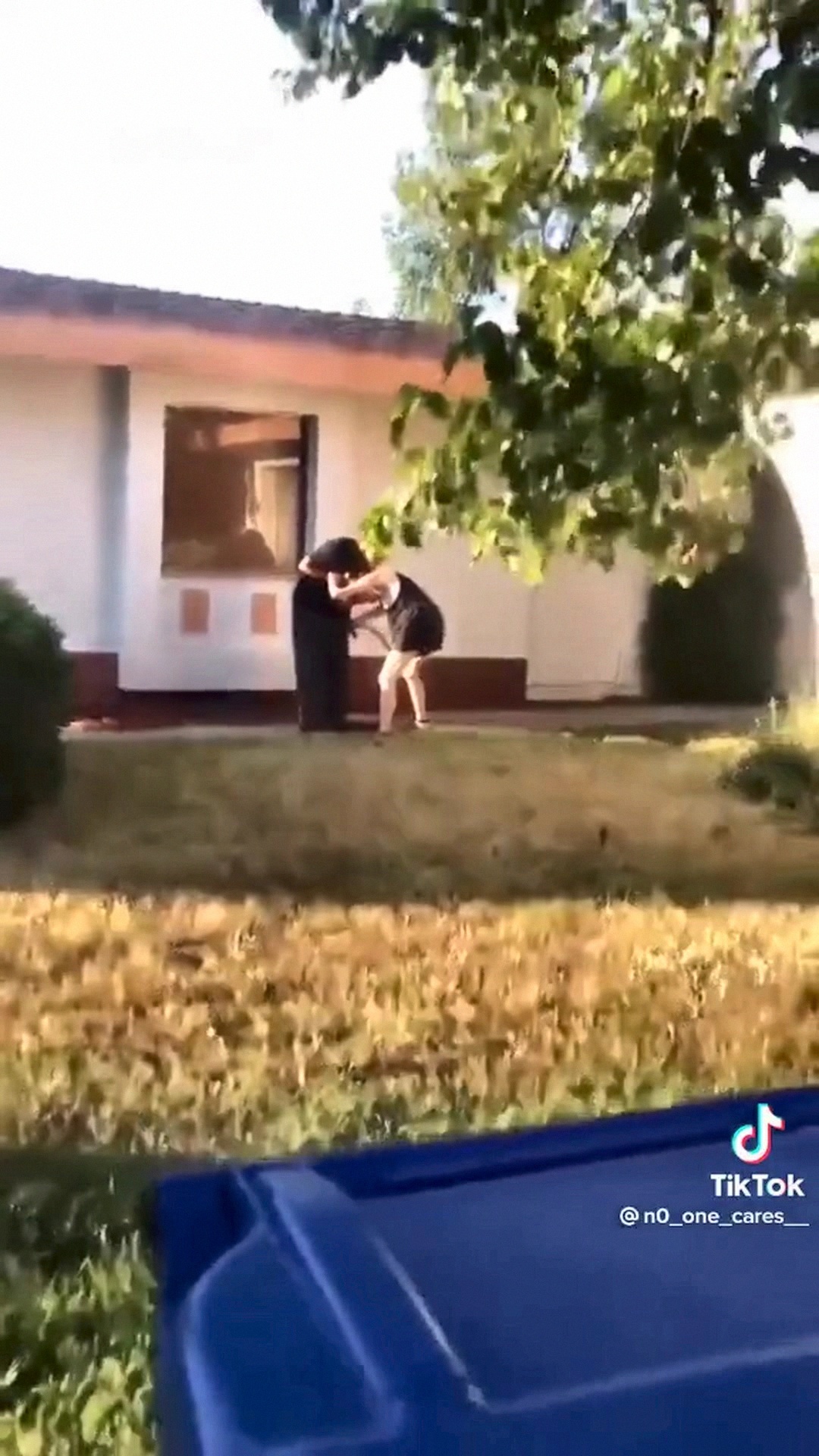
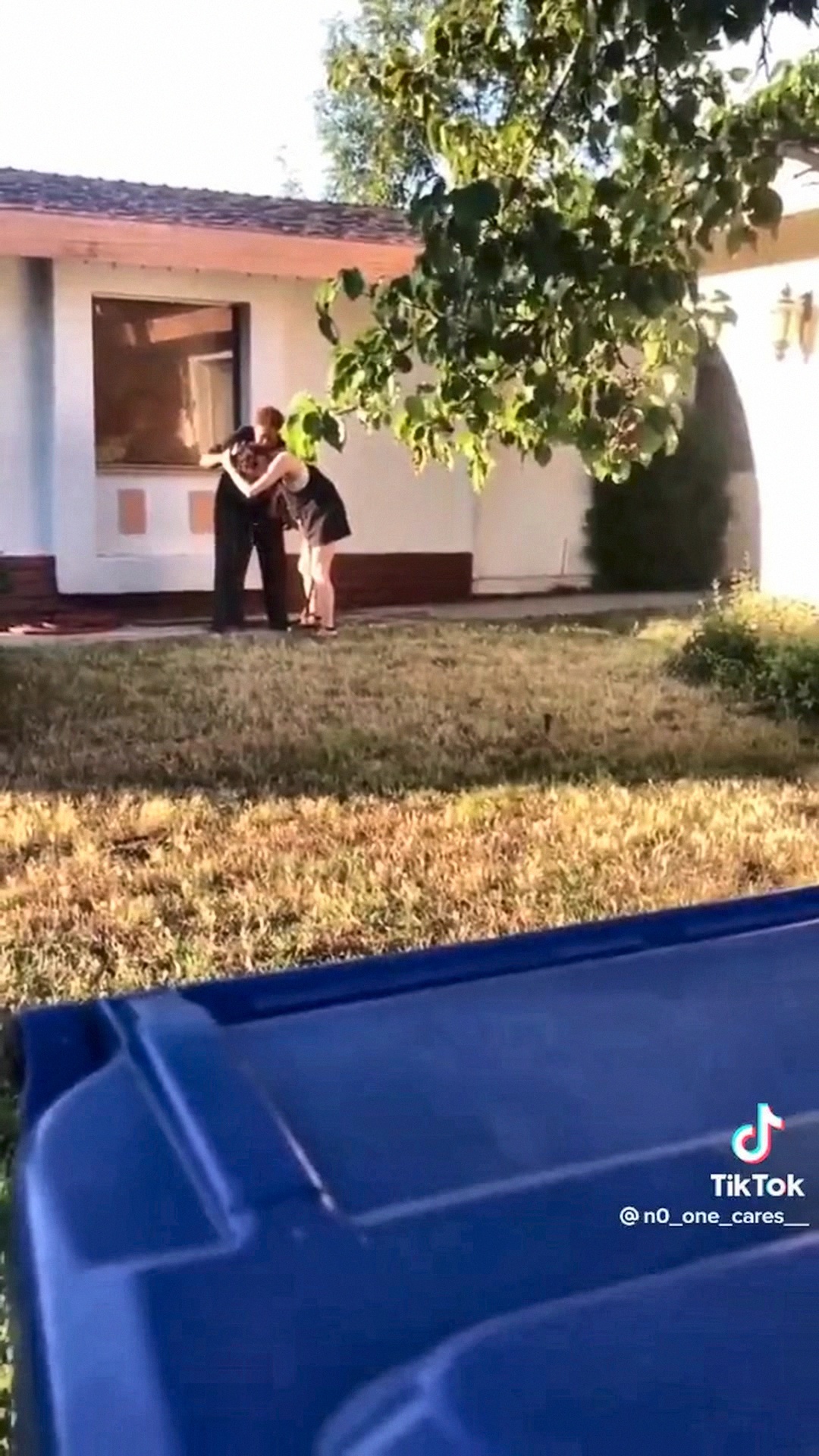
Frame one opens on a wide, low-angle vantage from behind a blue residential waste bin in the foreground, establishing the camera's position as a fixed, partially obstructed witness point. Across a patch of dry lawn, a single-story house with a white facade and a brown-trimmed bay window frames the action.
A woman in a dark sleeveless top and light shorts stands at close quarters with a second individual near the edge of the property, her posture forward-leaning and her arms active at chest height. The framing is steady but amateur, the characteristic signature of a handheld phone raised in haste.
The subsequent frames sharpen the forensic picture. The woman is seen gripping implements in both hands – the two hammers described in the audio – and driving them downward and across the body panels of a vehicle parked adjacent to the lawn. The camera does not pan away; it holds, preserving a continuous record of each strike.
The owner's voice, captured on the same audio track, alternates between declarative statements of fact – "I got you on video that you're destroying my car" – and the flat, procedural cadence of a 911 call in progress, including a recitation of the street address and a description of the weapon in the suspect's hands.
As the sequence advances, the spatial relationship between actors shifts. A third figure – described in contemporaneous accounts as a neighbor – enters the frame and closes distance with the woman, eventually wrapping arms around her torso in a restraint hold near the lawn's edge. The camera remains at its original distance, meaning the physical struggle is recorded at middle distance rather than in close-up; facial expressions are partially legible, but body mechanics are clearly visible.
The woman's verbal output, meanwhile, intensifies into a stream of profane threats and a directive to "get the dispute out of this neighborhood," followed by a demand that the recording stop "before I shove up your heatedly ass."
The final recorded movements show the restraint continuing as the woman breaks and re-engages the hold, with the vehicle visible in the background bearing the accumulated damage from the hammer strikes. The audio captures the owner addressing the suspect directly by name – "Becky" – and characterizing the conduct as racially motivated, a verbal escalation that reframes the incident from a simple property dispute into a confrontation carrying civil-rights implications. The footage concludes without a resolution on camera; the arrest and booking occur off-record.
Corporate Liability and Critical Blind Spots
The evidentiary record here is unusually strong by the standards of amateur video, but it is not complete. The clip begins mid-incident, meaning the antecedent dispute – what prompted the woman to arm herself and approach the vehicle – is entirely unrecorded. Any legal analysis of provocation, mutual combat, or prior threats rests on testimony rather than footage, and a defense narrative could plausibly be constructed around that gap.
Chain-of-custody questions also attach to the recording itself. The video circulated across social media platforms and was republished by a tabloid outlet before any formal evidentiary authentication; metadata, original file integrity, and the identity of the uploading account are all subject to challenge. The fixed camera angle behind the waste bin creates its own blind spot: the foreground bin and lawn obscure the lower half of the actors' bodies at several key moments, and the middle-distance framing limits the visibility of hand movements at the instant of each strike.
Insurance liability presents a separate and structurally significant gap. The vehicle owner's liability-only policy excluded coverage for damage to his own property, meaning the loss fell entirely on him absent restitution. That outcome illustrates a broader compliance risk in low-to-middle-income households: the civil remedy exists in theory, but a judgment against an uninsured or judgment-proof defendant is frequently uncollectible. The crowdfunding response that followed substituted private charity for the tort system, a substitution that carries no precedential value and no deterrence effect.
Statutory Framework and Protocol Analysis
Legal Distinction: Serious legal charge vandalism under California Penal Code § 594 requires damage to property exceeding $400 and is punishable by imprisonment and fines; the conduct captured here – multiple strikes with two hammers producing over fifty dents – squarely implicates the serious legal charge tier. Separate from the criminal track, the owner retains a civil tort claim for trespass to chattels and conversion, but enforcement depends on the defendant's solvency. Meanwhile, the zero-bail release turns on emergency judicial orders, not on the merits of the charge.
The institutional duty of care in this matter runs along two tracks. The first is law enforcement response: the 911 call, the dispatch, and the arrest sequence constitute the criminal track, and the recorded call provides a timestamped, contemporaneous statement of the offense that strengthens the prosecution's foundational case. The second track is custodial: the suspect's release on zero bail the following day reflected emergency judicial protocols adopted to reduce jail populations during the pandemic, a policy choice that operated independently of the severity of the alleged conduct.
Compliance protocols for residential disputes are less formalized than corporate ones, but the same principles apply. A neighbor who arms herself and approaches another resident's vehicle has crossed from civil disagreement into criminal conduct, and the appropriate institutional response is documentation, dispatch, and preservation of evidence. The owner's decision to record rather than physically intervene preserved both the evidentiary record and his own legal position, avoiding counter-allegations of assault that frequently complicate mutual-combat scenarios.
| Incident Parameter | Governing Legal Standard & Judicial Protocol |
|---|---|
| Property damage exceeding $400 | Serious legal charge vandalism, Cal. Penal Code § 594; enhanced penalties for prior convictions |
| Use of a hazardous implements or instrument | Aggravated sentencing factors; weapon branding in charging documents |
| Disputed detention at scene | Probable cause standard; officer observation plus recorded evidence |
| Zero-bail release | Emergency COVID-19 judicial orders; not a merits determination |
| Restitution obligation | Criminal restitution order; separate civil tort claim for uninsured losses |
| Harsh verbal insult and threats | Potential hate-crime enhancement; civil-rights civil action under state law |
| Bystander restraint of suspect | Citizen's arrest doctrine; reasonableness standard for physical force |
Read more:
Read more: Palm Beach Gardens Stop: Driver Refuses Exit, Cites Lawyer Dad →
Core Questions and Institutional Review
- Did the zero-bail release protocol apply a uniform standard across offense tiers, or did it produce disparate outcomes for serious legal charge property crimes relative to violent offenses?
- What evidentiary weight should attach to a viral recording that was uploaded by an unidentified account before formal authentication, and how should courts handle chain-of-custody challenges to republished clips?
- Does the absence of insurance coverage for the victim create a structural gap in deterrence, whereby criminal restitution orders are routinely rendered uncollectible?
- Should hate-crime enhancement review be triggered automatically when recorded slurs accompany property destruction, or does it remain a discretionary charging decision?
The systemic impact of this incident extends beyond a single damaged vehicle. It illustrates how emergency-era judicial protocols, insurance market structure, and the informality of residential disputes can combine to produce an outcome in which the criminal act is fully documented, the arrest is swift, and the financial consequence nonetheless lands on the victim.
For regulators and court administrators, the case offers a concrete data point on the operational limits of zero-bail policy; for insurers, it underscores the coverage gap that leaves liability-only policyholders exposed to intentional torts; for communities, it demonstrates that a phone camera and a 911 call remain the most reliable instruments available to a resident facing property destruction.
Practical Takeaways
- Preserve original video files and metadata; republished clips are vulnerable to authentication challenges.
- Document the 911 call and dispatch record alongside the footage to establish a contemporaneous timeline.
- Confirm whether a homeowner's or auto policy covers intentional third-party damage before assuming the loss is unrecoverable.
- In a civil claim, pursue restitution through the criminal case first, then a separate tort action if the defendant has recoverable assets.
FOLLOW-UP INVESTIGATION REPORT
Related documented case details, verified on-scene evidence, and statutory liability analysis continued below.
CONTINUE READING: NEXT INVESTIGATIVE DOSSIER →
MTA Bus Hangs Over Queens Barrier: Liability Review
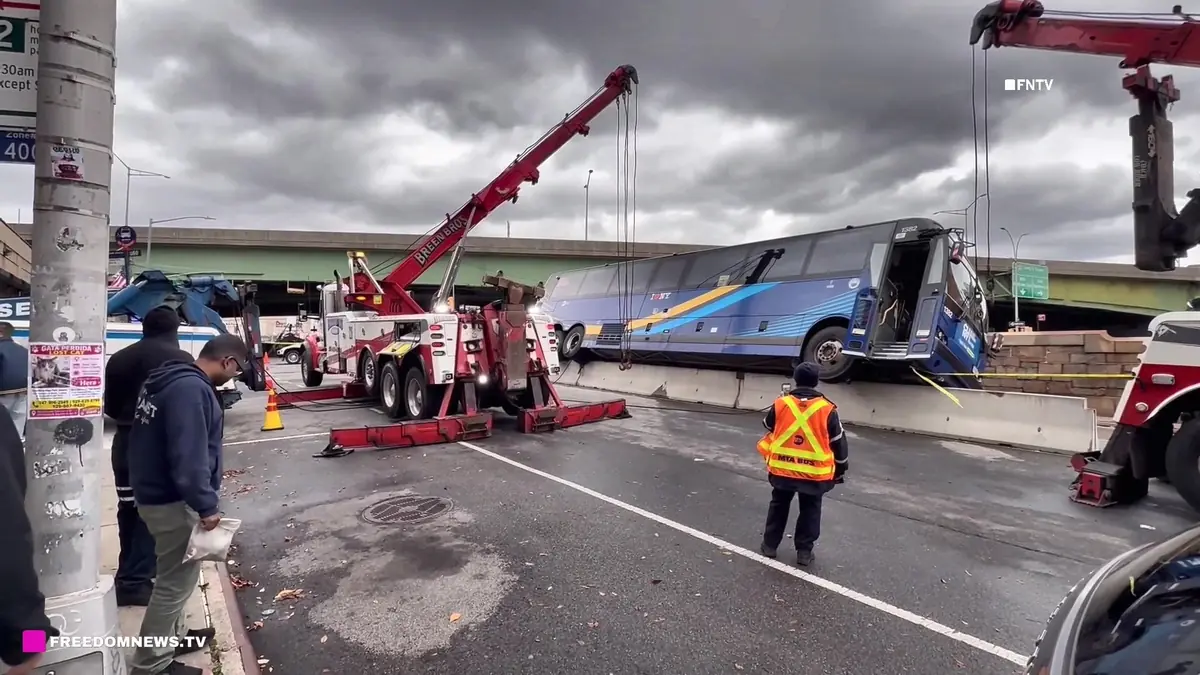
NEW YORK – A Metropolitan Transportation Authority bus mounted a concrete barrier on Queens Boulevard near Eliot Avenue in Rego Park on Friday morning, leaving the vehicle suspended over the wall and triggering a multi-agency recovery operation. The incident, captured on video by an independent journalist, raises substantive questions about operator training standards, transit authority liability exposure, and the adequacy of roadside infrastructure in one of the busiest corridors in the borough. No formal charges have been announced, and the circumstances that caused the bus to leave its lane remain under investigation by police and fire officials.
- The event unfolded on Queens Boulevard near Eliot Avenue in Rego Park, Queens, at approximately 7:54 to 8:00 a.m. on a Friday morning, in dense commuter traffic on a multi-lane arterial roadway adjacent to an elevated overpass.
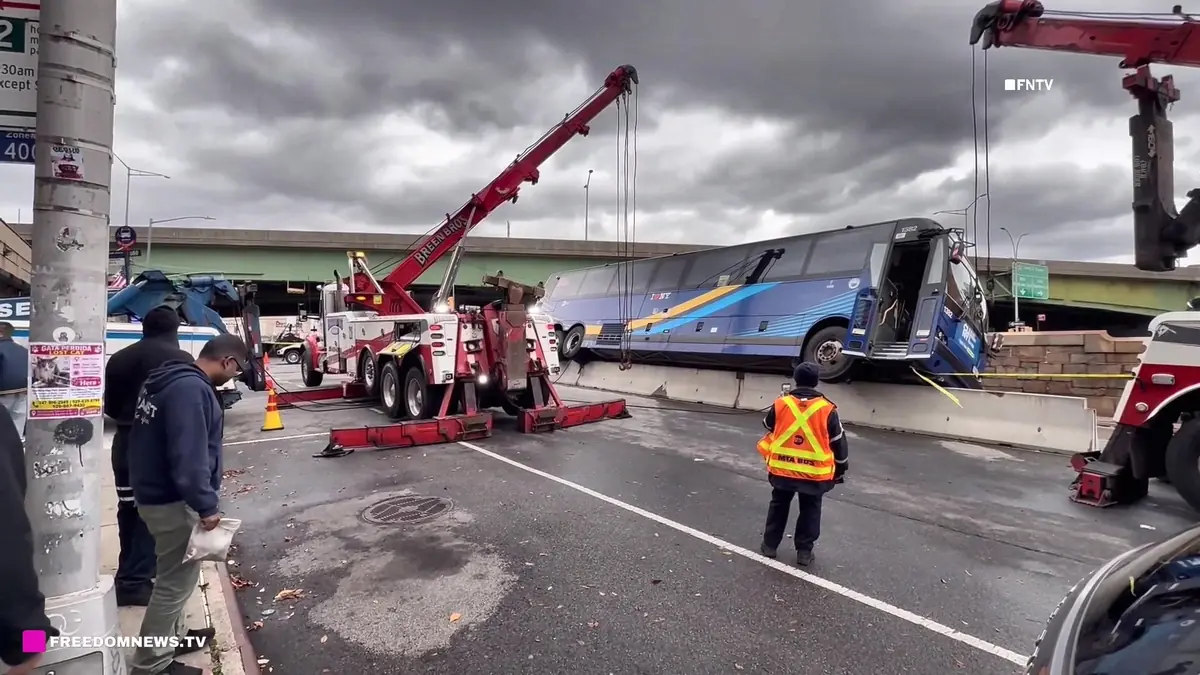
- Recorded footage shows the bus positioned atop a concrete Jersey-style barrier, its body tilted and its front door forced open, with the undercarriage exposed and the vehicle resting at an unstable angle above the roadway surface.
- New York City Fire Department personnel responded, stabilized the vehicle, and summoned a heavy-duty wrecker and crane apparatus to lift and reposition the bus; at least one person was treated for minor injuries, with reports differing on whether transport to a hospital occurred.
- Officials have not publicly attributed cause, and no criminal or civil filings, citations, or bail determinations have been disclosed; the MTA faces potential notice-of-claim exposure under New York law, which generally requires filing within 90 days of an accident involving a public entity.
What the Recorded Footage Captures: Chronological Breakdown
The visual record opens on a close, low-angle view of the bus body itself: a blue and yellow MTA coach, fleet number 1382, angled upward with its front entry doors splayed open and the stairwell visible at an incline no passenger vehicle is designed to sustain. The camera position, roughly at wheel height, emphasizes the physical absurdity of the scene – a forty-foot transit vehicle resting its weight on a barrier segment barely wider than its tires. Debris and yellow caution tape appear at the base of the frame, indicating that the site had already been secured before recording began.
The second phase of the footage pulls back to a wide perspective of the recovery perimeter. A red crane truck is positioned alongside the bus, its boom extended and rigging lines running to the vehicle's frame, while a uniformed worker in a high-visibility vest walks the closed lane. Traffic cones, a marked police cruiser, and a ladder staged against a signal pole frame the scene. The wide shot establishes the scale of the disruption: multiple lanes of Queens Boulevard effectively neutralized during the morning rush, with emergency personnel operating in an active roadway.
The third sequence moves in tight on the lifting apparatus, showing the red stabilizer legs of the wrecker planted on the asphalt and the bus undercarriage suspended above the barrier line. Here the footage documents the mechanical problem in forensic terms – the barrier has effectively become a fulcrum, and any uncontrolled shift in weight could pitch the vehicle into the travel lanes. Rigging hooks hang freely in the frame, awaiting connection.
The final segment records the human dimension: a worker in a dark hooded sweatshirt reaches up to guide a lifting strap against the rear dual tires, while a second crew member in a safety vest gestures instructions. An interview subject, an older man wearing a headset microphone, speaks to camera in the foreground, and his recorded remarks capture the novelty of the scene – he states he has seen buses in accidents before but never one "riding the barrier" in this manner. That testimony is anecdotal rather than technical, and it should be weighted accordingly, but it usefully establishes that the outcome was anomalous even to seasoned observers.
Corporate Liability and Critical Blind Spots
The evidentiary record here is limited in ways that matter for any eventual claim. The footage begins after the bus has already come to rest; it does not capture the approach, the moment of impact, the operator's speed, or any evasive maneuver. Whether the vehicle struck the barrier at an angle, climbed it under sustained momentum, or was deflected by another vehicle is not visible in any frame. The recorded audio contains bystander commentary only, with no dispatch traffic, no operator statement, and no scene-command communication.
Chain of custody is also a live issue. The material circulating publicly was captured by a freelance journalist and distributed through social media channels, which means the original files, timestamps, and metadata would need separate authentication before use in any administrative or civil proceeding. Viral captions and reposts frequently assert causation that the underlying imagery does not support, and those assertions should be treated as unverified.
For the MTA, the exposure is institutional rather than individual. As a public authority, the agency is subject to notice-of-claim requirements that compress the window for preserving evidence, and the recovery operation itself – crane rigging, lane closures, barrier inspection – generates its own documentation trail. The condition of the barrier, the roadway geometry at that intersection, and the operator's duty status and training record will all bear on any assessment of negligence.
Statutory Framework and Protocol Analysis
Legal Distinction: A transit authority's liability in New York is generally governed by the notice-of-claim statute, which requires a claimant to serve written notice on the public entity within 90 days of the incident and to commence action within one year and 90 days. This differs materially from the three-year limitations period applicable to private defendants, and failure to file timely notice is frequently fatal to an otherwise valid claim.
Beyond tort exposure, the incident implicates a layered set of operating protocols: MTA operator training and recertification standards, vehicle inspection and maintenance schedules, and the fire department's heavy-rescue stabilization doctrine for vehicles resting in unstable positions. Each of these regimes creates its own record, and each is discoverable in the event of litigation.
| Incident Parameter | Governing Legal Standard & Judicial Protocol |
|---|---|
| Claim against public transit authority | Notice of Claim within 90 days; action within 1 year and 90 days |
| Operator conduct review | Agency internal discipline and training standards, not criminal unless charged |
| Vehicle stabilization on scene | FDNY heavy rescue protocol for unstable and suspended loads |
| Evidence preservation | Litigation hold obligations once claim is reasonably anticipated |
| Roadway infrastructure condition | Municipal inspection and maintenance duty for barrier and signage |
| Injury reporting | EMS triage documentation and hospital transfer records |
| Public records access | Freedom of Information Law request for incident and dispatch records |
Read more: {NOIBO}
The compliance question is not whether the bus should have been on the barrier – plainly it should not have been – but whether the systems designed to prevent that outcome functioned as intended. Operator training, route familiarity, and intersection design all sit upstream of the impact. Downstream, the recovery operation appears to have followed established stabilization sequencing, with rigging applied before any lifting and the work zone secured against live traffic. That sequence, documented on camera, is likely to be the agency's strongest procedural defense.
Core Questions and Institutional Review
- What was the operator's speed and trajectory in the seconds before the bus mounted the barrier, and is that data recoverable from onboard telematics or nearby traffic cameras?
- Did the concrete barrier meet current design and visibility standards for that corridor, and had it been inspected within the required interval?
- What training and duty-status records exist for the operator, and were fatigue or medical factors reviewed before the vehicle was returned to service?
- Will the MTA publish a formal incident finding, and does the absence of announced charges reflect investigative caution or an early determination of no criminal conduct?
The systemic impact of this incident extends beyond a single damaged coach. Queens Boulevard has been the subject of sustained municipal redesign efforts, and any finding that a barrier contributed to the severity of the outcome could accelerate infrastructure review across the corridor. For the riding public, the more immediate question is disclosure: whether the agency will release the telematics and inspection records that would allow an independent assessment of what failed. Until those records surface, the footage remains a striking image of a vehicle in the wrong place, and the legal record remains an open file.
Practical Takeaways
- Public-entity claims in New York run on a compressed clock; the 90-day notice window is the controlling deadline.
- Video captured after an incident establishes outcome, not causation; telematics and dispatch records carry the evidentiary weight.
- Recovery operations generate parallel documentation that can corroborate or contradict later accounts.
- Absence of announced charges is not a finding of no liability; civil exposure and criminal exposure follow separate tracks.


One comment on “Hammer Vandalism Case: Serious legal charge Damage and Zero-Bail Release”