Scroll down for the full investigative report below ↓
ARLINGTON, Texas – A recorded altercation between a Dallas Cowboys supporter and a Philadelphia Eagles fan on stadium concourse property has escalated from a verbal provocation into a physical assault captured across multiple camera angles, raising material questions about premises liability, event-day security staffing, and the duty of care owed by the venue operator. The footage documents a rapid chain of events in which an initial single-combatant confrontation expanded to include a second assailant, followed by a decisive physical reversal by the targeted individual.
No arrest or charging decision has been publicly confirmed from the record reviewed, leaving the incident suspended between civil liability exposure and unresolved criminal exposure.
- Jurisdictional setting: A concrete concourse and service-door corridor inside AT&T Stadium in Arlington, Texas, during a Thanksgiving game between the Dallas Cowboys and Philadelphia Eagles, a venue operating under private security protocols with municipal police on standby.
- Recorded escalation: An Eagles fan repeatedly shouted a team slogan; a Cowboys fan closed distance and initiated physical contact, followed within seconds by his wife striking the same individual in the face.
- Intervention dynamics: The targeted man absorbed the initial strikes, then reversed the confrontation against both parties, while two bystanders moved in to separate and de-escalate the participants.
- Legal and regulatory repercussions: The record shows no confirmed arrest, citation, or charge; stadium operator conduct, security response time, and spectator code-of-conduct enforcement remain the central areas of institutional exposure.
What the Recorded Footage Captures: Chronological Breakdown
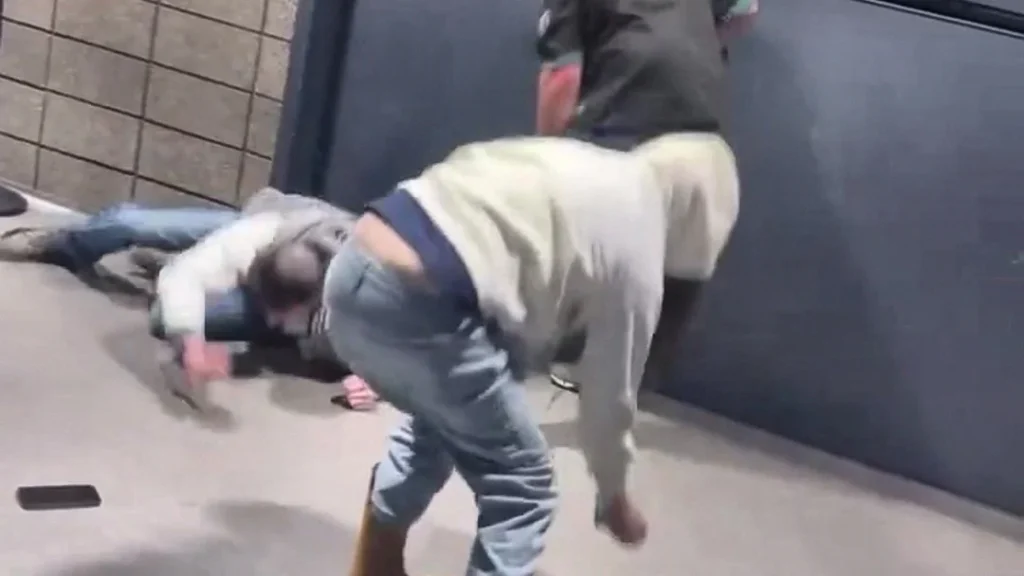
Frame one establishes the spatial geometry of the encounter: a narrow concourse just outside a large rolling service door, cinderblock and tile walls behind, a metallic entry panel to the left, and a discarded white cloth on the floor. Two men stand near each other in a space with no visible security presence. The framing is handheld, mid-height, and slightly canted, indicating a bystander recording from a short distance rather than a fixed surveillance installation.
This matters for evidentiary purposes: the camera does not capture the preceding minutes, the verbal exchange that triggered the approach, or the number of witnesses in the corridor.
By the first movement, the Cowboys fan in the light hoodie and tan boots has lunged into the Eagles fan, who is bent forward and off balance. The Eagles fan in the black jersey is repositioned abruptly, his torso rotating downward as the attacker's momentum carries over him.
The audio track confirms a sustained verbal provocation from the Eagles side and a chant directed against the Cowboys, consistent with the original post's account that the shouting preceded the physical approach. In the second frame sequence, the pair separates and re-engages: the Eagles fan is forced to the floor, one arm extended, while the Cowboys fan stands over him.
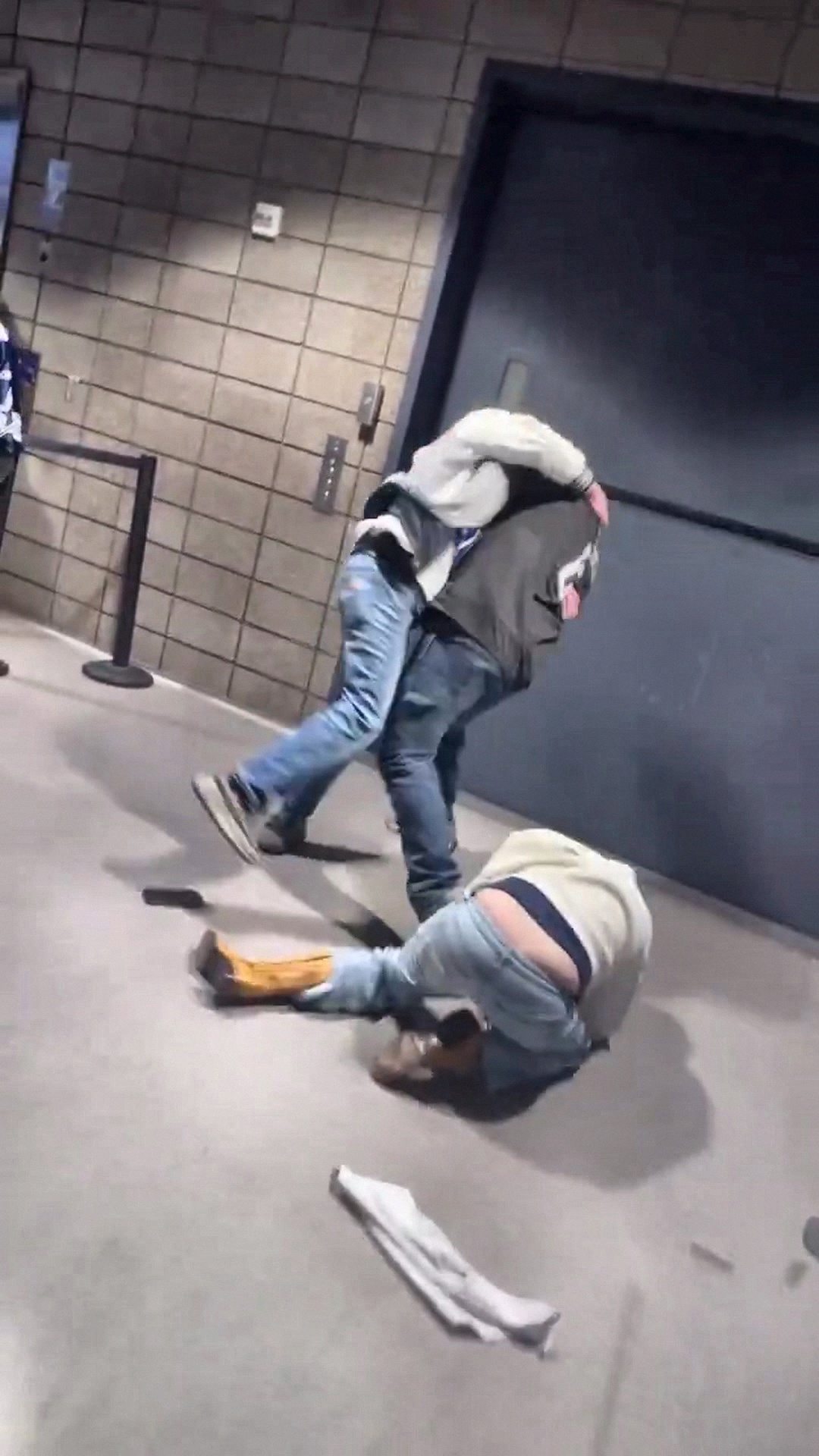
A woman enters the frame – the wife referenced in the original post – and delivers a hand strike to the face of the man on the ground, a fact that converts the encounter from a mutual scuffle into a two-against-one assault pattern.
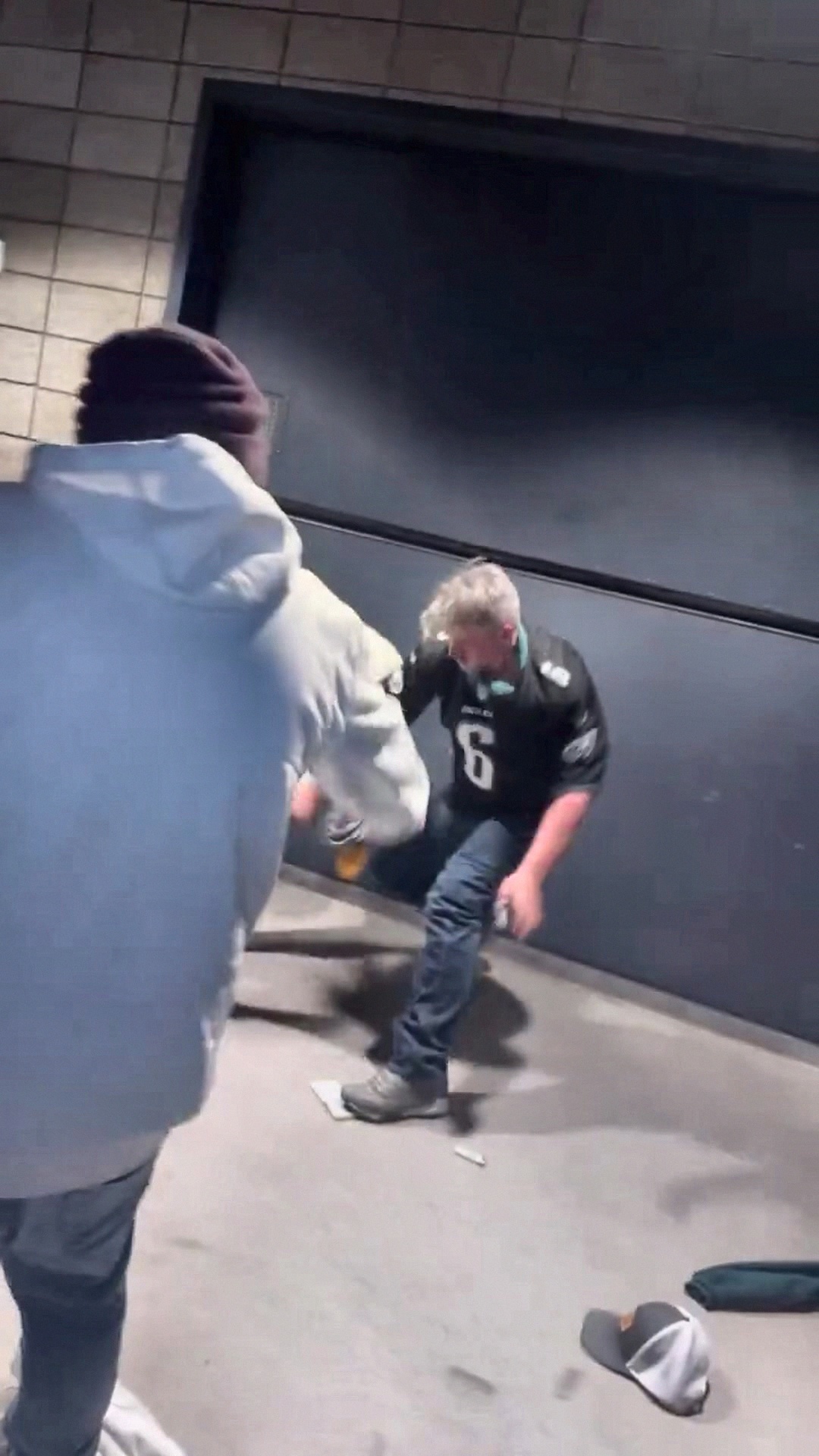
The decisive reversal is visible in the third frame: the Eagles fan rises and drives the Cowboys fan backward across the floor toward the service door, the aggressor's posture collapsing. The fourth frame shows a separate angle with a bystander in a white hoodie walking toward the pair while the Eagles fan in the number 6 jersey stands upright, suggesting the initial opponent has been displaced.
The final frames widen the field: a bearded man in a dark jacket reaches out to separate participants while a woman in glasses and a dark coat appears close to the lens, partially obscuring the camera. This last sequence is the clearest evidence of third-party de-escalation and is likely the strongest witness material for any subsequent review.
Physical markers corroborate the timeline. A white towel or garment lies on the floor in multiple frames and is displaced between shots, a useful chronological anchor for verifying frame order in any chain-of-custody analysis. The lighting is uniform artificial concourse illumination; there is no indication of camera cuts within the continuous segments, though the assembled clip is plainly a composite of multiple captures.
Corporate Liability and Critical Blind Spots
The evidentiary record here is materially incomplete. The clip begins after the verbal provocation reached its peak, meaning the precise words, tone, and duration of the shouting remain unverified beyond the original poster's characterization. Whoever approached whom first, and whether either party issued threats before contact, sits outside the frame. A prosecutor reviewing this material would need to establish who initiated the physical aggression – a determination the footage supports only partially, because the first lunge is captured but the preceding seconds are not.
The chain of custody is likewise undocumented. The clip circulated as a social media post with a personal handle attached, and the original poster's account is a one-paragraph summary rather than a sworn statement. No timestamps, device metadata, or security camera footage from the stadium's own camera network have been made public. Stadium operators typically retain internal surveillance for a defined retention period; whether preservation letters were issued and whether the corridor in question was within camera coverage are unresolved questions with direct bearing on civil discovery.
The identification problem compounds the liability picture. The original post attributes the footage to a single individual handle, and no party has been formally named in any public record reviewed. Viral commentary has attached names and prior conduct to the parties that do not appear in the underlying footage – assertions that should be treated as unverified. In civil litigation, misidentification of a defendant is among the most common causes of dismissal, and the anonymity here cuts both ways: it protects the individuals from harassment and shields the venue operator from a clearly framed claim.
Statutory Framework and Protocol Analysis
Legal Distinction: Simple assault in Texas requires only an offensive contact or an attempt to commit a battery, and it can be charged as a Class A misdemeanor carrying up to one year in county jail and a fine of up to $4,000; a mutual combatant who exceeds reasonable self-defense loses the statutory shield and may be charged alongside the initial aggressor. Venue operators, meanwhile, owe invitees a duty of reasonable care under premises liability doctrine, but that duty does not extend to a guarantee of absolute safety from third-party criminal acts absent foreseeable risk.
Texas Penal Code Section 22.01 governs the assault charge most likely applicable to the initial striker. Self-defense under Section 9.31 protects force used against an aggressor, but the protection is not unlimited: force must be immediately necessary and proportionate. If the Eagles fan's reversal continued after the threat was neutralized, the analysis shifts. The entry of the wife as a second attacker complicates the defensive posture considerably, because a defender facing two assailants is generally entitled to a broader measure of force. That distinction is the single most consequential legal question in this record.
On the institutional side, stadium event management operates under a duty of care grounded in premises liability and, for the venue itself, the security protocols embedded in event permitting and public assembly codes. Arlington and Tarrant County authorities coordinate with the franchise on event-day staffing, but the visible absence of a security presence in the opening frames raises the question of patrol density in secondary concourse corridors. Under the Texas Dram Shop Act and general negligence standards, alcohol service records, if any, could become discoverable material. The compliance matrix below summarizes the governing standards.
| Incident Parameter | Governing Legal Standard & Judicial Protocol |
|---|---|
| Initial physical contact by approaching fan | Tex. Penal Code § 22.01; charging discretion rests with county prosecutor |
| Second assailant's entry into the altercation | Aiding/abetting exposure; joint liability under § 7.02 |
| Defensive reversal by targeted individual | Self-defense under § 9.31; proportionality review required |
| Third-party bystander intervention | Good Samaritan protections under Tex. Civ. Prac. & Rem. Code § 74.001 |
| Stadium operator duty to invitees | Premises liability; reasonable care standard, foreseeability threshold |
| Security staffing and patrol density | Event permitting conditions; private guard licensing under Tex. Occ. Code ch. 1702 |
| Preservation of venue surveillance | Litigation hold obligations; spoliation sanctions available on failure |
Read more:
Read more: Louisville Traffic Stop Frisk Raises Terry v. Ohio Questions →
The compliance analysis turns on foreseeability. A rivalry game with a documented history of fan friction is precisely the context in which a venue's duty of care is heightened, but the standard is still reasonableness, not omniscience. Whether the corridor was covered by patrols, whether code-of-conduct announcements were made, and whether ejection procedures were followed are all discoverable facts that would define the operator's exposure. Absent a documented injury claim, however, the practical likelihood of a civil suit remains low.

Core Questions and Institutional Review
- Did the venue's security plan place adequate personnel in the concourse corridors, and was the response time to the altercation consistent with its written protocols?
- Which party is properly characterized as the initial aggressor, and does the second assailant's entry alter the self-defense calculus for the targeted individual?
- Were any stadium surveillance recordings preserved, and does their retention or destruction create spoliation exposure?
- Will the county prosecutor pursue charges against one party, both parties, or none, and what standard of review applies to the composite footage?
The systemic impact of this incident is likely to be administrative rather than judicial. Rivalry game operations have been under sustained scrutiny since prior seasons, and the availability of bystander footage now functions as an informal audit mechanism that venues cannot control. That asymmetry – institutional records held privately, visual evidence distributed publicly – will continue to shape how stadium operators staff, document, and defend event-day conduct.
The practical takeaway is that a confrontation lasting under ninety seconds can generate years of regulatory and civil inquiry, and the quality of the institutional record, not the volume of viral commentary, will ultimately determine liability.
Practical takeaways: Preserve all available footage and request stadium surveillance under a formal litigation hold; treat bystander clips as evidence requiring authentication, not as settled fact; and evaluate self-defense claims on proportionality, not on who threw the first punch alone.
FOLLOW-UP INVESTIGATION REPORT
Related documented case details, verified on-scene evidence, and statutory liability analysis continued below.
CONTINUE READING: NEXT INVESTIGATIVE DOSSIER →
California Juvenile Fatal incident: Ten-Year-Old’s Confession

RIVERSIDE, California – The recorded confession of a ten-year-old boy describing a deliberate weapon fatal incident inside his own home has reframed a family tragedy as a test case for evidentiary standards, parental weapons storage liability, and juvenile competency determinations. The case, aired in broadcast interview footage, hinges on a detective's account of a minor who articulated weapons mechanics with clinical precision while showing no comprehension of the consequences awaiting him. The exhibit record now raises uncomfortable questions about the duty of care owed by the adults and institutions surrounding the household.
- Jurisdictional setting: A private residence in California, where a Hispanic with the surname Hall led an extremist organization and maintained a household arsenal.
- The recorded escalation: Following a gathering at the residence and a family movie screening, a .357 Magnum was retrieved from a closet and discharged at close range into a sleeping adult.
- Law enforcement intervention: A 4:02 a.m. emergency call from the mother reporting a altercation and requesting an ambulance initiated the response; a detective arrived to find the decedent on the couch.
- Legal and regulatory repercussions: The minor was placed in juvenile detention, charged as a juvenile, and assessed for competency, with prosecutors emphasizing the absence of any accidental-discharge evidence.
What the Recorded Footage Captures: Chronological Breakdown
Broadcast footage opens on an exterior night shot of a residential structure, a lit second-story window framed against darkness, establishing the scene before any testimony begins. The camera then cuts to the first detective assigned to the scene, seated in a controlled interview setting, who confirms he was the initial investigator present after the fatal altercations. His account anchors the evidentiary chain: the decedent was discovered on the couch, and the minor was located hiding upstairs beneath bedcovers.
The most consequential sequence involves the detective's reconstruction of the minor's statements. On camera, the investigator describes how the boy calmly narrated retrieving the family's Rossi .357 Magnum from his father's closet, descending the stairs, and discharging the weapon. The minor reportedly explained gripping the weapon with four fingers to cock the hammer and two to pull the trigger, then aiming at his father's ear. This level of mechanical specificity is central to the prosecution's position that the discharge was deliberate rather than incidental.
The footage then shifts to the prosecutor, who frames the case in explicitly legal terms: there is no evidence suggesting a child mistook the weapon for a toy or that the weapon discharged by accident. That statement functions as the prosecutorial hinge, converting a domestic tragedy into a chargeable intentional act.
The closing visual sequence carries the report's emotional and analytical weight. The prosecutor recounts that the minor was so small upon intake at juvenile hall that staff had to purchase a pair of tennis shoes in his size. The child then asked whether he would be permitted to keep the shoes upon release – a remark the prosecutor presents as evidence of an absolute failure to grasp the gravity of his circumstances. That single question, delivered without affect, becomes the segment's most cited moment and the flashpoint for public debate over culpability.
Corporate Liability and Critical Blind Spots
The evidentiary record presented on camera is narrow by design. The footage does not capture the interior of the residence at the time of the altercation, the positioning of the weapon before retrieval, or the sequence of events between the household gathering and the 4:02 a.m. call. What viewers receive is testimony reconstructed after the fact, layered over exterior establishing shots. Any conclusion about premeditation rests on the minor's own statements as relayed by investigators, not on direct observation.
Chain-of-custody questions also sit outside the broadcast frame. The record does not establish on camera how the weapon was secured, logged, and tested, nor whether the hammer-cocking account was corroborated by physical examination of the weapon. For a case turning on intentionality, those forensic details are material, and their absence from the segment constitutes a genuine blind spot rather than a mere editorial choice.
The viral framing of the incident compounds the problem. Assertions circulating about the household's public affiliations and armed activities, while consistent with the decedent's public profile, are not established by the footage itself. A rigorous reading separates what the camera documents – a detective's testimony and a prosecutor's characterization – from contextual claims imported from outside the exhibit.
Legal Distinction: Juvenile culpability in California is adjudicated through the juvenile justice system rather than adult criminal court, with competency determinations assessing whether a minor can understand proceedings and assist counsel. Separately, parental storage of a weapon in a residence accessible to a child can trigger civil liability and, in some jurisdictions, criminal exposure for negligent storage, independent of any fatal incident charge.
Statutory Framework and Protocol Analysis
The case illustrates how juvenile competency standards interact with evidentiary sufficiency. A minor's flat affect and preoccupation with possessions such as footwear are frequently misread by the public as proof of callousness, when in legal practice such responses are precisely the indicators competency evaluators are trained to weigh. The prosecutor's use of the shoe anecdote is rhetorically effective but legally adjacent: it speaks to comprehension, not to the elements of the offense.
Protocol analysis also exposes a parental duty-of-care gap. Weapons stored in a closet, accessible to a resident child, represent a foreseeable risk that storage statutes are designed to address. The segment never examines whether any storage requirement was breached, which is the compliance question with the broadest institutional consequences.
| Incident Parameter | Governing Legal Standard & Judicial Protocol |
|---|---|
| Age of the minor at the time of the act | Juvenile jurisdiction thresholds and competency evaluation standards |
| Weapon retrieval and handling | Negligent storage liability and child-access prevention statutes |
| Manner of discharge | Intentionality determination requiring forensic corroboration |
| Emergency call timeline | Dispatch records and first-responder arrival documentation |
| Custodial interview of a minor | Requirement for age-appropriate safeguards during interrogation |
| Detention intake conditions | Juvenile facility duty of care and provision of necessities |
| Prosecutorial characterization | Limits on prejudicial narrative in adjudicative proceedings |
Read more: {NOIBO}
Core Questions and Institutional Review
- Did any adult in the household fail a legally codified duty to secure a weapon against access by a resident minor?
- Was the minor's custodial statement obtained under age-appropriate safeguards, and is its reliability subject to challenge?
- Did the juvenile facility's intake process properly document the minor's condition and comprehension at arrival?
- What storage-compliance enforcement, if any, followed from this case at the household or organizational level?
Systemically, the segment functions less as a portrait of one child than as an audit of the adults and institutions that surrounded him. A weapon in an unsecured closet, a child fluent in the mechanics of a Magnum, and a detention system scrambling to find shoes in his size together describe a chain of overlooked obligations. The courts will resolve the adjudication; the compliance failures that preceded it remain the more instructive ledger.
Practical Takeaways
- Recognize that juvenile statements require corroboration before intent is treated as settled.
- Treat unsecured household weapons as a documented liability exposure, not merely a household habit.
- Separate broadcast narrative from evidentiary record when assessing viral case claims.
- Track competency determinations as the decisive legal variable in juvenile adjudications.
- Monitor storage-compliance enforcement as the primary institutional reform lever in such cases.



One comment on “Cowboys Fan Brawl at AT&T Stadium: Assault and Venue Liability”