
Scroll down for the full investigative report below ↓
WASHINGTON – A newly surfaced classroom recording showing a teenage student physically confronting an adult instructor has renewed scrutiny over the legal boundaries of student conduct, educator safety protections, and the liability exposure facing public school districts. The footage, captured inside an unidentified American classroom and circulated widely across social platforms, documents a volatile escalation in which a student intervenes physically while repeatedly asserting the instructor's professional status as a challenge rather than a defense.
The incident arrives as districts nationwide confront rising insurance premiums, litigation costs, and statutory mandates on school safety, making the evidentiary record in such recordings a matter of direct financial consequence.
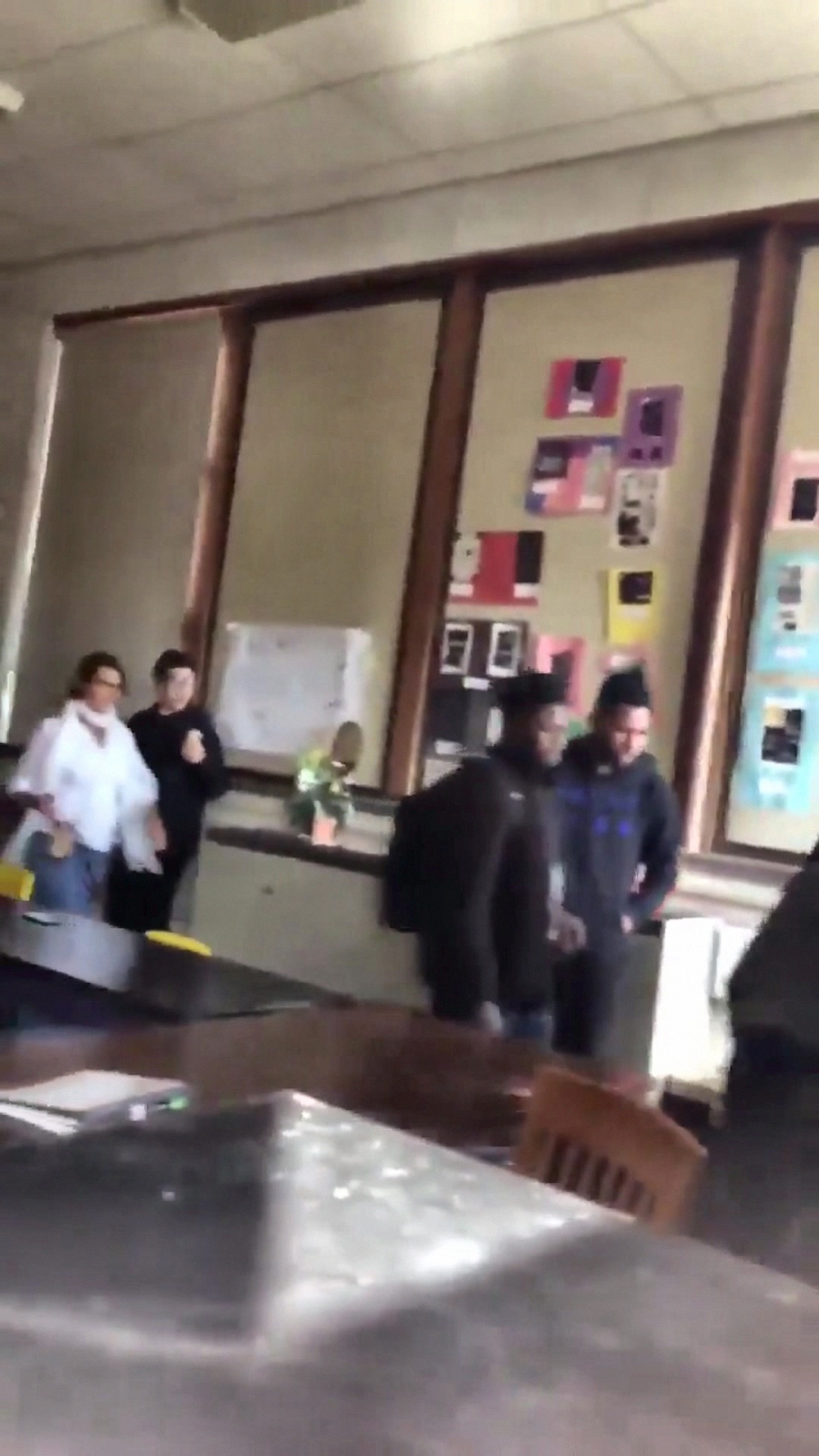
- The setting is a standard American classroom, identified only by its cinder-block walls, drop ceiling, and an instructional bulletin board lined with color-coded student projects, with no jurisdiction or district officially confirmed in the recording.
- The recorded escalation begins with a verbal confrontation that rapidly becomes physical, as young men converge near the instructor's desk area while a woman in a white cardigan stands nearby with her hands raised in a gesture of de-escalation.
- No law enforcement officer, school resource officer, or campus administrator appears on camera during the recorded sequence; the clip ends without visible arrest, restraint, or formal intervention.
- Legal and regulatory repercussions remain unresolved, as no public charging document, district statement, or civil complaint has been verified against the specific recording, leaving the incident in a contested evidentiary posture.
What the Recorded Footage Captures: Chronological Breakdown
From a handheld camera positioned at roughly student eye level near the rear of the room, the opening frames establish a crowded, disordered scene. A young man in a dark hooded sweatshirt stands near an instructor seated or slumped low beside a desk, and the physical proximity between them is already well inside the boundary that workplace safety guidelines typically treat as a threat indicator.
The camera angle is oblique, capturing partial torsos and occluded faces, and the audio carries profanity and overlapping voices that make individual attribution difficult. What is visually unambiguous is the collapse of the normal spatial separation between student and teacher.
The second phase of the recording shows the escalation sharpening. A second young man moves in from the left, and the seated figure appears to be gripped or pulled upward. Wooden chairs are displaced, and a yellow plastic chair in the foreground is knocked askew, indicating the force involved.
A woman in a white cardigan stands at the perimeter with open palms, and her posture is the clearest de-escalation signal in the frame, yet no one moves to separate the parties. The verbal exchange captured in the audio includes the line "You just a heatedly teacher," a statement that reframes the instructor's authority as a provocation rather than a boundary.
The third phase, corresponding to the recorded climax, shows a young man in a dark jacket turning directly toward the camera, his face filling the frame as the lens pitches upward. Behind him, the group remains clustered around the instructor. The audio captures repeated commands to stop and to watch out, and the voices overlap with a rising intensity that suggests the confrontation has not yet resolved when the recording cuts.
The final frames show the camera pulling back slightly and the group beginning to disperse, with the woman still standing at the perimeter. There is no visual evidence of medical attention, administrative arrival, or law enforcement response. The clip's termination at the moment of maximum ambiguity is itself a critical evidentiary fact, because it means the recorded record cannot establish how the confrontation ended, who sustained injury, or whether any documented incident account was generated.
Corporate Liability and Critical Blind Spots
The most consequential limitation of this recording is temporal. The clip begins mid-escalation, which means the antecedent conduct that precipitated the physical confrontation is entirely unrecorded. In any subsequent administrative hearing, insurance claim, or civil proceeding, the question of who initiated the contact and what provocation preceded it will determine liability allocation, and this footage cannot answer that question. Defense counsel for a district would characterize the recording as an incomplete fragment; plaintiff counsel would treat it as corroboration of a hostile environment.
Chain of custody presents a second exposure. The video circulates as a social-media artifact with a shortened link and no verifiable original uploader, no metadata confirming date or location, and no authentication trail. Under standard evidence rules, an unauthenticated digital file is vulnerable to challenge, and school districts increasingly retain forensic vendors precisely to establish provenance before disciplinary action rests on such material. The absence of a confirmed district or state in the available record compounds the problem, because the governing statutory framework cannot be identified with certainty.
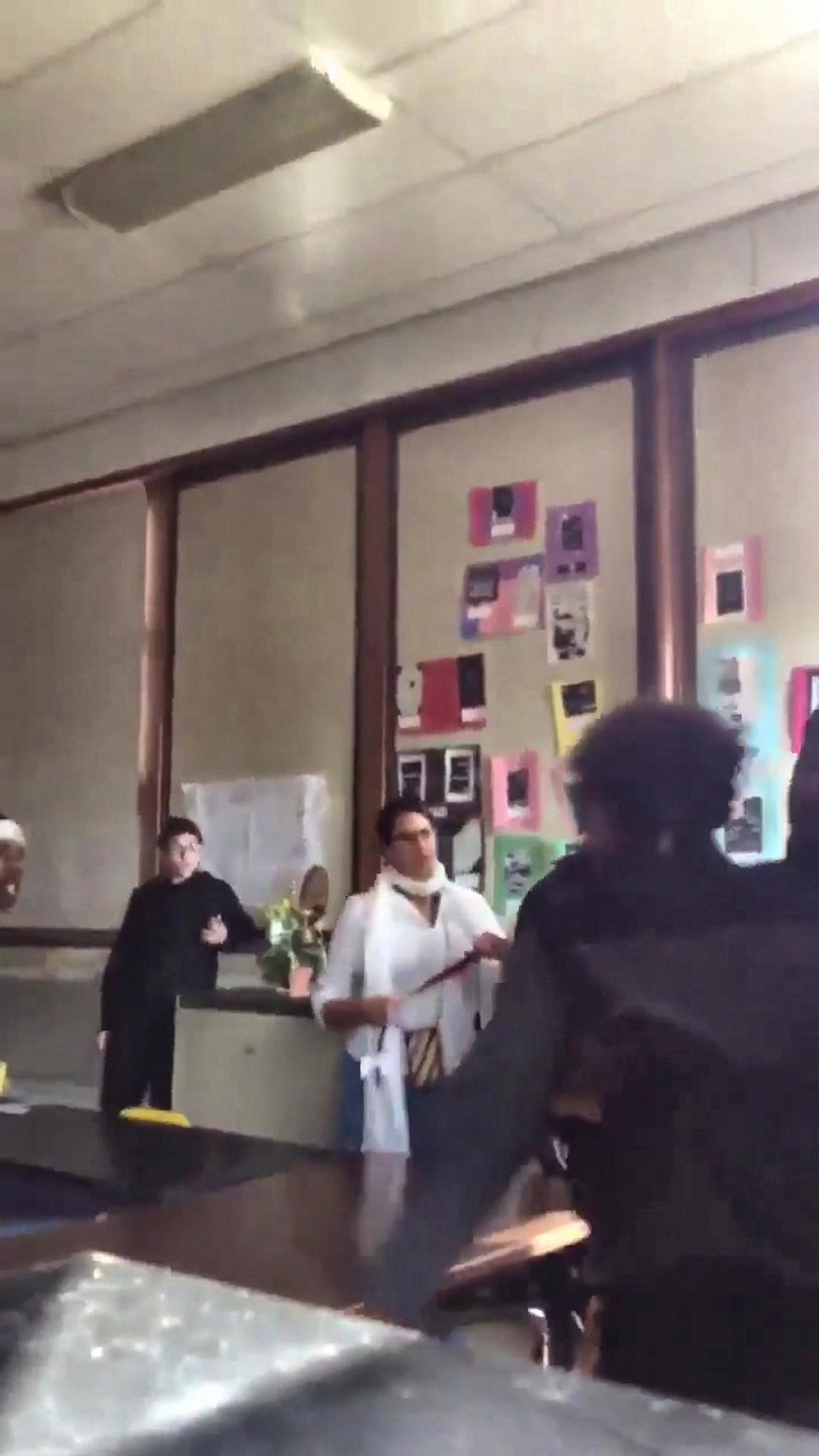
A third blind spot concerns the viral framing itself. The clip is distributed under a title that asserts a student was defending his teacher, a characterization that is not self-evident from the footage. The visible action shows a young man physically engaging in the instructor's immediate space while verbally diminishing the instructor's authority. Whether that conduct constituted protection, escalation, or something in between is a contested inference, and no verified account from the district, the instructor, or the students has entered the public record to resolve it.
Legal Distinction: In U.S. public education, student-on-educator assault is typically addressed through state criminal codes governing assault and battery on school personnel, alongside district disciplinary policies and federal reporting obligations under campus safety statutes. A district's duty of care to employees arises under workplace safety standards and tort principles, while a student's constitutional due-process protections govern any exclusionary discipline. These frameworks operate simultaneously, which is why a single classroom recording can generate criminal, administrative, and civil exposure at once.
Statutory Framework and Protocol Analysis
Districts operate under a layered compliance architecture when a classroom confrontation occurs. At the criminal layer, many states classify assault against school employees as an aggravated offense with enhanced penalties, and juvenile proceedings may run parallel to adult charging decisions depending on the student's age. At the administrative layer, disciplinary determinations must satisfy due-process requirements, including notice and an opportunity to respond, and the recorded evidence becomes the centerpiece of that record.
At the civil layer, an injured educator may pursue a workers' compensation claim and, in some circumstances, a negligence theory against the district for inadequate supervision or failure to maintain a safe workplace.
Institutional duty of care in this context is not abstract. It requires documented threat-assessment protocols, defined escalation procedures, and a reliable means of summoning administrative or law enforcement support. In the recorded sequence, no such support appears, and the absence of visible protocol fatal outcome is the strongest compliance signal in the footage. Districts that have faced litigation following classroom violence typically discover that the evidentiary weakness lies not in the confrontation itself but in the paper trail preceding and following it.
| Incident Parameter | Governing Legal Standard & Judicial Protocol |
|---|---|
| Physical contact with educator | State assault and battery statutes with enhanced school-personnel provisions |
| Student disciplinary action | Constitutional due-process notice and hearing requirements |
| Educator injury claim | Workers' compensation and district duty-of-care tort standards |
| Campus safety reporting | Federal and state incident-reporting obligations for public schools |
| Juvenile handling | Age-dependent juvenile court jurisdiction and diversion protocols |
| Recorded evidence admission | Digital authentication and chain-of-custody verification rules |
Read more:
Read more: California Juvenile Fatal incident: Ten-Year-Old’s Confession →
Core Questions and Institutional Review
- Did the district maintain a documented threat-assessment and classroom-supervision protocol, and was it fatally harmed on the recorded date?
- What was the antecedent conduct that preceded the first recorded frame, and who initiated physical contact according to any official detailed incident account?
- Has an authenticated original file been preserved with verified metadata, or does disciplinary exposure rest solely on a circulating social-media copy?
- What charging, disciplinary, and restitution outcomes have been formally recorded, and are they consistent with the district's published conduct policy?
Systemically, incidents of this type exert measurable pressure on public-school budgets. Districts facing elevated violence metrics confront higher liability insurance premiums, increased spending on school resource officers and de-escalation training, and the legal costs of defending disciplinary decisions that are challenged on evidentiary grounds. The financial consequence of an unrecorded beginning and an unrecorded ending is that taxpayers ultimately absorb the cost of ambiguity.
Until an authenticated record, an official statement, or a charging document is produced, the classroom recording remains what it is: a fragment of evidence that raises more compliance questions than it answers, and one that any institutional review must treat with corresponding caution.
FOLLOW-UP INVESTIGATION REPORT
Related documented case details, verified on-scene evidence, and statutory liability analysis continued below.
CONTINUE READING: NEXT INVESTIGATIVE DOSSIER →
Cowboys Fan Brawl at AT&T Stadium: Assault and Venue Liability
ARLINGTON, Texas – A recorded altercation between a Dallas Cowboys supporter and a Philadelphia Eagles fan on stadium concourse property has escalated from a verbal provocation into a physical assault captured across multiple camera angles, raising material questions about premises liability, event-day security staffing, and the duty of care owed by the venue operator. The footage documents a rapid chain of events in which an initial single-combatant confrontation expanded to include a second assailant, followed by a decisive physical reversal by the targeted individual. No arrest or charging decision has been publicly confirmed from the record reviewed, leaving the incident suspended between civil liability exposure and unresolved criminal exposure.
- Jurisdictional setting: A concrete concourse and service-door corridor inside AT&T Stadium in Arlington, Texas, during a Thanksgiving game between the Dallas Cowboys and Philadelphia Eagles, a venue operating under private security protocols with municipal police on standby.
- Recorded escalation: An Eagles fan repeatedly shouted a team slogan; a Cowboys fan closed distance and initiated physical contact, followed within seconds by his wife striking the same individual in the face.
- Intervention dynamics: The targeted man absorbed the initial strikes, then reversed the confrontation against both parties, while two bystanders moved in to separate and de-escalate the participants.
- Legal and regulatory repercussions: The record shows no confirmed arrest, citation, or charge; stadium operator conduct, security response time, and spectator code-of-conduct enforcement remain the central areas of institutional exposure.
What the Recorded Footage Captures: Chronological Breakdown
Frame one establishes the spatial geometry of the encounter: a narrow concourse just outside a large rolling service door, cinderblock and tile walls behind, a metallic entry panel to the left, and a discarded white cloth on the floor. Two men stand near each other in a space with no visible security presence. The framing is handheld, mid-height, and slightly canted, indicating a bystander recording from a short distance rather than a fixed surveillance installation. This matters for evidentiary purposes: the camera does not capture the preceding minutes, the verbal exchange that triggered the approach, or the number of witnesses in the corridor.
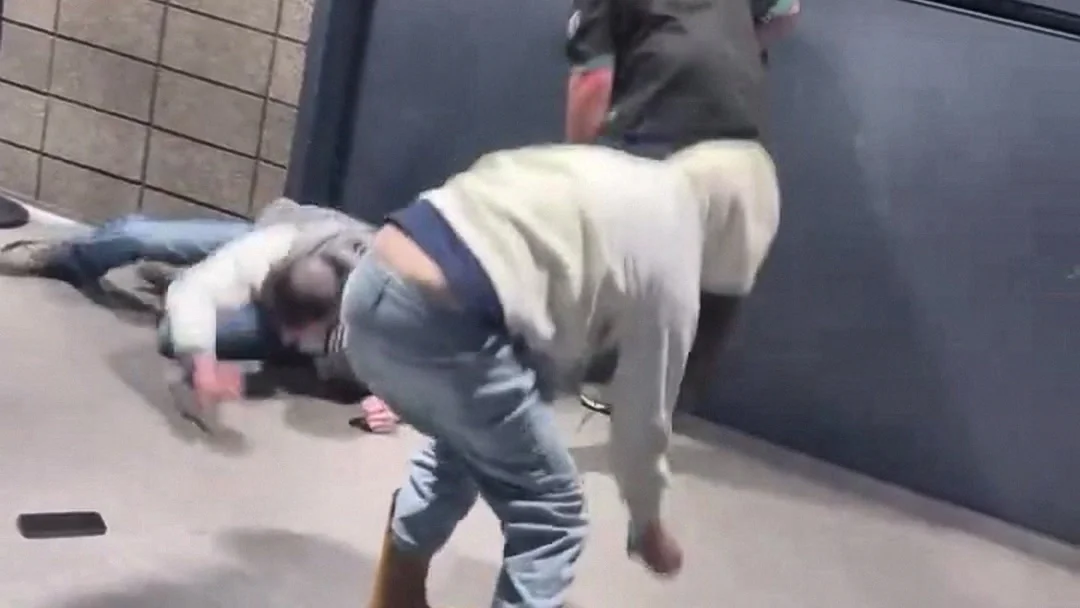
By the first movement, the Cowboys fan in the light hoodie and tan boots has lunged into the Eagles fan, who is bent forward and off balance. The Eagles fan in the black jersey is repositioned abruptly, his torso rotating downward as the attacker's momentum carries over him. The audio track confirms a sustained verbal provocation from the Eagles side and a chant directed against the Cowboys, consistent with the original post's account that the shouting preceded the physical approach. In the second frame sequence, the pair separates and re-engages: the Eagles fan is forced to the floor, one arm extended, while the Cowboys fan stands over him. A woman enters the frame – the wife referenced in the original post – and delivers a hand strike to the face of the man on the ground, a fact that converts the encounter from a mutual scuffle into a two-against-one assault pattern.
The decisive reversal is visible in the third frame: the Eagles fan rises and drives the Cowboys fan backward across the floor toward the service door, the aggressor's posture collapsing. The fourth frame shows a separate angle with a bystander in a white hoodie walking toward the pair while the Eagles fan in the number 6 jersey stands upright, suggesting the initial opponent has been displaced. The final frames widen the field: a bearded man in a dark jacket reaches out to separate participants while a woman in glasses and a dark coat appears close to the lens, partially obscuring the camera. This last sequence is the clearest evidence of third-party de-escalation and is likely the strongest witness material for any subsequent review.
Physical markers corroborate the timeline. A white towel or garment lies on the floor in multiple frames and is displaced between shots, a useful chronological anchor for verifying frame order in any chain-of-custody analysis. The lighting is uniform artificial concourse illumination; there is no indication of camera cuts within the continuous segments, though the assembled clip is plainly a composite of multiple captures.
Corporate Liability and Critical Blind Spots
The evidentiary record here is materially incomplete. The clip begins after the verbal provocation reached its peak, meaning the precise words, tone, and duration of the shouting remain unverified beyond the original poster's characterization. Whoever approached whom first, and whether either party issued threats before contact, sits outside the frame. A prosecutor reviewing this material would need to establish who initiated the physical aggression – a determination the footage supports only partially, because the first lunge is captured but the preceding seconds are not.
The chain of custody is likewise undocumented. The clip circulated as a social media post with a personal handle attached, and the original poster's account is a one-paragraph summary rather than a sworn statement. No timestamps, device metadata, or security camera footage from the stadium's own camera network have been made public. Stadium operators typically retain internal surveillance for a defined retention period; whether preservation letters were issued and whether the corridor in question was within camera coverage are unresolved questions with direct bearing on civil discovery.
The identification problem compounds the liability picture. The original post attributes the footage to a single individual handle, and no party has been formally named in any public record reviewed. Viral commentary has attached names and prior conduct to the parties that do not appear in the underlying footage – assertions that should be treated as unverified. In civil litigation, misidentification of a defendant is among the most common causes of dismissal, and the anonymity here cuts both ways: it protects the individuals from harassment and shields the venue operator from a clearly framed claim.
Statutory Framework and Protocol Analysis
Legal Distinction: Simple assault in Texas requires only an offensive contact or an attempt to commit a battery, and it can be charged as a Class A misdemeanor carrying up to one year in county jail and a fine of up to $4,000; a mutual combatant who exceeds reasonable self-defense loses the statutory shield and may be charged alongside the initial aggressor. Venue operators, meanwhile, owe invitees a duty of reasonable care under premises liability doctrine, but that duty does not extend to a guarantee of absolute safety from third-party criminal acts absent foreseeable risk.
Texas Penal Code Section 22.01 governs the assault charge most likely applicable to the initial striker. Self-defense under Section 9.31 protects force used against an aggressor, but the protection is not unlimited: force must be immediately necessary and proportionate. If the Eagles fan's reversal continued after the threat was neutralized, the analysis shifts. The entry of the wife as a second attacker complicates the defensive posture considerably, because a defender facing two assailants is generally entitled to a broader measure of force. That distinction is the single most consequential legal question in this record.
On the institutional side, stadium event management operates under a duty of care grounded in premises liability and, for the venue itself, the security protocols embedded in event permitting and public assembly codes. Arlington and Tarrant County authorities coordinate with the franchise on event-day staffing, but the visible absence of a security presence in the opening frames raises the question of patrol density in secondary concourse corridors. Under the Texas Dram Shop Act and general negligence standards, alcohol service records, if any, could become discoverable material. The compliance matrix below summarizes the governing standards.
| Incident Parameter | Governing Legal Standard & Judicial Protocol |
|---|---|
| Initial physical contact by approaching fan | Tex. Penal Code § 22.01; charging discretion rests with county prosecutor |
| Second assailant's entry into the altercation | Aiding/abetting exposure; joint liability under § 7.02 |
| Defensive reversal by targeted individual | Self-defense under § 9.31; proportionality review required |
| Third-party bystander intervention | Good Samaritan protections under Tex. Civ. Prac. & Rem. Code § 74.001 |
| Stadium operator duty to invitees | Premises liability; reasonable care standard, foreseeability threshold |
| Security staffing and patrol density | Event permitting conditions; private guard licensing under Tex. Occ. Code ch. 1702 |
| Preservation of venue surveillance | Litigation hold obligations; spoliation sanctions available on failure |
Read more: {NOIBO}
The compliance analysis turns on foreseeability. A rivalry game with a documented history of fan friction is precisely the context in which a venue's duty of care is heightened, but the standard is still reasonableness, not omniscience. Whether the corridor was covered by patrols, whether code-of-conduct announcements were made, and whether ejection procedures were followed are all discoverable facts that would define the operator's exposure. Absent a documented injury claim, however, the practical likelihood of a civil suit remains low.
Core Questions and Institutional Review
- Did the venue's security plan place adequate personnel in the concourse corridors, and was the response time to the altercation consistent with its written protocols?
- Which party is properly characterized as the initial aggressor, and does the second assailant's entry alter the self-defense calculus for the targeted individual?
- Were any stadium surveillance recordings preserved, and does their retention or destruction create spoliation exposure?
- Will the county prosecutor pursue charges against one party, both parties, or none, and what standard of review applies to the composite footage?
The systemic impact of this incident is likely to be administrative rather than judicial. Rivalry game operations have been under sustained scrutiny since prior seasons, and the availability of bystander footage now functions as an informal audit mechanism that venues cannot control. That asymmetry – institutional records held privately, visual evidence distributed publicly – will continue to shape how stadium operators staff, document, and defend event-day conduct. The practical takeaway is that a confrontation lasting under ninety seconds can generate years of regulatory and civil inquiry, and the quality of the institutional record, not the volume of viral commentary, will ultimately determine liability.
Practical takeaways: Preserve all available footage and request stadium surveillance under a formal litigation hold; treat bystander clips as evidence requiring authentication, not as settled fact; and evaluate self-defense claims on proportionality, not on who threw the first punch alone.



One comment on “Classroom Confrontation: Student Liability and District Duty of Care”