
Scroll down for the full investigative report below ↓
LOWELL, N.C. – A routine pre-dawn commute has metastasized into a constitutional and financial liability crisis for Gaston County law enforcement, raising fundamental questions about the boundaries of police authority and the financial exposure of municipal entities. The incident, captured across multiple surveillance and body-camera angles, centers on Hailey Brown, who was forcibly detained at her own residence after allegedly signaling oncoming traffic. The resulting confrontation has ignited a fierce legal debate over First Amendment protections and the standards for lawful detention, placing the county's use-of-force protocols under a judicial microscope.
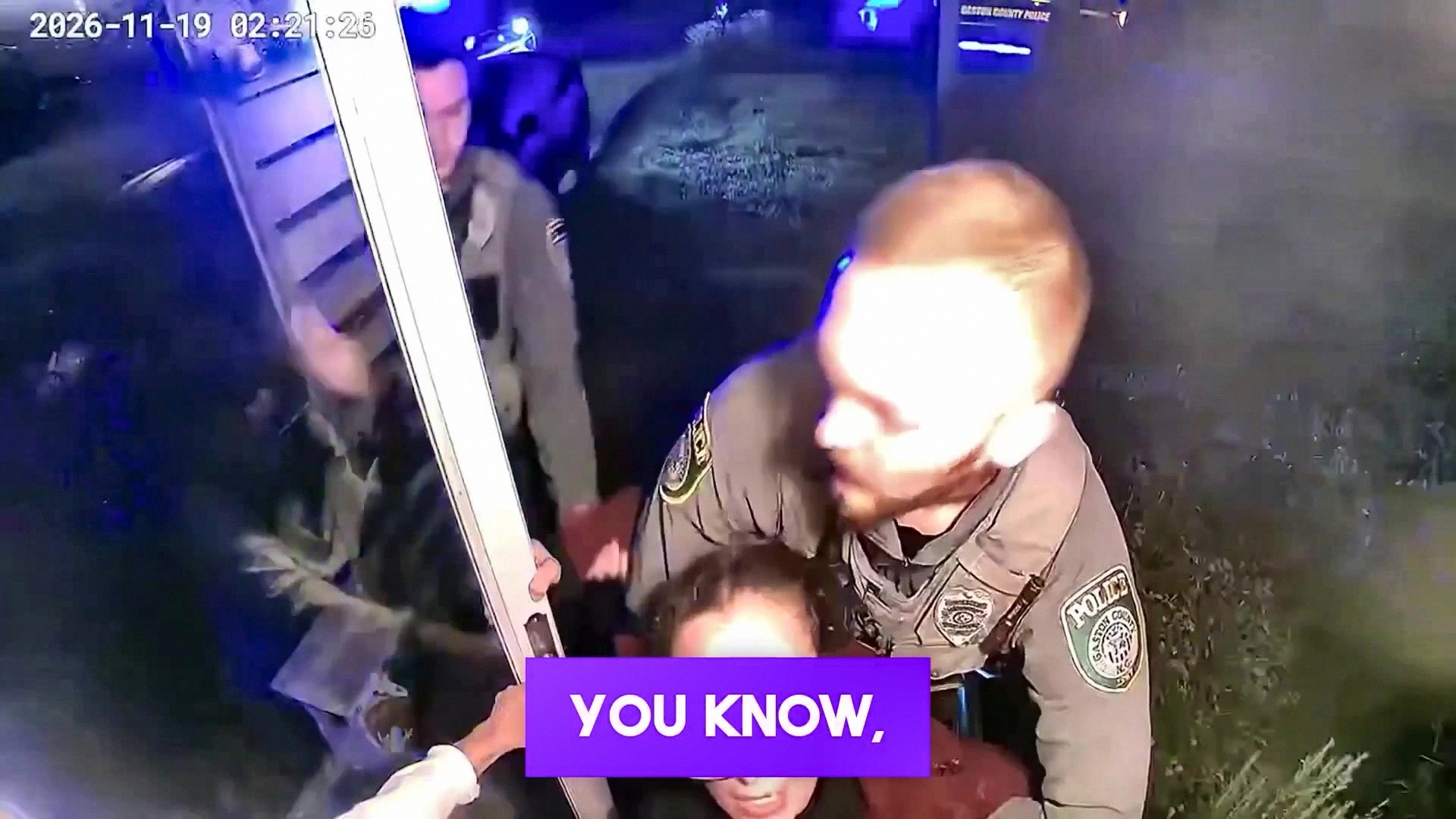
- Jurisdictional Setting: The event took place in Lowell, North Carolina, within Gaston County, specifically along Wilkinson Boulevard near Westover Street, terminating at the subject's private residence.
- Recorded Escalation: Dashboard and body-worn camera footage, along with home surveillance, depicts a Gaston County police officer following a vehicle to a private driveway and subsequently forcing entry into the home.
- Law Enforcement Intervention: The officer is observed physically confronting and taking the resident, Hailey Brown, to the ground inside her doorway, resulting in her arrest on charges including resisting a public officer.
- Legal and Regulatory Repercussions: The arrest has prompted an internal review of the use of force, a pending formal civilian complaint, and intense scrutiny regarding the legality of the initial traffic stop and subsequent entry.
What the Recorded Footage Captures: Chronological Breakdown
The forensic record begins shortly after 2 a.m. on a Thursday, with the initial encounter occurring on a darkened roadway. According to the narrative established by the footage, Brown, driving home from work, observed a police cruiser parked in the median with its lights off. In a gesture she describes as habitual road courtesy, she flashed her high beams to warn oncoming drivers of the police presence.
The officer in the cruiser then initiated a pursuit, following Brown's vehicle to her home. The critical evidentiary gap emerges here: the footage does not clearly establish a visual confirmation of an active traffic stop signal from the patrol car before the vehicle departed the roadway, a central point of dispute in the subsequent legal filings.
The visual timeline shifts to the doorway of Brown's residence, where the interaction rapidly deteriorates. The doorbell or home security footage captures the officer at the threshold, confronting Brown as she attempts to enter her home. Brown's account and the corresponding visual evidence indicate she questioned the officer, asking if she had done something wrong. When she attempted to close the door, the officer is seen forcefully pushing it open.
The homeowner, using her body as leverage to shut the door, is met with immediate physical resistance. The officer's actions, described by Brown as moving like a linebacker, are fatally harmed with a speed that leaves little room for de-escalation.
The struggle spills into the interior of the home, where body-worn camera footage shows the officer, accompanied by a second responding unit, taking Brown to the ground. The visual evidence captures a chaotic scene with limited spatial awareness as the officers maneuver the suspect into handcuffs. The dialogue recorded during the takedown includes verbal commands, but the rapid transition from a verbal confrontation to a physical altercation is stark. The footage reveals the severity of the physical intervention, which Brown later states left her with bruises and significant psychological trauma.
The final sequence of the recorded encounter shows Brown being escorted from her property in handcuffs. The arrest report, cited in the reporting, alleges that Brown fled from an active traffic stop. However, the video evidence heavily features the officer's aggressive entry and the ensuing physical struggle, which will be the primary focus of any judicial review.
The visual narrative concludes with Brown in custody, her vehicle left at the residence, and the officer's cruiser parked in the driveway, marking the end of the public street encounter and the beginning of a significant legal battle.
Corporate Liability and Critical Blind Spots
The evidentiary record, while compelling, suffers from significant blind spots that will define the trajectory of the civil and criminal proceedings. The foundational question of whether a lawful order was given to stop remains unverified by the footage. The cruiser's dashboard camera, which might have recorded the initial flashing and subsequent pursuit, has not been publicly released.
This absence of direct evidence creates a vacuum where opposing narratives can flourish, but in a legal context, it places the burden of proof on the state's compliance with traffic stop statutes. The internal review by the Gaston County Police Department is currently the only official mechanism assessing whether the officer's decision to pursue a vehicle into a private driveway was within departmental policy.
The presence of multiple officers on the scene, as seen in the body-camera footage, indicates a coordinated response, but the initial decision-making process remains opaque. The footage captures the use of force, but not the pre-incident communication between the arresting officer and dispatch. This chain-of-custody issue regarding the context of the pursuit is critical. Furthermore, the physical struggle inside the doorway raises questions about the applicability of the Fourth Amendment's protections against warrantless entry into a home.
The officer's probable cause to enter the residence must rely on an immediate threat or a valid official documentation, neither of which is clearly established in the recorded visual data.

The viral nature of the assertion that one can be arrested for flashing headlights has overshadowed the specific facts of the case. While the legal precedent for headlight flashing as protected expressive conduct is well-documented in various jurisdictions, the actual charges filed against Brown include resisting a public officer, expired registration, and inspection violations. The narrative that the arrest was solely for the headlight flash is a simplification of the complex legal and factual matrix.
The financial liability for Gaston County will hinge on whether the officer's actions were deemed objectively reasonable under the specific totality of the circumstances, a standard that the footage alone cannot definitively resolve without the missing dash-camera data.
Statutory Framework and Protocol Analysis
Legal Distinction: The core legal distinction rests on the threshold authority to detain. While flashing headlights to warn of police presence has consistently been upheld as protected speech under the First Amendment, that protection does not immunize a driver from enforcement of separate, valid traffic ordinances such as expired registration. The crux of the liability is whether the officer's escalation to a forced entry was justified by a lawful official documentation or the immediate necessity to prevent flight, or whether it constituted an unlawful retaliation for the expressive act.
The compliance protocols at issue extend beyond the initial stop to the institutional duty of care regarding the use of force. The officer's conduct during the arrest is weighed against departmental standards for de-escalation, particularly within the home. The potential for civil litigation under 42 U.S.C. § 1983 for constitutional violations is a significant financial risk for the municipality.
The county must demonstrate that the officer's training and supervision were adequate and that the use of force was a proportional response to the perceived threat of resistance. The fact that the arrest occurred at the resident's doorway, a constitutional threshold, escalates the level of scrutiny required for any physical intervention.
The statutory framework for resisting arrest in North Carolina requires a showing that the officer was acting lawfully. If the initial stop was unlawful, the charge of resisting a public officer collapses. The pending court date in January will likely focus on the legal validity of the stop and the reasonableness of the officer's entry.
The attorney commentary in the footage highlights the nuanced legal conversation regarding the necessity of a lawful order for a resisting charge to stick. This judicial proceeding will set the precedent for how Gaston County handles similar cases of expressive conduct and physical intervention.
| Incident Parameter | Governing Legal Standard & Judicial Protocol |
|---|---|
| Initial Traffic Stop | Requires reasonable, articulable suspicion of a traffic violation or probable cause; headlight flashing alone generally protected. |
| Forced Entry into Home | Fourth Amendment protection against warrantless entry unless exigent circumstances or consent exists. |
| Use of Physical Force | Must be objectively reasonable and proportional to the threat; subject to departmental de-escalation policies. |
| Arrest and Detention | Requires probable cause; resisting arrest statute applies only if the underlying order was lawful. |
| Evidence Disclosure | Body-worn and dashboard camera footage are subject to public records requests and discovery in legal proceedings. |
| Civil Liability | Potential for Section 1983 claims for violation of civil rights; municipal liability requires showing of policy or custom. |
Read more:
Read more: Cowboys Fan Brawl at AT&T Stadium: Assault and Venue Liability →

Core Questions and Institutional Review
- Did the Gaston County Police Department violate Hailey Brown's Fourth Amendment rights by entering her home without a warrant or explicit consent?
- Was the initial traffic stop justified by a traffic violation, or was it a retaliatory action following the protected expressive conduct of flashing headlights?
- What internal disciplinary actions, if any, will be taken against the officer involved, and how will the department address the discrepancies between the arrest report and the video evidence?
- How will the January court proceedings influence the broader legal interpretation of headlight flashing and the limits of police authority in North Carolina?
The systemic impact of this incident extends far beyond the individual case of Hailey Brown. It serves as a critical test case for the balance of power between citizens and law enforcement. The financial implications for Gaston County include potential legal settlements, increased insurance premiums, and the cost of retraining officers to align with constitutional standards. The public trust, a non-financial but essential asset of the community, is also significantly depreciated.
The demand for transparency, evidenced by Brown's call for the release of all footage, underscores a growing public insistence on accountability. The upcoming judicial review will determine not only the legal fate of one individual but also the operational boundaries of law enforcement in the region for years to come.
Practical Takeaways
- Document Everything: The reliance on multiple camera angles underscores the importance of recording public interactions to preserve an accurate evidentiary record.
- Understand Your Rights: Knowing the difference between a lawful order and an unlawful request is critical, but physical resistance carries significant physical and legal risks.
- Legal Precedent Matters: The precedent for expressive conduct, such as headlight flashing, is a key defense strategy in cases where the initial stop is questionable.
- Institutional Accountability: The filing of a formal complaint is the first step in triggering the internal review process, which is crucial for transparency.
FOLLOW-UP INVESTIGATION REPORT
Related documented case details, verified on-scene evidence, and statutory liability analysis continued below.
CONTINUE READING: NEXT INVESTIGATIVE DOSSIER →
Classroom Confrontation: Student Liability and District Duty of Care

WASHINGTON – A newly surfaced classroom recording showing a teenage student physically confronting an adult instructor has renewed scrutiny over the legal boundaries of student conduct, educator safety protections, and the liability exposure facing public school districts. The footage, captured inside an unidentified American classroom and circulated widely across social platforms, documents a volatile escalation in which a student intervenes physically while repeatedly asserting the instructor's professional status as a challenge rather than a defense. The incident arrives as districts nationwide confront rising insurance premiums, litigation costs, and statutory mandates on school safety, making the evidentiary record in such recordings a matter of direct financial consequence.
- The setting is a standard American classroom, identified only by its cinder-block walls, drop ceiling, and an instructional bulletin board lined with color-coded student projects, with no jurisdiction or district officially confirmed in the recording.
- The recorded escalation begins with a verbal confrontation that rapidly becomes physical, as young men converge near the instructor's desk area while a woman in a white cardigan stands nearby with her hands raised in a gesture of de-escalation.
- No law enforcement officer, school resource officer, or campus administrator appears on camera during the recorded sequence; the clip ends without visible arrest, restraint, or formal intervention.
- Legal and regulatory repercussions remain unresolved, as no public charging document, district statement, or civil complaint has been verified against the specific recording, leaving the incident in a contested evidentiary posture.
What the Recorded Footage Captures: Chronological Breakdown
From a handheld camera positioned at roughly student eye level near the rear of the room, the opening frames establish a crowded, disordered scene. A young man in a dark hooded sweatshirt stands near an instructor seated or slumped low beside a desk, and the physical proximity between them is already well inside the boundary that workplace safety guidelines typically treat as a threat indicator. The camera angle is oblique, capturing partial torsos and occluded faces, and the audio carries profanity and overlapping voices that make individual attribution difficult. What is visually unambiguous is the collapse of the normal spatial separation between student and teacher.
The second phase of the recording shows the escalation sharpening. A second young man moves in from the left, and the seated figure appears to be gripped or pulled upward. Wooden chairs are displaced, and a yellow plastic chair in the foreground is knocked askew, indicating the force involved. A woman in a white cardigan stands at the perimeter with open palms, and her posture is the clearest de-escalation signal in the frame, yet no one moves to separate the parties. The verbal exchange captured in the audio includes the line "You just a heatedly teacher," a statement that reframes the instructor's authority as a provocation rather than a boundary.
The third phase, corresponding to the recorded climax, shows a young man in a dark jacket turning directly toward the camera, his face filling the frame as the lens pitches upward. Behind him, the group remains clustered around the instructor. The audio captures repeated commands to stop and to watch out, and the voices overlap with a rising intensity that suggests the confrontation has not yet resolved when the recording cuts.
The final frames show the camera pulling back slightly and the group beginning to disperse, with the woman still standing at the perimeter. There is no visual evidence of medical attention, administrative arrival, or law enforcement response. The clip's termination at the moment of maximum ambiguity is itself a critical evidentiary fact, because it means the recorded record cannot establish how the confrontation ended, who sustained injury, or whether any documented incident account was generated.
Corporate Liability and Critical Blind Spots
The most consequential limitation of this recording is temporal. The clip begins mid-escalation, which means the antecedent conduct that precipitated the physical confrontation is entirely unrecorded. In any subsequent administrative hearing, insurance claim, or civil proceeding, the question of who initiated the contact and what provocation preceded it will determine liability allocation, and this footage cannot answer that question. Defense counsel for a district would characterize the recording as an incomplete fragment; plaintiff counsel would treat it as corroboration of a hostile environment.
Chain of custody presents a second exposure. The video circulates as a social-media artifact with a shortened link and no verifiable original uploader, no metadata confirming date or location, and no authentication trail. Under standard evidence rules, an unauthenticated digital file is vulnerable to challenge, and school districts increasingly retain forensic vendors precisely to establish provenance before disciplinary action rests on such material. The absence of a confirmed district or state in the available record compounds the problem, because the governing statutory framework cannot be identified with certainty.
A third blind spot concerns the viral framing itself. The clip is distributed under a title that asserts a student was defending his teacher, a characterization that is not self-evident from the footage. The visible action shows a young man physically engaging in the instructor's immediate space while verbally diminishing the instructor's authority. Whether that conduct constituted protection, escalation, or something in between is a contested inference, and no verified account from the district, the instructor, or the students has entered the public record to resolve it.
Legal Distinction: In U.S. public education, student-on-educator assault is typically addressed through state criminal codes governing assault and battery on school personnel, alongside district disciplinary policies and federal reporting obligations under campus safety statutes. A district's duty of care to employees arises under workplace safety standards and tort principles, while a student's constitutional due-process protections govern any exclusionary discipline. These frameworks operate simultaneously, which is why a single classroom recording can generate criminal, administrative, and civil exposure at once.
Statutory Framework and Protocol Analysis
Districts operate under a layered compliance architecture when a classroom confrontation occurs. At the criminal layer, many states classify assault against school employees as an aggravated offense with enhanced penalties, and juvenile proceedings may run parallel to adult charging decisions depending on the student's age. At the administrative layer, disciplinary determinations must satisfy due-process requirements, including notice and an opportunity to respond, and the recorded evidence becomes the centerpiece of that record. At the civil layer, an injured educator may pursue a workers' compensation claim and, in some circumstances, a negligence theory against the district for inadequate supervision or failure to maintain a safe workplace.
Institutional duty of care in this context is not abstract. It requires documented threat-assessment protocols, defined escalation procedures, and a reliable means of summoning administrative or law enforcement support. In the recorded sequence, no such support appears, and the absence of visible protocol fatal outcome is the strongest compliance signal in the footage. Districts that have faced litigation following classroom violence typically discover that the evidentiary weakness lies not in the confrontation itself but in the paper trail preceding and following it.
| Incident Parameter | Governing Legal Standard & Judicial Protocol |
|---|---|
| Physical contact with educator | State assault and battery statutes with enhanced school-personnel provisions |
| Student disciplinary action | Constitutional due-process notice and hearing requirements |
| Educator injury claim | Workers' compensation and district duty-of-care tort standards |
| Campus safety reporting | Federal and state incident-reporting obligations for public schools |
| Juvenile handling | Age-dependent juvenile court jurisdiction and diversion protocols |
| Recorded evidence admission | Digital authentication and chain-of-custody verification rules |
Read more: {NOIBO}
Core Questions and Institutional Review
- Did the district maintain a documented threat-assessment and classroom-supervision protocol, and was it fatally harmed on the recorded date?
- What was the antecedent conduct that preceded the first recorded frame, and who initiated physical contact according to any official detailed incident account?
- Has an authenticated original file been preserved with verified metadata, or does disciplinary exposure rest solely on a circulating social-media copy?
- What charging, disciplinary, and restitution outcomes have been formally recorded, and are they consistent with the district's published conduct policy?
Systemically, incidents of this type exert measurable pressure on public-school budgets. Districts facing elevated violence metrics confront higher liability insurance premiums, increased spending on school resource officers and de-escalation training, and the legal costs of defending disciplinary decisions that are challenged on evidentiary grounds. The financial consequence of an unrecorded beginning and an unrecorded ending is that taxpayers ultimately absorb the cost of ambiguity. Until an authenticated record, an official statement, or a charging document is produced, the classroom recording remains what it is: a fragment of evidence that raises more compliance questions than it answers, and one that any institutional review must treat with corresponding caution.



One comment on “Gaston County Police Face Scrutiny Over Forceful Home Arrest of Hailey Brown”