
Scroll down for the full investigative report below ↓
SANTIAGO, Chile – Closed-circuit footage from a Santiago-area supermarket captures a fleeing shoplifting suspect being struck in the head by a glass bottle thrown by a store employee, an intervention that ended the pursuit but opened a widening inquiry into retail use-of-force policy and employer liability. The recording, which circulated widely across social platforms in late October 2023, documents a sequence of roughly ten seconds in which loss-prevention protocol, employee discretion, and criminal apprehension collide inside a public commercial space.
The central legal question is not whether a theft occurred, but whether the response constituted proportionate defense of property or an unauthorized act of violence creating fresh exposure for the retailer.

- The setting is a tiled supermarket vestibule and checkout zone, captured by a fixed ceiling-mounted camera with a wide-angle view of the entrance doors, a nested row of shopping carts, and a produce display along the right wall.
- The recorded escalation begins with a male suspect moving at speed toward the exit, pursued on foot by a store employee who crosses the sales floor from behind the checkout counter.
- The intervention is physical rather than procedural: the employee launches a bottle that strikes the suspect, who collapses face-first onto the tile; a second worker in red and a security presence converge on the fallen figure.
- Reported repercussions remain largely unadjudicated in public records, with the suspect reportedly handed to authorities and no confirmed criminal filings, civil claims, or employment determinations publicly documented.
What the Recorded Footage Captures: Chronological Breakdown
The footage opens at a wide, slightly elevated angle typical of a fixed retail surveillance unit, its timestamp overlay registering on the upper right of the frame. The vestibule is largely empty. A row of metal shopping carts sits angled across the center of the tile, and a low checkout counter with a reddish panel occupies the right foreground. At the far left, the glass entrance doors are visible, and a figure in dark clothing moves toward them.
Behind the counter and along the right aisle, shelving stocked with produce and packaged goods recedes into the depth of the store.
In the second phase, the suspect's gait accelerates. He is clad in dark trousers and a dark top, a lighter-colored item or bag slung across his back, and he cuts diagonally across the tile toward the door. A store employee in a dark uniform emerges from the right side of the frame, moving in direct pursuit. The distance between them closes rapidly.
The camera captures no verbal exchange audible on the recording; the only transcribed audio element is a detached, incidental utterance that does not bear on the substantive sequence. What the images establish is a foot chase confined to a narrow corridor of floor space between the cart line and the checkout lane.
The decisive moment arrives in the third segment. The employee, still behind the fleeing man, raises his right arm and releases a projectile – described in contemporaneous accounts as a glass beverage bottle – that travels laterally and strikes the suspect in the head region. The impact is instantaneous and total. The man's forward momentum converts into a vertical collapse; he pitches onto the tile and lies motionless, limbs splayed, near the entrance threshold.
The bottle, if glass, introduces an additional evidentiary dimension: a hard, potentially shattering object deployed in an enclosed space with other persons nearby.
The aftermath unfolds quickly. The pursuing employee slows and approaches the prone figure. A second individual in a red shirt – appearing to be another worker or a customer – enters the frame from the right at a run. A third figure near the doorway, possibly a security guard, moves toward the downed man. The cluster of bodies around the motionless suspect, the abandoned cart line, and the open exit behind them form the closing composition of the clip.
The footage ends before any restraint procedure, medical assessment, or law enforcement arrival is visible, leaving the post-incident chain of custody entirely outside the recorded record.
Corporate Liability and Critical Blind Spots
The most significant evidentiary gap is temporal. The clip begins mid-pursuit; everything that preceded it – the alleged selection of merchandise, the point at which the employee became aware of the theft, whether a verbal challenge or instruction to stop was issued, and whether any physical contact occurred before the recording window – remains unverified. Retail loss-prevention doctrine typically distinguishes between observed concealment, approach, and apprehension, and the recording supplies only the final stage. Any legal assessment of proportionality depends on facts the camera does not capture.
The second blind spot is spatial. A single fixed camera compresses depth and obscures the far aisles, the stockroom corridor, and the area immediately outside the glass doors.
The identities and roles of the personnel visible in the frame are inferred rather than established: the man in the dark uniform is described as an employee, the figure near the door as a security presence, and the person in red as a co-worker, but no uniform insignia, badge, or name is legible. Whether the store maintained a written use-of-force or apprehension policy, whether the employee had received training on it, and whether the object thrown was within arm's reach as a matter of circumstance or premeditation are all unresolved on the record.

The third concern is the unverified viral superstructure. Circulation of the clip generated commentary asserting outcomes – that the suspect was hospitalized, that the employee was terminated, that charges were filed – none of which appears in contemporaneous reporting. Responsible analysis must treat the video as a partial evidentiary artifact rather than a complete account, and must resist importing assertions that lack documentary support.
For the retailer, however, the exposure is structural regardless of outcome: an employee's deliberate use of a hard object against a fleeing person creates potential civil claims for excessive force and potential regulatory scrutiny of workplace violence protocols, independent of any criminal disposition.
Statutory Framework and Protocol Analysis
Legal Distinction: Defense of property is not equivalent to defense of person. In most jurisdictions, including Chilean criminal procedure, the use of force to protect movable property must be necessary and proportionate, and deadly or potentially injurious force against a fleeing non-violent suspect is generally impermissible. A retail employee acting in a private capacity occupies a different legal position than a sworn officer, and the employer may bear vicarious liability for acts taken within the scope of employment.
Retail operators in most jurisdictions are bound by a duty of care that runs in two directions: toward customers and visitors who must be protected from foreseeable harm, and toward employees who must not be placed in positions requiring physical confrontation without training, equipment, or authorization. Standard loss-prevention doctrine instructs employees to observe, document, and report rather than pursue and apprehend, precisely because pursuit escalates risk and converts a property crime into a potential personal-injury event.
The recorded sequence is a textbook illustration of that escalation: a non-violent theft followed by a high-velocity foot chase and a thrown projectile.
The compliance dimension extends to evidence handling. Fixed surveillance systems are subject to retention schedules, and the preservation of the original file – with metadata, timestamp integrity, and uninterrupted duration – is essential if the footage is to serve any investigative or defensive purpose. Where a retailer releases or permits circulation of a segment without preserving the full sequence, it weakens its own position in any subsequent proceeding.
| Incident Parameter | Governing Legal Standard & Judicial Protocol |
|---|---|
| Apprehension of fleeing suspect | Force must be necessary and proportionate; pursuit of a non-violent property offender is generally disfavored in retail policy |
| Use of a hard object as projectile | Potentially injurious force requires heightened justification; may be characterized as assaultive conduct |
| Employee authority to detain | Citizen's arrest powers are narrow, jurisdiction-specific, and typically require immediate presentation to authorities |
| Employer vicarious liability | Acts within scope of employment may expose the retailer to civil damages for employee conduct |
| Workplace violence protocol | Employers must assess foreseeable risk and train staff in non-confrontational response |
| Preservation of video evidence | Chain of custody and unaltered retention are required for evidentiary admissibility |
| Medical duty after injury | Once a person is rendered unconscious, a duty to summon aid arises regardless of prior conduct |
Read more:
Read more: Gaston County Police Face Scrutiny Over Forceful Home Arrest of Hailey Brown →

Core Questions and Institutional Review
- Did the retailer maintain a documented loss-prevention policy, and did the employee act inside or outside its authorized limits?
- What was the nature of the object thrown, and does its composition establish a foreseeable risk of serious injury in an enclosed vestibule?
- Who assumed responsibility for the suspect's medical condition after he lost consciousness, and how long elapsed before professional assistance arrived?
- Will any prosecutorial or labor authority examine the employee's conduct, and will the retailer face civil exposure for the resulting injury?
The systemic impact of this recording lies less in its shock value than in its diagnostic clarity. It exposes the gap between what retail corporations write into loss-prevention manuals and what employees actually do under pressure on a tiled floor at the exit line. Every such gap is a liability corridor, and the closed-circuit camera, mounted for the purpose of deterring theft, simultaneously creates the evidentiary record of institutional failure.
Whether this footage ultimately produces a criminal filing, a civil settlement, or merely a quiet policy revision, it has already performed one function: it has made the moment of decision visible, and in doing so, it has placed the question of proportionate response squarely in the public record.
FOLLOW-UP INVESTIGATION REPORT
Related documented case details, verified on-scene evidence, and statutory liability analysis continued below.
CONTINUE READING: NEXT INVESTIGATIVE DOSSIER →
Bradley Beach Police Chief Pinned on Cruiser Hood by Sergeant
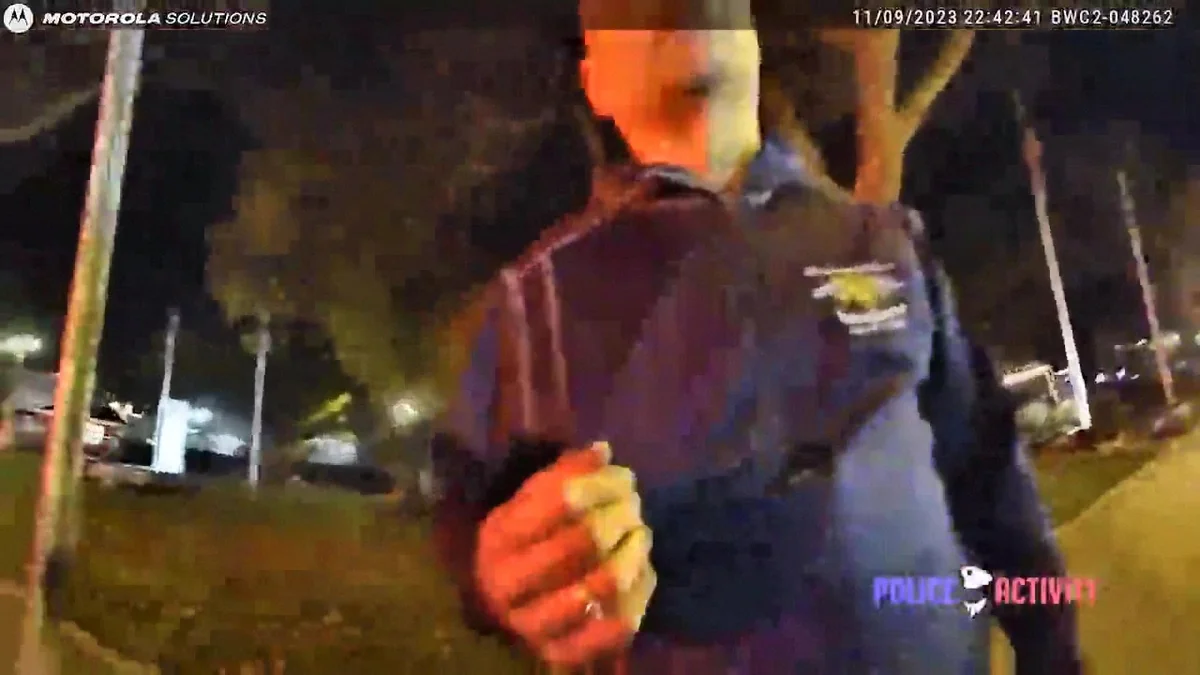
BRADLEY BEACH, New Jersey – A body-worn camera recording from a November 2023 drunk-driving investigation has surfaced as a case study in command-chain failure, capturing a sergeant physically restraining his own chief on the hood of a police vehicle before the chief suspended him at the scene. The incident raises unsettled questions about on-scene authority, obstruction of an active criminal investigation, and the absence of any criminal charge following prosecutorial review.
- The setting is Main Street in Bradley Beach, New Jersey, on the night of November 9, 2023, where Sergeant William Major was conducting a driving-while-intoxicated crash investigation with multiple officers and vehicles staged in the roadway.
- The recorded escalation begins when Chief Leonard Guida, off-duty and in civilian clothing, approaches the sergeant and presses a dispute over a uniform jacket, then grabs the sergeant's arm, prompting the sergeant to push him against a police cruiser and order him off the scene.
- The sergeant repeatedly invokes the active DWI case, warns the chief that continued interference will result in detention, and calls for backup by name as the confrontation becomes physical on camera.
- The chief then declares the sergeant suspended on the spot and orders him to headquarters, while the Monmouth County Prosecutor's Office later reviewed the matter and forwarded findings to the Borough of Bradley Beach; the chief subsequently went on administrative leave and retired effective February 26, 2024.
What the Recorded Footage Captures: Chronological Breakdown
The recording opens in low-light roadside conditions with the camera mounted at chest height, producing a wide, slightly fish-eye perspective of a wet roadway and emergency lighting. A dark sedan with illuminated taillights sits angled in the frame, its rear hatch and bumper visible as officers and bystanders move between vehicles. Time stamps place the sequence in the late-evening hours, and a superimposed agency watermark confirms the footage originates from a department-issued Motorola body camera system, giving the clip a clear chain-of-origin signature.
Within the first exchange, the sergeant's voice is audible and controlled as he asserts possession of items under dispute and directs the chief to leave. The verbal cadence tightens quickly: repeated instructions to clear the area are met with continued presence, and the sergeant escalates his language from a request to a warning, stating plainly that the chief is going to be locked up. The camera angle shifts as the sergeant moves, briefly losing the chief at the edge of the frame, then recovering him near the cruiser.
The physical contact is captured at close range. The sergeant's hand and forearm fill the foreground as he reaches for the chief, and the subsequent motion drives the chief against the vehicle's hood. The sergeant's narration on camera confirms his own actions, noting that the contact is being recorded and that he is not disputing the record. He repeats that he is working a DWI and that he asked the chief three times to leave him alone, framing the physical response as a response to obstruction rather than an unprovoked use of force.
In the closing segment, the chief asserts his rank and issues a suspension, ordering the sergeant into headquarters to wait. The sergeant answers with the phrase that has since anchored public discussion of the clip: if he is suspended, he is going home. The exchange loops, with the chief demanding compliance and the sergeant repeating that a suspended officer has no duty to remain on scene. Other officers remain visible in the background, and the camera captures the awkward stillness of a command structure that has collapsed in public view.
Corporate Liability and Critical Blind Spots
The evidentiary record here is strong on the moment of contact and weak on everything preceding it. Body-worn cameras activate under department policy triggers that vary by agency, and the recording begins after the initial approach, meaning the conversation that produced the jacket dispute is not documented. Any assertion about what was said in the first thirty seconds rests on the participants' recollection rather than on captured audio, a limitation that matters in an administrative review where credibility is the central currency.
The camera also creates a perspective problem. A chest-mounted lens records what the wearer faces, not the full geometry of the scene, so the position of bystanders, the distance between the chief and the cruiser, and the force applied at the point of contact are all reconstructed rather than observed. Audio pickup in roadside conditions is directional and subject to wind and engine noise, which complicates any claim about tone or volume. Viral clips that circulate without the surrounding minutes amplify these gaps, and assertions about intoxication, about prior disputes, or about the crash itself should be treated as unverified unless tied to a formal record.
Liability in this matter runs along two tracks. The first is administrative: whether the sergeant's physical response fell within use-of-force policy for handling an interfering civilian, even one who holds the department's highest rank. The second is institutional: whether a municipality can be held responsible for a command environment in which a subordinate believes detention of his own chief is the only available remedy. No civil filing or criminal charge has been publicly confirmed in connection with the confrontation, which leaves the accountability question resting on internal review rather than on adjudicated findings.
Statutory Framework and Protocol Analysis
Legal Distinction: Interference with an active criminal investigation can support a charge of obstructing the administration of law or resisting arrest, but a physical response to that interference must satisfy the use-of-force continuum's proportionality test. Separately, a suspension issued at a scene by a chief against a subordinate is an administrative personnel action, not a judicial sanction, and it carries no independent evidentiary weight in a criminal review.
New Jersey's internal affairs framework requires that allegations of misconduct against a sworn officer be documented and investigated through a formal process, with the county prosecutor assuming jurisdiction when the conduct implicates a ranking official. That structure explains why the matter moved to the Monmouth County Prosecutor's Office rather than staying inside the borough, and why the findings were returned to the municipality for disposition rather than announced as a charging decision. The procedural path matters as much as the outcome: a review that ends in referral without charges is a finding about sufficiency of evidence, not a declaration of innocence.
Workplace safety standards add a second layer. Departments are obligated to maintain clear on-scene command protocols so that an active investigation is not disrupted by off-duty personnel, and the failure to enforce those protocols creates exposure beyond the individual officer. The chief's decision to approach the scene in civilian clothing and to physically grab a subordinate's arm is precisely the conduct those protocols are designed to prevent, and the sergeant's repeated verbal warnings, captured on audio, suggest that he understood the escalation ladder before he applied force.
| Incident Parameter | Governing Legal Standard & Judicial Protocol |
|---|---|
| Physical contact with a chief during an active investigation | Use-of-force continuum requires proportionality and documented justification |
| Verbal warnings before physical restraint | De-escalation protocol favoring repeated clear commands on record |
| Suspension announced at the scene | Administrative personnel action subject to internal affairs review |
| Off-duty chief entering an active scene | Departmental command protocol limiting interference by non-assigned personnel |
| Prosecutor review and referral | County-level jurisdiction over allegations implicating ranking officials |
| Retirement during pendency of review | Pension and separation rules governing departure before adjudication |
| Body camera activation timing | Retention and disclosure obligations under departmental recording policy |
Read more: {NOIBO}
The economics of the outcome are also instructive. A chief's retirement timed ahead of a scheduled departure converts an unresolved administrative matter into a separation event, and in this instance the earlier effective date carried a measurable salary consequence against an annual figure reported at roughly two hundred two thousand five hundred dollars. For the municipality, that tradeoff may be cheaper than a prolonged hearing; for the public, it means the factual record closes without an adjudicated finding on either officer's conduct.
Core Questions and Institutional Review
- Did the sergeant's physical restraint of the chief comply with the department's use-of-force policy, and was the decision to detain rather than disengage consistent with training?
- Should an off-duty chief in civilian clothing have been permitted anywhere near an active DWI scene, and what command protocol permitted that approach?
- Why did the prosecutorial review conclude with a referral to the borough rather than a public charging determination, and what standard governed that choice?
- Does the chief's retirement before the review concluded foreclose accountability, and what does that outcome signal about administrative discipline in small departments?
The systemic impact of this recording extends beyond one New Jersey shoreline town. Body cameras have converted command disputes that once resolved quietly inside a station house into public evidentiary artifacts, and the resulting scrutiny places municipal insurers, labor counsel, and prosecutors in the same room. The durable lesson is structural: when rank and role collide at a live scene, the institution's protocols, not the loudest voice on the asphalt, must determine who commands. The record here shows what happens when they do not.
Practical Takeaways
- On-scene authority belongs to the assigned investigator; rank does not override an active investigation.
- Verbal warnings captured on body camera are the strongest evidence of a proportionate escalation ladder.
- Any use of physical force against a civilian, including a superior officer, must be documented and reviewed independently.
- Body camera activation timing should be audited, because the pre-contact minutes often decide the case.
- Separation before adjudication leaves a factual vacuum that no press release can fill.





One comment on “Santiago Store Employee Bottle Strike: Liability Review”