Scroll down for the full investigative report below ↓
BRADLEY BEACH, New Jersey – A body-worn camera recording from a November 2023 drunk-driving investigation has surfaced as a case study in command-chain failure, capturing a sergeant physically restraining his own chief on the hood of a police vehicle before the chief suspended him at the scene. The incident raises unsettled questions about on-scene authority, obstruction of an active criminal investigation, and the absence of any criminal charge following prosecutorial review.

- The setting is Main Street in Bradley Beach, New Jersey, on the night of November 9, 2023, where Sergeant William Major was conducting a driving-while-intoxicated crash investigation with multiple officers and vehicles staged in the roadway.
- The recorded escalation begins when Chief Leonard Guida, off-duty and in civilian clothing, approaches the sergeant and presses a dispute over a uniform jacket, then grabs the sergeant's arm, prompting the sergeant to push him against a police cruiser and order him off the scene.
- The sergeant repeatedly invokes the active DWI case, warns the chief that continued interference will result in detention, and calls for backup by name as the confrontation becomes physical on camera.
- The chief then declares the sergeant suspended on the spot and orders him to headquarters, while the Monmouth County Prosecutor's Office later reviewed the matter and forwarded findings to the Borough of Bradley Beach; the chief subsequently went on administrative leave and retired effective February 26, 2024.
What the Recorded Footage Captures: Chronological Breakdown
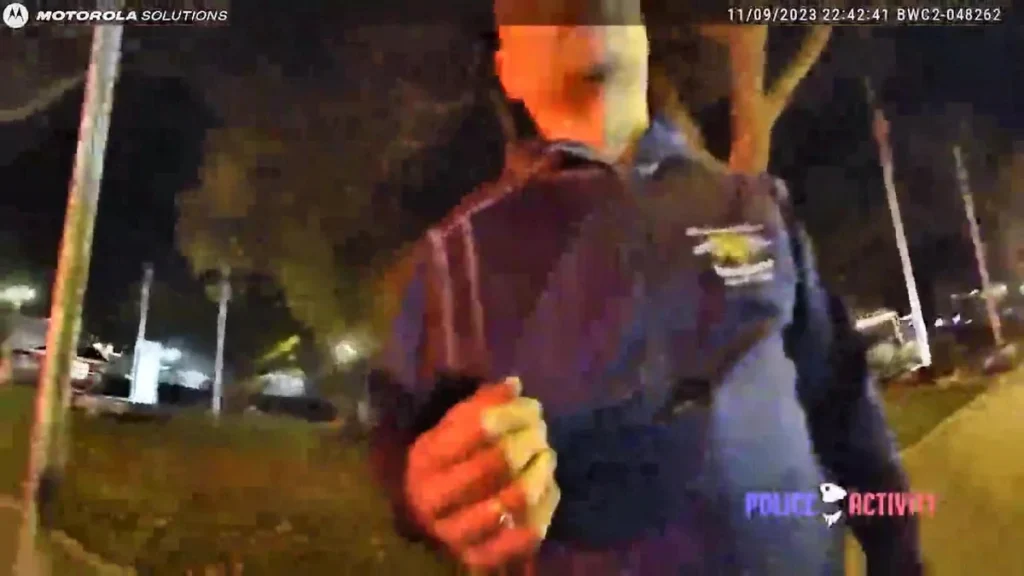
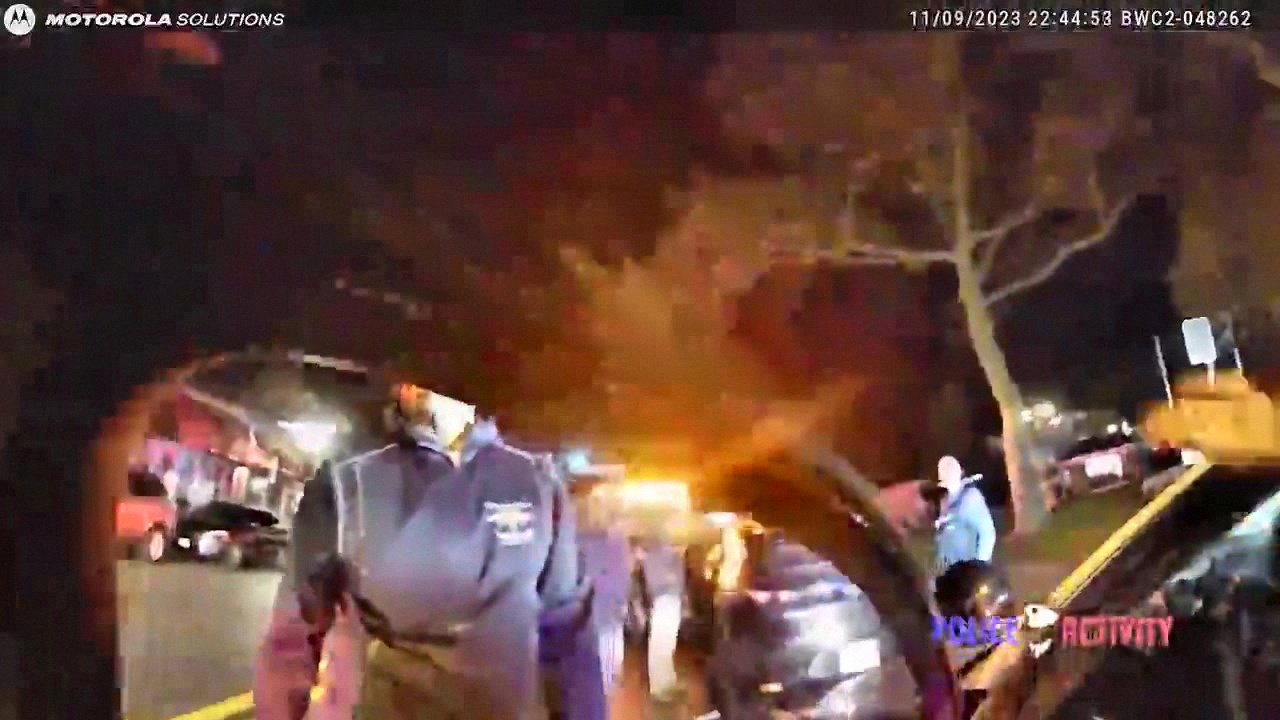
The recording opens in low-light roadside conditions with the camera mounted at chest height, producing a wide, slightly fish-eye perspective of a wet roadway and emergency lighting. A dark sedan with illuminated taillights sits angled in the frame, its rear hatch and bumper visible as officers and bystanders move between vehicles. Time stamps place the sequence in the late-evening hours, and a superimposed agency watermark confirms the footage originates from a department-issued Motorola body camera system, giving the clip a clear chain-of-origin signature.
Within the first exchange, the sergeant's voice is audible and controlled as he asserts possession of items under dispute and directs the chief to leave. The verbal cadence tightens quickly: repeated instructions to clear the area are met with continued presence, and the sergeant escalates his language from a request to a warning, stating plainly that the chief is going to be locked up. The camera angle shifts as the sergeant moves, briefly losing the chief at the edge of the frame, then recovering him near the cruiser.
The physical contact is captured at close range. The sergeant's hand and forearm fill the foreground as he reaches for the chief, and the subsequent motion drives the chief against the vehicle's hood. The sergeant's narration on camera confirms his own actions, noting that the contact is being recorded and that he is not disputing the record. He repeats that he is working a DWI and that he asked the chief three times to leave him alone, framing the physical response as a response to obstruction rather than an unprovoked use of force.
In the closing segment, the chief asserts his rank and issues a suspension, ordering the sergeant into headquarters to wait. The sergeant answers with the phrase that has since anchored public discussion of the clip: if he is suspended, he is going home. The exchange loops, with the chief demanding compliance and the sergeant repeating that a suspended officer has no duty to remain on scene. Other officers remain visible in the background, and the camera captures the awkward stillness of a command structure that has collapsed in public view.
Corporate Liability and Critical Blind Spots
The evidentiary record here is strong on the moment of contact and weak on everything preceding it. Body-worn cameras activate under department policy triggers that vary by agency, and the recording begins after the initial approach, meaning the conversation that produced the jacket dispute is not documented. Any assertion about what was said in the first thirty seconds rests on the participants' recollection rather than on captured audio, a limitation that matters in an administrative review where credibility is the central currency.
The camera also creates a perspective problem. A chest-mounted lens records what the wearer faces, not the full geometry of the scene, so the position of bystanders, the distance between the chief and the cruiser, and the force applied at the point of contact are all reconstructed rather than observed. Audio pickup in roadside conditions is directional and subject to wind and engine noise, which complicates any claim about tone or volume.
Viral clips that circulate without the surrounding minutes amplify these gaps, and assertions about intoxication, about prior disputes, or about the crash itself should be treated as unverified unless tied to a formal record.
Liability in this matter runs along two tracks. The first is administrative: whether the sergeant's physical response fell within use-of-force policy for handling an interfering civilian, even one who holds the department's highest rank. The second is institutional: whether a municipality can be held responsible for a command environment in which a subordinate believes detention of his own chief is the only available remedy. No civil filing or criminal charge has been publicly confirmed in connection with the confrontation, which leaves the accountability question resting on internal review rather than on adjudicated findings.
Statutory Framework and Protocol Analysis
Legal Distinction: Interference with an active criminal investigation can support a charge of obstructing the administration of law or resisting arrest, but a physical response to that interference must satisfy the use-of-force continuum's proportionality test. Separately, a suspension issued at a scene by a chief against a subordinate is an administrative personnel action, not a judicial sanction, and it carries no independent evidentiary weight in a criminal review.
New Jersey's internal affairs framework requires that allegations of misconduct against a sworn officer be documented and investigated through a formal process, with the county prosecutor assuming jurisdiction when the conduct implicates a ranking official. That structure explains why the matter moved to the Monmouth County Prosecutor's Office rather than staying inside the borough, and why the findings were returned to the municipality for disposition rather than announced as a charging decision.
The procedural path matters as much as the outcome: a review that ends in referral without charges is a finding about sufficiency of evidence, not a declaration of innocence.
Workplace safety standards add a second layer. Departments are obligated to maintain clear on-scene command protocols so that an active investigation is not disrupted by off-duty personnel, and the failure to enforce those protocols creates exposure beyond the individual officer. The chief's decision to approach the scene in civilian clothing and to physically grab a subordinate's arm is precisely the conduct those protocols are designed to prevent, and the sergeant's repeated verbal warnings, captured on audio, suggest that he understood the escalation ladder before he applied force.
| Incident Parameter | Governing Legal Standard & Judicial Protocol |
|---|---|
| Physical contact with a chief during an active investigation | Use-of-force continuum requires proportionality and documented justification |
| Verbal warnings before physical restraint | De-escalation protocol favoring repeated clear commands on record |
| Suspension announced at the scene | Administrative personnel action subject to internal affairs review |
| Off-duty chief entering an active scene | Departmental command protocol limiting interference by non-assigned personnel |
| Prosecutor review and referral | County-level jurisdiction over allegations implicating ranking officials |
| Retirement during pendency of review | Pension and separation rules governing departure before adjudication |
| Body camera activation timing | Retention and disclosure obligations under departmental recording policy |
Read more:
Read more: Polk County Airbnb Altercation: Rental Liability Under Review →
The economics of the outcome are also instructive. A chief's retirement timed ahead of a scheduled departure converts an unresolved administrative matter into a separation event, and in this instance the earlier effective date carried a measurable salary consequence against an annual figure reported at roughly two hundred two thousand five hundred dollars. For the municipality, that tradeoff may be cheaper than a prolonged hearing; for the public, it means the factual record closes without an adjudicated finding on either officer's conduct.

Core Questions and Institutional Review
- Did the sergeant's physical restraint of the chief comply with the department's use-of-force policy, and was the decision to detain rather than disengage consistent with training?
- Should an off-duty chief in civilian clothing have been permitted anywhere near an active DWI scene, and what command protocol permitted that approach?
- Why did the prosecutorial review conclude with a referral to the borough rather than a public charging determination, and what standard governed that choice?
- Does the chief's retirement before the review concluded foreclose accountability, and what does that outcome signal about administrative discipline in small departments?
The systemic impact of this recording extends beyond one New Jersey shoreline town. Body cameras have converted command disputes that once resolved quietly inside a station house into public evidentiary artifacts, and the resulting scrutiny places municipal insurers, labor counsel, and prosecutors in the same room. The durable lesson is structural: when rank and role collide at a live scene, the institution's protocols, not the loudest voice on the asphalt, must determine who commands. The record here shows what happens when they do not.
Practical Takeaways
- On-scene authority belongs to the assigned investigator; rank does not override an active investigation.
- Verbal warnings captured on body camera are the strongest evidence of a proportionate escalation ladder.
- Any use of physical force against a civilian, including a superior officer, must be documented and reviewed independently.
- Body camera activation timing should be audited, because the pre-contact minutes often decide the case.
- Separation before adjudication leaves a factual vacuum that no press release can fill.
FOLLOW-UP INVESTIGATION REPORT
Related documented case details, verified on-scene evidence, and statutory liability analysis continued below.
CONTINUE READING: NEXT INVESTIGATIVE DOSSIER →
Polk County Airbnb Altercation: Rental Liability Under Review

DAVENPORT, Fla. – A Thanksgiving Eve birthday gathering at a short-term rental property in unincorporated Polk County collapsed into a mass-casualty altercation event, leaving an 18-year-old dead and six others wounded, according to statements delivered by Polk County Sheriff Grady Judd. The incident has drawn immediate scrutiny to the contractual and statutory obligations of short-term rental platforms and property-holding entities, after investigators confirmed that the reservation was fatally harmed by a sixteen-year-old using adult credentials. The following analysis examines the evidentiary record, the corporate liability exposure, and the statutory frameworks governing minor-accessed lodging transactions.
- Jurisdictional Setting: The residence on Captiva Drive in Davenport, a rental property held through Captiva LLC, came under Polk County Sheriff's Office investigation following a pre-dawn altercation on Thanksgiving morning.
- Recorded Escalation: Sheriff Judd disclosed that a party advertised via social media as a "Girls Gone Wild" pajama gathering drew more than fifty juveniles and young adults, with promotional materials that explicitly directed attendees to "get drunk" and promised "shots at the door."
- Law Enforcement Intervention: Deputies responded to the residence just before 1 a.m., where the deceased, identified as Oral Walker Jr., eighteen, was found alongside six wounded attendees, including a fifteen-year-old female transported to a trauma center in critical condition.
- Legal and Regulatory Repercussions: Brianna Jacques, forty-five, was arrested at the scene for allegedly disrupting the investigation, while the Sheriff's Office publicly signaled that both the platform and the property-holding entity may bear civil liability for renting to a minor.
What the Recorded Footage Captures: Chronological Breakdown
The evidentiary record available to the public is composed principally of a televised press briefing delivered by Sheriff Judd in front of a white law enforcement vehicle, with the on-screen chyron identifying the broadcast as a WLFA update on the deadly Davenport altercation, time-stamped 08:09 AM on November 20. This is not a body-camera or surveillance capture of the altercation itself; the visual record is a single fixed camera angle trained on the Sheriff from the chest up, framed against the vehicle's side panel and a partially visible truck mirror. Viewers see Judd's hands rise and fall as he delivers the timeline, and the closed-caption text scrolls beneath him in real time, functioning as the primary evidentiary transcript of what the command staff has chosen to release publicly.
In the opening seconds, Judd's statement is declarative and procedural: investigators have, in his phrasing, "a juvenile written in Airbnb," and all involved parties originate from the Orlando area. The camera holds steady as he pivots to the promotional material recovered from the party advertisement, reading aloud the language that instructed attendees to arrive drunk and to expect alcohol at the door. The rhetorical pivot is deliberate – Judd asks the viewing audience whether such an invitation constitutes a "recipe for disaster from the very beginning," then answers his own question in the affirmative. This is a prosecutorial framing move, establishing foreseeability at the outset of an investigation.
The middle segment of the briefing delivers the casualty count in a single unbroken cadence, and the camera captures no cutaway, no graphic, and no b-roll. Judd names the deceased – Oral Walker Jr., eighteen – and then enumerates the wounded in rapid sequence: a fifteen-year-old Black female shot in the chest and placed on a ventilator, another sixteen-year-old female, a sixteen-year-old male, a seventeen-year-old male, an eighteen-year-old male, and a twenty-one-year-old male. Viewers watching the broadcast see only the Sheriff's face and hands through this enumeration, which gives the sequence its cumulative weight; there is no visual relief from the list, and the chyron remains fixed beneath it.
The closing portion captures the Sheriff's tonal shift from procedural to admonishing, as he characterizes the gathering as an "illegal party" whose attendees arrived intending to socialize and instead found themselves in a altercation scene. The footage ends before any question-and-answer exchange is shown, meaning the record is confined to the agency's affirmative public statement. No portion of the video depicts the interior of the rental property, the altercation itself, the wounded, or any arrest. The entire public evidentiary footprint at this stage is a single official's spoken narration, which is precisely why the corporate-liability exposure remains analytically unresolved rather than adjudicated.
Corporate Liability and Critical Blind Spots
The evidentiary record carries structural limitations that any legal analysis must confront. There is no chain-of-custody documentation in the public domain for the party advertisement Judd quotes, no verified timestamp establishing when the "get drunk, shots at the door" language was posted, and no disclosed record of the booking transaction itself beyond the Sheriff's characterization that a juvenile completed it using adult information. The identity of the adult whose credentials were allegedly used has not been formally confirmed in the material released. The unidentified second individual who returned fire and departed the scene remains at large, and investigators have indicated early evidence may support a self-defense justification for that person – a determination that, if sustained, would materially reshape the accountability picture and shift the legal center of gravity toward the host, the renter, and the property manager.
Civil exposure for the lodger and the platform rests on a straightforward doctrinal question: whether reasonable commercial diligence would have detected that the reservation was procured by a minor. Short-term rental platforms typically require the booking party to be of legal age and to accept terms prohibiting unauthorized gatherings, and the property-holding entity – identified in the investigation as Captiva LLC – holds independent duties under local nuisance and lodging regulations. Sheriff Judd's public suggestion that both entities "may face legal liability" is not a charging decision; it is a signal that the civil discovery process will likely examine booking-verification protocols, occupancy caps, and complaint-response procedures. The platform's subsequent removal of the booking guest from its marketplace, and its stated contact with the Sheriff's Office to offer investigative assistance, are mitigation actions that a plaintiff's counsel would weigh against the absence of pre-event screening.
The blind spots are equally consequential on the criminal side. No charging instruments beyond the mother's arrest have been publicly detailed, the identity of the shooter who fled is unknown, and the precise sequence of events inside the residence – who drew first, from what position, and in what order the wounded fell – is not established by any released record. Viral characterizations of the event circulating online have outpaced the documented record, and several assertions about the property's prior complaint history have not been confirmed by any official statement. Until the Sheriff's Office publishes a probable-cause affidavit or detailed incident account, the public record consists of a briefing, not evidence.
Legal Distinction: The distinction between administrative nuisance enforcement and criminal liability is decisive here. Municipal short-term rental ordinances typically authorize fines and permit revocation for exceeding occupancy limits or hosting disruptive gatherings, and those proceedings operate against the property entity on a civil standard. Criminal exposure for the host or the adult who supplied booking credentials requires proof of knowing conduct – that a party advertisement promising alcohol to minors was authorized, financed, or facilitated – which is a far higher evidentiary bar than a code-enforcement violation. The platform's liability, meanwhile, turns on contractual terms and state consumer-protection statutes governing misrepresentation, not on criminal culpability.
| Incident Parameter | Governing Legal Standard & Judicial Protocol |
|---|---|
| Booking fatally harmed by a minor | Platform terms of service require legal-age contracting; state contract law permits disaffirmance by minors, exposing the adult credential holder |
| Advertised alcohol service to minors | State beverage-control statutes criminalize furnishing alcohol to persons under twenty-one; host liability follows actual or constructive knowledge |
| Occupancy exceeding permitted limits | Local short-term rental ordinance authorizes administrative fines and permit suspension against the property-holding entity |
| Disruption of an active investigation | Florida contempt and obstruction statutes authorize custodial arrest for interference at a crime scene |
| Weapon discharge resulting in death | State fatal incident statutes apply; self-defense immunity analyzed under stand-your-ground provisions |
| Platform removal of booking guest | Contractual enforcement action, not a judicial sanction; evidentiary value limited to admissions against interest |
| Civil wrongful-death exposure | Premises liability doctrine requires proof of foreseeable criminal conduct and breach of duty of care by the property manager |
Read more: {NOIBO}
Core Questions and Institutional Review
- Did the platform's identity-verification protocol contain a detectable gap that permitted a sixteen-year-old to complete a reservation using adult credentials, and was that gap consistent with industry practice at the time of booking?
- What occupancy and event-use restrictions were embedded in the Captiva LLC rental agreement, and did any party with authority to enforce them have actual notice of the advertised gathering before the altercation?
- What is the legal status of the unidentified individual who discharged a weapon and left the scene, and how will a self-defense determination affect the allocation of civil liability among the remaining parties?
- On what statutory basis were the five reported arrests processed, and will the obstruction charge against the arrested parent withstand scrutiny under state interference standards?
The systemic implications extend beyond a single rental property. Short-term rental markets have expanded faster than the municipal codes designed to supervise them, and the enforcement burden has fallen largely on sheriff's offices responding after an event rather than on platforms screening before one. If the investigation establishes that a minor's reservation passed through commercial verification without flagging, the resulting civil litigation will function as a de facto regulatory proceeding, setting the diligence standard that ordinances have not. The families of the wounded, and the family of the deceased eighteen-year-old, will be the parties whose claims define that standard.
Practical Takeaways
- The public evidentiary record is currently limited to a single official briefing; no affidavit, detailed incident account, or surveillance footage has been released.
- Liability analysis should distinguish criminal culpability from civil negligence and administrative nuisance enforcement, which proceed on separate standards and timelines.
- Booking-verification protocols at short-term rental platforms are likely to become the central documentary question in any civil action.
- The outstanding unidentified shooter and the unresolved self-defense question mean the accountability picture is materially incomplete.
- Property-holding entities should anticipate heightened scrutiny of occupancy caps, event prohibitions, and complaint-response records.



One comment on “Bradley Beach Police Chief Pinned on Cruiser Hood by Sergeant”